France and Germany are reportedly days away from a deal on the ECB's top jobs, with Spain's De Cos as the favourite to succeed Lagarde
An EU official confirmed two candidates are in the race for president, meaning De Cos and the Dutch economist Klaas Knot, in line with what I reported at the start of the month
https://t.co/4ZjMkrvebi
Jensen Huang's exit, AI bubble fears and the US debt pile took centre stage on the last day of @WebSummit
"On the current path the US is on, there is a 100% chance of bankruptcy," @TKL_Adam warned on a panel moderated by @euronews
https://t.co/uLzgI1sNIQ
#WebSummit2026
Great discussion on the digital euro with Alessandro Giovannini from the European Central Bank @WebSummit in Lisbon yesterday
Thank you to the event organisers for the opportunity to moderate the panel! Link to an article on what was said in the comments
#WebSummit2026
In 2025, the EU house price-to-income ratio was 6.8% higher than in 2015, meaning that house prices rose relative to household income over the decade.🏡📈
Largest increase in:
🇵🇹Portugal (+60.8%)
Largest decrease:
🇷🇴Romania (-42.8%)
Read more 👉https://t.co/5fIXSVsQdy
The @WebSummit has kicked off in Lisbon tonight
Cloudflare CEO Matthew Prince, Lovable CEO Anton Osika and Recursive CEO Richard Socher discussed the future of AI on stage with a focus on recursive self improvement and the infrastructure buildout, as well as the recent volatility in tech equities and Jensen Huang's affair
On whether investors should be concerned about the current scale of CapEx spending, the chief executives argued that the investment will in fact continue to be insufficient until we see AI fully automate a large portion of productive tasks in most industries
On the Huang affair, Prince noted that the Nvidia CEO has financed and supports a massive share of the sector which makes a lot of AI firms exposed to the backlash. However, all three speakers agreed that the story is mostly a distraction and a temporary issue for investors. $NVDA is currently down over 5% on the day but other hyperscalers have actually risen between 2-5% with $META leading
#WebSummit2026
Peter Thiel's critique of European tech is sharper than most people quote it:
"In the social democratic European societies, it's acceptable to be moderately successful. It's not acceptable to be wildly successful."
That's not a cultural observation. It's a structural diagnosis.
Look at the pattern: Skype sold to Microsoft. Spotify relocated to New York and listed in the US. DeepMind sold to Google before it could compound. Klarna — one of Europe's most valuable fintechs — spent years being investigated and regulated the moment it hit scale.
The moment a European startup gets big enough to matter, the social contract shifts. Regulators, press, and public sentiment move from neutral to hostile. So founders learn to exit early — not because they lack ambition, but because the system taxes it.
Europe produces world-class talent and early-stage innovation. It just doesn't retain the compounding.
The constraint isn't capital. It's the ceiling culture places on acceptable ambition — and founders respond rationally to the incentives they're actually given.
The race to replace Christine Lagarde at the ECB is officially on, with eurozone countries sending in their nominees until this Friday
Two names lead the field: Spain’s Hernández de Cos and the Netherlands’ Klaas Knot
https://t.co/OusHcFm35W
This week on Euronews’ business show The Big Question, I sat down with Markus Villig, CEO and founder of Bolt, who started the company as a teenager in Estonia and has built it into one of Europe's biggest ride-hailing and delivery platforms. Episode coming soon!
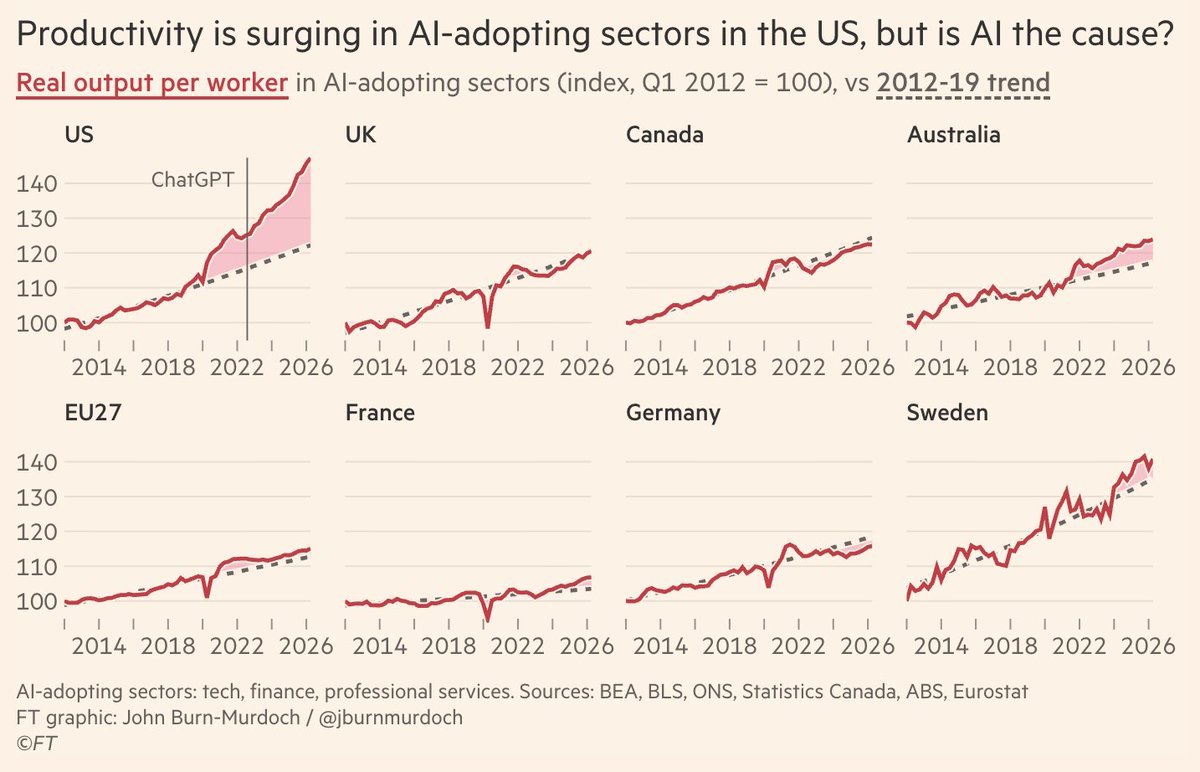
My main worry about Europe’s public finances fits into one figure from @jburnmurdoch at @FT.
The figure shows that real output per worker has grown more slowly in the EU-27 than in the U.S. (France and Germany look particularly worrisome) and that the gap between the two trends is widening, likely because of AI adoption in the U.S.
Why is this a problem? The large capex requirements of AI point to much higher real interest rates over the next decade. If a country with a debt-to-GDP ratio of 100% must go from financing itself at 2% to 5%, its budget carries an additional burden of 3% of GDP.
Countries that adopt AI massively and enjoy fast productivity growth will, more or less, digest this shock to their budgets. But countries that do not adopt AI (or do it poorly) will not grow fast. In other words, France or Spain might end up with the worst possible combination: high real interest rates because of high worldwide AI capex and low real per capita growth because of low AI adoption due to internal barriers.
Most European countries simply do not have the fiscal space, especially as their populations age, to absorb such an increase in the interest they pay on their debt.
Governments will be tempted to rely on temporary measures (e.g., playing with the maturity structure of the debt) or to cut other spending, such as investment in infrastructure. But we saw tragically last week, with the high-speed train accident in Spain, what a decade or so of neglect of public infrastructure leads to.
The day of reckoning might not be too far in the future. Four years? Five years? Economies are complex systems, so any concrete forecast is foolish. But the fundamental problems are real, and reality always finds a way.
Tomorrow in Brussels.
The Euronews EU Enlargement Summit 2026 takes place tomorrow at Autoworld. Join us in Brussels or follow the discussions live on Euronews.
➡️ https://t.co/OZLhww4Nvf
Oil slid in early trading on hopes a deal in Qatar could reopen the Strait of Hormuz, but don't call it optimism yet
Trump said the US still has "one or two sites" to hit, and Netanyahu is reportedly pushing for strikes right after Tuesday's midterms
https://t.co/tbWf4heHZd
The Belgian national debt amounts to over €735 billion, more than 110% of Belgium's GDP, while 60% is permitted by the EU. #EuropeNews https://t.co/wzE4Jl4isG
Investigators say several factors may have been involved, including a compromised DevOps engineer’s laptop, with signs pointing to North Korean actors being responsible. https://t.co/shAiJQSlSt
The ECB held rates steady and warned energy prices keep rising, hours after Christine Lagarde announced she is leaving early
It also admitted financing conditions have tightened, with French bond yields hovering around 5%
https://t.co/EWNTcuSL5d