Have you ever heard the Declaration of Independence read out loud?
You should. It’s the greatest break-up letter ever written.
At just 33 years old, Thomas Jefferson, with cold moral clarity, told the British government to pound sand:
“Whenever any Form of Government becomes destructive of these ends [life, liberty, and the pursuit of happiness], it is the Right of the People to alter or to ABOLISH it.”
The power of that line isn’t just what it says. It’s how it’s said.
Jefferson wasn’t writing from a place of outrage. He was transmitting conviction—moral clarity delivered from a steady frame of mind.
It’s said Jefferson revised the Declaration of Independence with the help of Franklin and Adams dozens of times before it was finalized.
And that deliberate, cutting language, paired with emotional steadiness, is precisely why the words still land 250 years later.
Today, we’re blessed to be the inheritors of the great nation those steady hands wrote into existence.
Happy Birthday, America. 🇺🇸
An 11-year-old boy. One crochet hook. 60 skeins of yarn. No pattern. Two weeks. 🇺🇸
While juggling tennis camps and baseball games, Grayson poured his heart into crocheting this stunning American flag blanket—just in time to celebrate America’s 250th Independence Day. 🧨
No fancy instructions, just pure determination and love for his country. The result is a beautiful family heirloom that proves some of life’s greatest treasures are still made by hand. 🇺🇸✨
Proud of this kid and the quiet power of creativity in the next generation.
What an inspiration! 👏
Here it comes... A reoccurring negative polarity coronal hole structure is soon to go geoeffective and hit Earth with its high-speed-stream. This follows after a sequence of M-flares have charged up the ionosphere, and a minor CME impact has just come in. Yeehaw!
240 years ago today, the most underrated general in American history died. From a sunburn.
Nathanael Greene was never supposed to be a soldier. He was a Quaker from Rhode Island who ran his family's iron forge. He had asthma, a stiff leg that gave him a permanent limp, and zero combat experience. His own church suspended him just for going to watch a military parade.
So how did he end up commanding the entire Southern army? He read. He bought every book on warfare he could find and taught himself strategy from scratch. Washington noticed, and trusted him more than almost anyone.
By 1780 the war in the South was a disaster. The previous American general got beaten so badly he fled 200 miles on horseback. Congress let Washington pick the replacement, and he picked Greene without hesitation.
Greene's plan was insane. He looked at his small, starving, half-naked army and decided he could not win, so he would lose correctly. He ran Cornwallis all over the Carolinas until the British were exhausted, far from supply, and bleeding men they could not replace. "We fight, get beat, rise, and fight again."
At Guilford Courthouse, Cornwallis technically won the battle and lost a quarter of his army doing it. That was the whole point. Greene lost almost every fight on paper and won the entire South. Cornwallis limped off to a little tobacco port to rest and refit. The port was called Yorktown.
Here's the part that should make you angry. To feed and clothe his men, Greene personally co-signed for war supplies because the government wouldn't pay. When the bills came due, Congress refused to honor them. The man who saved the South came home buried in debt that wasn't his.
Georgia gave him a plantation near Savannah as thanks. He finally had peace. Then one hot afternoon in June 1786 he spent the day walking a neighbor's rice fields with no hat. He collapsed from sunstroke and a week later he was dead at 43.
One last twist. After he died, his widow Catharine took in a broke young houseguest tinkering with an idea. His name was Eli Whitney, and the cotton gin was invented at the dead general's home.
June 19, 1786. Remember the name. Nathanael Greene.
Elon Musk got rejected by Netscape. He walked into the lobby, was too shy to talk to anyone, and walked out. Never got the job.
At his first company Zip2, the board demoted him. Twice. They refused to let him be CEO.
He got fired from PayPal as CEO while flying to his own honeymoon. The board voted him out mid air.
He almost died of malaria in 2000. Ten days in intensive care. Lost 45 pounds. A day from death.
His first child died at 10 weeks old.
His first rocket exploded. Falcon 1, flight one. Burned on the pad.
His second rocket exploded.
His third rocket exploded. The last of his money was nearly gone.
Tesla nearly went bankrupt in 2008. The closest he ever came to a nervous breakdown.
Both companies almost died on the same Christmas Eve.
He was sued by investors. Mocked by the people who built cars before him.
His childhood heroes, the astronauts who inspired him, testified against his company to Congress.
The Cybertruck window shattered on live stage in front of the world.
He overpaid for Twitter by his own admission and watched its value collapse.
He was beaten unconscious as a child and thrown down a flight of stairs.
He has said he goes to sleep alone and it kills him.
He failed in public, over and over, for thirty years.
He is the richest man in the history of the world.
The difference was never the absence of failure. It was the refusal to stop after it.
On June 13, 1777, a 19-year-old French teenager landed on a beach in South Carolina, uninvited, to fight in someone else's war. He would become one of the most important men in American history.
The Marquis de Lafayette was one of the richest young aristocrats in France. He had a beautiful wife, a fortune, and zero reason to risk any of it. But he believed in the American cause so fiercely that when the French king forbade him from going, Lafayette bought his own ship and sailed anyway. He literally went AWOL from a life of luxury to bleed for a country that didn't exist yet.
Congress was annoyed at first. Another foreign officer looking for a paycheck? Then Lafayette offered to serve for free and pay his own way. That got their attention.
He met Washington and the two formed one of the great father-son bonds in American history. Washington had no biological children. Lafayette named his only son George Washington Lafayette.
He took a bullet in the leg at Brandywine and kept rallying the retreat. He was instrumental at Yorktown, the battle that won the war. He went home a hero on two continents.
A foreign teenager believed in America before America did. 249 years ago today.
On this night in 1781, one man on a horse saved the American Revolution from losing Thomas Jefferson, Patrick Henry, and half of Virginia's government in a single morning.
You were never taught his name.
June 3, 1781. The British had chased Virginia's entire government out of Richmond. Jefferson, in his final days as governor, and the legislature had fled to Charlottesville, thinking they were safe in the foothills.
They were wrong.
That evening, 26 year old militia captain Jack Jouett was at a tavern in Louisa County when roughly 250 of the most feared cavalry in the British army came pounding down the road. Their commander: Banastre Tarleton, nicknamed "The Butcher," the man whose dragoons had cut down surrendering Americans at Waxhaws.
There was only one place they could be going. Charlottesville. 40 miles away. And the capture of Jefferson, the author of the Declaration of Independence, would be the prize of the war.
Jouett couldn't outrun them on the main road. So he didn't use it.
He swung onto overgrown backwoods trails and the abandoned Old Mountain Road, riding 40 miles through the dark with only the full moon for light. Legend says low hanging branches whipped and scarred his face for life.
Tarleton stopped his men for a 3 hour rest. Jouett never stopped.
Before sunrise on June 4, he came up the mountain to Monticello and woke Jefferson. Then he rode down into Charlottesville and warned the legislature.
Jefferson got out with minutes to spare. British dragoons were coming up his mountain as he left. The legislature escaped over the Blue Ridge to Staunton. Tarleton caught only seven stragglers, one of them a frontiersman serving in the legislature named Daniel Boone.
Paul Revere rode about 12 miles in 1775 and got captured before reaching Concord. Longfellow wrote him a poem and made him immortal.
Jack Jouett rode 40 miles, lost nothing, saved everything, and got a thank you gift of two pistols and a sword from the Virginia Assembly.
No poem. No fame. Almost no memory.
The richest man in America signed a document that could have gotten him hanged, and when someone sneered that he was safe because no one would know which Charles Carroll to come for, he picked up the pen and told the British exactly where to find him.
His name was Charles Carroll, and the colonies were crawling with men who shared it. His own father was Charles Carroll of Annapolis. So when the Declaration of Independence came to him for signing in 1776, a delegate made a cruel little joke. He said Carroll risked nothing by signing. There were so many Charles Carrolls that the King's men would never know which one to hang.
Carroll didn't argue. He leaned over the page and added three words to his signature: "of Carrollton." The name of his estate. His address. He was the only signer in the entire room who wrote down where he lived, and he did it on purpose, so that if the British wanted to come hang the traitor, they would know exactly which door to knock on.
That is who Charles Carroll of Carrollton was.
Here is what makes the moment even sharper. He was not a man with little to lose. He was the single wealthiest man in the thirteen colonies and the largest private landowner among them. While George Washington and John Hancock get talked about as rich men, it was Carroll who topped them all. When he signed, he was wagering the biggest personal fortune in America against a noose.
And he was the last man anyone would have expected to be there at all. Carroll was Catholic. In colonial Maryland, a colony founded as a Catholic refuge that had since turned on its own, Catholics could not vote. They could not hold public office. They could not worship in public. The most educated, wealthiest man in America was, in the eyes of the law, a second-class subject barred from the very government he was helping to create. He had spent seventeen years being educated by Jesuits in France and spoke five languages fluently, and back home he still could not legally cast a ballot.
So he became the only Catholic to sign the Declaration of Independence, putting his name on a revolution that he hoped would build a country with room for men like him. That was its own enormous bet, made by a man the existing system had already shut out.
Then he simply outlived everyone.
Thomas Jefferson and John Adams both died on the same astonishing day, July 4, 1826, exactly fifty years after the Declaration. When they were gone, Charles Carroll of Carrollton was the last living signer left on earth. For six more years he was the final human link to that room in Philadelphia, the last hand that had signed, a living relic of the founding that ordinary Americans traveled to see and shake.
He finally died in November 1832 at the age of ninety-five, fifty-six years after he wrote his address on a treason document and dared the empire to come find him.
The richest man in America. The only Catholic. The last one standing. He had more to lose than any of them, every legal reason to stay quiet, and he signed his full address anyway.
We remember the names we were handed in school. We forget the man who made sure his couldn't be mistaken for anyone else's.
Which Founding Father do you think history shortchanged the most?
In recognition of the 250-year anniversary of the founding of the United States of America as a free and independent nation, Elder Quentin L. Cook and I discussed the importance of religious liberty and its underlying significance for the restored Church of Jesus Christ.
We believe in religious liberty.
As the Eleventh Article of Faith reminds us, “We claim the privilege of worshiping Almighty God according to the dictates of our own conscience, and allow all men the same privilege, let them worship how, where, or what they may.”
Someone just asked me if Henry Nowak 'started it' because of a drunk comment on Snapchat.
Let me be clear:
The attacker was caught on recording saying 'I am a bad man.' He had Henry's phone in his pocket. His mother hid the 8-inch knife at home.
Even if Henry said something stupid, words don't justify a knife.
No words deserve that.
#JusticeForHenry #TheShift
Alma 61:15 teaches us that the spirit of freedom, is the Spirit of God.
🇺🇸 Miracles of the American Revolution.
Day 18
LAFAYETTE’S TIMELY ARRIVAL
June 1777
By the spring of 1777 the American cause was struggling, yet again.
Washington’s army had been driven out of New York, morale was low, and the British were preparing new offensives. The Continental Congress was desperate for experienced officers and foreign support, but help was slow in coming.
At that critical moment, a 19-year-old French nobleman named Marie-Joseph Paul Yves Roch Gilbert du Motier, Marquis de Lafayette, arrived in America. He had slipped out of France against the wishes of his government and used his own money to buy a ship and bring a small group of officers with him.
When Lafayette reached Philadelphia and offered his services to Congress for no pay, many were skeptical of the young foreigner. But when his papers reached General Washington, something changed. Washington immediately took a liking to the young man and brought him into his military family.
Lafayette’s arrival proved to be far more than just another officer. His enthusiasm, courage, and genuine love for the American cause lifted the spirits of both Washington and the army. The spirit of freedom was burning through his veins and it was palpable.
He quickly proved himself in battle and became one of Washington’s most trusted commanders. His presence also helped pave the way for the formal French alliance that would later turn the tide of the war.
This timely arrival of one young man at exactly the right moment brought fresh hope, leadership, and long-term strategic benefit to a cause that badly needed it.
It was the hand of Almighty God inspiring a young man through the true spirit of freedom, AKA the Holy Ghost.
When the American Revolution needed encouragement and capable leadership the most, God sent an unlikely young Frenchman who would become one of its greatest champions.
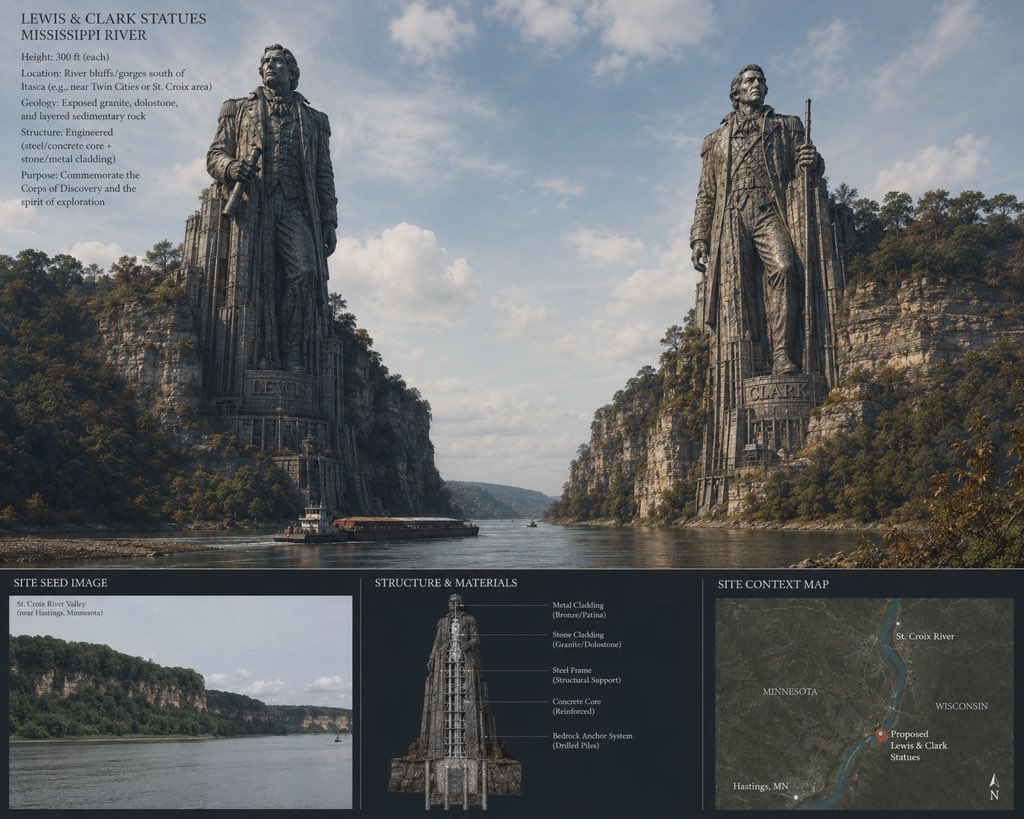
I think we need to build this.
I designed this below image, representing Lewis and Clark on the Mississippi in the style of Argonath.
At $1 Billion or more, I think it can be done.
Utahns.. “this is worth a listen to”
Fear mongering is a powerful and effective tool used by the Left. Remember-Climate Change experts?
Arctic will be ice-free in summer by around 2013 or 2014”…. Whoops-their Bad 🤪..
You won’t regret watching this clip
I first listened to this truly prophetic speech decades ago, but I’ve thought about it countless times since then
Neal A. Maxwell masterfully diagnosed the problems with our increasingly godless society