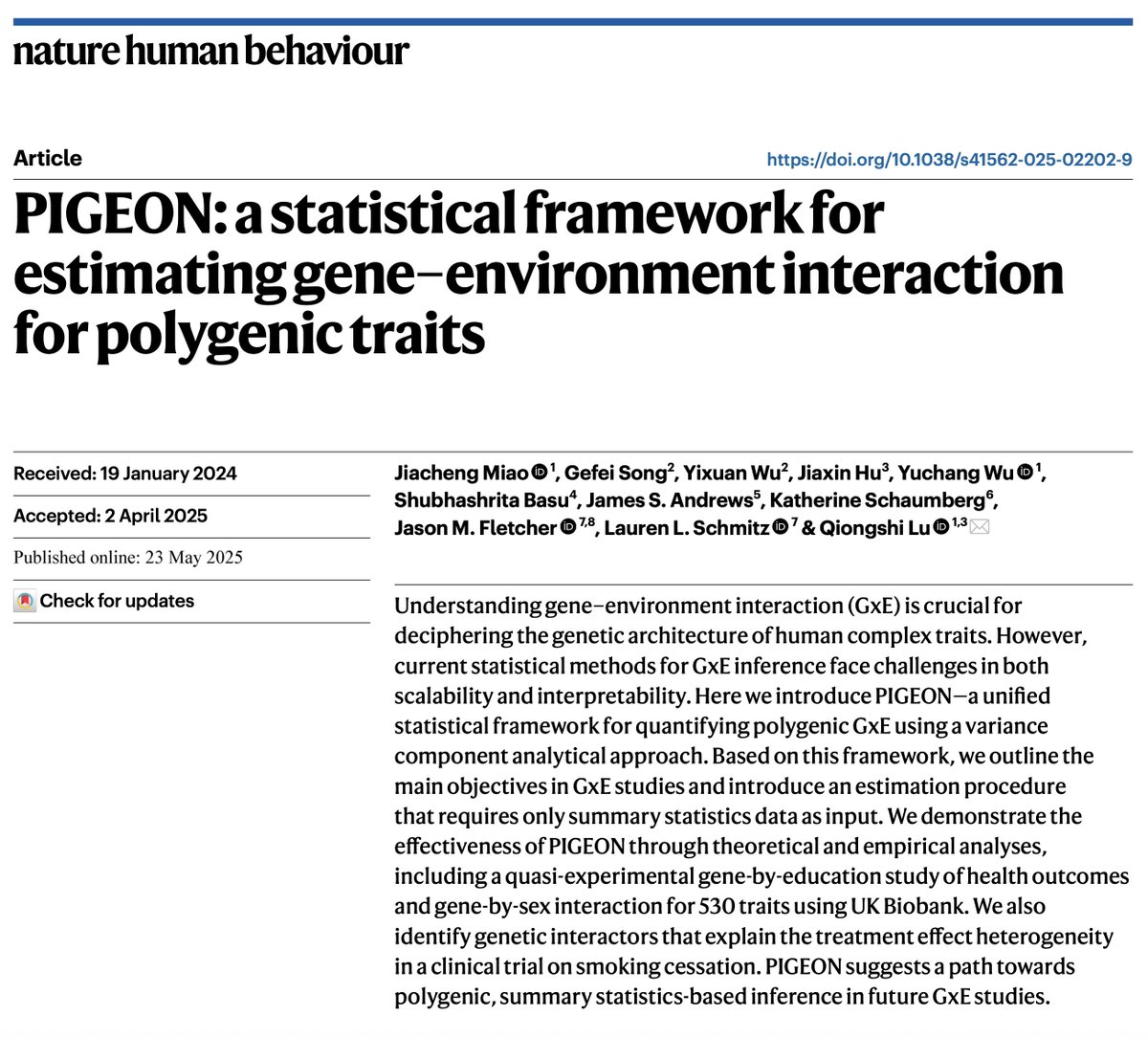
@Jiacheng_Miao's PIGEON paper on GxE methodology is now published @NatureHumBehav with a new title. In our view, this paper can reshape the study design for future complex trait GxE work.
Paper📰https://t.co/UjPbAmhrp8
Software🧑💻https://t.co/564QCMFIEV
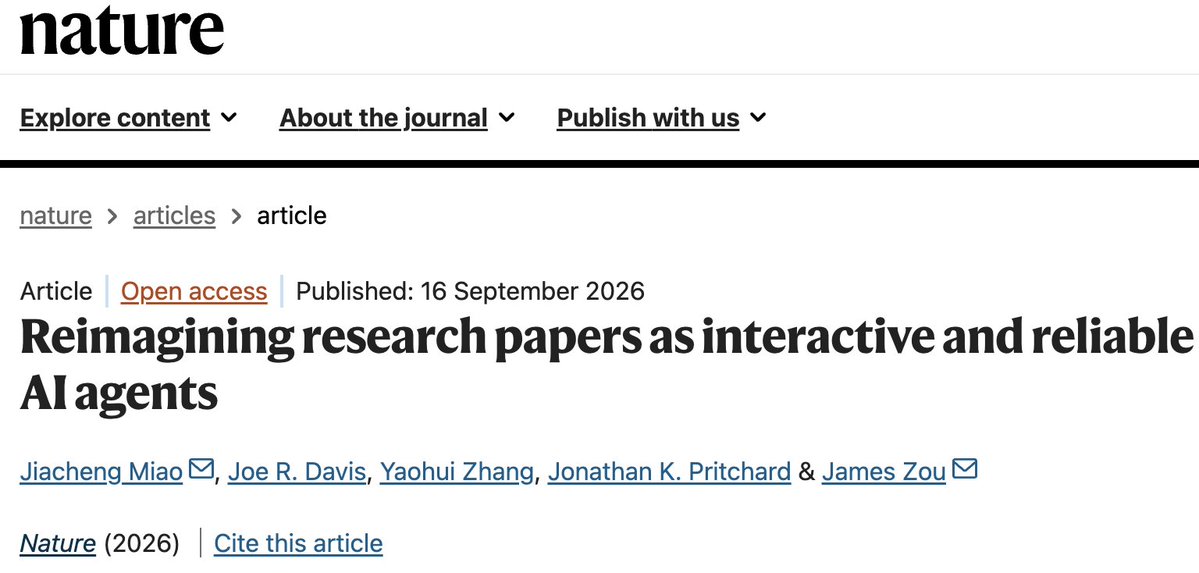
🔥 Excited to share that #paper2agent is published in @Nature today!
Papers have long been the primary format for communicating scientific knowledge, but they remain static. Putting that knowledge to work requires connecting findings to data, navigating supplementary materials, and adapting methods to new questions - effort repeated by each new reader.
We introduce Paper2Agent, a multi-agent framework that automatically turns research papers into virtual authors. Paper2Agent turns a paper’s manuscript, code, data, and supplements into an MCP server that any AI agent can access, with automated testing and iterative refinement in an agentic loop. The paper then becomes a virtual author you can talk to: trace claims to evidence, analyze your own data, and collaborate with other papers’ virtual authors
Agentifying a paper turns it from something people read into something people and AI agents can discover and build on - providing the context needed to interpret its findings and reuse its methods reliably. We tested how reliably these agents put papers to use. Across multiple benchmarks, agents created by Paper2Agent outperformed baselines such as Claude Code working directly with papers' PDFs and code repositories.
Once papers become virtual authors, they can collaborate - much like human researchers do. In one case study, agents built from AlphaGenome and two large-scale genetic perturbation studies worked together to propose a new computational approach for integrating evidence across different perturbation datasets. By connecting predictions from one paper with experimental data from others, they helped pinpoint a likely causal gene for psoriasis.
We hope Paper2Agent makes scientific knowledge easier to access, reuse, and build on - a first step toward a future where millions of paper agents proactively collaborate with human researchers and one another to advance discovery.
🤖Talk to the virtual author for Paper2Agent itself: https://t.co/wCzxUS4alX
📎Paper: https://t.co/2EGOPUgirB
💻Code: https://t.co/290bZWDmRt
VERY grateful to work with this incredible team: @james_y_zou, @jkpritch, Yaohui, and Joe!
We showed that polygenic components of treatment efficacy capture far more variation than individual variants, but it's hard to detect them from treatment samples alone (too small). Need transfer learning from large GWAS to pull it out.
https://t.co/b0fEOam3ND
Interested to pursue graduate studies (MS/PhD) at the intersection of biological, biomedical problems and data science? Join us for a virtual open house on Nov 13th to learn more about our Biomedical Data Science program at UW Madison @UWMadison!
https://t.co/YEB43csUX6
I had the wrong software link earlier in the thread. See below for the correct one. We've done three very different PIGEON GxE applications. Read the paper for more details. All sumstats produced in the paper are publicly available too.
Software🧑💻https://t.co/ksnWMFuRuQ
@Jiacheng_Miao's PIGEON paper on GxE methodology is now published @NatureHumBehav with a new title. In our view, this paper can reshape the study design for future complex trait GxE work.
Paper📰https://t.co/UjPbAmhrp8
Software🧑💻https://t.co/564QCMFIEV
Based on this advance, we make two predictions:
1) The future success of complex trait GxE research resides in sharing and meta-analyzing GWIS summary statistics.
2) Future GxE method development should focus on techniques that rely only on summary-level data.
In this Article, the authors introduce PIGEON, a statistical framework for estimating gene-environment interactions for complex traits. @Jiacheng_Miao@Q_StatGen
https://t.co/kWbUZdsduB
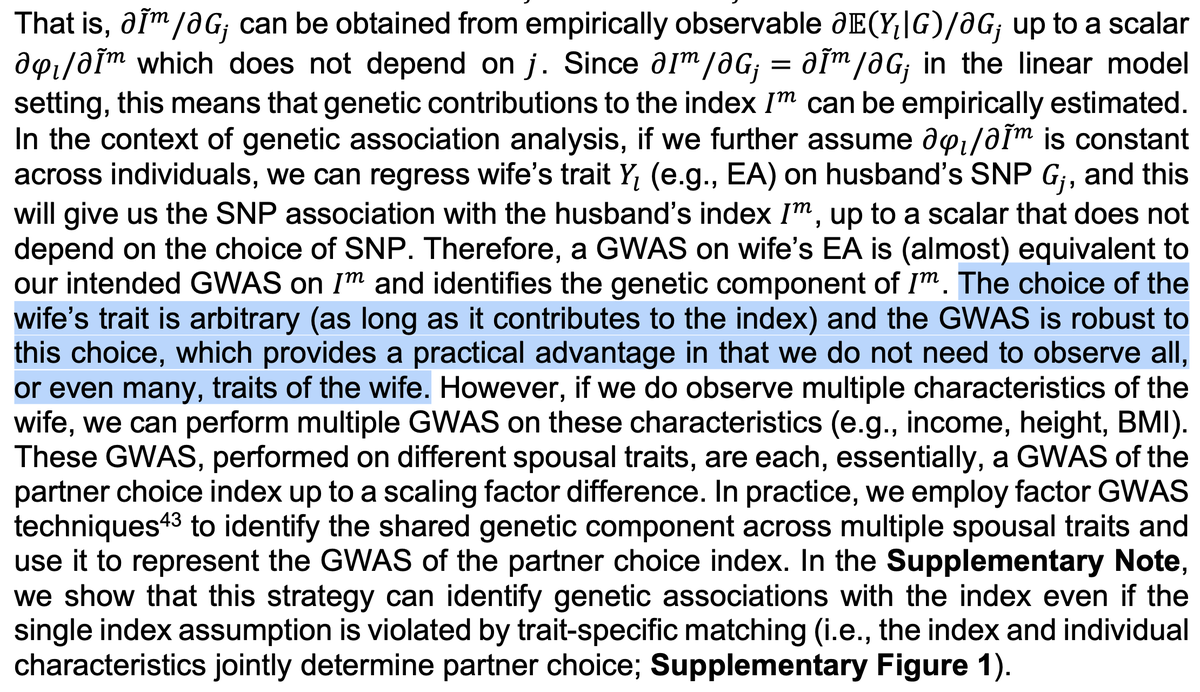
@zkutalik Thank you! An important feature of this model is that it's supposed to be robust to the choice of traits (attaching a screenshot snippet here and we explained more in the paper). We also tried using any 3 out of the 4 traits to obtain the index GWAS and basically got same results
This is a big project with many more results in the paper. But overall, we are excited about being able to study genetic associations with something we cannot directly measure. Lead author @qinwen_zzz is an undergrad who's doing PhD interviews recently. Snatch him while you can!
Beyond excited to share this new paper with all of you . It's the most fun we've ever had. We figured out how to study a latent index driving partner choice without measuring it directly🥂
@qinwen_zzz
Preprint📰: https://t.co/dLsmZvcjiV
Sumstats⬇️: https://t.co/0LJOblAOmR
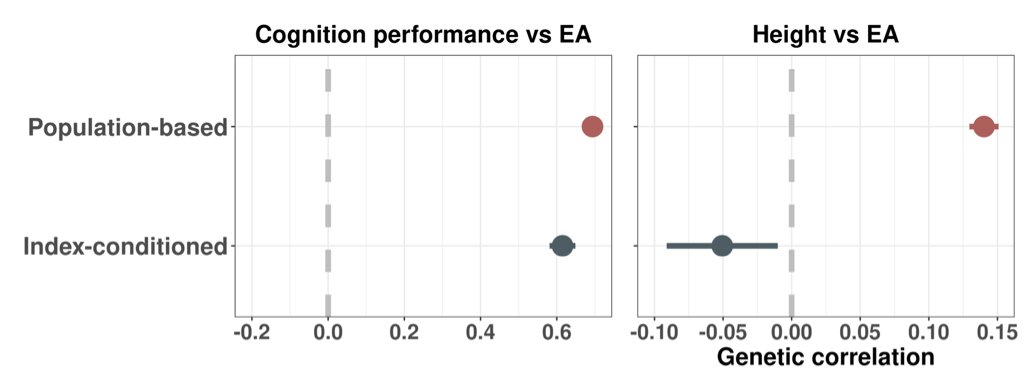
The index GWAS also allows us to remove assortative-mating-driven biases in GWAS applications. For example, genetic correlation of education and height reduced to null after conditioning on the index. But rg of education and cognition remained unchanged