@cristianoamon@Qualcomm@donnymac $qcom @Clareconley if company believes in it’s targets it should be buying back aggressively and buying personal shares to show conviction. Below acquisition share comp price for modular, warrant price for Amazon- 5 year average. Time to move
$QCOM FQ4: BEAT. Down after hours off a 5.3% SpaceX-day gain. A good quarter for anyone reading past the spreadsheet.
The numbers:
-Revenue $10.44B vs $10.15B consensus: BEAT
-Non-GAAP EPS $2.17 vs $2.16 consensus: MEET. Vs $2.19 whisper: MISS
-December revenue guide ~$10.8B vs $10.5B consensus: BEAT.
-Non-GAAP EPS ~$2.25 vs $2.27 consensus: MISS
Takeaways:
1. Data center is real: $650M+ guided for December, up every quarter to a $7B+ exit, $5B FY27 reaffirmed. In July I said it would hit soon.
2. Automotive's first $2B quarter, +89%, beat its ~60% guide by ~$300M: an ~$8B run rate, by my math.
3. Data center covers the Apple decline. Without it, the December QCT guide is down ~4%, by my math.
4. SpaceX breaks the "arms dealer for all but Apple and Elon" label, mine included. Even Elon can't build all his chips.
5. Margin is a timing story: price increases fully land in 2H FY27, and the 30% long-term QCT margin target stands.
The diversification story continues.
@Qualcomm
$QCOM just announced a Starlink partnership with $SPCX.
$QCOM chips will power tens of thousands of Starlink’s ground towers across the US starting in 2027 as SpaceX builds out its own phone carrier to take on big telecom.
Tower gear has been Ericsson and Nokia’s turf for decades. Landing Elon as a customer is a big foot in the door puts $QCOM in pole position for whatever 6G network SpaceX builds next.
Lots of interesting growth vectors with $QCOM (robotics, wearables etc.) but expansion into tower gear isn't something I had on my bingo card. Certainly adds more unpriced upside on to the stock.
This is Qualcomm technology operating at an incredible scale. @SpaceX selected @Qualcomm#Dragonwing to help power @Starlink Mobile’s nationwide terrestrial 5G network in the U.S.
Proud of the teams who made this milestone possible.
SpaceX selected Qualcomm Dragonwing to accelerate @Starlink Mobile’s nationwide terrestrial 5G network. Together with @elonmusk and the @SpaceX team, we’re excited to build world-leading cellular infrastructure and a path to AI-native 6G. 🤜🤛
SpaceX has selected Qualcomm #Dragonwing Cellular Infrastructure solutions to support @Starlink Mobile’s nationwide terrestrial 5G network in the U.S. https://t.co/Up7LxbQz5o
@Tesla, @Hyundai, @BMW and @Toyota auto makers all moving into robotics. Why? It is not disimilar, they need the same skills - power efficiency, safety-grade compute and connectivity. Begs the question who wins in robotics on the silicon side? The current silicon partner to the auto industry? $QCOM https://t.co/fk8HKKrj96 via @ft
.@Qualcomm's groundbreaking #HBC memory tech is nearing commercialization...
https://t.co/FkuFy3VuLQ
This novel memory-on-logic tech could give $qcom a shot in the arm in addressing #AI memory constraints — both bandwidth and supply chain...
@TantraAnalyst
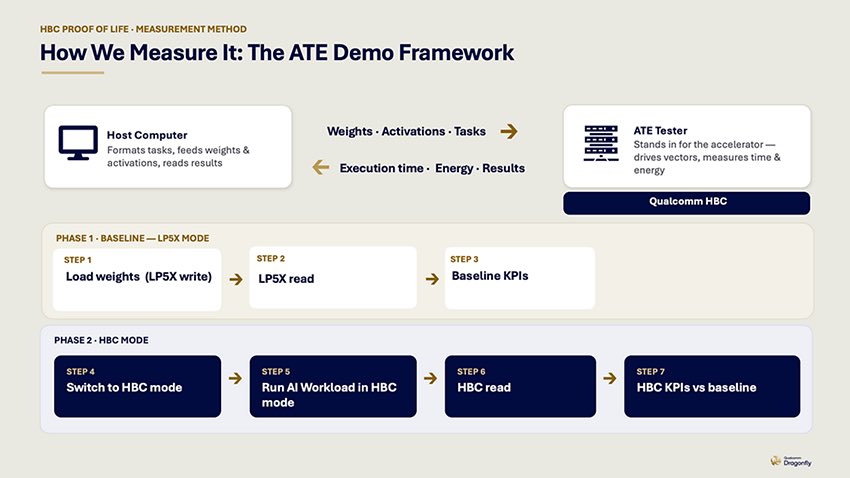
Memory bandwidth has been the limiting factor for LLM inference for a while now, and anyone building out inference capacity is paying for it in power and in cost per token. @Qualcomm has been talking about High Bandwidth Compute as its answer to that problem, and today it showed first-generation HBC silicon working in its San Diego lab, running the full memory read-write path and near-memory compute at production-representative sizes.
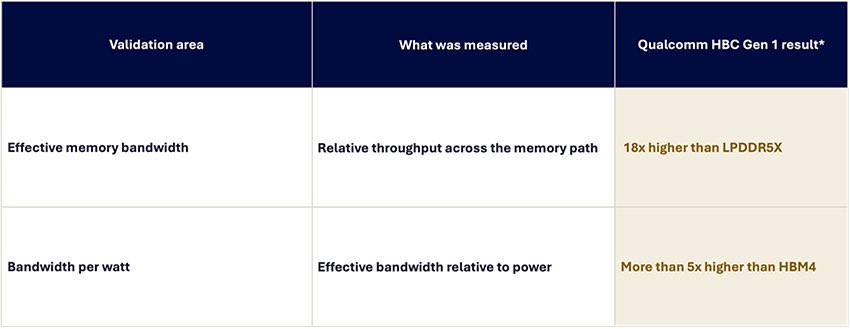
The numbers Qualcomm is sharing are big, with 18x the effective bandwidth of LPDDR5X and more than 5x the bandwidth per watt of HBM4. Those are Qualcomm estimates, normalized from ATE testing and compared against published competitor specs, so I'll want to see how they translate once HBC is sitting inside a full accelerator.
That first accelerator will likely be Dragonfly AI250, which Qualcomm expects to sample in the first half of 2027 as part of its Dragonfly Rack platform. A data center product has already taped out and early bring-up of the bonded DRAM stack is apparently yielding well, which tells me this has moved past the research phase. Qualcomm has more than a decade of experience bonding DRAM onto logic from its mobile business, but HBC is the first time I've seen that work pointed directly at data center inference economics.
If HBC delivers anything close to those efficiency numbers in a shipping system, the market impact could be significant. HBM supply has been one of the tightest constraints on AI infrastructure buildouts, and it is a big part of what makes today's accelerators (and basically everything else!) so expensive. An inference platform that gets its bandwidth from a different memory approach would give hyperscalers and cloud providers another lever on cost and supply, and it would put real pressure on NVIDIA and AMD in the inference tier, where tokens per dollar per watt matter more than peak training performance.
Silicon is only part of what these customers are buying, though. Hyperscalers commit to a platform for years, and they need confidence in a multi-generation roadmap, a mature software stack, supply they can count on and support when things break at scale. Qualcomm walked away from its Centriq server CPU effort in 2018, and data center buyers have long memories. The HBC results are a strong technical step, and the next couple of years will determine whether Qualcomm can prove it is the kind of reliable, long-term partner these companies need.
https://t.co/DgPZepsPRi
$QCOM HBC is now validated silicon, not an Investor Day slide. @Qualcomm has first-gen High Bandwidth Compute running in its San Diego lab, with the full memory read-write path and near-memory compute at production-representative sizes.
-18x effective memory bandwidth vs. LPDDR5X, the same 18x it promised in June
-More than 5x the bandwidth per watt of HBM4
Coming out of Investor Day, I said the open question was execution timing, not credibility. This is the first hard proof point on execution. It is still lab silicon. The next test is stacked-DRAM yields at volume and tokens per dollar when AI250 samples in 1H 2027.
Our first-gen @Qualcomm HBC silicon is validated in our San Diego lab and exceeding expectations. Placing compute closer to memory tackles the bandwidth constraint in AI inference, and it’s coming to Qualcomm Dragonfly AI250. Proud of this team.
Read more: https://t.co/ttrFKjBoCt
.@Qualcomm has validated its first-generation High Bandwidth Compute (HBC) silicon, reporting an impressive 18X increase in effective memory bandwidth over its previous LPDDR5X-based AI200 architecture.
This could have major implications for AI inference economics, where memory bandwidth, power consumption, and data movement remain critical bottlenecks. If these gains translate into production-scale performance and efficiency, Qualcomm could have a compelling alternative to conventional HBM-based accelerator designs, putting additional competitive pressure on established AI data center players.
It's sill very early, but this is definitely a technology worth watching as Qualcomm pushes further into the AI data center market...👇
https://t.co/QRLxkAKvPa
The first Qualcomm High Bandwidth Compute silicon is here, and it’s validated on real hardware. We’re bringing compute closer to memory to take on the memory wall and lay the foundation for Qualcomm Dragonfly AI250. Learn more: https://t.co/MmuZJiAA1i
We’ll report our Q4 FY26 earnings on November 4th. I invite you to tune into the webcast at 1:45 PM PT for a closer look at our performance and outlook.
@michaelsikand What’s your read on $QCOM . Crazy that a company trading the same price as 5 years ago is down here when it’s AI story is all potential upside and not risk as it hasn’t shown up on paper yet