Introducing Qodo 3.0: the quality and governance layer for the software factory.
Engineering teams are building agentic software factories. Output is up, but code review hasn't kept up.
And a factory with no quality control is just a faster way to ship defects.
Qodo 3.0 governs your software factory from the first line an agent writes through review and into production.
Instead of individual PRs, group your code into work packages as connected changes across repos. Reviewed, ranked, and measured together, with a clear map of impact.
How do standards become usable, enforceable engineering knowledge? Read the discussion on pp. 16–18 of our 2026 State of AI Code Quality report.
Download: https://t.co/dL0RjHlSsW
Only 34.6% of developers in our 2026 survey say coding agents always follow organizational standards.
A migration exception may be wrong for a new API endpoint. Preserve its owner, scope, and reason so the next agent can check whether it applies.
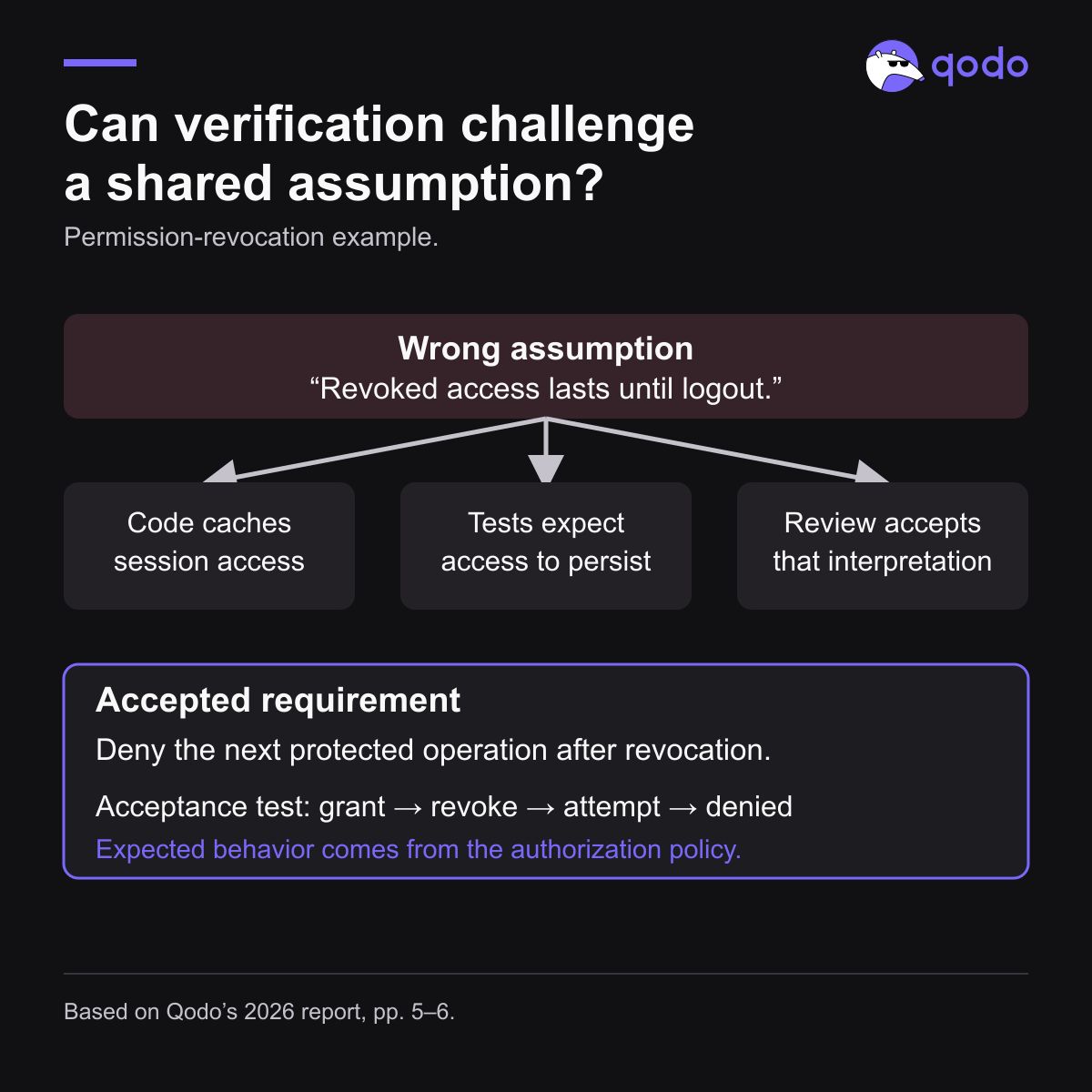
Our 2026 State of AI Code Quality report discusses assumptions carrying across development stages on pp. 5–6. The diagram illustrates that mechanism.
Download: https://t.co/dL0RjHlSsW
Code, tests, and review can share the same wrong assumption.
If access must end on the next protected operation after revocation, testing access until logout won't verify the requirement.
Ground acceptance tests in the agreed policy.
Our 2026 State of AI Code Quality report examines quality at the change, repository, system, and organizational levels on pp. 20–23.
Download: https://t.co/dL0RjHlSsW
Three services add pollers against one database. Each change passes local tests.
Can the database handle their combined workload?
Check shared capacity and operating limits before those changes reach production.
Where should we draw the boundary for language models?
@honeycombio's Liz Fong-Jones joins @nnennahacks and @itamar_mar on The Agentic Review podcast to discuss why lessons from coding don't transfer to every field.
I want prompt changes evaluated like production code. They change which findings developers see.
What I like about Qodo's approach: cost, latency, and missed findings measured separately. That's the standard I'd want before shipping a prompt change.
Which code review findings will your team act on?
We used GEPA to improve Qodo’s recommendation agent. In a production A/B test, its average cost fell roughly 50% and latency 25%, with comparable precision.
Ravid Cohen explains how we tested it. https://t.co/t2czafURMq
When does fine-tuning a model make sense?
Gil Elbaz (@gil_elbaz_) discusses latency, scale, and domain knowledge as reasons to train, alongside the expertise that requires. Listen to The Agentic Review podcast with @nnennahacks and @itamar_mar.
31.7% of engineering leaders in our 2026 survey say quality depends on exhaustive manual work.
Which controls rely on someone remembering to intervene?
Record why a retry was disabled or who owns a data contract, and keep that reasoning current.
What breaks when AI agents reach production?
Tomorrow in NYC, we're bringing builders and OSS maintainers together to talk reliability, code review, agent loops and observability.
Agentic AI in the Wild
Oct 22 · 5–8 PM EDT
Corgi Cafe, 121 E 27th St
A reviewer needs to challenge the agent writing the code.
Inside Qodo's Dark Factory, the Reviewer never edits the implementation. Shared context lets it question the plan while keeping that responsibility separate.