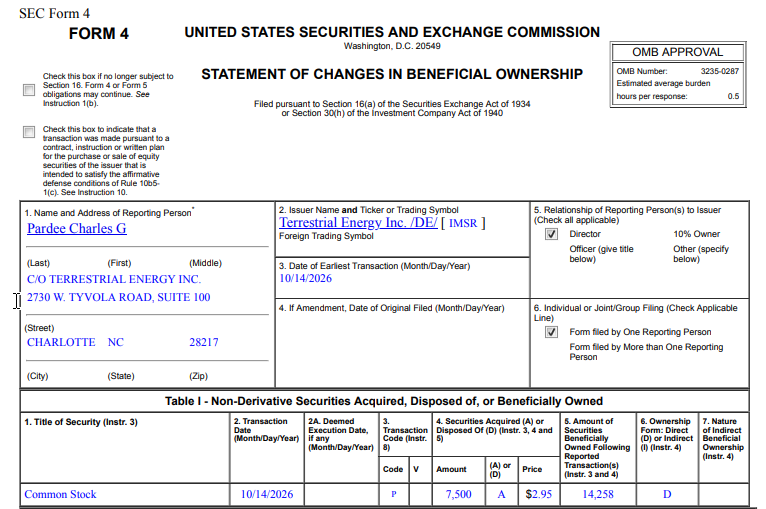
A third Form 4 just dropped. The pattern is now impossible to miss. $IMSR
Oct 9: Director Fred Buckman — 12,000 shares at $3.278. Nearly triples his direct stake. Oct 13: CEO Simon Irish — 16,900 shares at $3.007. First-ever open-market buy, on the day the stock touched its cash value. Oct 14: Director Charles Pardee — 7,500 shares at $2.95. More than doubles his direct stake.
Three insiders. Three consecutive business days of purchases. Each one the first open-market transaction of that person’s tenure. Each at a lower price than the one before — they kept buying as it fell. All three discretionary: no 10b5-1 plans, confirmed in each filing.
Before October 9, this company had never recorded a single open-market insider transaction (in either direction). Now the complete log reads: sales, zero, through the entire drawdown to all-time lows. Buys, three, all inside one week, roughly $112K combined.
Modest dollars individually but insider signals compound differently than they sum: one buy is an opinion, two is a coincidence worth watching, and three in a row at descending prices is a board looking at the same tape you are and reaching a different conclusion than the sellers.
The lock-up everyone’s been dreading expires in 13 days. The people who know the company best are spending the final days before it expires accumulating, not positioning to exit.
Insiders don’t buy the week before they plan to sell. Three of them just said so in writing.
$IMSR - Uranium term prices just hit an all-time high ($96/lb, above the 2007 peak). Nuclear equities are sitting at 52-week lows. TD Cowen and Goldman just explained the gap — four mechanisms:
1. A buyers' strike, not a bear case. Goldman's own desk: investor "inbounds have been extremely light." The marginal buyer didn't turn bearish — he left the room. Small caps feel this worst: remove attention, and enterprise value drifts toward cash with nothing actually going wrong.
2. The AI-nuclear divorce. The AI ETF is +25% YTD. The nuclear ETF is -12%. The market still funds AI demand — it just stopped paying for the power supply meant to run it. That repricing was most of the sector's 2025 multiple.
3. Time-to-power. Hyperscalers need megawatts in 2027, not gigawatts in 2037, so capital rotated to gas turbines, batteries, and uprates. Everything with a 2030s start date got hit with the "too late" discount — applied indiscriminately, no differentiation.
4. Dead sponsorship at the risk end. Holtec pulled a $10B IPO. The recent nuclear IPO class is broken. Policy headlines that used to pop stocks 10% now fade within hours. The announcement economy is out of fuel.
Why I think $IMSR gains the most when this turns:
Mechanism 3 is the deepest discount. $IMSR is the one developer whose deployment model exists to answer it. Gas-first, nuclear behind it. Both named projects (Riot, U.S. Army/Aberdeen) are structured exactly that way. The market is applying the "too late" discount to the company that built the time-to-power bridge.
Mechanism 1 cuts hardest at the small end and reverses hardest there too. ~$420M cap, $283M cash, zero debt: the business is priced at ~$140M. When attention returns to a sector, the deepest discounts reprice first and fastest.
And while the sector burned narrative, $IMSR progressed: two topical reports delivered on guidance, two named projects a quarter early, three desks covering; all Buy. For contrast, FERC just bounced Oklo's PJM interconnection application as deficient. Regulatory execution is becoming the differentiator, and it's measurable.
The fuel market is the tell: utilities are contracting below replacement at record prices — demand deferred, not cancelled. TD's words: "not a question of if, it is a question of when."
Honest caveat: none of these reversals run on IMSR's calendar. Rates, utility contracting, and fund flows turn when they turn. This is a patience trade — at a price that charges almost nothing for the wait.
A record high that nobody cared about isn't how a bull market ends. It's what the middle of one looks like.
Sources in reply.