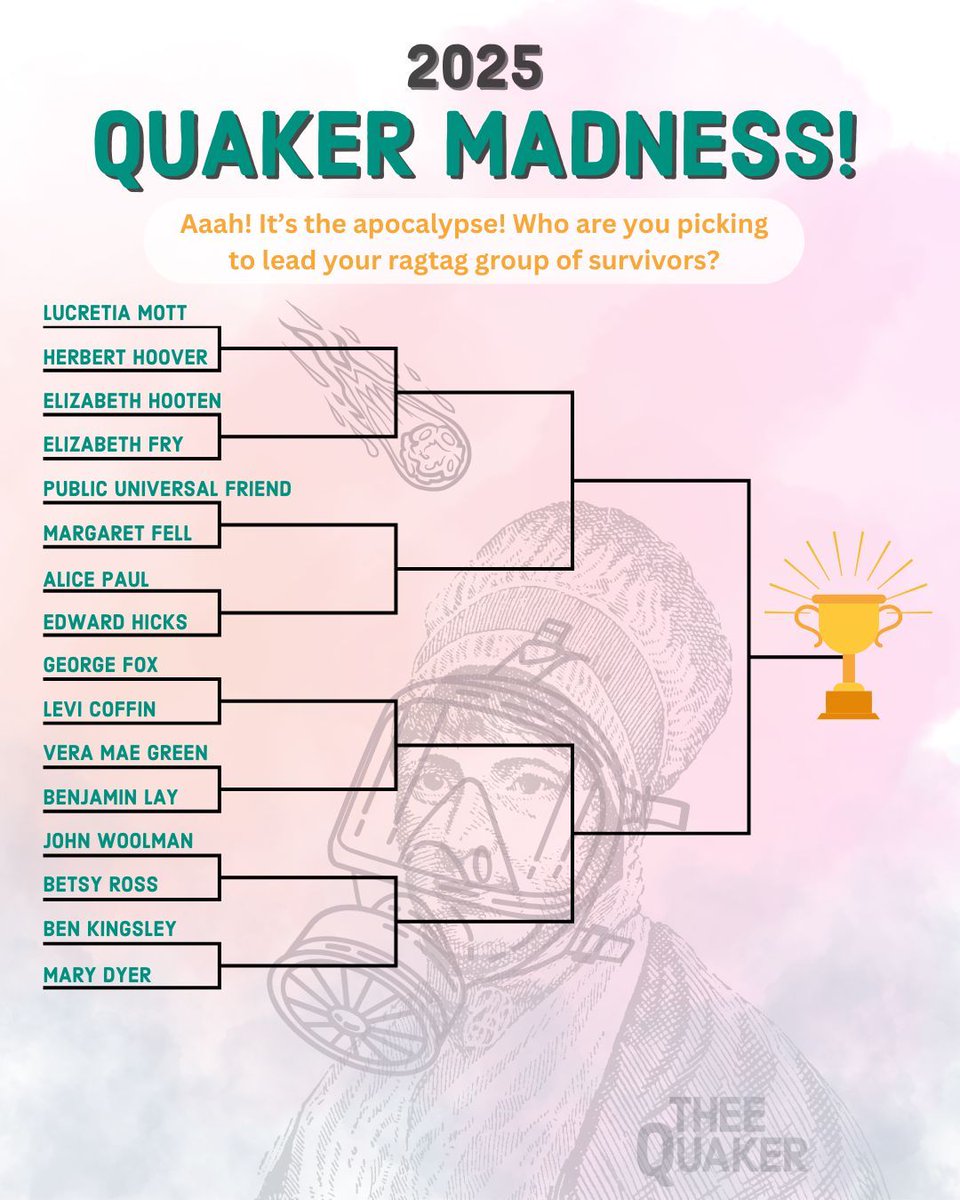
Back by popular demand, it's time to set up your March Madness bracket, Quaker style!
This year, it's the apocalypse (cause unspecified)! Pick the Quaker who you'd trust most to lead your ragtag group of survivors.
Check in every Friday, when we’ll pit the winners against each other.
Pick your favs here: https://t.co/x0k78JW3ia
(Voting closes at 11:59 PM Eastern on Tuesday, 3/11.)
Who do you think will win it all?
Saturday is International Women’s Day, a perfect time to reflect on the legacy of Quaker feminist and abolitionist Lucretia Mott.
Mott’s Quaker beliefs inspired her activism against slavery. She co-founded the Philadelphia Female Anti-Slavery Society in 1833, but as a woman was not allowed to participate in the 1840 World Anti-Slavery Convention. This deepened Mott’s interest in women’s rights, leading her to co-organize the historic Seneca Falls Convention in 1848, which sparked the women’s suffrage movement in the United States.
As the first president of the American Equal Rights Association, Mott fought for universal suffrage while continuing to advocate for the abolition of slavery. She was involved in founding the coeducational Swarthmore College, and dedicated much of her time to public speaking on topics of equality, a radical thing for a woman to do at the time. Mott’s tireless pursuit of justice for all solidified her legacy as a trailblazer for human rights.
This episode of our podcast has gotten more listens in its first week than any other episode! It must be because Phil Gulley speaks directly to our condition in these difficult times.
Using both the pulpit and the page, Quaker pastor Philip Gulley has been a bold voice that challenges the church’s stance on heaven and hell, LGBTQ issues, and more. As he’s seen greater censorship in the publishing world, Phil has moved to an online newsletter where he examines the rise of Donald Trump and calls on Christians to be more active in the pursuit of truth and justice.
In this interview, Jon speaks with Phil about Christian nationalism, his focus post-election, and much more.
https://t.co/fOCUwNjTQa
The Monthly Meeting of Friends of Philadelphia (Arch Street Friends) have been worshiping in Philadelphia since 1682. When Friends first came to Philadelphia, they gathered to worship in private homes until the first meeting house was built on the bank of the Delaware River. As the Meeting increased in size, it outgrew a succession of meeting houses until the present large meeting house was built in 1804, on a site originally granted by William Penn as a Friends burial ground. Mainly used by the Monthly Meeting each week, the building also serves as an exhibition and conference center, and is visited by thousands of tourists each year.
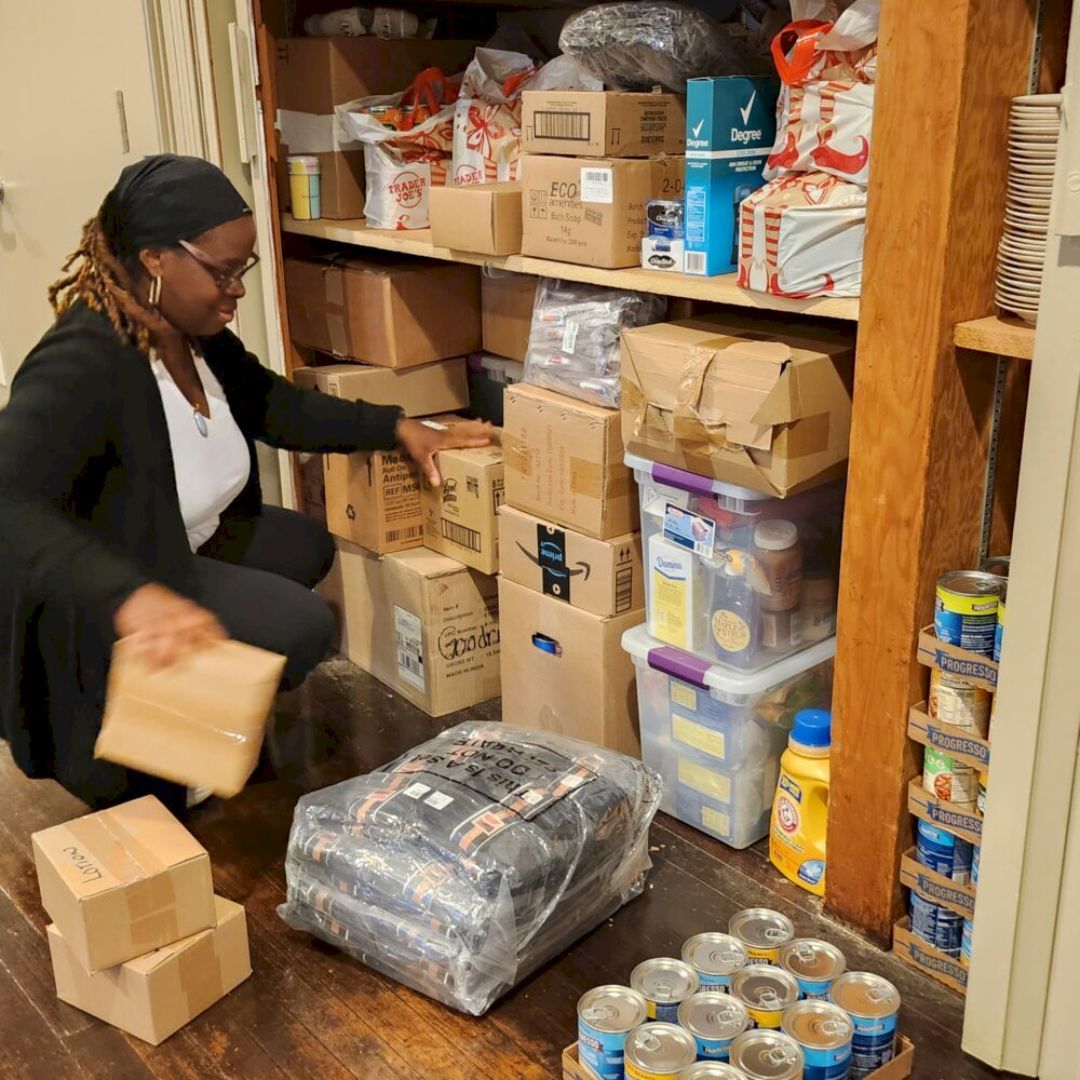
Arch Street Friends also has a food pantry, where they distribute personalized packages to those in need based on individual situations. They also support those in emergency situations when possible.
Unprogrammed worship at Arch Street is Sunday 10:30-11:30, and Wednesday 5:30-6:30. The museum building reopens to the public for self-guided tours in March.
https://t.co/7glhOTOfnR
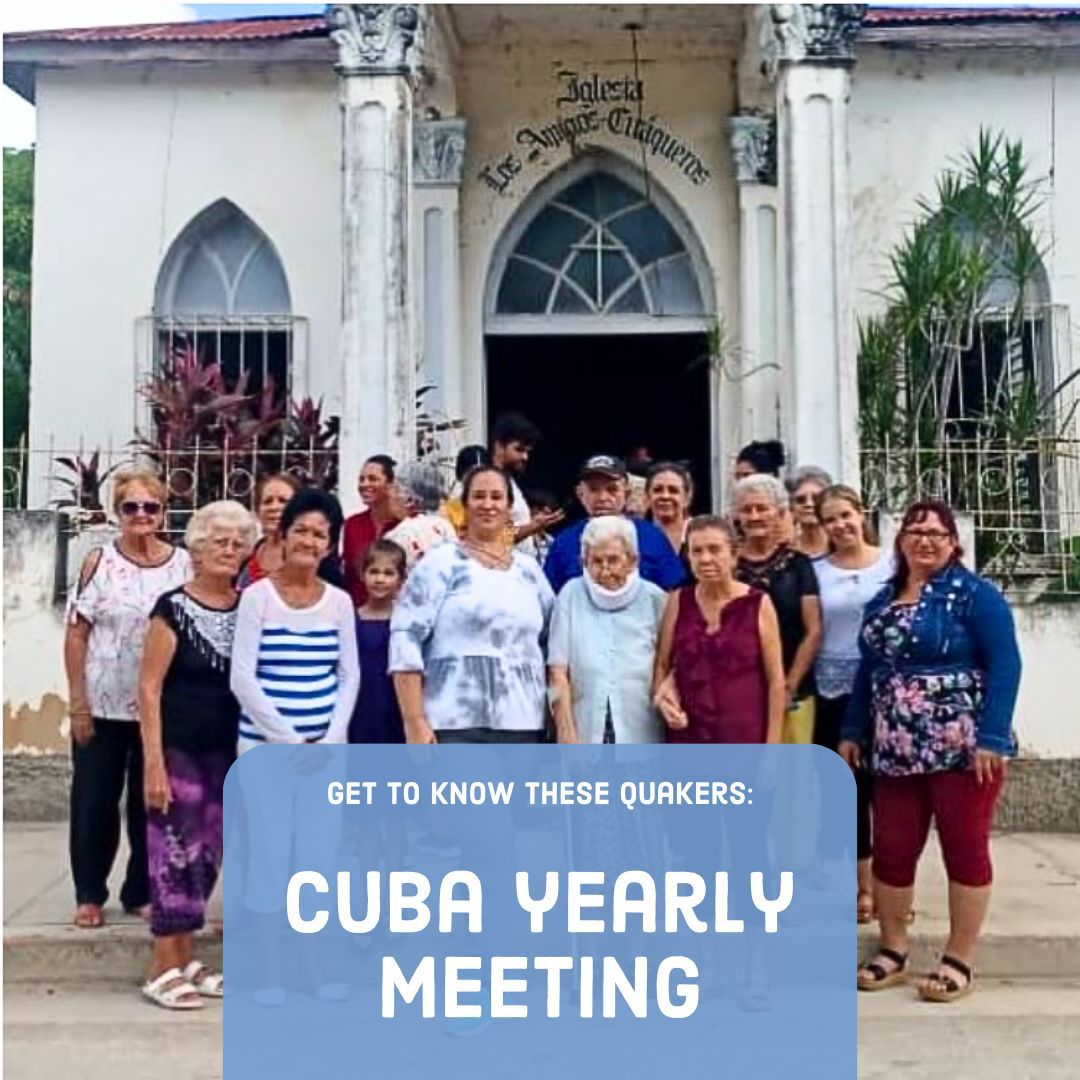
Cuba Yearly Meeting of Friends was established in 1927, and has nine monthly meetings. The yearly meeting actively participates in international Quaker organizations, including FUM and FWCC. It is also a member of the Cuban and Latin American Councils of Churches.
Cuba Yearly Meeting sponsors the Cuban Quaker Institute of Peace, which offers programs to train people to reduce violence in their communities.
Since 1991, Cuba Yearly Meeting has a "sister meeting" relationship with New England Yearly Meeting. Its primary task is to arrange for exchanges of religious visitors between the two yearly meetings.