Monthly Portfolio Update 📊
$MA is now my largest position, and I have no plans to trim it at the moment.
This month, I added to $SPGI and $NFLX while also opening a starter position in $AVGO.
My focus remains on finding businesses with wide competitive moats, durable cash flows, and long runways for growth that can compound capital at high rates of return over the long term.
The goal is simple: own great businesses and let compounding do the heavy lifting.
$COST is just one of those businesses that keeps chugging along. They continue to open new stores, deliver a better value proposition to consumers, maintain low churn rates, and bring new members into the fold.
While the valuation isn’t attractive enough for me currently, it’s a business I watch from a distance and admire. Consistently growing revenue and cash flows while reinvesting back into the business at high rates of return is exactly what you want to see from a long-term compounder.
$MELI MAUs continue to grow at a very impressive clip. Short term, we may continue to see some weakness, but the long-term trend continues to move in the right direction. With a great management team at the helm that remains confident in the returns they can generate, I’m happy to remain patient.
@ItsDumbInvestor@invest091 I haven’t looked at this one either. I didn’t know they aren’t a memory company anymore. Are there any write ups on this one?
Here are some businesses with exceptional moats:
Railroads: $CP $CNI $UNP $CSX
Waste Haulers: $WM $RSG $WCN
Financials: $SPGI $MCO $MA $V $MSCI $FICO
Semiconductors: $ASML $TSM $SNPS $CDNS
Retail: $AMZN $WMT $COST $TJX
These are just a few that come to mind, but they all have structural advantages that reinforce their competitive positions.
Railroads and waste haulers operate networks that would be incredibly difficult and expensive to replicate. $MA and $V have global payment networks that new competitors cannot easily recreate. $SPGI and $MCO benefit from entrenched positions in credit ratings, while $ASML has spent decades building technological capabilities that make it indispensable to the semiconductor industry.
The common denominator is a durable competitive advantage that protects these businesses from competition and allows them to compound cash flows over time.
The strategy is simple: find dominant businesses, buy them at attractive valuations, and let compounding do the heavy lifting for decades. 🤷🏽♂️
$ASML has been selling off recently, and I view this as a key opportunity to continue adding to my position at these levels.
Virtually all advanced semiconductor demand has to flow through ASML’s business. You simply cannot go around its EUV machines. The company occupies an incredibly important position in the semiconductor supply chain, giving it a powerful competitive moat and significant pricing power with customers.
As semiconductor demand continues to grow, more machines will be needed to support the industry’s expansion. Add in the growing number of AI use cases and the increasing demand for advanced chips, and ASML stands to be one of the biggest beneficiaries of this long-term buildout.
A critical tollbooth in one of the most important growth industries of the next decade.
$TPL could be getting close to giving long-term investors another opportunity to own it.
An amazing business model with exceptionally high margins and a unique asset base that gives it a localized monopoly in parts of the Permian Basin. Definitely one I always keep track of.
Weekly portfolio update.
Not much to say other than it was a rough week for the market, and my portfolio was certainly no exception. However, weeks like this can present some of the best opportunities to start shopping, adding to existing positions, or initiating positions in quality businesses.
Stay disciplined, keep your eyes on the long-term fundamentals, and don’t let short-term market volatility distract you from the bigger picture. Long-term investors should welcome opportunities like these. 📈
A follow-up to my post yesterday on $CRWD.
At current valuations, $CRWD would need to grow FCF by roughly 35% annually over the next 5 years while maintaining an aggressive 2.5% FCF yield just to justify today’s price.
As we’ve seen this year with software, even great businesses aren’t immune to multiple compression.
I think there are better opportunities elsewhere. A great company, but not a great price. I’ll happily stay on the sidelines at these levels.
@invest091@WillBiddy_ I’ve kept tabs on this one for a bit. I’ll dig into your Substack post today. That’s an interesting tidbit. Low 300s I think, is fair they have a 21% hit to cash flow from SBC.
$TYL has delivered a 13% EPS CAGR over the last 10 years. With its vertically integrated, highly sticky government software platform, I think the business is well positioned to sustain a similar growth trajectory for years to come. Switching costs and deeply embedded customer relationships make this a very attractive business model.
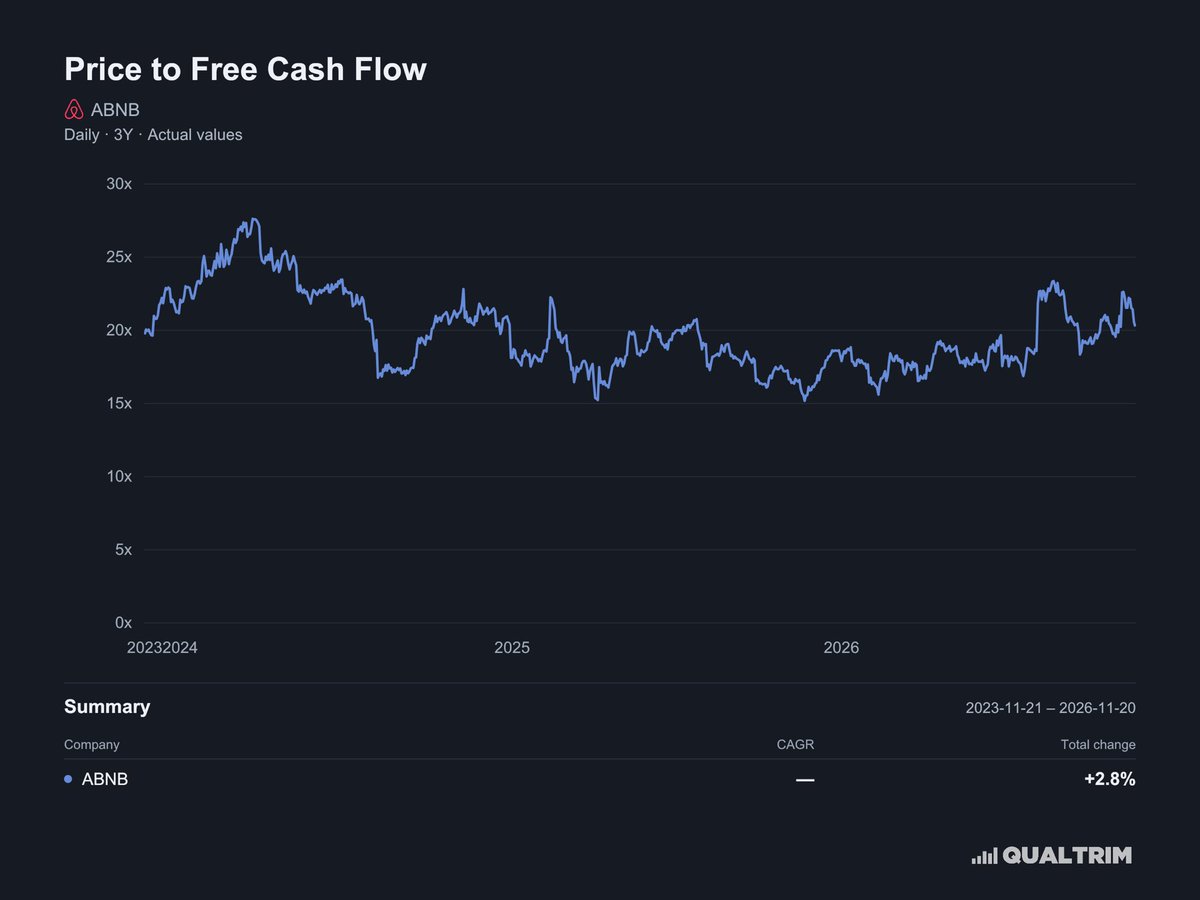
$ABNB still trading around a 20x FCF multiple. I think there’s room for a rerating as the business continues to compound.
A fantastic wide-moat business with a strong global network effect and significant runway ahead.