Connected Britain 2026 Recap 🇬🇧
What an incredible event.
We showed service providers how Qualoo can help identify real network issues, including customer WiFi problems, with detailed intelligence without requiring direct access or permissions from the operator.
Day two brought strong interest from potential clients, sales contracts and channel partners who can help scale Qualoo.
The biggest reaction?
“Wow.”
People were surprised by the level of detail Qualoo can uncover from real-world network data.
They also loved the audit trail and proof of internet quality written to blockchain.
DePIN + network intelligence + verifiable data.
Lots of great connections made. Lots more to come.
The internet is more than a speed test.
Slow connection.
Dropped calls.
Unstable WiFi.
High latency.
Poor performance in certain locations.
The challenge is understanding why.
That’s what Qualoo is building.
Real-world network intelligence powered by DePIN, helping make internet quality more visible, measurable, and verifiable.
Measure it. Understand it. Prove it.
Well in the depin model early investors help fund the infrastructure,software , network build out and initial network use cases in return for tokens, as more nodes join the network they also earn tokens, services are sold in tokens, which means more rewards more nodes and you have a global network across every provider, technology,country, with no huge single capex budget from a centralized entity who could never deploy a global test network
Connected Britain 2026 Recap 🇬🇧
What an incredible event.
We showed service providers how Qualoo can help identify real network issues, including customer WiFi problems, with detailed intelligence without requiring direct access or permissions from the operator.
Day two brought strong interest from potential clients, sales contracts and channel partners who can help scale Qualoo.
The biggest reaction?
“Wow.”
People were surprised by the level of detail Qualoo can uncover from real-world network data.
They also loved the audit trail and proof of internet quality written to blockchain.
DePIN + network intelligence + verifiable data.
Lots of great connections made. Lots more to come.
@0x_Dcce@Keith_Qualoo@ConnBritain@Eduardo15122002 It will also help Africa to dramatically improve the internet, holding providers accountable,mapping current digital landscape, optimizing Whats there and targeting investment where needed , while helping consumer to make better connectivity choices
Qualoo is heading to London.
On 9–10 September, we’ll be at ExCeL London, connecting with telecom, ICT, connectivity, and digital infrastructure leaders.
We’re building a new way to understand internet quality through real-world data, global mapping, and decentralised infrastructure.
If you’re attending, come meet the Qualoo team and see what we’re building.
📍 ExCeL London
📅 9–10 September
🎟️ Free & discounted passes: https://t.co/MZxNhHE9jP
Getting to Know the Internet with Qualoo EP 12: The Future of Internet Intelligence
The internet is becoming increasingly important to how we work, communicate, learn, and access essential services.
But understanding internet quality is still often reduced to a few simple numbers.
Speed.
Signal.
Availability.
The future requires a much broader view.
Continuous measurements.
Real-world data.
Geographic intelligence.
Historical analysis.
Evidence-based reporting.
And the ability to understand how network performance changes over time.
This can help us move from simply asking:
"Is the internet working?"
to asking:
"How is it performing, where are the problems, why are they happening, and is the network improving?"
That's the direction of Internet Intelligence.
Not just measuring the internet.
Understanding it.
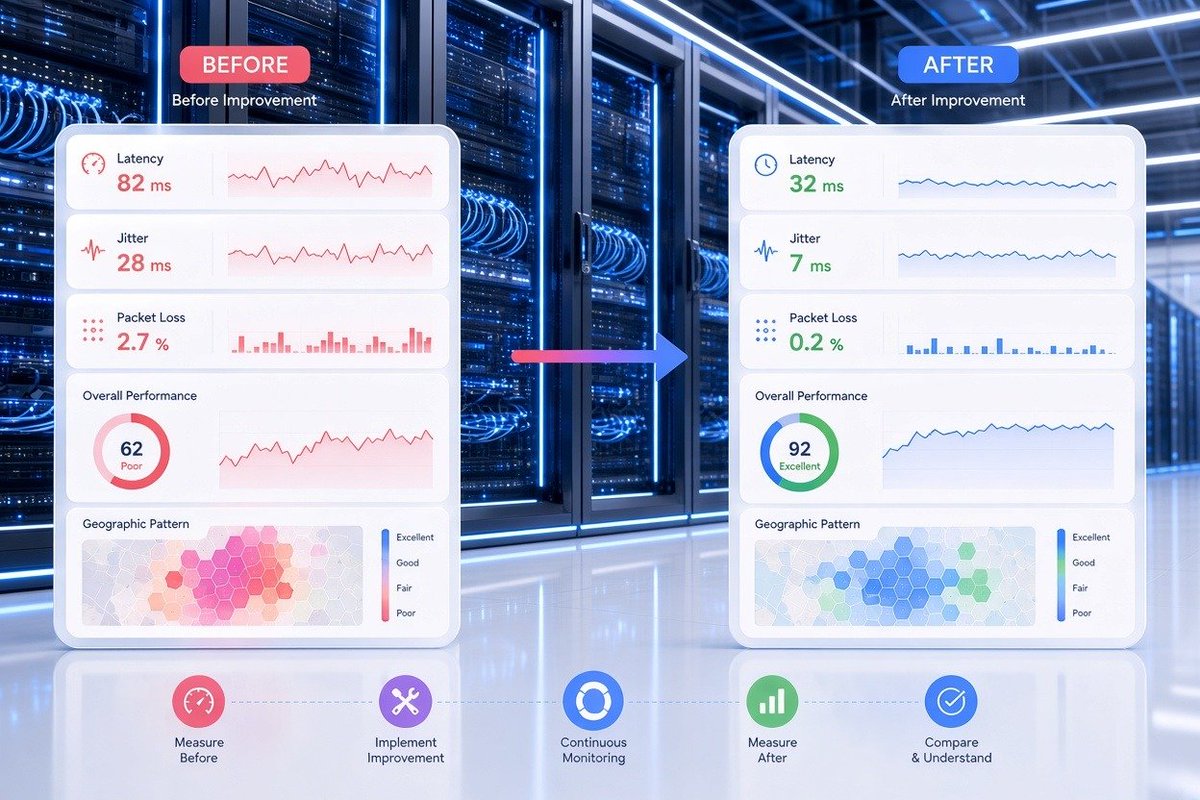
Getting to Know the Internet with Qualoo EP 11: How Do We Know a Network Improved?
Saying that a network has improved is one thing.
Proving it is another.
To understand whether an improvement actually made a difference, we need evidence from before and after the change.
We can compare measurements such as:
• Latency
• Jitter
• Packet loss
• Overall network performance
• Geographic patterns
The before measurements establish a baseline.
The after measurements show what changed.
This allows us to move beyond assumptions and ask a much more important question:
What does the data show?
Network improvements should not only be announced.
They should be measurable.
Getting to Know the Internet with Qualoo EP 11: How Do We Know a Network Improved?
Saying that a network has improved is one thing.
Proving it is another.
To understand whether an improvement actually made a difference, we need evidence from before and after the change.
We can compare measurements such as:
• Latency
• Jitter
• Packet loss
• Overall network performance
• Geographic patterns
The before measurements establish a baseline.
The after measurements show what changed.
This allows us to move beyond assumptions and ask a much more important question:
What does the data show?
Network improvements should not only be announced.
They should be measurable.
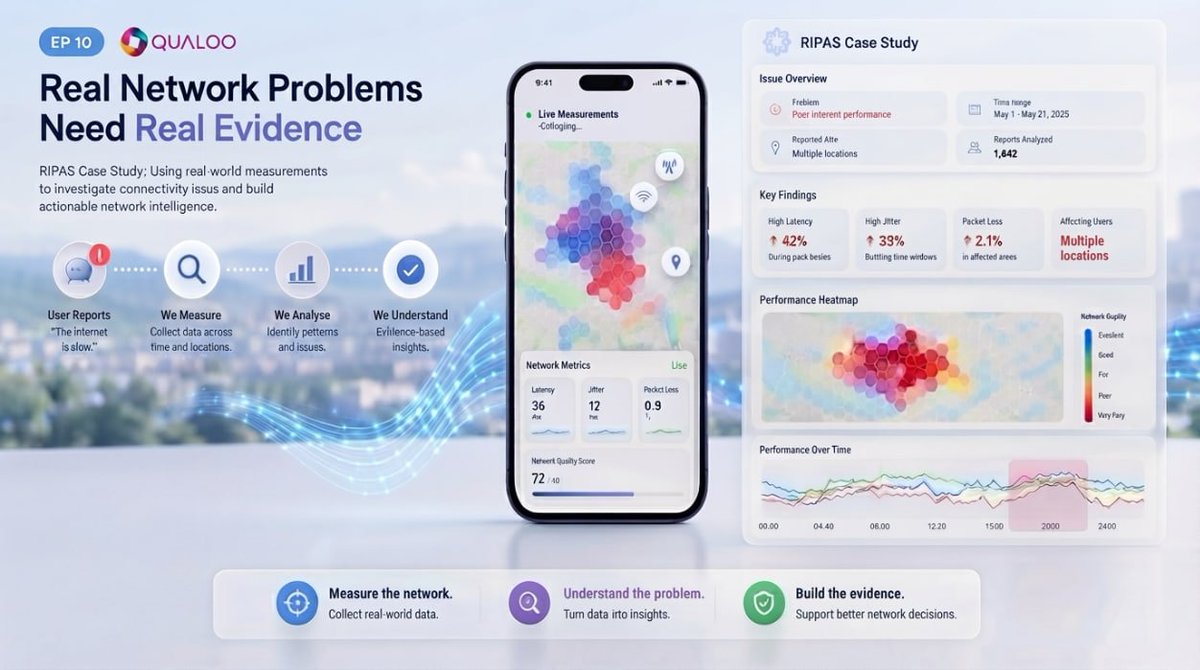
Getting to Know the Internet with Qualoo EP 10: Real Network Problems Need Real Evidence
When people report that a network is performing poorly, the first challenge is understanding what is actually happening.
A complaint such as:
"The internet is slow."
is a starting point.
But it doesn't tell us:
Where is the problem?
When does it happen?
How frequently does it occur?
What network conditions are involved?
This is where real-world network measurement becomes important.
Through continuous measurements, we can collect evidence across different times and locations, then analyze the data to identify patterns and potential issues.
The RIPAS case study demonstrates how this type of network intelligence can be used to investigate real-world connectivity conditions.
Instead of relying only on assumptions, we can look at the evidence.
Measure the network.
Understand the problem.
Build the evidence.
That's how internet intelligence can support better network decisions.
Elon is right that people switch airlines for cabin Wi-Fi. We measured it from the seat, GPS at cruise.
Starlink (WestJet): 218 ms, 0.1% loss — calls work.
Intelsat multi-orbit (Royal Brunei, our flight): 467 ms — their own terms say no calls.
GEO cabins: 778–1,162 ms. Same instrument. 5,397 in-flight tests. Physics, not a vibe.
Getting to Know the Internet with Qualoo EP 9: Detect → Analyze → Report
Internet intelligence isn't just about detecting that something is wrong.
It's about understanding why, where, and when it happens.
The process starts with:
DETECT
Identify unusual or recurring network conditions through continuous measurements.
ANALYZE
Look at the data across time, location, and different network performance metrics to identify patterns.
REPORT
Turn those findings into clear evidence that can be understood, investigated, and acted upon.
This is how raw measurements become meaningful network intelligence.
Detect → Analyze → Report.
That's the journey from a network problem to actionable evidence.
Independent numbers from passenger seats, not the airline dashboard.
WestJet × Starlink: 218 ms median, 0.1% loss, 74 tests, 2 flights, GPS 11 km.
GEO systems we measure in cabins: 778–1,162 ms. Their best-ever reading is 714.
That’s why consultants book the Starlink metal. Happy to send the strip.
Deep dive more👇
https://t.co/P3PcIdmQ1I
@RoyalBruneiAir, we had to test this.
After 14 years without onboard internet, SkyConnect is finally live.
What can a passenger actually do with it?
And then we found something even more interesting about where the traffic was going.
Full breakdown 👇 https://t.co/VvqdTFtNJZ
Getting to Know the Internet with Qualoo EP 8: Before vs After
How do you know if a network improvement actually worked?
You compare the evidence.
Measurements collected before an improvement can establish a baseline.
Measurements collected after can show what changed.
We can then compare factors such as:
• Latency
• Jitter
• Packet loss
• Overall network performance
• Geographic patterns
This allows us to move beyond:
"We made an improvement."
And ask:
"What does the data show?"
Because real improvement should be measurable.
People are already choosing flights for the cabin internet. We measure why — from the seat, GPS at cruise, same method, including a competitor to Starlink.
Starlink cabins: you can often take the call.
A new Intelsat multi-orbit cabin we just flew (Royal Brunei SkyConnect, $8.99): WhatsApp texts and a film. A voice call: no. Anything live: forget it. They say so on the splash screen.
Old GEO still sold on big airlines: you paid, still more offline than on.
Full write-up ↓
https://t.co/nGxnBP8ABX
BREAKING: Delta customers are now admitting that they’re booking flights with other airlines specifically for @Starlink
Many Delta customers are complaining on 𝕏 and tagging the airline’s account, saying that Delta’s Wi-Fi is slow, unreliable, or sometimes doesn’t work at all.
@RoyalBruneiAir, we had to test this.
After 14 years without onboard internet, SkyConnect is finally live.
What can a passenger actually do with it?
And then we found something even more interesting about where the traffic was going.
Full breakdown 👇 https://t.co/VvqdTFtNJZ
Getting to Know the Internet with Qualoo EP 7: What's Inside an Internet Report?
Collecting internet measurements is only the beginning.
The real value comes from understanding what those measurements are telling us.
A network report can bring together different pieces of evidence, including:
• Performance measurements
• Network conditions
• Geographic information
• Historical data
• Trends and patterns
Instead of looking at thousands of individual measurements, a report helps turn that data into a clearer picture of what is happening.
The goal isn't just to collect data.
It's to turn data into something people can understand and act on.
Getting to Know the Internet with Qualoo EP 6: Why
Continuous Monitoring Matters
A single internet test can tell you what happened once.
Continuous monitoring can help show you what happens over time.
That difference matters.
A recurring problem might only appear:
• During busy hours
• In a specific location
• At certain times of day
• Under specific network conditions
By continuously collecting measurements, we can start identifying patterns that a single test could easily miss.
Because understanding internet quality isn't about collecting one number.
It's about understanding how the network behaves.
Getting to Know the Internet with Qualoo EP 5: What Is Packet Loss?
Ever wondered why your game suddenly freezes, your video call drops, or a stream starts buffering?
Packet loss could be part of the problem.
When data travels across a network, it is broken into packets. If some of those packets fail to reach their destination, they may need to be transmitted again.
This can lead to:
• Gaming interruptions
• Frozen video calls
• Buffering
• Unreliable connections
And a traditional speed test may not reveal the full picture.
Internet quality isn't only about how fast data moves.
It's also about whether the data gets there reliably.