I get the $META bull case, but “easiest buy” is where I’d push back a bit.
The business is excellent: ~38% operating margin, 23% ROIC and ~24% 3Y revenue growth.
Qualtix still rates it a Buy, with fair valuation.
The only thing keeping me from calling it obvious is the entry. After the recent move, the business looks stronger than the setup.
Great company, reasonable price, just not a no-brainer entry.
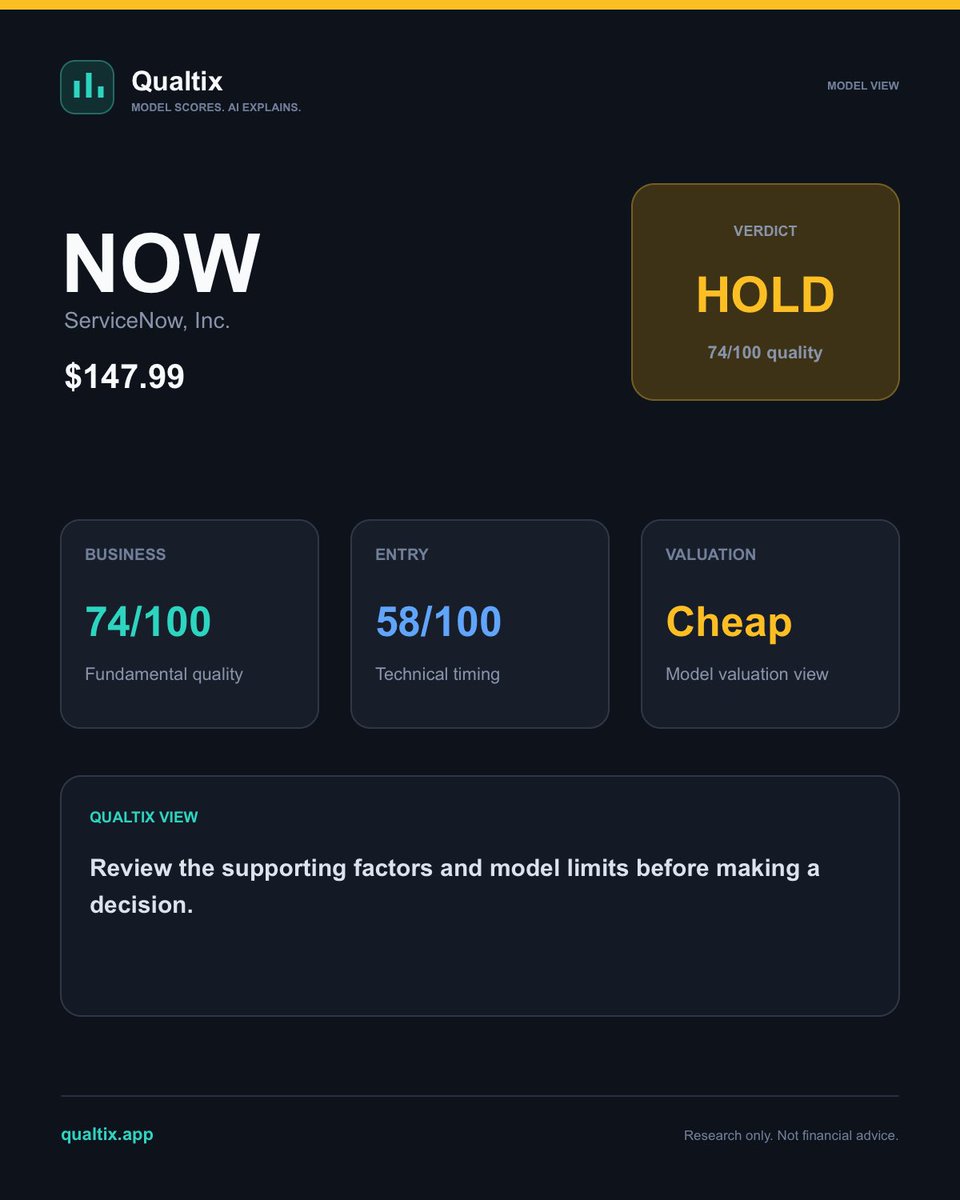
Stage 2 definitely makes $NOW more interesting, but I still like the business more than the entry here.
Qualtix has it at:
Business 74
Entry 44
Valuation Attractive
The fundamentals are still solid: 22.5% 3Y revenue CAGR and 31% FCF margin.
But after a +25.6% 3M move, $NOW is already ~21% above its 50-day MA.
So for me, the reversal is real. The question now is whether it can hold this breakout without giving back too much of the move.
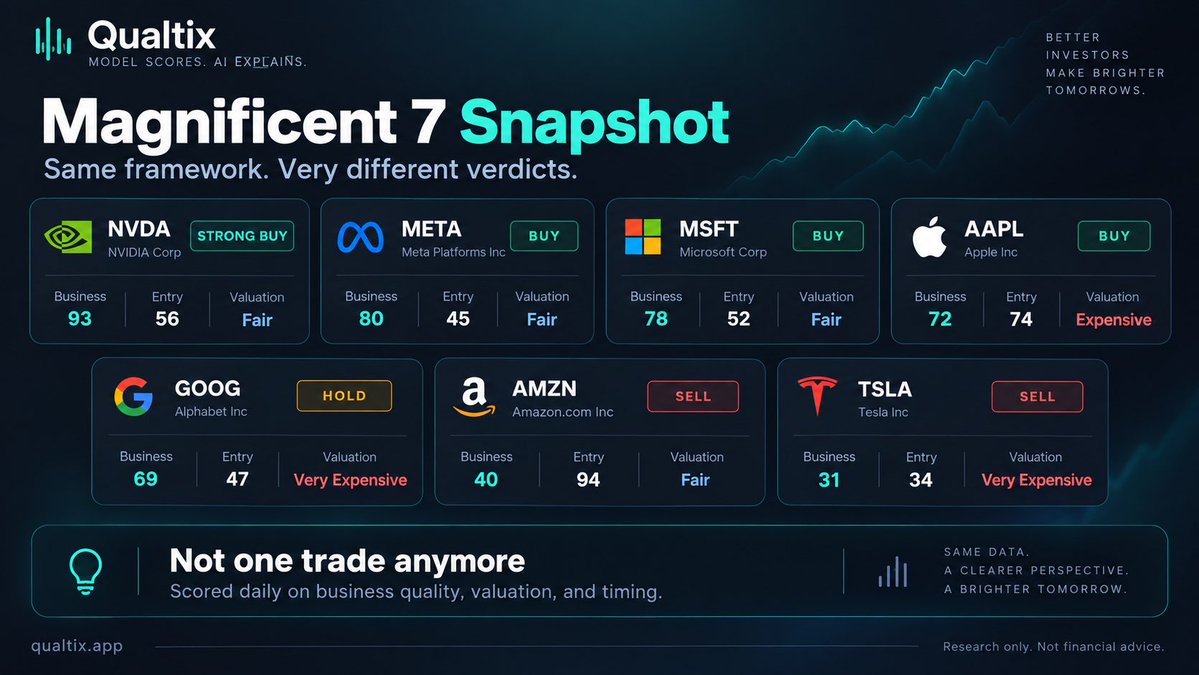
The Magnificent 7 are not one trade anymore.
$NVDA - Strong Buy
$META - Buy
$MSFT - Buy
$AAPL - Buy
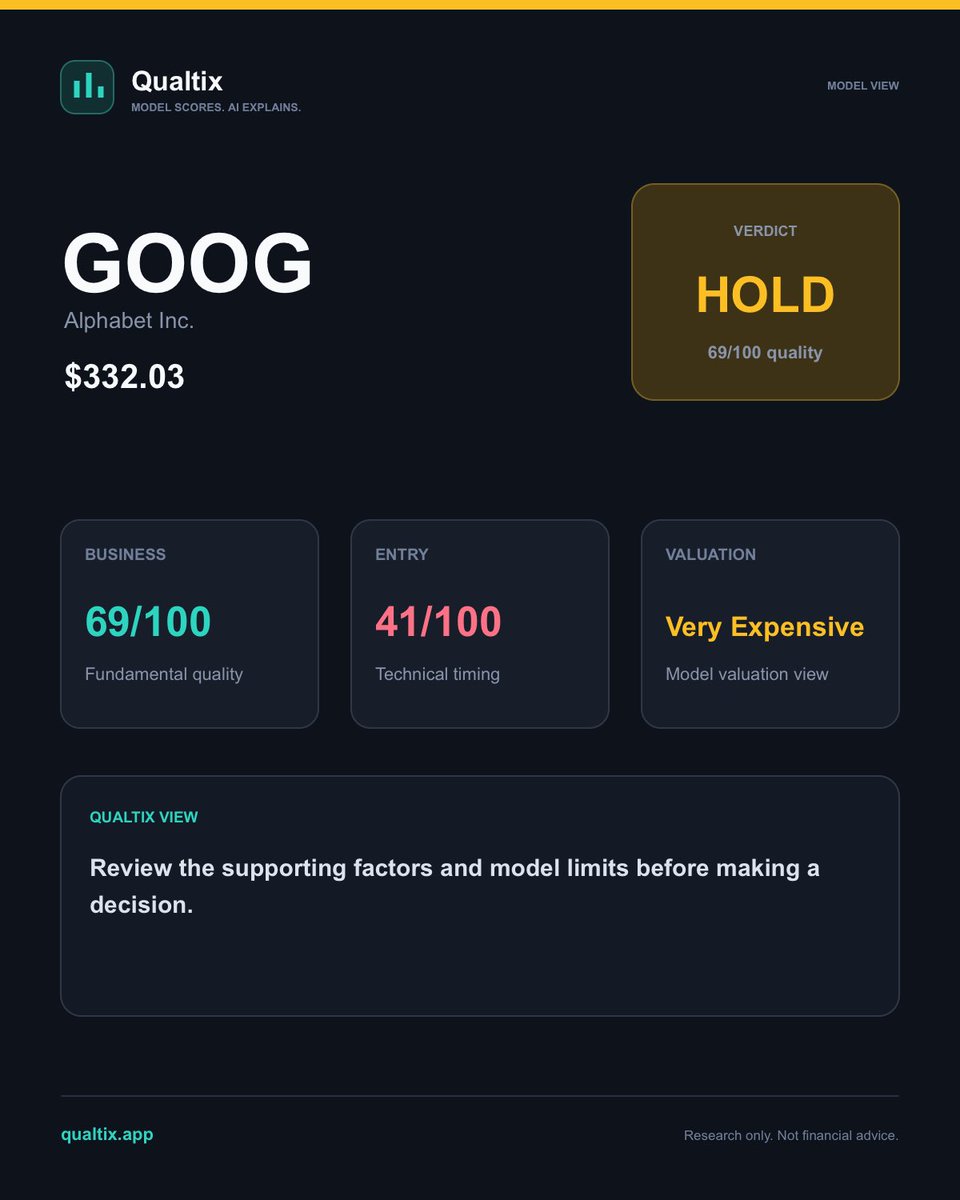
$GOOG - Hold
$AMZN - Sell
$TSLA - Sell
Same rules for all 7: business quality, valuation and entry timing.
The biggest surprise to me is $AMZN - great entry setup, but the business score still isn’t strong enough.
Which rating do you disagree with most?
The Magnificent 7 are not one trade anymore.
$NVDA - Strong Buy
$META - Buy
$MSFT - Buy
$AAPL - Buy
$GOOG - Hold
$AMZN - Sell
$TSLA - Sell
Same rules for all 7: business quality, valuation and entry timing.
The biggest surprise to me is $AMZN - great entry setup, but the business score still isn’t strong enough.
Which rating do you disagree with most?
The Magnificent 7 are not one trade anymore.
$NVDA - Strong Buy
$META - Buy
$MSFT - Buy
$AAPL - Buy
$GOOG - Hold
$AMZN - Sell
$TSLA - Sell
Same rules for all 7: business quality, valuation and entry timing.
The biggest surprise to me is $AMZN - great entry setup, but the business score still isn’t strong enough.
Which rating do you disagree with most?
Yes. We already have enough on $AVGO from the earlier Qualtix snapshots, and I’d use that to make the reply more specific:
That’s exactly the tension with $AVGO.
The business is genuinely elite: ~48% operating margin, 44% FCF margin, 27% ROIC and ~36% 3Y revenue growth.
So the issue isn’t whether Broadcom is benefiting from AI. It clearly is.
The issue is how much future execution is already embedded in the price. When expectations get this high, even great numbers can produce a bad stock reaction.
I’d still want to own the business. I’d just be much more selective about the entry.
I don’t think the $META “undervalued” argument is crazy, but the reason isn’t the 364% run.
The business is still putting up ~38% operating margins, 23% ROIC and ~24% 3Y revenue growth, while valuation sits around 19x EV/EBIT.
That’s a pretty unusual mix for a mega-cap growing at this rate.
The real risk is whether the massive AI capex keeps producing incremental returns, not whether the stock has already gone up a lot.
If those returns hold, $META can still look cheap even after the run.
The index inclusion explains the immediate pop, but it doesn’t automatically make $BE cheap.
The business is growing fast, but at ~8% ROIC and a very demanding valuation, there’s still a lot that needs to go right.
S&P 500 inclusion creates forced demand.
The next leg has to come from the fundamentals.
I like $SOFI, but S&P 500 inclusion isn’t really a reward for “deserving it.” It’s about whether the business has matured enough to meet the index’s standards consistently.
The growth case is real - ~34% 3Y revenue CAGR and improving profitability - but ROIC is still only around 5%, so there’s more to prove on earnings quality and capital efficiency.
For me, getting into the S&P would be the consequence of the business getting stronger, not the thesis itself.
This is one of those drops where “oversold” alone doesn’t tell you much.
$LULU still has solid economics underneath it: ~28% ROIC, healthy margins, and the stock is now around 15% below its 50-day MA with RSI near 32.
But growth has clearly cooled, with 3Y revenue CAGR down around 8%.
So I wouldn’t frame this as “cheap = buy.” The real question is whether the market is overreacting to a temporary slowdown, or correctly repricing a business that won’t grow like it used to.
That’s what I’d want to figure out before calling the bottom.
This is the interesting part with $MU:
At $2,000 the forward multiple could still look cheap, but with memory stocks the denominator matters more than the headline P/E.
Right now the business is putting up ~66% operating margins, 55% ROIC and huge revenue growth.
So the real question isn’t “is 13x cheap?”
It’s how durable are those earnings once the memory cycle cools?
@CKCapitalxx S&P 500 inclusion is a real tailwind, but it doesn’t change the business overnight.
$BE still has ~33% 3Y revenue growth and ~20% FCF margin, but ROIC is under 8% and the valuation is very demanding.
Nice catalyst. Now the fundamentals have to catch up to the price.
Memory is breaking out, but $MU and $SNDK are very different setups right now.
$MU has the stronger business quality: 85 vs 78.
But $SNDK has the cleaner entry: 67 vs 54, plus much higher ROIC at 77% vs 55%.
So if this move keeps running, I’d rather own the better setup than just default to the bigger name.
Better business or better entry - which matters more here?
$META breaking $615 is interesting because the fundamentals still back the story.
38% operating margin, 23% ROIC and ~24% 3Y revenue growth, while valuation still looks reasonable.
The only thing I wouldn’t do is chase the candle. If $META can hold this breakout, the setup gets much more interesting.
Great business. Fair price. Now price has to prove the move.
That’s the key difference between a bad quarter and a bad setup.
$AVGO can post huge AI growth and still sell off because expectations were already extreme.
The business itself still looks excellent: 48% operating margin, 44% FCF margin and 27% ROIC.
What changed is the entry. After the drop, the stock is ~10% below its 50-day MA with RSI near 33.
So I’d frame this less as “AI disappointment” and more as expectations resetting around a very strong business.
$1T revenue is the eye-catching number, but the real question is what happens to the economics on the way there.
$GOOG already runs at ~33% operating margins with ~20% ROIC. If Cloud + AI can keep growing without capex eating the incremental returns, that $1T becomes very interesting.
If margins compress, the revenue headline matters a lot less.
For me, that’s the metric to watch.
I actually agree with the “healthy pullback” take more than the bearish one.
$NOW is still a good business with 22.5% 3Y revenue growth and a 31% FCF margin, but the stock is now ~31% above its 50-day MA with RSI at 74.
That doesn’t mean the rally is over. It just means the easy entry is probably gone.
A reset toward support without the fundamentals changing would make the setup a lot more interesting.
That $1.7M/employee number is wild, but I’d be careful calling it pure “productivity.”
For $MU, a lot of this is the cycle turning, better pricing and higher-value memory mix, not just doing more with fewer people.
What’s impressive is that the operating leverage is showing up everywhere: ~66% operating margin and 55% ROIC.
Great business momentum. The harder question now is how much of this cycle is already priced in.
I wouldn’t try to guess the first move after earnings here.
$AVGO is still a very strong business: 44% operating margin, 43% FCF margin and ~29% 3Y revenue growth.
But the setup isn’t cheap, and expectations are doing a lot of the work.
So for me the key isn’t “beat or miss.” It’s whether AI growth and guidance are strong enough to justify the premium.
Great business. Much harder earnings setup.
At almost the same forward multiple, I think $NVDA is the tougher one to pass on.
$META has the edge on gross margin, but NVDA is putting up:
65% operating margins vs 38%
74% ROIC vs 23%
and a completely different growth profile.
So the real debate isn’t 18x vs 19x earnings.
It’s whether NVDA can sustain anything close to its current earnings power.
If the answer is yes, I’m taking $NVDA here.