$571 million from legally banned users isn't a loophole, it's proof that tokenized contracts don't respect borders.
U.S. wallets led Polymarket volume across political markets despite a federal ban. Zero enforcement at the protocol layer.
QuanChain's jurisdiction oracle resolves wallet provenance at 200ms fast-path finality, compliance becomes an on-chain fact, not a terms-of-service clause.
If a chain can't enforce its own access rules in real time, is it regulated infrastructure or just a public ledger with a disclaimer?
AI didn't steal bitcoin's thunder. It exposed which infrastructure institutional capital actually trusts. QuanChain's oracle-triggered cryptographic migration completes in under 90 days, not the 3-year NIST migration cycle. Does your chain's upgrade window beat its threat window?
$70 billion in Aptos was one $3,000 server away from collapse, 89% success rate, attack cost in the hundreds.
Reactive patching is not a security model for real-world chains holding real assets.
QuanChain's oracle-triggered migration rotates cryptographic parameters before the exploit window opens, not after researchers find it.
Should "we patched it" satisfy your security bar for a production-grade chain?
Bitcoin rebounds to $63,000 after three straight green days and $4.4 billion in spot ETF outflows in June. The price action is real. The cryptographic exposure underneath it is also real.
Every satoshi on that recovery still settles on ECDSA. That has not changed. A post-quantum migration for Bitcoin requires a hard fork, broad consensus, and a signature scheme the community has not agreed on. Those are not small variables.
QuanChain's oracle-triggered migration spans 20 security levels in 90 seconds because the assumption was never that a $1T asset class would move fast enough to protect itself. It won't.
Bitcoin rebounds. Its underlying cryptographic assumptions do not self-update. The early July dip was macro noise. The ECDSA exposure is structural.
Which post-quantum signature scheme do you think a credible Bitcoin fork proposal would need to specify first, CRYSTALS-Dilithium or SPHINCS+?
Bitcoin doesn't need $1T in new capital. It needs one reason for that capital to trust it.
$697B drove 689% this cycle. Earlier cycles hit 50,000%+ on far less. QuanChain's oracle-triggered migration spans 20 security levels in 90 seconds, the settlement guarantee a $1T position actually demands.
When does quantum-resistant infrastructure become a board prerequisite?
𝗣𝗼𝘄𝗲𝗿 𝗧𝗿𝗮𝗻𝘀𝗶𝘁𝗶𝗼𝗻 𝗧𝗶𝗺𝗲𝗹𝗶𝗻𝗲
@Quan_Chain governance control transfers naturally from team to community as tokens distribute:
⬩ Launch: team holds roughly 90% voting power, community 10%
⬩ Year 1: team 60%, community 40%
⬩ Year 2: team 45%, community 55%
⬩ Year 3: team 30%, community 70%
⬩ Year 4 onward: team roughly 15%, community 85%
No governance attack is required. No contentious vote. The community reaches majority voting power around Year 3 through natural token distribution across staking rewards, ecosystem grants, and public allocation.
Supply chain security isn't a developer problem, it's a consensus layer problem. 108 malicious packages across npm, Go, and Chrome extensions in a single campaign, yet most chains have no live revocation mechanism. QuanChain's oracle-triggered migration re-anchors trust in under 200ms. If a governance vote is your incident response plan, is that production-grade?
Pure data theft just outcompeted ransomware, Kairos collected $1 million from a U.S. government entity without encrypting a single file. Backups don't help when leakage is the weapon. QuanChain's oracle-triggered controls make exfiltrated data unreadable without the originating key. What stops the next group from copying this playbook?
Nobody's modeling 4 coordinated quantum programs. They should be.
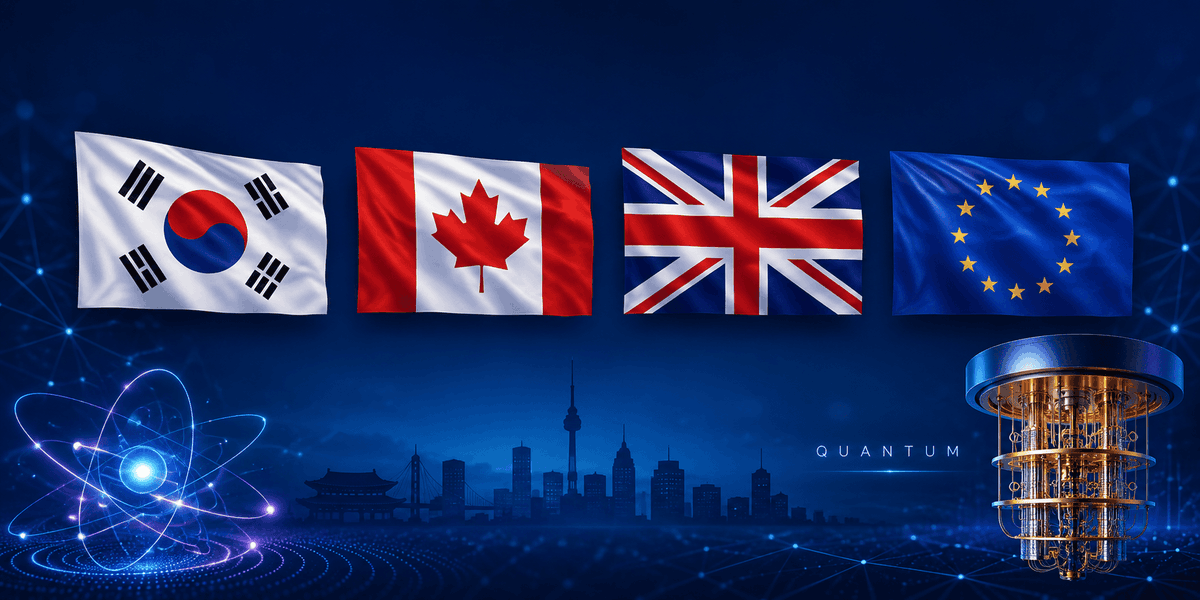
South Korea, Canada, UK, and EU formalized quantum acceleration at Quantum Korea 2026. QuanChain's oracle-triggered migration spans 20 security levels and moves first.
If your chain can't migrate in 90 days, is it production-grade?
The AI energy crisis won't be solved by GPUs. Probabilistic transistors just proved inference can run at a fraction of the cost. QuanChain's 200ms fast-path finality was designed for this compute class. Does cheap inference finally make on-chain AI economically viable?
StarkWare just published what they're calling "crypto's strongest post-quantum roadmap to date" for Starknet.
It has 3 phases.
Phase 1: Replace hash functions.
~2 months.
Phase 2: Migrate existing contracts with a new toolkit.
Phase 3: Can't happen yet because they have to wait for Ethereum to replace its own elliptic-curve cryptography first. 😬
That's not a criticism of Starknet or anything… It's genuinely one of the better-positioned chains. STARK-based proofs are already quantum-resistant.
They've thought this through.
But it illustrates exactly what "retrofitting" quantum security onto an existing chain looks like.
Even in the best case scenario, with a great engineering team & years of warning - it's still a multi-year, multi-phase migration that depends on decisions made by other protocols you don't control.
QuanChain doesn't need to have phases.
We have already prepared for this.
Falcon-1024, CRYSTALS-Dilithium & SPHINCS+ have been active on mainnet since genesis.
The address format never exposes public keys on-chain.
Automatic migration triggers are built in.
No Phase 3 waiting on someone else's decision.
That ship already sailed, before the race started.
Your hardware wallet's air gap is worthless if the firmware has 7 unpatched filesystem holes. FatFs ships inside millions of embedded devices, hardware crypto wallets included. QuanChain's oracle-triggered migration contains storage exploits in 200ms. Should cold storage require verified firmware?
𝗧𝗲𝗮𝗺 𝗩𝗲𝘀𝘁𝗶𝗻𝗴: 𝗙𝗼𝘂𝗿 𝗬𝗲𝗮𝗿 𝗔𝗹𝗶𝗴𝗻𝗺𝗲𝗻𝘁
The team allocation of 1.5 billion QUAN (15% of total supply) follows a strict vesting schedule:
⬩ Year 1: complete cliff, no tokens released
⬩ Years 2-4: linear release after cliff
This ensures long-term alignment between the team and the protocol. You cannot build a quantum-resistant blockchain and sell your allocation before it proves itself. The cliff prevents any short-term extraction.
Whales absorbed $16.7B in Bitcoin while ETFs bled a record $4B in June. That's not panic-buying, it's a 10-year infrastructure bet.
Concentrated positions at that scale are exactly the quantum-attack surface nation-states map. QuanChain's oracle-triggered migration moves custody across 20 security levels before a threat is confirmed, not after.
At what wallet size does a Bitcoin position become a nation-state quantum target?
The Clarity Act has earned its first major law enforcement endorsement.
The National Organization of Black Law Enforcement Executives backing the Digital Asset Market Clarity Act signals that regulatory infrastructure for blockchain is being built now, not later.
That is the right frame. But the Blockchain Regulatory Certainty provisions need a cryptographic annex that does not yet exist. If custody and settlement standards get codified around ECDSA, the industry will be migrating signature schemes under legal obligation in five years rather than on engineering grounds today.
NOBLE becoming the first major law enforcement body to publicly support the legislation is meaningful. Regulators and law enforcement are ready to engage with digital assets seriously. The open question is whether the technical standards that follow will be quantum-resistant by design, or whether post-quantum requirements will be retrofitted after the fact.
Which signature scheme should the Clarity Act mandate for long-term custody infrastructure?
The first all-NIST post-quantum mainnet tx (July 2) isn't the finish line, it's the starting gun.
Static algorithm stacks are safe until one standard breaks. QuanChain's oracle-triggered migration rotates cryptographic primitives live, no hard fork.
Can your chain swap its cryptography mid-flight, or is 'post-quantum' just a snapshot?
IQM Quantum Computers just became the first European quantum computing company listed on Nasdaq.
23 quantum computers installed globally. Publicly traded. Publicly funded.
The companies building the machines that will eventually break current encryption are now on the stock market.
Anyone can buy in.
Every time one of these milestones happens - IBM's 1000-qubit chip, Google's error correction paper, now IQM's IPO - the response from most blockchain projects is the same: "we're monitoring the situation."
QuanChain's answer was written in the genesis block.
Falcon-1024.
CRYSTALS-Dilithium.
SPHINCS+.
TADEQS 20-level adaptive security.
Automatic migration triggers that move your funds before you have to think about it.
The race to build quantum computers capable of breaking elliptic-curve cryptography is now publicly traded.
$QCH is not racing to catch up.
Ransomware isn't a malware problem, it's a credential handover nobody caught.
CVE-2025-5777 handed Anubis session tokens; RMM tools handled the rest. QuanChain rotates 20 security levels in <200ms, before lateral movement completes.
Is rotation speed now the real perimeter?
𝗪𝗵𝗮𝘁 𝗘𝗮𝗰𝗵 𝗣𝗿𝗼𝗽𝗼𝘀𝗮𝗹 𝗧𝘆𝗽𝗲 𝗖𝗼𝘃𝗲𝗿𝘀
Parameter proposals can modify minimum stake amounts, slashing percentages, fee distribution ratios, and block size limits. Treasury proposals govern development grants, security audit funding, and CCRP operational costs.
Upgrade proposals authorise protocol upgrades, new features, and WASM VM changes. Emergency proposals enable network pause, quantum threat response, and critical security patches
The deposit is returned if the proposal reaches quorum, regardless of outcome. This prevents frivolous submissions without penalising legitimate governance participation.