How should you use this space? Any way you like! Some ideas, tag #QuantEd and @QuantEdWomen to
- find collaborators
- share great work
- discuss interesting research
- find reviewers
- advise or ask about grant-writing
- navigate career transitions
- meet up
- offer seminars
I'm looking for a new post-doc or two, to start any time in the next 9 months or so. Causal inference, public health applications, policy evaluation, etc. Details here; spread the word! https://t.co/eYvOuVrM03
Conclusions are invalid if the statistics are wrong
Statistics don't matter if the research design is flawed (sig effects are irrelevant if groups are confounded)
Research design doesn't matter if measurement is bad (comparable groups are irrelevant if you're comparing noise)
Curious how to handle noncompliance in an RCT?
Wondering why as treated and per protocol analyses aren't valid?
Check out this great short video I worked on w/folks @NEJMEvidence!
https://t.co/FZosenYkyt
It's critical that we all read and reflect on this piece by Dr. Roberts regarding his experiences at Perspectives on Psychological Science which are a mere symptom of larger issues in the field related to racism and white supremacy: https://t.co/UB4Y9mad7R
BREAKING: In a 4-3 decision, the North Carolina Supreme Court ordered lawmakers to transfer state funds for years two and three of the Leandro plan, making way for major investments in the state's public education system. #nced
New Rosenbaum & Rubin dropped:
https://t.co/o973orgE5q
My favorite line: "The statistician who adjusts for observed covariates in an ornate and obscure way does no service, particularly if ornate obscurity erects barriers to success in the step from association to causation."
Today in our lab meeting, instead of a research presentation, we held a Q&A session, in which undergraduates could ask question of our graduate students and postdoc. (The idea to do this came from one of our undergraduates.) 1/x
Vivian Wong (@EdPolicyWorks) and Peter Steiner (@EDMSatUMD) received a new #IESfunded#NCER award to develop methods for conducting systematic replication studies to identify generalizability boundaries of intervention effects. Learn more here: https://t.co/P76qXwf68A
In a new blog, Director Mark Schneider outlines some of the strategies IES is pursuing to find out what works for students with disabilities and under what conditions. https://t.co/KtKYYso48Y
New 2-year postdoc opening in my lab starting in the fall/winter to work on method development in latent variable modeling and model fit. Application deadline is June 27, please shared with anyone who might be interested!
https://t.co/wT301wnFb7
Love this study for its focus on design:
- Thoughtful def'n of policy and non-policy states (and timing) to isolate single policy effects
- Augmented synthetic controls to adjust for diff's across states
- Lots of care in how to discuss the effects
- Lots of robustness checks
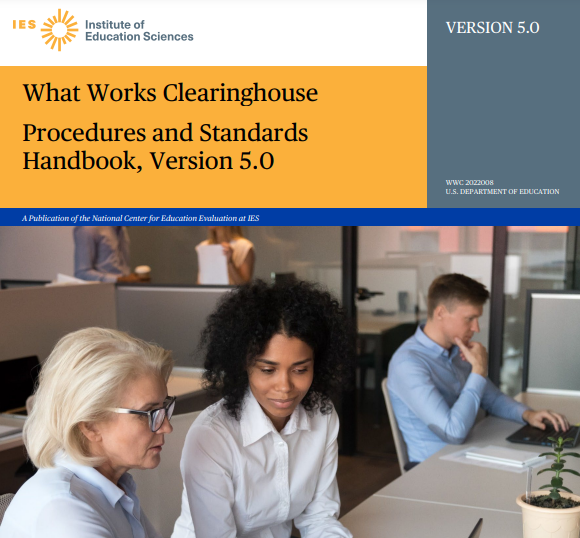
Just Released: @WhatWorksED has released version 5.0 of the WWC Procedures and Standards Handbook for public comment.
We'd love your feedback! Check out the document at:
https://t.co/QVuT0jOJdc
Curious about the basics of diff-in-diff designs for mental health services research?
Check out this new training video by @elizmstone and then join us for a twitter chat March 15 12-12:30pm EST!
@HopkinsALACRITY@JHSPH_CMAP
https://t.co/5yzNZ1CdXb
I'm hoping for this to be my first in-person conference!
Great meeting for anyone interested in causal inference, whether from econ, public health, education, ...
@sreesociety@WomenInStat@QuantEdWomen