AI risk cuts across sectors and indices, but it leaves a common footprint: exposure to rising real rates and industrial metals.
Our AI risk score: SOXX = 1, QQQ = 0.28 (28% of SOXX’s AI risk).
Last week’s big moves matched the prior day’s scores.
#AI#Macro
Underweight tech?
You may still be long the AI trade.
The S&P 500 macro exposure profile is 0.96 correlated with US semis’, at about a third of the size.
Thursday, growth lagged value by 3.1pts. Macro accounts for 1.9.
Our MXS measure separates stock calls from the macro bet.
“Are we as idiosyncratic as we think?”
The question 20+ long-only managers asked us most in 2026. For one fund, macro was 18% of active risk on an average day and 49% on stress days.
What we heard: https://t.co/jf1Whk8BQ0
#ai#stocks#portfoliomanagement#equities#longonly
Every weight in an equity portfolio is two decisions: the company, and its macro exposure. Most optimisers only see the first.
Our new guide shows how Qi MFERM brings macro into equity portfolio construction.
https://t.co/AOkYwh8qxv
A L/S equity book can have clean factor exposures and still bleed through a regime shift. The exposure
tells you the shape of the position. It doesn't tell you how sensitive that position is to the macro
environment right now. Those are different inputs, and leaves a gap.
EXCLUSIVE: Hedge fund titan Chris Rokos to leave the UK for Greece, the latest exit by one of the country’s top taxpayers and biggest names in finance. He ranked 3rd in the Sunday Times’ latest annual list of top tax payers, with a bill of £330m. https://t.co/xmy2vl4X0o
Daily attribution separates two things most PMs conflate: Returns earned because the environment cooperated. Returns earned because the stock pick was right. Buffett calls it "swimming naked at low tide." The environment eventually goes out, and you find out what you really own.
See it on your own book:
Request a Macro Factor analysis on a live equity portfolio inside @FactSet Portfolio Analytics.
Ask your @FactSet representative
#equities#portfoliomanagement
"What investors have lacked is a systematic measure of the macro environment their companies operate in."
Mahmood Noorani, CEO, Quant Insight.
Now you can identify, measure and action via @FactSet
Separating skill from luck starts with knowing what the macro environment handed you. An equity portfolio return driven by conditions isn’t alpha. Quant Insight quantifies that gap daily across 18,000+ securities.
When the environment is top-down driven, most stocks move together. That’s not diversification failing - that’s regime information.
Knowing which conditions are in control changes how you read an equity portfolio.
Most funds track what their portfolio did.
Fewer track what the macro environment made their portfolio do.
Those are different questions, and measuring both leads to better investment and risk decisions next time.
When sizing, adding, or trimming a position, one question matters:
How much of the return is the stock — and how much is the macro environment?
Quant Insight measures macro exposure daily at the individual stock level, helping separate market tailwinds from genuine alpha.
Most funds can’t tell how much of their return is real alpha.
Macro tailwinds, factor tilts, and stock-specific insight all land in the same P&L line.
Strip the macro layer out first. What’s left is the only thing worth measuring.
That’s what MFERM was built to answer.
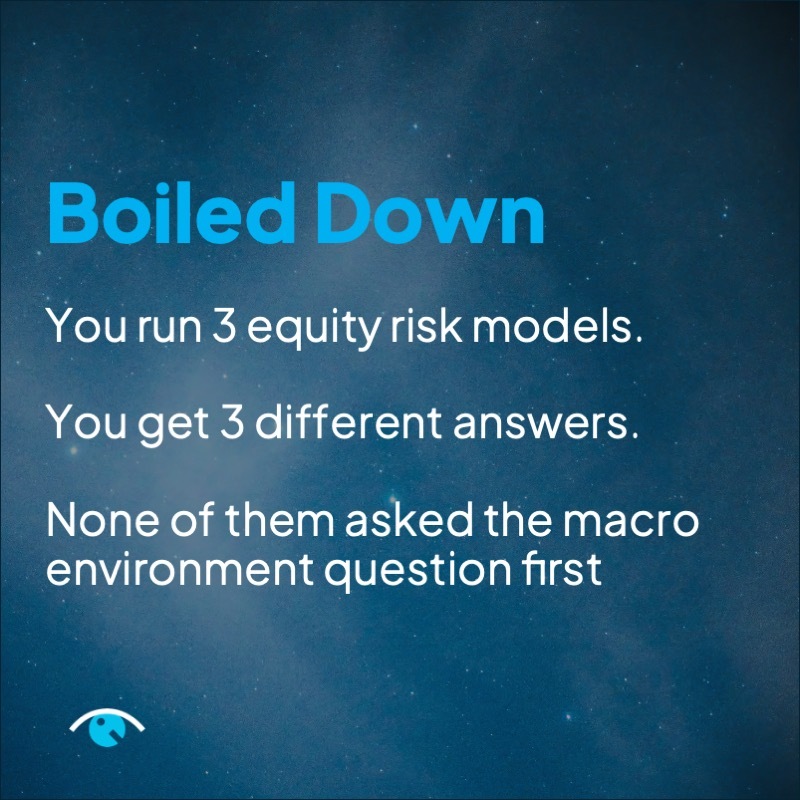
Most funds run three equity risk models and get three different answers about what’s driving returns.
The frustrating part isn’t the disagreement. It’s that none of them ask the environmental question first.
MFERM does. At the single-security level. Every day.
Conviction built on a stale read of the environment is a timing problem.
Rates move. Spreads reprice.
Quant Insight’s factor model updates daily across 18,000+ securities — so your thesis reflects where conditions actually are, not where they were.