#RSAC 2026 is a wrap. But our mission to secure the enterprise continues 🚀 🚀 🚀 .
Thank You RSAC Conference for putting together another great event 🙌 🙏 .
We are looking forward to hashtag #RSAC.
Kicking things off with our interview with @SCMagazine along with the team at @securityweekly
Be sure to tune in !!!
If you are at RSAC, visit us at Early Stage Expo #48
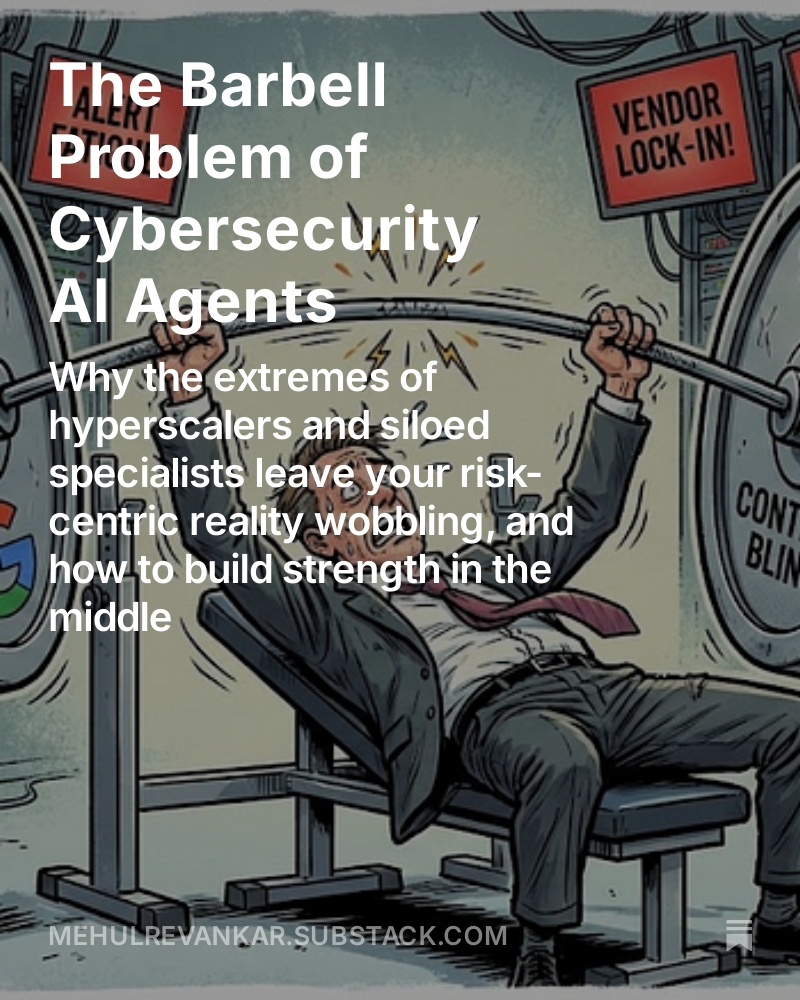
As organizations deploy the first iterations of AI agents, a distinct pattern is emerging. I call it the AI Agent Barbell Problem. 🏋
Right now, we are looking at a structural issue in the market: heavy weights on both ends, connected by a thin, fragile middle.
On one side: The Hyperscalers.
On the other: Siloed niche tools.
Both connected by a thin fragile middle.
More on my thoughts here....
https://t.co/e7UGetGLOp
McAfee Vulnerability Manager, BeyondTrust Enterprise Vulnerability Manager, and now Cisco Vulnerability Management. Another one bites the dust !!!
The history of vulnerability management (VM) is littered with vendors who tried to expand into the space, only to realize it is the "easiest-looking hard category" to crack.
Few quick thoughts why this category is so deceptively difficult to disrupt, where the incumbents are vulnerable, and why the path to scale now requires alignment with the industry's biggest players or the newest players.
https://t.co/DTLPkUcELX
“We’re investing against the thesis that basically all incumbents are going to get nuked. And everything is going to get rebuilt from scratch, just across the board.” - Marc Andreessen
A provocative statement from Marc, and one that got me thinking.
And I found myself reading Forrester's Q3, 2025 Unified Vulnerability Management (UVM) report over the weekend , and I couldn't help but wonder what happens to this category in the age of AI. Do we see an incremental change or a complete rebuild?
Here's my take.
It’s a long one, so grab a cup of coffee ☕️ and settle in. It's a fun read with a brief history into VM 😉.
https://t.co/IJKxoCaYkm
Building software with AI feels like a fundamental shift in how we build software, and maybe how we build the future. Great post by Sasan Padidar
https://t.co/oFdP5xiLJJ