As promised, here are the raw quantum bits behind $QUANTUM.
CA: AUd3rULBqpeUMUcoguBc8afg68g2hjj7SegB9AJsKCyQ
IBM job db470m84qg6s73c1o67g on ibm_marrakesh: 64 qubits, 128 shots, 8,192 bits.
How to check it:
1. Join every bit in the file into one string and take its SHA-256. You get 15f22c99b64e31521c288bbb0e98ad486e71b049c6e5916c93b7270fb34711fa, the fingerprint we posted before launch.
2. Take SHA-256("quantum-mint-seed-v1:" + those bits) as an ed25519 seed. It gives you exactly this CA.
Qubits in, address out.
The first, true quantum coin.
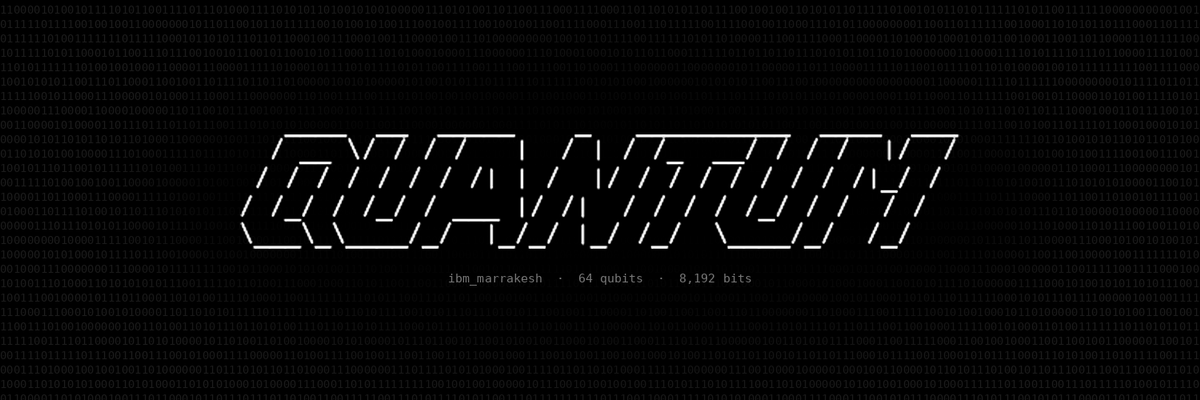
New header (:
ibm_marrakesh: the IBM quantum chip that made $QUANTUM.
64 qubits: the number measured each run.
8,192 bits: every result it gave back, and the ones that decided $QUANTUM's mint.
& the 1s and 0s in the background are the actual bits!
QuantumCoin is going to be ran as it's own, first of a kind, unique token on @solana
Posts will strictly adhere to the Quantum realm, and all things related to our token.
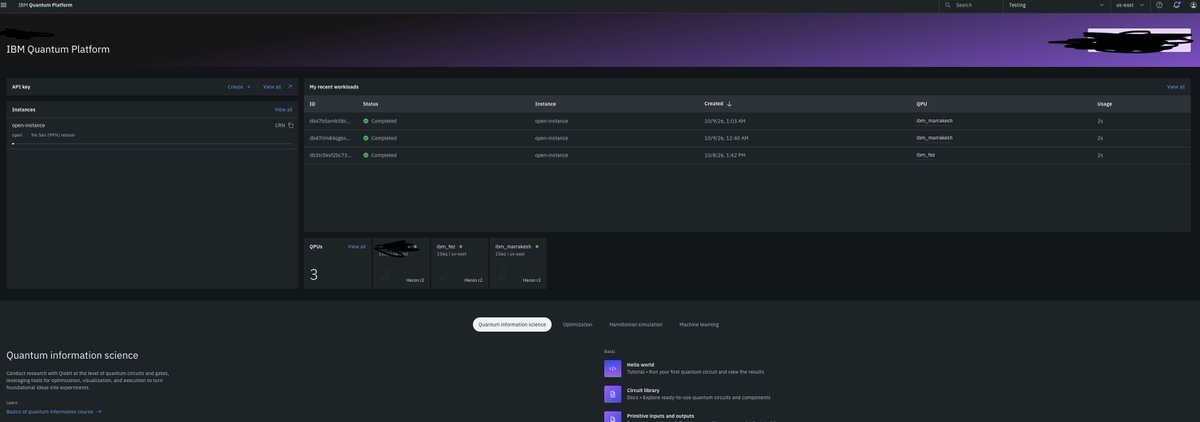
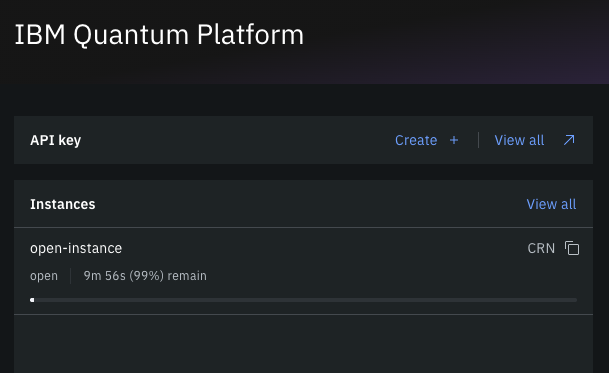
But as a one-time post, for people who may not fully understand that a token mint was created by an actual, quantum machine, we'll post the concrete screenshot below of our QC dashboard, with a link that brings you down the rabbit hole of IBM's quantum cloud, if you'd like to indulge (:
https://t.co/7qdUibAHGS
How $Quantum was made, a history lesson:
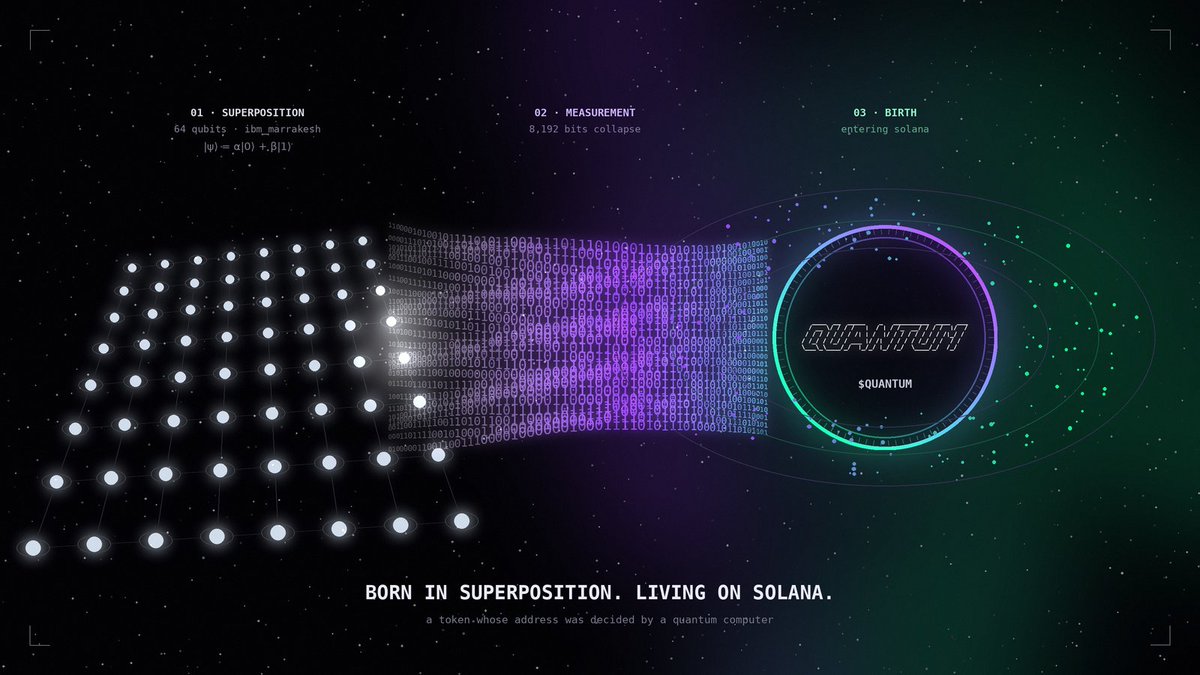
We wrote a tiny quantum program, called a circuit: 64 qubits, each sent through a Hadamard gate, which puts it in a perfect 50/50 superposition of 0 and 1.
We sent it to IBM's cloud. It waited in the queue with jobs from researchers around the world, then ran on ibm_marrakesh, a real superconducting chip kept colder than outer space.
Each qubit was measured, which forces a superposition to land on a 0 or a 1. Nothing decides which way it goes ahead of time. We ran it 128 times.
IBM sent back 8,192 bits, along with a job ID and timestamp. We hashed those bits into a key, and that key is the $Quantum address.
Data in from the universe, coin out on Solana.
Check it yourself, no trust needed.
Step 1 (anyone):
Copy the pinned bits as one line, with no spaces.
Paste them into any SHA-256 tool, like https://t.co/aAYSyugiGj
You'll get 15f22c99b64e31521c288bbb0e98ad486e71b049c6e5916c93b7270fb34711fa, the exact fingerprint we posted before launch.
Step 2 (devs):
pip install solders, then run:
python3 -c "import hashlib;from solders.keypair import Keypair;b=open('bits.txt').read().strip();print(Keypair.from_seed(hashlib.sha256(b'quantum-mint-seed-v1:'+b.encode()).digest()).pubkey())"
Out comes AUd3rULBqpeUMUcoguBc8afg68g2hjj7SegB9AJsKCyQ, the $Quantum CA.
Made possible by @IBM
As promised, here are the raw quantum bits behind $QUANTUM.
CA: AUd3rULBqpeUMUcoguBc8afg68g2hjj7SegB9AJsKCyQ
IBM job db470m84qg6s73c1o67g on ibm_marrakesh: 64 qubits, 128 shots, 8,192 bits.
How to check it:
1. Join every bit in the file into one string and take its SHA-256. You get 15f22c99b64e31521c288bbb0e98ad486e71b049c6e5916c93b7270fb34711fa, the fingerprint we posted before launch.
2. Take SHA-256("quantum-mint-seed-v1:" + those bits) as an ed25519 seed. It gives you exactly this CA.
Qubits in, address out.
The first, true quantum coin.
QuantumCoin ($Quantum) is the first coin born on a quantum computer, via @IBM
The token address and the launch wallet were both generated from randomness measured on IBM's ibm_marrakesh quantum chip, not from a normal random number generator.
CA: AUd3rULBqpeUMUcoguBc8afg68g2hjj7SegB9AJsKCyQ
Proof, locked in before launch:
CA from IBM job db470m84qg6s73c1o67g fingerprint 15f22c99b64e31521c288bbb0e98ad486e71b049c6e5916c93b7270fb34711fa
Launch wallet from IBM job db47b5amb58s7388phc0 fingerprint 35dc2e1fcde51eaee111501531201451a082d36cedf98d1cb8ac21e9c3cb1142
After launch we'll publish the raw quantum bits for the CA. Hash them and you get the fingerprint above, then derive the key and you get this exact CA.
The address came from qubits.