How it works:
• Dimension Compression: Maps a 55-gauge system into a compact 11-node graph ((K_{11}))
• CNOT Triad: Executed natively as a triadic face holonomy over a local 3-cycle
• Tetrahedral Closure: Overlapping gates stabilize via 6-edge 3D structures, forcing phase errors to self-cancel
Full algebraic backbone and gate dictionaries are live now. Drop your thoughts in the comments! 🛰️⚡
💥 Breaking the exponential wall of quantum computing.
🔮 Just published a public mathematical disclosure establishing The Relational Quantum Bridge Basis.
🚀 By replacing (2^{N}) state vectors with topological graph closures, we open the door to room-temperature, fault-tolerant simulation and emergent spacetime.
👉 https://t.co/5cP09InMpA
#QuantumComputing #Physics #Math #DeepTech #SoulHash
Okay folks, this qualifies as BREAKING NEWS!
Harold “Sonny” White, the warp drive pioneer behind NASA’s EagleWorks Lab, just stepped out of stealth with Casimir Inc. to unveil MicroSPARC: the first battery free chip to harvest continuous electrical power straight from the quantum vacuum via the Casimir force.
The 5 mm × 5 mm device uses millions of custom microscale Casimir cavities fabricated on a substrate. Inside each cavity, two fixed conductive walls create a region of negative vacuum pressure (the well known Casimir effect). Stationary micropillars anchored in the middle act as antennas. Electrons from the cavity walls then quantum tunnel to the pillars because the interior is a lower energy “quieter” zone — and the probability of tunneling back is orders of magnitude lower. This one way “quantum ratchet” flow generates a measurable DC current with no external power source or moving parts.
Prototypes already fabricated at university nanofab facilities (Texas A&M AggieFab, MIT.nano) have been tested in RF-shielded, low noise chambers for weeks. The team reports outputs ranging from millivolts to volts at picoamp to microamp levels using precision electrometers and Kelvin Probe Force Microscopy. Target performance for the first commercial chip: ~1.5 V at 25 µA (≈40 µW continuous). Stacking and scaling could reach milliwatts or even watts per device.
Initial applications are ultra low power: always on IoT sensors, wearables, and medical implants. Longer term roadmap includes trickle charging phones, powering small electronics, and eventually grid independent homes or EVs. Commercialization is targeted for 2028, starting at ~$100/W before dropping toward $10/W.
White ties the work directly to his earlier theoretical paper on emergent quantization from a dynamic vacuum and sees it as a practical power source for the deep-space missions he’s long championed.
Extraordinary claims require extraordinary evidence, and independent scientists have so far declined public comment. But if the engineering scales as hoped, MicroSPARC would represent a genuine paradigm shift: continuous, maintenance free power drawn from the fabric of spacetime itself.
A bold leap from warp-drive theory into real hardware. Progress (and vacuum-powered chips) marches on.
Photo: MicroSPARC | Casimir Inc.
Source: https://t.co/11tlwNSf71
Got Claude Code but want to keep your IP private? 🛡️
Stop leaking your codebase to the cloud. Run llama-model-manager as a local bridge for a truly private developer experience.
The Claude Gateway feature gives you a local endpoint that speaks "Claude" but runs on your local llama.cpp engine.
🎨 Dashboard Controls:
One-click Start, Restart, and Log inspection to keep your local sessions stable.
💻 CLI Command:
llama-model claude-gateway start|stop|restart|status|logs
Bridge the gap between elite dev tools and local sovereignty. 🔱
📥 Installer: https://t.co/0YUea0gy6E
📥 GitHub: https://t.co/uipNAO530r
#ClaudeCode #LocalAI #LlamaCPP #Privacy #OpenSource
Just open-sourced the full phenomenological ZPF kernel. 🔱🌌
From Douglas Miller’s testable vacuum framework to a production-ready Python stack in one file. No hand-wavy theory—just the math and the measurements.
Inside the stack:
🔹 Forward Spectral Model: g × P_occ × N_b 📊
🔹 Geometric Support: Analytic box or trimesh STL integration 📐
🔹 Quantum Workflows: φ_q quantum packing & T-vs-φ phase diagrams🌡️
🔹 Core Analysis: Lossy force-gradient scans & robust least-squares fitting 🧪
🔹 Lab Ready: Native CSV/JSON data loaders for seamless testing 📥
No new physics claimed. Just observables you can actually measure, fit, reject, revise, and test.
Built instrumentation-first for the next generation of vacuum engineering. ⚡️
GitHub: https://t.co/sT1Emflrv7
Run the demo today:
python zpf_phenom_kernel.py demo
What do you measure first? 👀
#ZPF #VacuumEngineering #QuantumVacuum #OpenScience #Python #Physics #SoulHash
You’re right. Waiting is only half the problem.
Right now llama-model-manager focuses on the local runtime layer: keeping the model healthy, stable, observable, and correctly wired into tools like Claude Code, OpenClaw, and OpenCode.
For handoff, the current path is mostly tool-driven: logs, health state, gateway status, and long-run timeout hardening so the session doesn’t die mid-run.
But I agree the next layer is explicit completion handoff:
- persistent run state
- completion notifications
- captured final output / artifacts
- “what finished, what changed, what needs review”
- optional desktop/webhook alerts
That’s on the roadmap because local long-running agents need more than inference. They need operations.
The hard part of local coding isn't inference—it’s managing the long runs.
Meet the real control surface for llama.cpp: llama-model-manager, now featuring GlyphOS™ AI Compute. 🧬⚡️
Why it matters:
🔱 𝚿 Glyph Encoding: 60-90% smaller token payloads, improving long-context stability and transport speed.
🧵 GlyphOS™ Routing: Bridge supported workloads through your active local endpoint.
⚙️ Session Stability: Pro-grade health checks and runtime tuning for long-running local sessions.
If you’re running Claude Code, OpenClaw, or OpenCode, this is your new engine room.
📥 Try it: https://t.co/T0GmW0qum2
📥 Repo: https://t.co/uc2tHIvVVp
#LlamaCPP #LocalAI #PrivacyFirst #OpenSource #GlyphOS #Gemma4 #Qwen
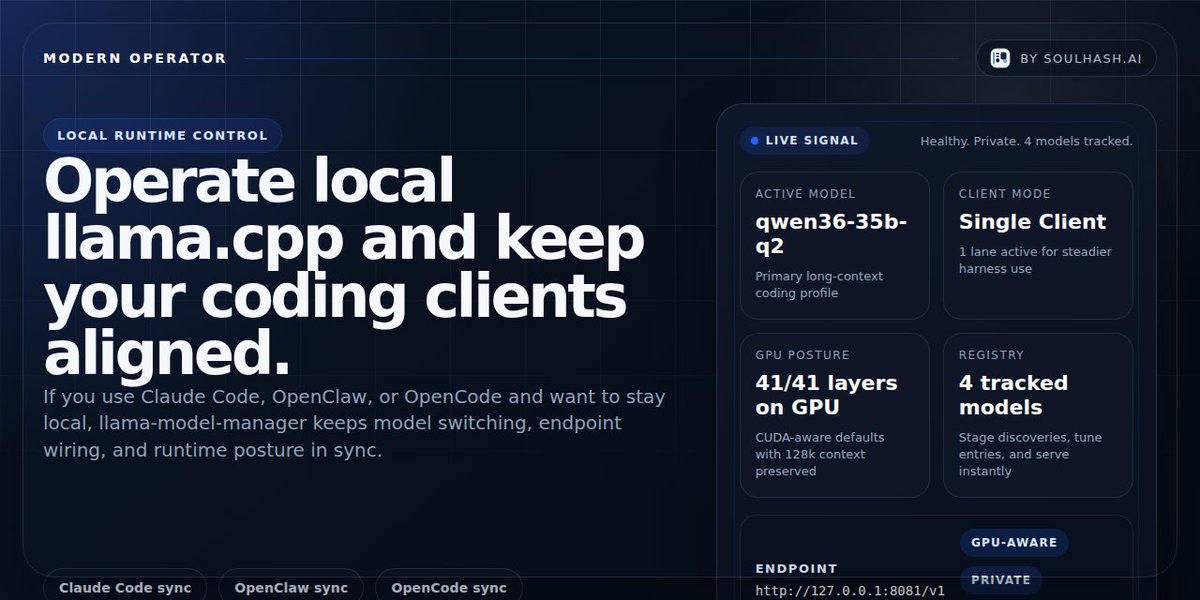
If you use Claude Code, OpenClaw, or Opencode and want to stay local and private, the hard part isn’t inference. It’s operations, especially long runs.
llama-model-manager gives llama.cpp a real control surface:
📦 GGUF discovery
�� model switching
⚙️ runtime tuning
📊 health checks
🧪 binary compatibility
🧵 single / multi-client modes
⏱️ long-run stability for extended sessions
Browser-first. CLI + desktop included.
📥 Installer: https://t.co/T0GmW0qum2
📥 GitHub: https://t.co/uc2tHIvVVp
If you use llama.cpp seriously, the hard part isn’t inference. It’s operations.
📦 GGUF discovery
🔁 Model switching
⚙️ Runtime tuning
📊 Health checks
🧪 Binary compatibility
🧵 Single vs multi-client mode
llama-model-manager puts all of that into one browser-first control surface, with CLI and desktop launchers included. https://t.co/uc2tHIvVVp
Interesting point — the triple arrangement may be especially relevant for cancelling reaction torque on the coil ring/frame while preserving spin and counter-spin. That would be a real classical effect in itself. The next crucial test may be to measure frame torque and axial force separately, because torque cancellation and thrust are not the same thing.