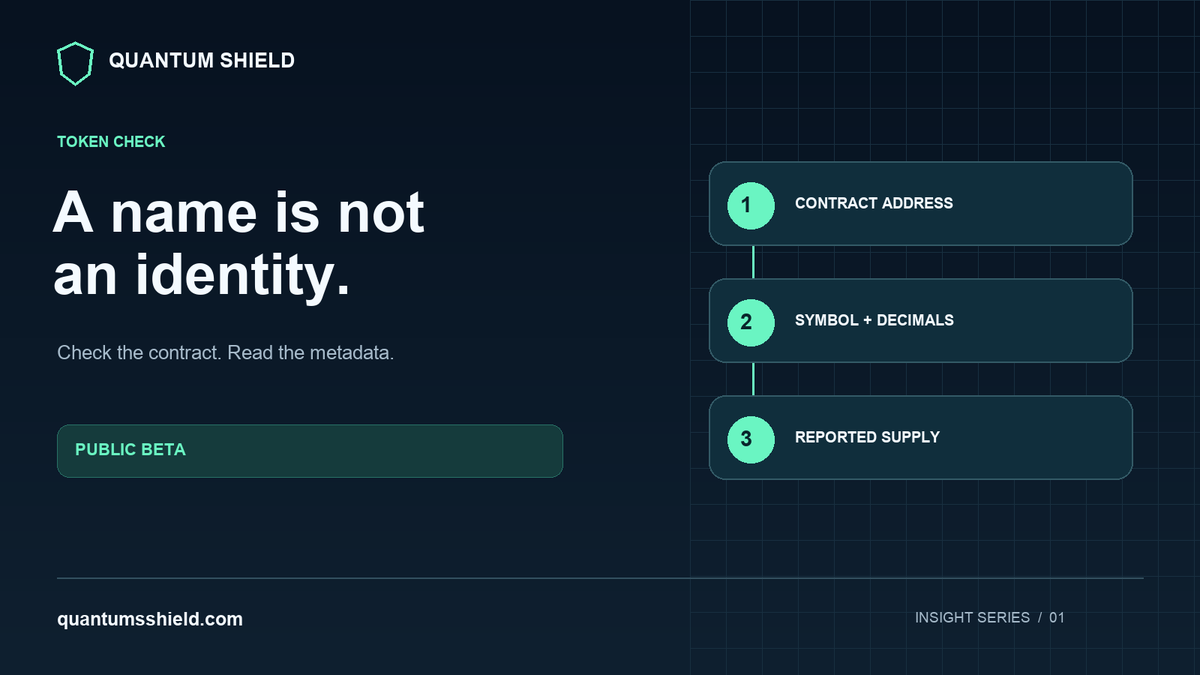
Token names can be copied. Start with the contract address.
Quantum Shield Token Check reads name, symbol, decimals and reported supply on supported networks. Metadata is not a safety verdict.
https://t.co/MuzdzEJ66e
#Web3Security#Onchain
✍️ What a post-quantum signature actually is:
Classical signatures are the maths behind every wallet. You hold a private key. It produces a public key. You sign with the private key, and anyone can check the signature against the public key without ever seeing the private one.
That one-way trick has held for forty years. It works because turning the public key back into the private key is impossible for a normal computer.
A quantum computer running Shor's algorithm reverses it. The public key becomes the private key, and the signature becomes forgeable.
Enter post-quantum signatures.
Same job, different maths. ML-DSA, the NIST standard, rests on lattice problems: finding one hidden point in a grid of hundreds of dimensions. No known quantum shortcut. The signature is larger, around 4,600 bytes against 64, and a quantum computer can't forge it.
→ On NaoX, transactions can be signed with ML-DSA-87, FIPS 204 at Security Level 5, the strongest parameter set the standard defines
→ Verified natively by the chain in around 38.5 microseconds, roughly 26,000 per second per core
→ Same wallet, same tools, no change for the developer
A signature built for the world before Q Day comes.
⚙️ Introducing Proof of Security, the NaoX consensus mechanism
Fine, the transactions are post-quantum. Who validates them?
Validators are the machines whose signatures decide a chain's history.
If their keys are classical, a quantum computer can forge them.
That's locking the vault and leaving the guards' credentials on a sticky note.
Proof of Security is built the other way round.
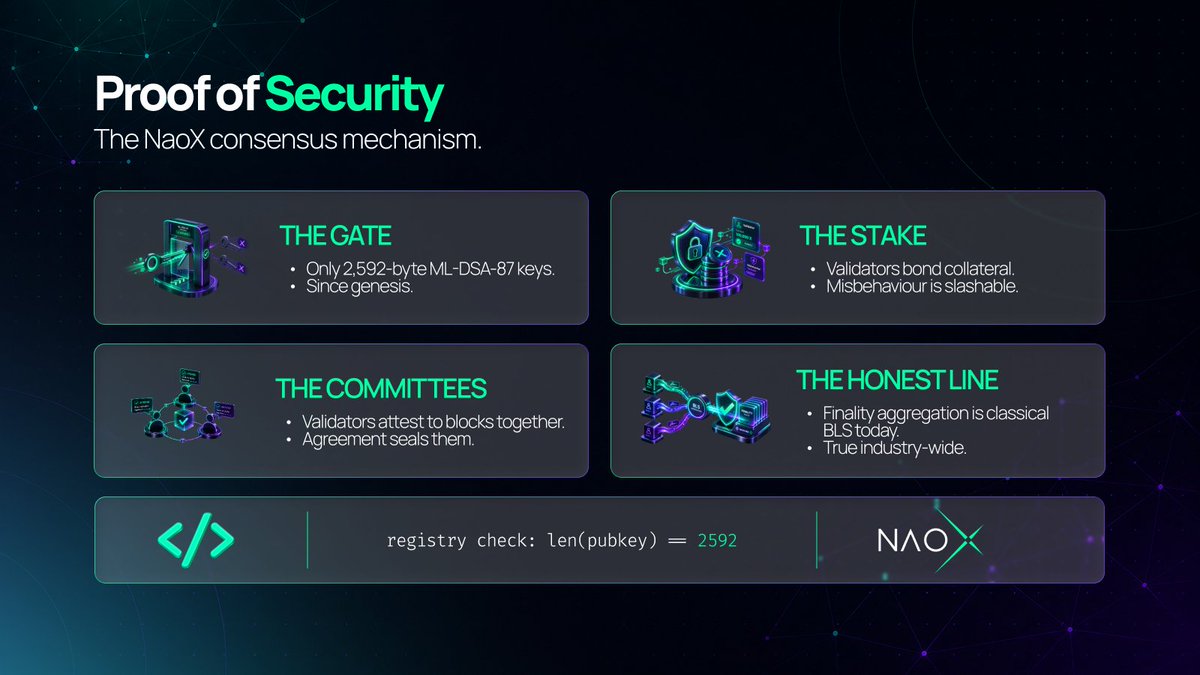
A validator cannot join without a post-quantum key. The registry accepts exactly 2,592 bytes, one ML-DSA-87 public key, and refuses everything else. In the chain's own code, since genesis.
→ The gate: only 2,592-byte ML-DSA-87 keys
→ The stake: validators bond collateral, misbehaviour is slashable
→ The committees: validators attest to blocks together
→ The honest line: finality aggregation is classical BLS today, as across all proof of stake
Commitments in blog posts can be edited. Commitments in genesis cannot.
Old keys don't age out of this consensus. They never get in 🚪
GM!
Press send on a crypto transaction, and it's protected by maths a quantum computer will break.
On a post-quantum chain like NaoX, every step that follows is different, and you'd never notice.
Here's how a post-quantum blockchain works ⬇️
Privacy x Quantum Resistant 🔐
Two of the biggest narratives in the industry right now, usually built by different teams on different chains.
@PQabelian is combining both on one chain, and Richard explains why privacy is so crucial in a post-quantum world.
Learn more 👇
20,000 physical qubits is all it will take to break Bitcoin?
According to @IonQ_Inc, yes. On 8 September it published a full technical blueprint for breaking the signature scheme almost the entire crypto industry runs on: 19,397 trapped-ion qubits, 25.7 days, one private key. Its hardware roadmap has a machine of that size in the 2028 timeframe.
Here's how far the hardware has come, largest machine by year, one qubit per seat:
→ 2019: Google's Sycamore, 53 qubits
→ 2021: IBM Eagle, 127
→ 2022: IBM Osprey, 433
→ 2023: IBM Condor, 1,121
→ 2028: the blueprint, 20,000
In March @Google put the same job at under 500,000. Twenty-five times fewer in six months, and every revision has moved the same way.
The people setting the deadlines can see the seats filling. That's what December 2029, 2030 and 2031 are: the last dates to be out of the ground before the stadium fills.
Every transaction on @NaoXprotocol has been signed with a post-quantum signature since genesis, verified natively by the protocol, at the parameter set the NSA requires for national security systems. The seats can fill whenever they like.
Drum roll please 🥁
Episode 5 of The Post-Quantum Experience is now live, with @EliBenSasson, co-founder of @StarkWareLtd and @zcash, and author of the new book Zero Knowledge, Infinite Trust.
Eli co-invented STARKs, the proofs behind Starknet. They're built on hash-based cryptography, the kind considered secure against quantum computers.
Now StarkWare is putting that head start to work. Last month it sent the first quantum-resistant transaction on Bitcoin mainnet, and it's mapping Starknet's path to post-quantum.
Hear how Eli and the team are preparing crypto for the quantum era.
Dive in 👇
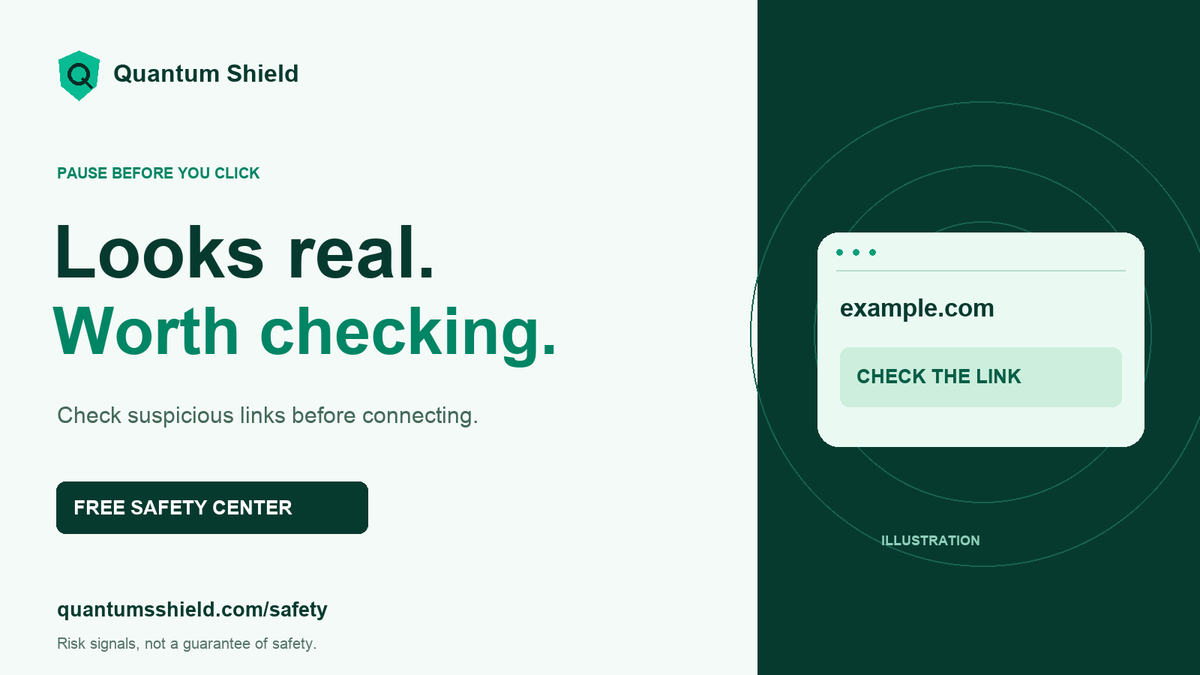
Looks real. Is it?
Check suspicious links for reported phishing and wallet-risk signals with Quantum Shield’s free Safety Center.
No wallet signature required. No scan guarantees safety.
https://t.co/WN4zBrW4S0
#Web3Security#CryptoSecurity
Your wallet. A clearer picture.
Check native balances, explore token metadata, and compare two wallets with Quantum Shield’s free tools.
Paste an address. No sign-in needed.
https://t.co/e7zr1ILvmy
#Web3#Blockchain
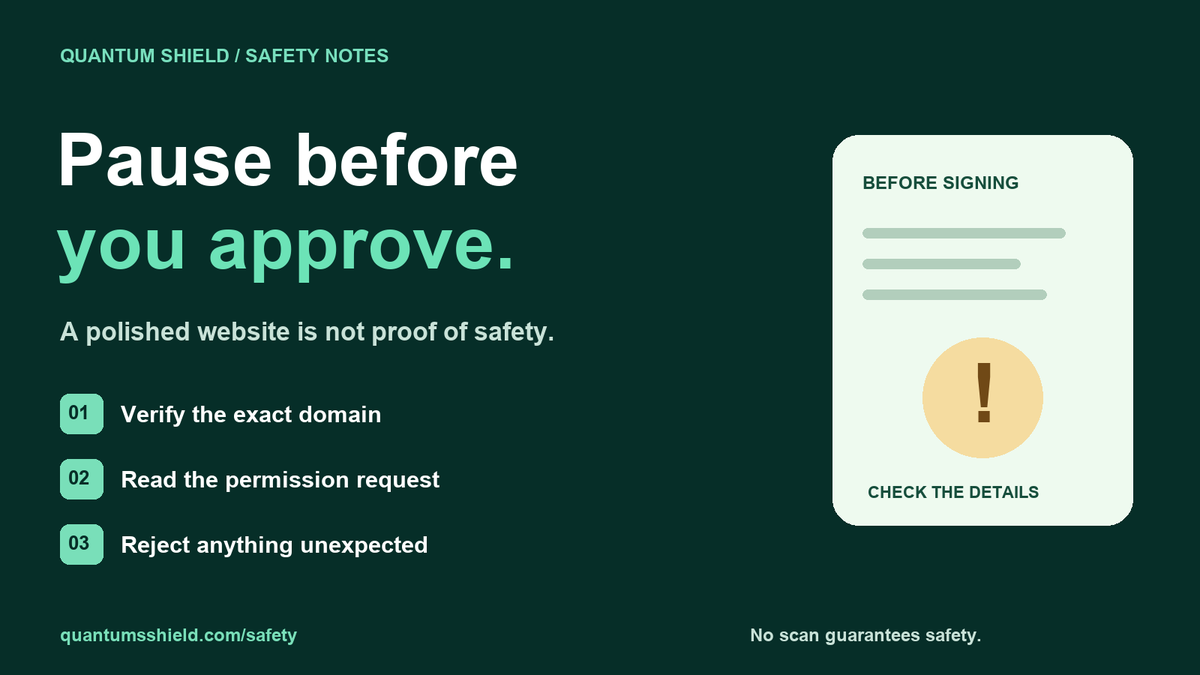
Pause before you approve.
Verify the exact domain. Read every wallet permission. Reject requests you don’t understand.
Our Safety Center offers risk signals—not a safety guarantee.
https://t.co/WN4zBrW4S0
#WalletSecurity#Web3Security
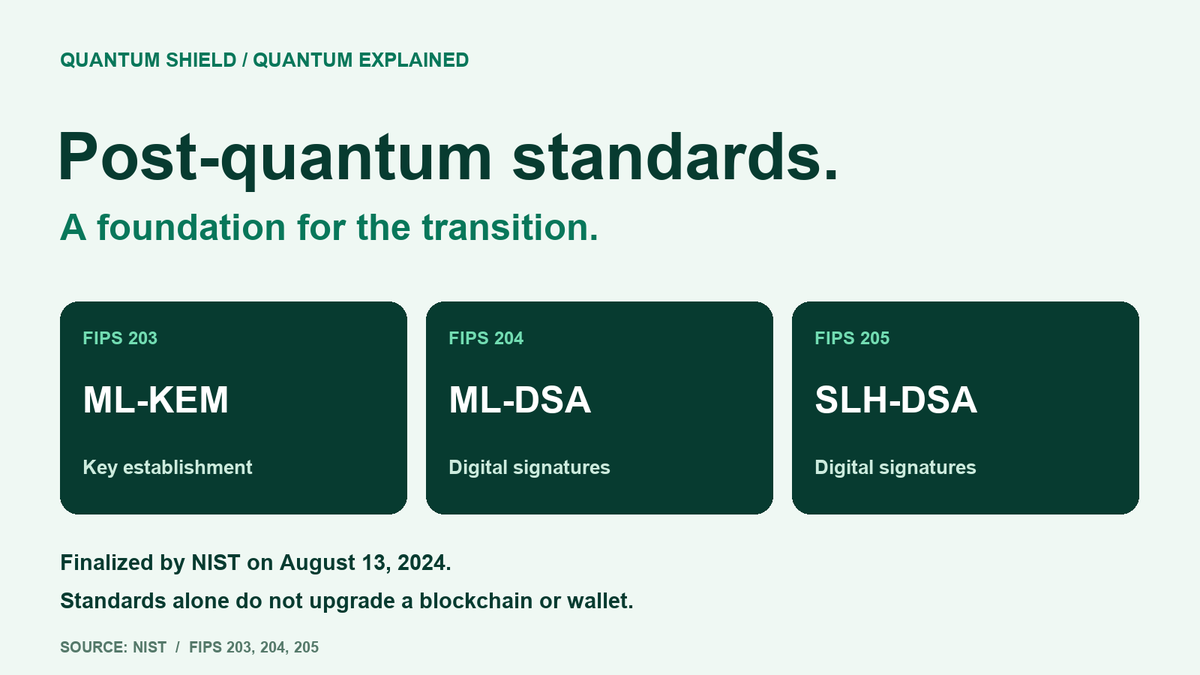
Quantum preparation starts with standards.
In August 2024, NIST finalized ML-KEM, ML-DSA and SLH-DSA. Adoption still requires implementation—wallets do not upgrade automatically.
Source: https://t.co/4EYCOjJKCF
#PostQuantum#CyberSecurity
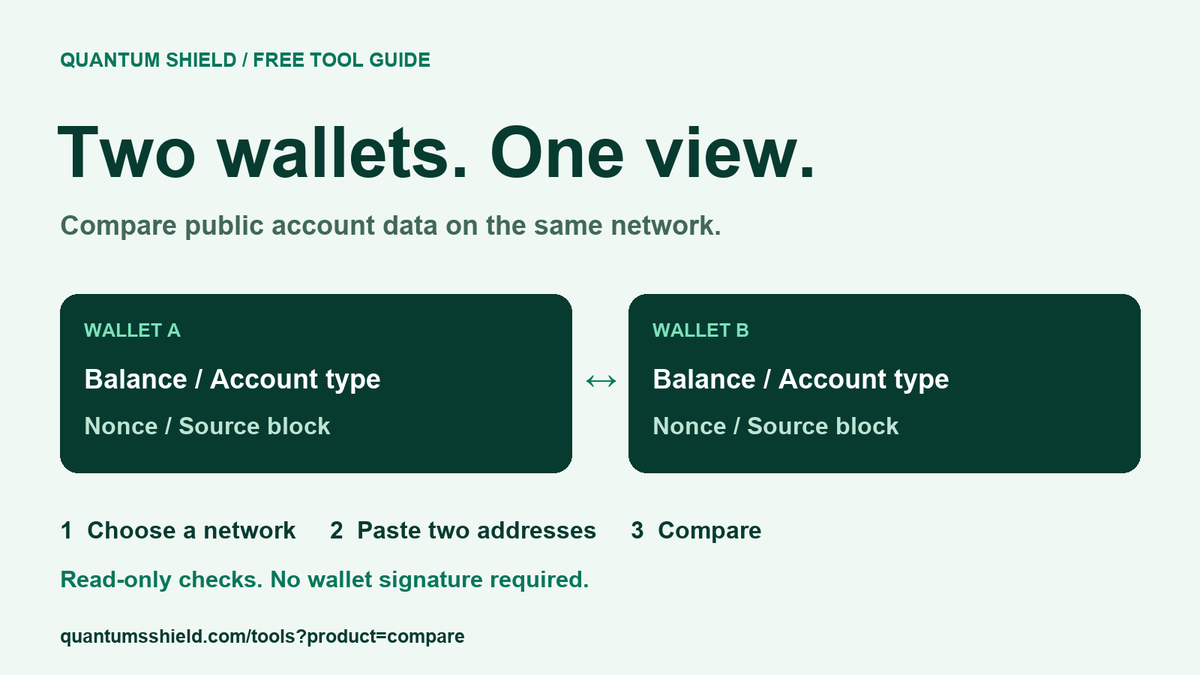
Two wallets. One view.
Choose a network, paste two public addresses, then compare native balances, account types and nonces at the same recorded block.
Free beta. No signature needed. No safety verdict.
https://t.co/I90K8q9V8k
#Web3#Onchain
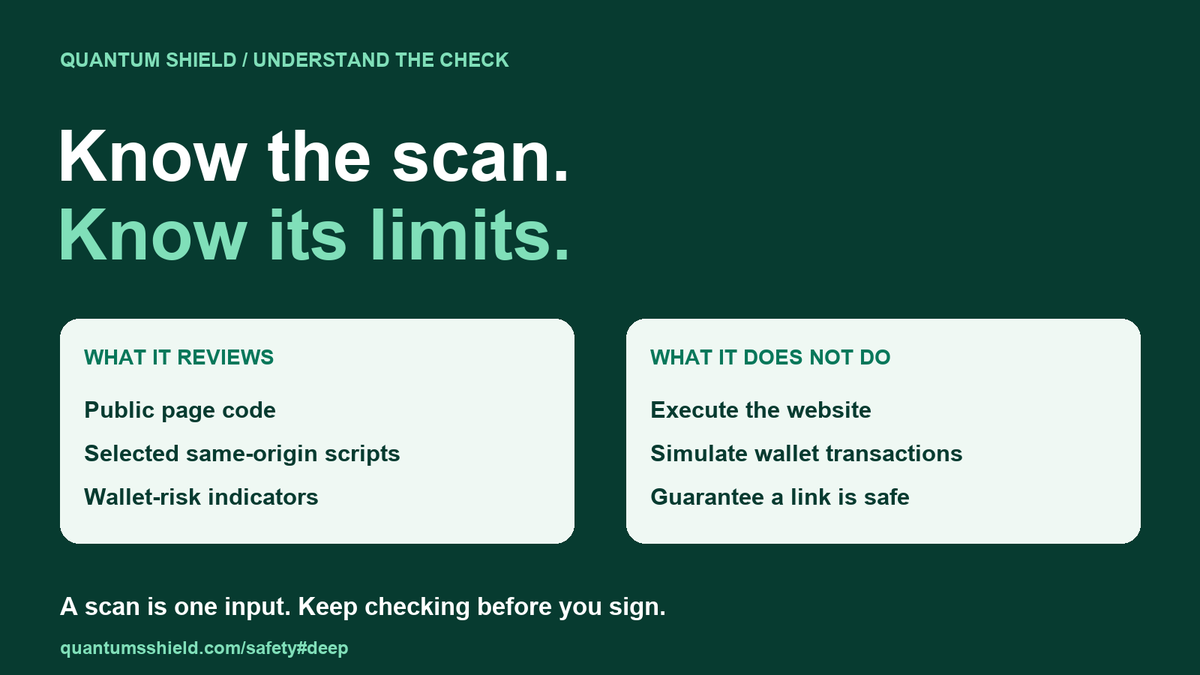
Know the scan. Know its limits.
Our website review checks public code for wallet-risk indicators. It does not execute the site or simulate transactions.
No flags ≠ guaranteed safe. Read the coverage limits.
https://t.co/4xtppzfzaR
#Web3Security
Know the scan. Know its limits.
Our website review checks public code for wallet-risk indicators. It does not execute the site or simulate transactions.
No flags ≠ guaranteed safe. Read the coverage limits.
https://t.co/4xtppzfzaR
#Web3Security
Two wallets. One view.
Choose a network, paste two public addresses, then compare native balances, account types and nonces at the same recorded block.
Free beta. No signature needed. No safety verdict.
https://t.co/I90K8q9V8k
#Web3#Onchain