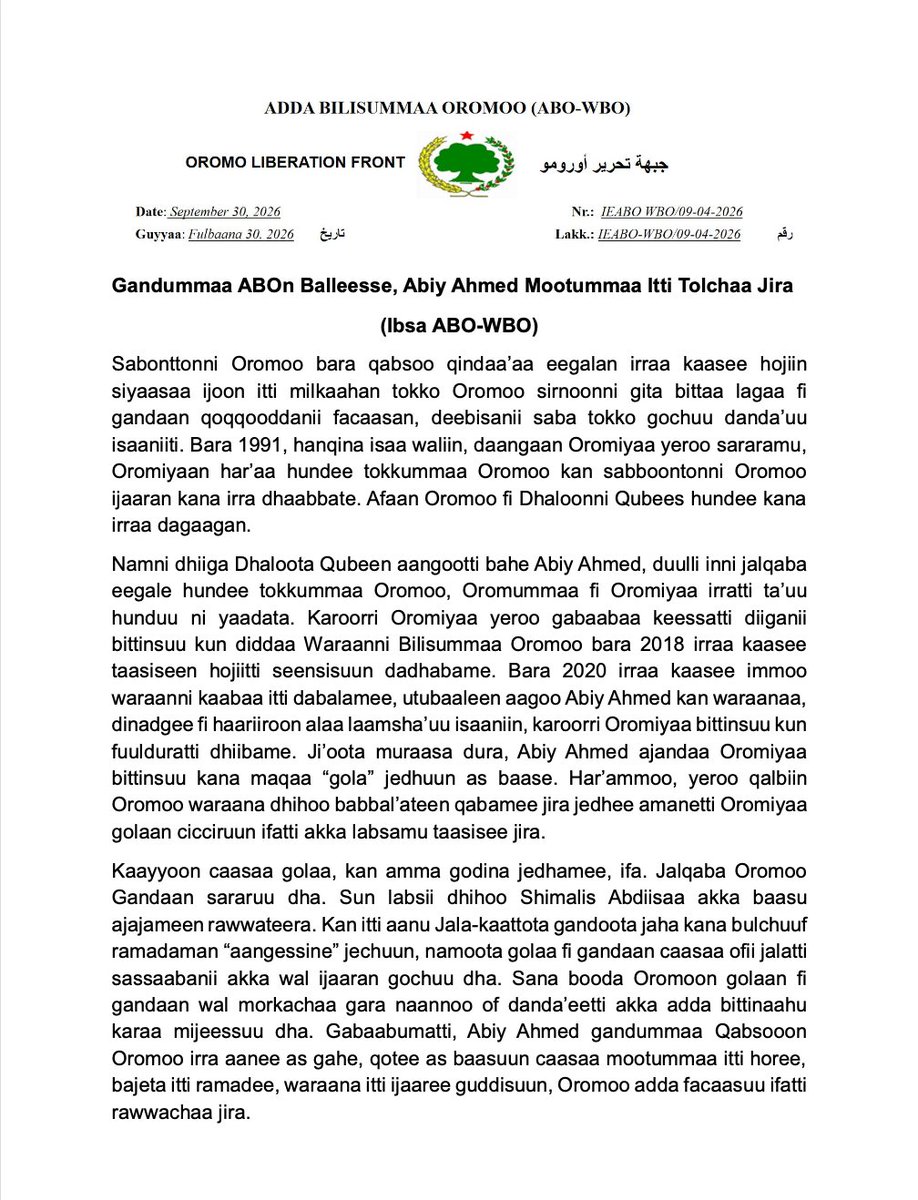
Thank you, Dr. Milkessa Gemechu, and everyone else who stood firm and showed solidarity with our people back home in Washington in the face of the atrocities committed by Fascist Abiy!
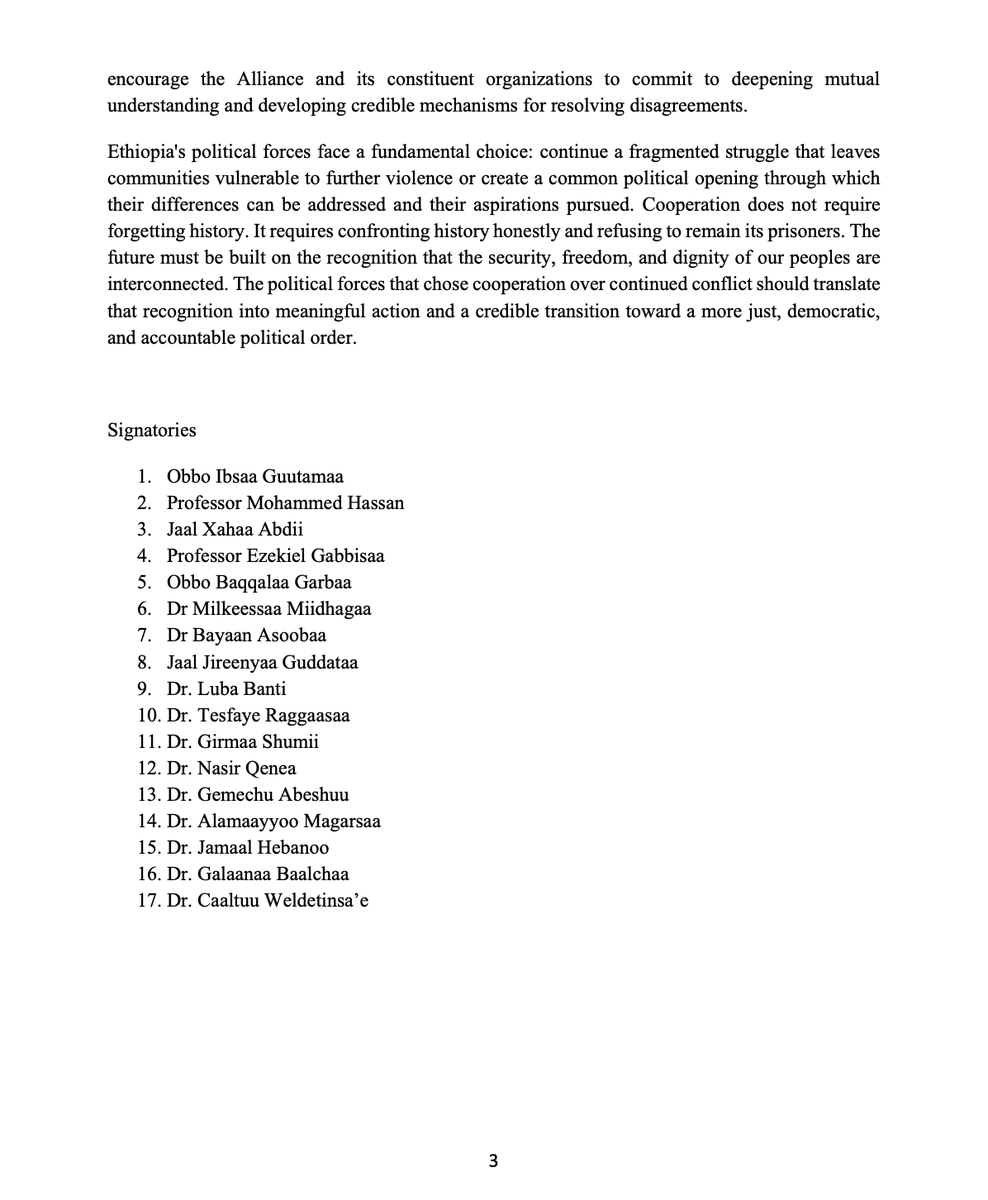
Statement by Oromo Intellectuals on Ethiopia's Political Crisis and the Need for an Inclusive Transition
We, the undersigned Oromo public intellectuals, have viewed with grave concern the deepening political crisis in Ethiopia and its devastating consequences for the country's peoples. The country remains mired in a civil war with multiple fronts, widespread violence, political instability, and an increasingly fractured political landscape. Given these circumstances, a comprehensive, inclusive, and broad-based political transition is urgently needed to avert further bloodshed and the potential disintegration of the state.
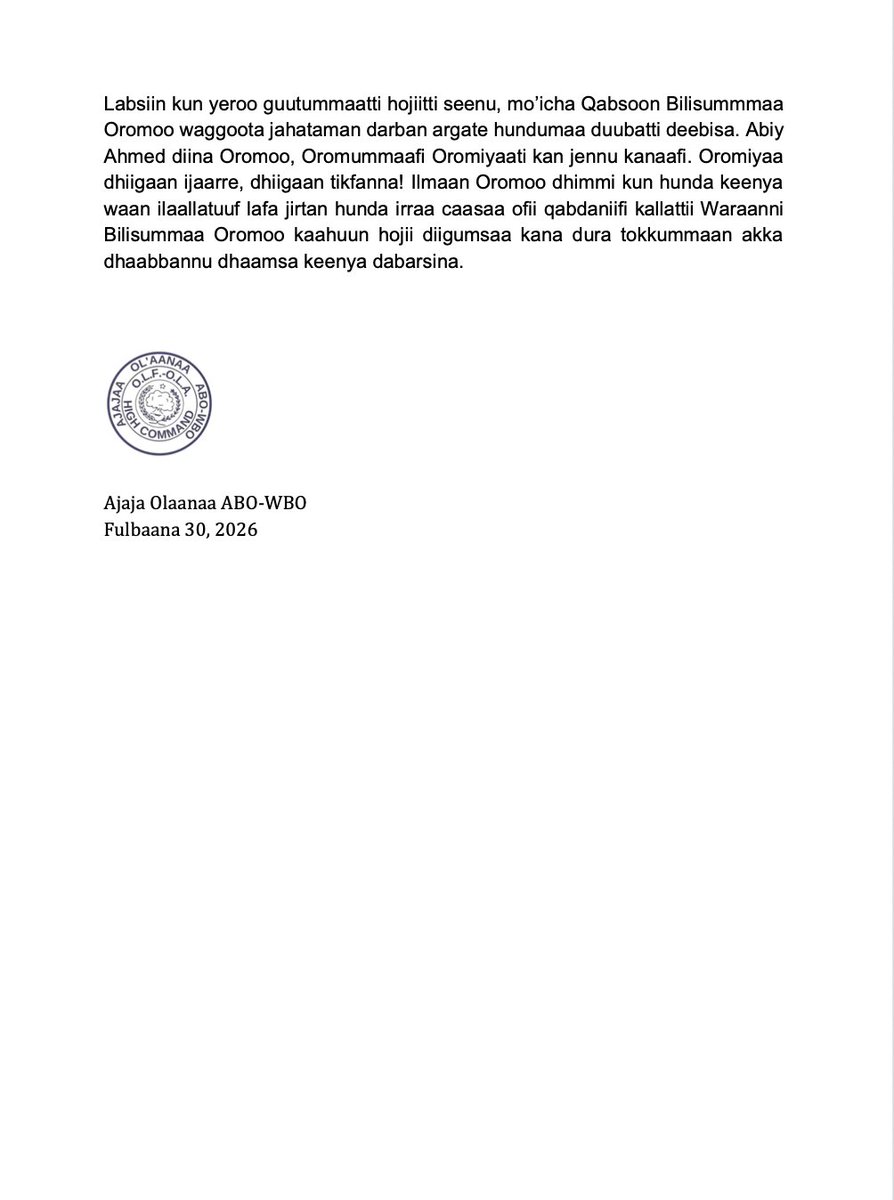
In this respect, we view the emergence of the newly formed Alliance and the Oromo Liberation Front-Oromo Liberation Army’s (OLF-OLA) participation in it as a significant first step toward finding a way out of a protracted crisis.
The crisis now engulfing the entire country began in Oromia eight years ago. The regime entered Oromia with an open declaration of genocide from the Chaffee, the regional state legislature, against the Oromo people, the social base of the Oromo Liberation Army (OLA), rather than solely against the organization itself. This intent was captured in a statement made by the head of the Oromia Prosperity Party (PP), who declared: "We do not bother to catch the fish (the OLA); we will rather drain the sea (the Oromo)." The consequences of this doctrine were severe: large numbers of Oromo civilians were killed, maimed, displaced, and subjected to horrors never before seen in Oromo history.
Similar patterns of collective punishment and militarized responses were later extended to other peoples of the country, one after another. The fragmentation of opposition forces afforded the regime an undeserved opportunity to consolidate its position and further deepen the crisis.
For far too long, Ethiopia's opposition political landscape has been characterized by cycles of violence, mutual suspicion, and division. The regime has repeatedly converted legitimate political grievances into horizontal conflicts between communities, deepening mistrust and social tensions into enduring ethnic antagonisms. The strategy shifted attention away from the central crisis of governance and made collective political solutions more difficult to achieve.
Whatever differences exist regarding the country's past and future, the peoples of Ethiopia must not be made enemies of one another while their common political grievances remain unresolved and their shared future uncertain. The struggle for justice and freedom must not become a struggle between communities. Instead, it should create conditions in which all peoples defend their rights, hold perpetrators of violence accountable, and build a political order in which no community is subjected to domination or collective punishment.
Historical grievances and political differences cannot simply be ignored. They must be acknowledged and addressed through credible political mechanisms. At the same time, they should not become insurmountable obstacles to cooperation when the country's circumstances demand a common response. Political maturity requires recognizing that a future founded on mutual respect, shared responsibility, and peaceful engagement is preferable to continued conflict, fragmentation, and mistrust.
While the crisis affects all peoples of Ethiopia, its origins and consequences in Oromia require particular attention. Oromo political aspirations and the rights of the Oromo people must remain central to any political process. Their realization, however, need not be pursued in isolation from the legitimate aspirations of other peoples. A political arrangement that protects the rights, dignity, and agency of all communities offers a more sustainable basis for addressing the country's interconnected crises.
The need for cooperation extends beyond opposing the present trajectory of violence unleashed by the Prosperity Party regime. The weakening or removal of an existing political order does not automatically produce democracy, peace, or justice. Without a credible transitional arrangement, the country risks reproducing the same patterns of exclusion, political domination, and conflict under a different configuration of power. It must also create a process by which the peoples of Ethiopia can freely determine their political future, without coercion or the imposition of predetermined outcomes.
To avoid repeating past mistakes, the upcoming transition should bring together all relevant political stakeholders, including armed and unarmed opposition groups, civil society, and representatives of Ethiopia's diverse nations and nationalities. Together, these forces can establish a credible, inclusive, and broad-based transitional process, grounded in mutual understanding, respect for distinct political identities and legitimate national aspirations, and the protection of civilians. Only such a process can address the root causes of the conflicts and lay the foundation for lasting peace, justice, democratic governance, and the right to self-determination
We also urge Oromo intellectuals, civic actors, and political stakeholders to approach the evolving political landscape with seriousness, political maturity, and a clear understanding of the historical realities confronting our people. Legitimate questions concerning emerging political alignments, their objectives, commitments, and long-term implications must be examined openly and critically. However, reflexive rejection driven by partisan interests, historical antagonisms, or political mistrust risks foreclosing opportunities for meaningful political engagement. In this regard, we encourage the Alliance and its constituent organizations to commit to deepening mutual understanding and developing credible mechanisms for resolving disagreements.
Ethiopia's political forces face a fundamental choice: continue a fragmented struggle that leaves communities vulnerable to further violence or create a common political opening through which their differences can be addressed and their aspirations pursued. Cooperation does not require forgetting history. It requires confronting history honestly and refusing to remain its prisoners. The future must be built on the recognition that the security, freedom, and dignity of our peoples are interconnected. The political forces that chose cooperation over continued conflict should translate that recognition into meaningful action and a credible transition toward a more just, democratic, and accountable political order.
Signatories
Obbo Ibsaa Guutamaa
Professor Mohammed Hassan
Jaal Xahaa Abdii
Professor Ezekiel Gabbisaa
Obbo Baqqalaa Garbaa
Dr Milkeessaa Miidhagaa
Dr Bayaan Asoobaa
Jaal Jireenyaa Guddataa
Dr. Luba Banti
Dr. Tesfaye Raggaasaa
Dr. Girmaa Shumii
Dr. Nasir Qenea
Dr. Gemechu Abeshuu
Dr. Alamaayyoo Magarsaa
Dr. Jamaal Hebanoo
Dr. Galaanaa Baalchaa
Dr. Caaltuu Weldetinsa’e
#Oromia #Ethiopia
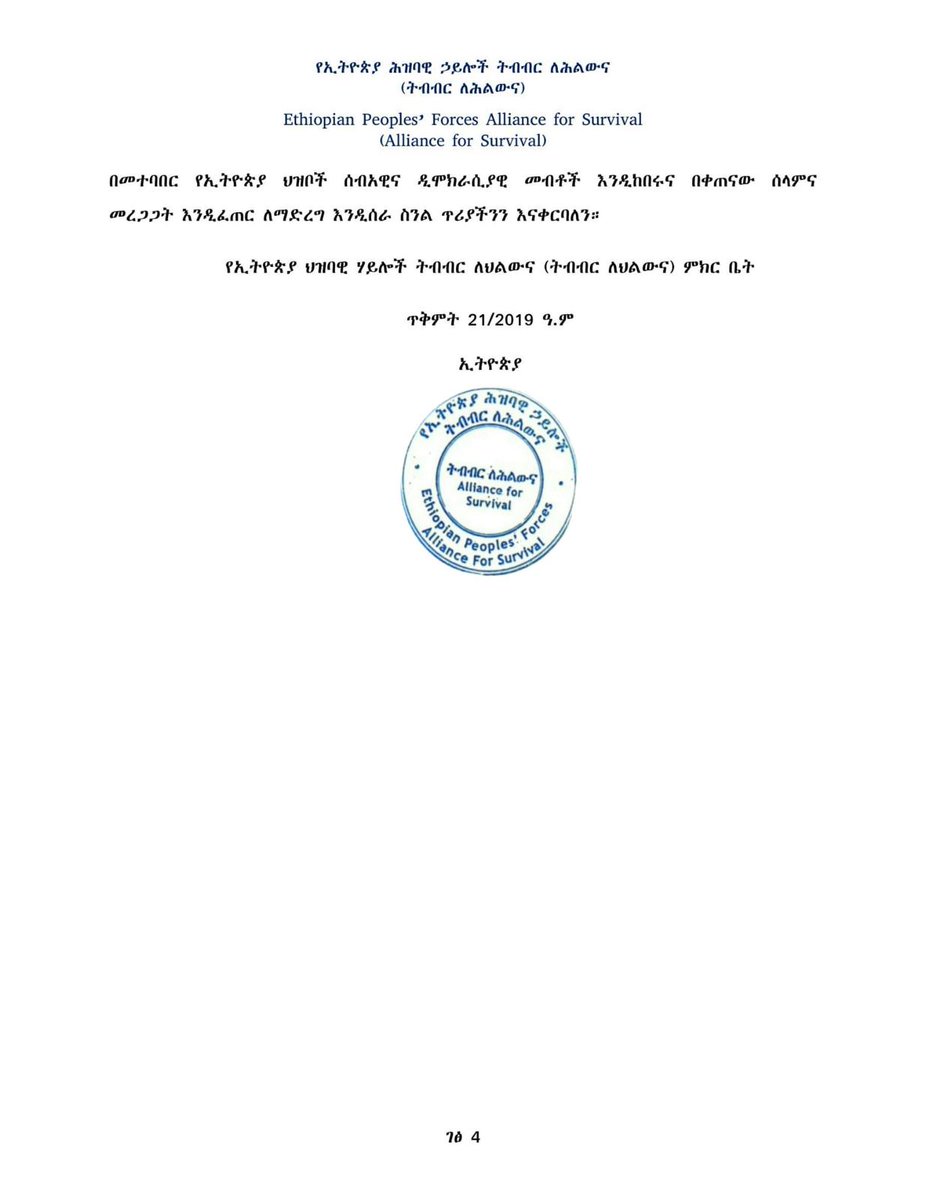
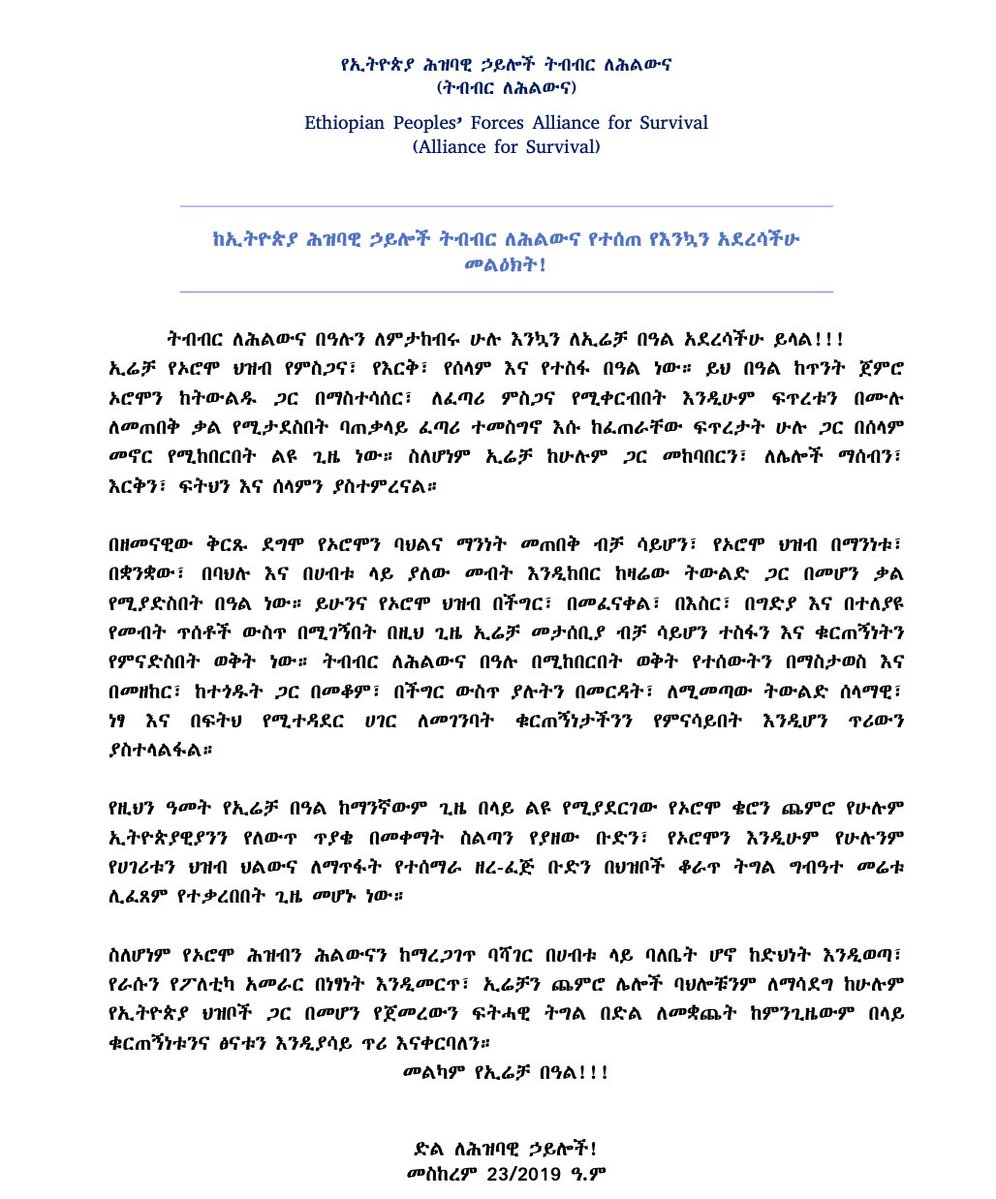
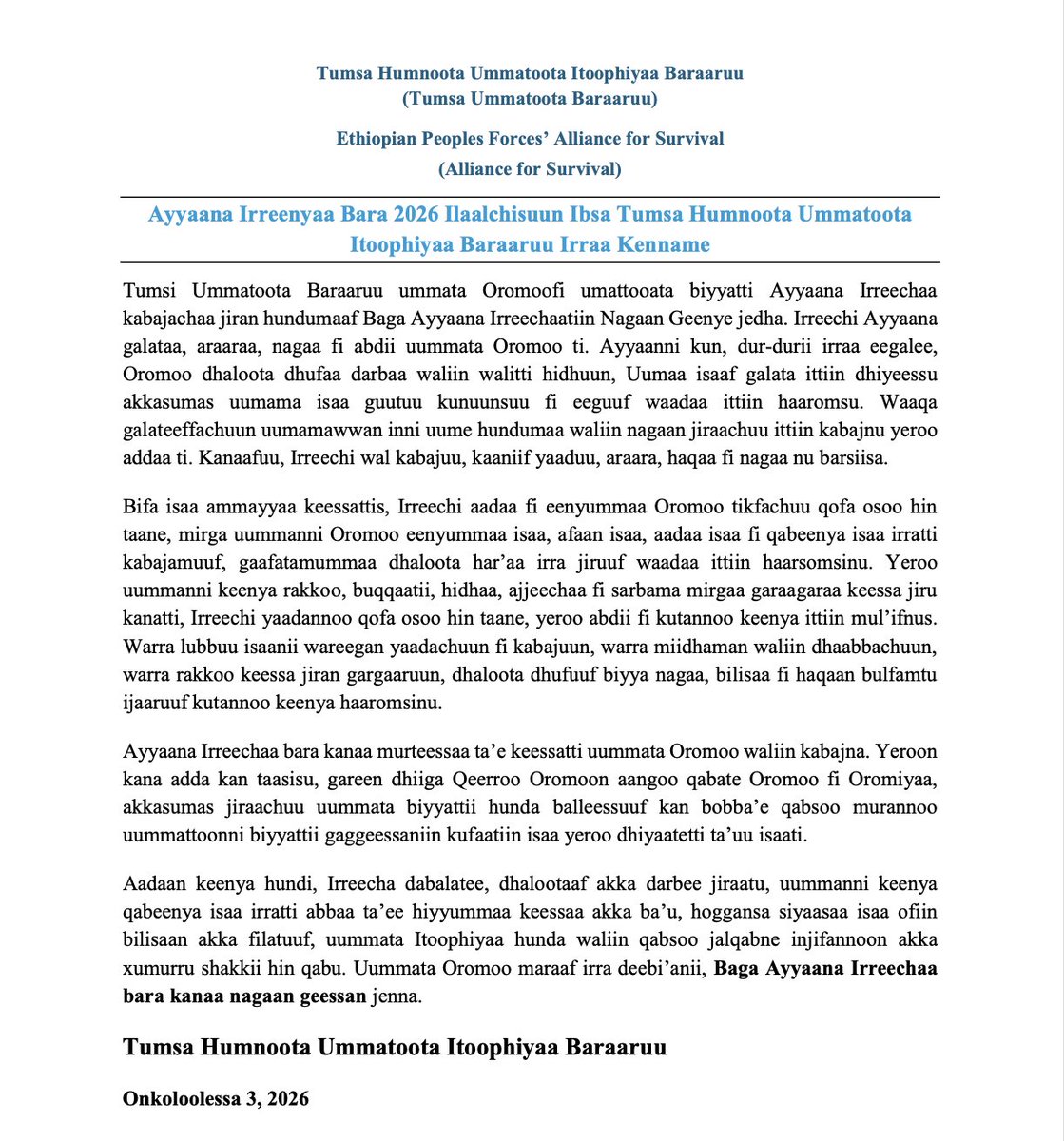
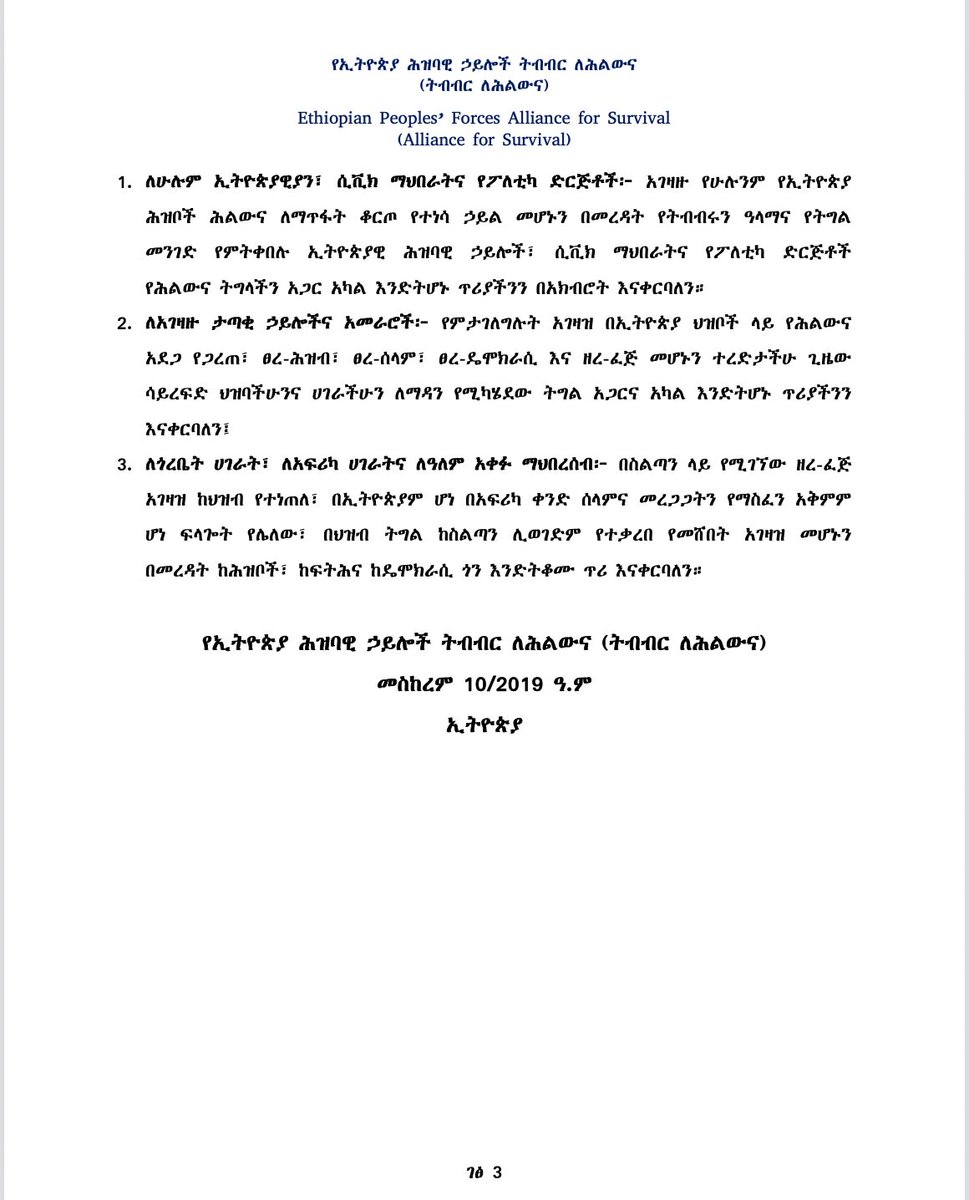
Statement issued by the Ethiopian Peoples’ Forces Alliance for Survival (Alliance for Survival)
Ever since Ethiopia fell into the hands of Prosperity’s personalist, dictatorial and genocidal regime, war, genocide, mass slaughter and absolute poverty have become its defining features. It has become a country in which law and order have collapsed; millions have fallen into severe poverty and been displaced; hope for its citizens has vanished; and the government declares one destructive war after another. Dictatorial rule has been imposed upon it, and it has moved beyond state failure to face the danger of disintegration. It has also become a country pushed to the margins of regional and international political, economic and diplomatic affairs, deprived of its
voice and influence.
The regime rests on a distorted narrative and an anti-people state structure. It is at odds with reason and truth, equality and the participation of the peoples, justice and freedom, the dignity of the people and the sovereignty of the country. Because it does not pursue peaceful and constructive approaches, it has neither the will nor the capacity to halt the war consuming the
country and its peoples; bring lasting peace; guarantee citizens’ rights and freedoms; establish law and order; or end the peoples’ suffering and torment, poverty and backwardness. To achieve its sinister objectives, this dictatorial and genocidal regime has become a mercenary of foreign powers, selling out the interests of the peoples and turning the country into a subservient and dependent state.
Accordingly, we, the peoples’ forces concerned with the survival of Ethiopia’s peoples, bear the historic responsibility of overthrowing this regime, safeguarding the survival of all nations, nationalities and peoples, and opening a new chapter. The historic mission and first objective of the peoples’ forces is to defend ourselves collectively against the devastating war declared upon us; remove Prosperity’s personalist and dictatorial system, which has endangered the survival of our peoples and the security of the country; and bring about the establishment of an inclusive transitional government guided by a transitional charter. In doing so, we seek to open a new transitional chapter in which the human and democratic rights of all Ethiopians can be guaranteed in full, without diminution.
The principal objectives of the transitional period that begins after the regime’s fall will be:
1. To safeguard the survival of the peoples and the security of the country; stop all wars; guarantee human and democratic rights; maintain peace and security; stabilize the social and economic crisis; improve relations with neighboring countries; and restore the country’s regional and international standing.
2. In the interests of peace in the country and the continued survival of its peoples, to conduct an honest, trustworthy, fully inclusive and participatory popular and constitutional dialogue, through which decisive questions concerning the peoples and the
country will be resolved with the direct participation of the peoples.
Accordingly, we, the peoples’ forces listed below, have agreed to coordinate our popular and organizational capacities to remove Prosperity’s personalist, dictatorial and genocidal regime; guarantee the survival and security of our peoples; bring about the establishment of an inclusive transitional government; and open a new democratic transitional chapter. We have also agreed to resolve our differences peacefully, on the basis of the freely expressed will of our peoples, principles and a lawful order.
These forces are:
1. Amhara Fano National Movement (AFMN)
2. Oromo Liberation Army (OLF–OLA).
3. Tigray People’s Liberation Front (TPLF).
4. Ogaden National Liberation Front (ONLF).
5. Afar Revolutionary Democratic Unity Front (Ugugumo)
6. Benishangul Peoples’ Liberation Movement.
7. Gumuz Peoples’ Democratic Movement.
We have established a joint alliance called the Ethiopian Peoples’ Forces Alliance for Survival, known in short as the Alliance for Survival.
We express our profound joy at having achieved, after much effort and many difficulties, this great and decisive alliance that the Ethiopian people have eagerly awaited. On this occasion, we wish to make the following appeals:
1. To all Ethiopians, civic associations and political organizations: Recognizing that the regime is a force determined to destroy the very existence of all the peoples of Ethiopia, we respectfully call upon Ethiopian popular forces, civic associations and political organizations that accept the Alliance’s objectives and approach to struggle to become partners in our struggle for survival.
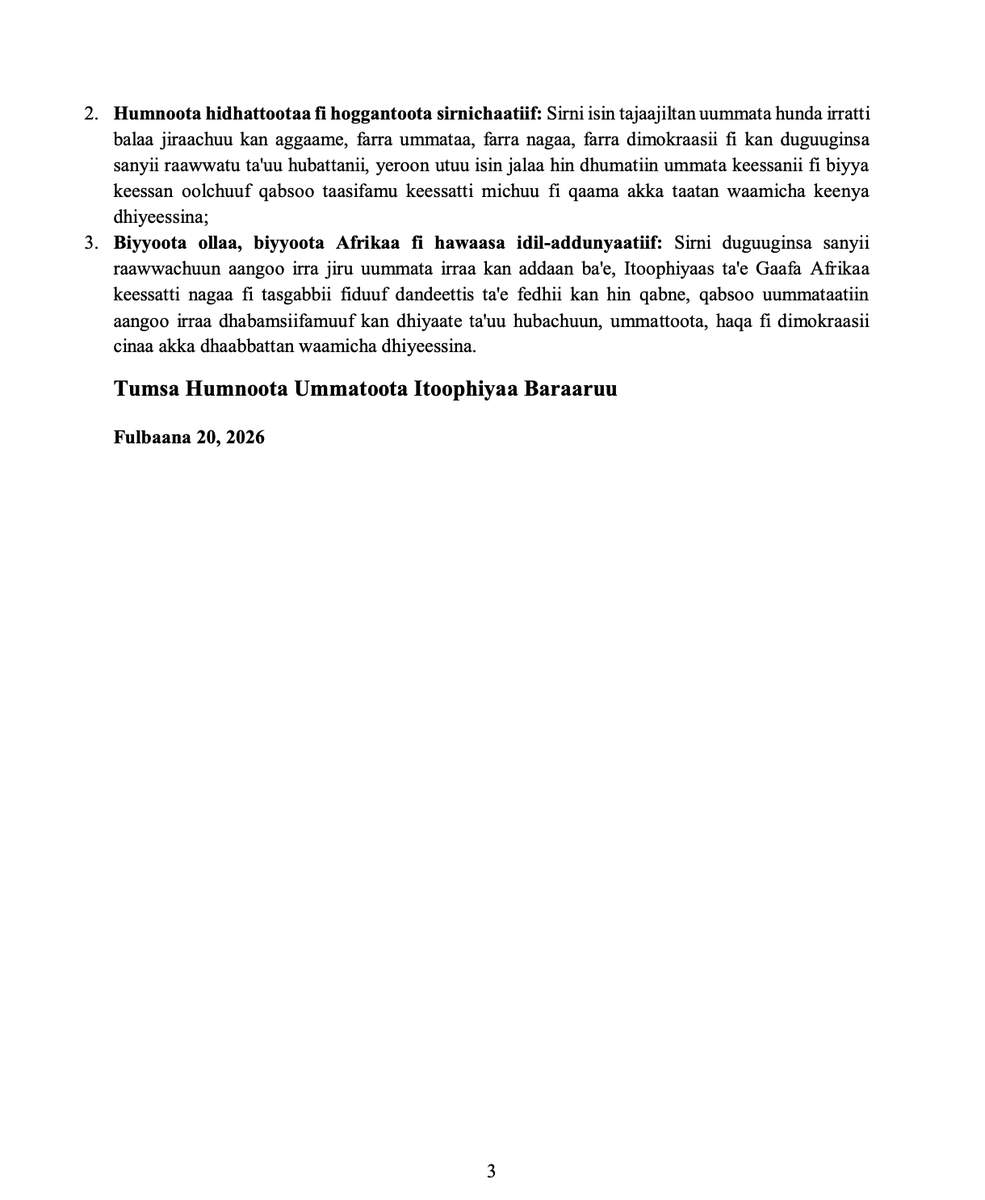
2. To the regime’s armed forces and their leadership: Recognizing that the regime you serve poses an existential threat to the peoples of Ethiopia, and that it is anti-people, anti-peace, anti-democratic and genocidal, we call upon you, before it is too late, to join and become partners in the struggle to save your people and your country.
3. To neighboring countries, African countries and the international community: Recognizing that the genocidal regime in power is alienated from the people; that it has neither the capacity nor the will to establish peace and stability in Ethiopia or the Horn of
Africa; and that it is a regime in its twilight, nearing removal from power through the people’s struggle, we call upon you to stand with the peoples, justice and democracy.
Ethiopian Peoples’ Forces Alliance for Survival
(Alliance for Survival)
#Oromia #Ethiopia
The claim that national oppression ceased to exist simply because an ethnic Oromo elite assumed state power fundamentally confuses the identity of those exercising power with the character of the political order. If having an Oromo at the top of the state instituions means the Oromo are no longer subject to national oppression, then the Oromo struggle against Meles Zenawi would have to be reduced to opposition to his being Tigrayan rather than opposition to the political system, policies, and practices of EPRDF.
The Oromo fought for emancipation from all forms of oppression. Some forms of oppression explicitly targeted Oromos as Oromos; others operated through the control and exploitation of Oromo land, resources, labour, and political institutions. Much of the cultural and political domination itself wasnt an end by itself. It served to facilitate that economic exploitation. The identity of the people occupying state offices does not, by itself, resolve any of our main questions.
Awol also makes no effort to not conflate regime with the Oromo people. Big mistake. Atrocities Abiy and co committed across Ethiopia belong only to the clique, not the Oromo.
As for the alliance, it's clearly tactical. A tactical alliance does not require strategic or ideological convergence. Former adversaries can cooperate around limited, immediate objectives while retaining fundamentally different visions of the future. The relevant question is therefore not whether the parties share a comprehensive political philosophy, but what they have actually agreed to, what they have not agreed to, and how that cooperation develops in practice.
The very not Awol-like argument and a deeper mistake here, is reducing political analysis to ethnic identity. Oromo emancipation was never simply about replacing one ethnic group of rulers with another; it was about agency, collective rights, control over resources, political freedom and accountable government. Those questions do not disappear because some of those exercising state power are Oromo.
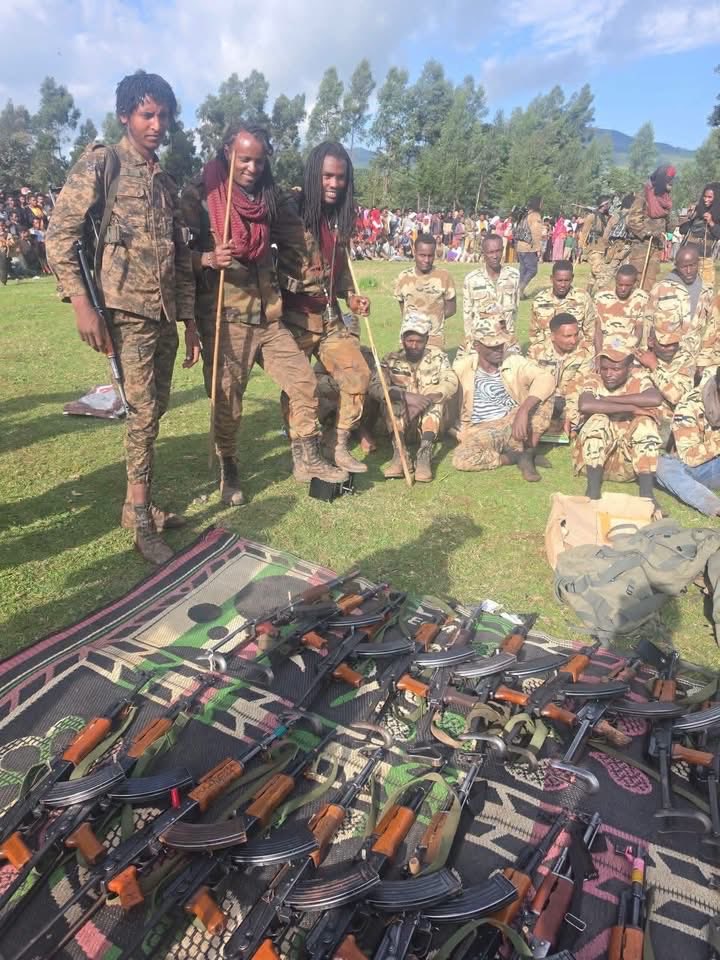
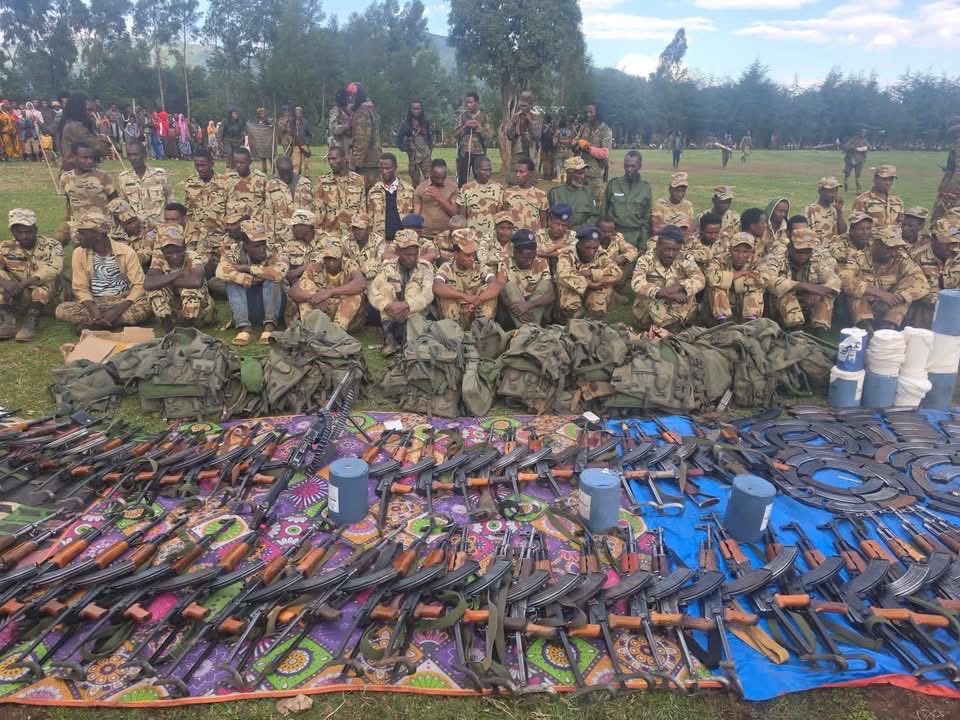
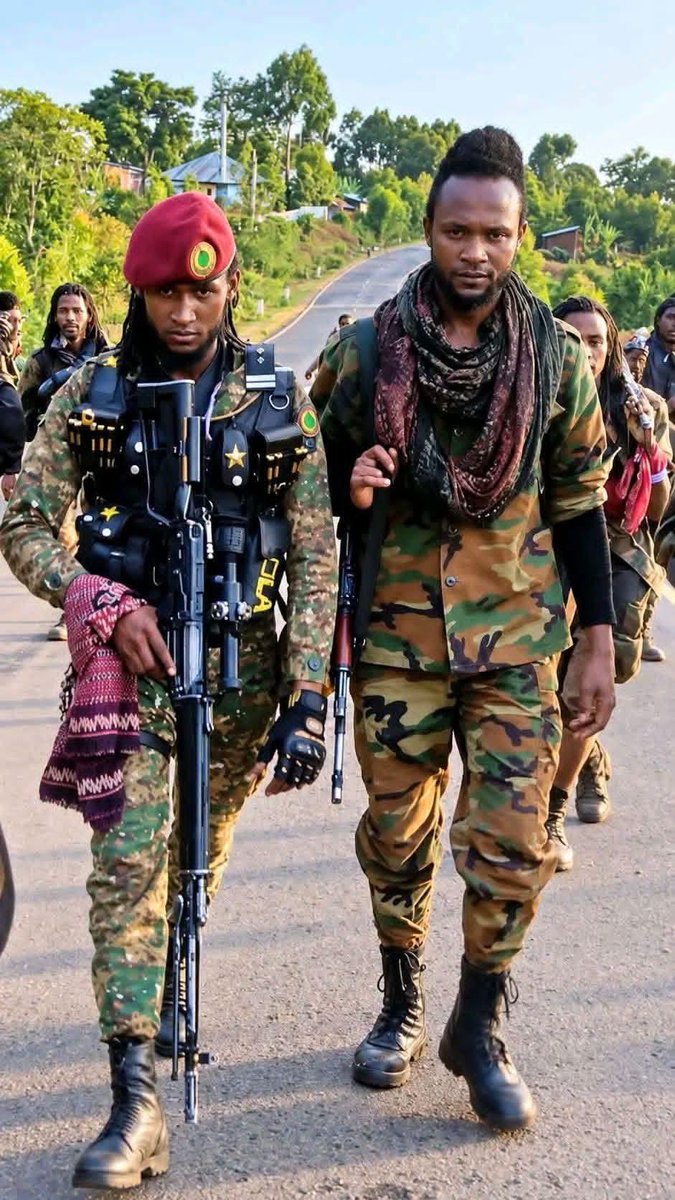
The freedom struggle is moving on. Here our outstanding General Sabaa’ai from South-Estern OLF-OLA zone 💪🏽🤜🏽🤛🏽💪🏽
#OROMIYAAN_BIYYA#OLF_OLA_IsTheFuture of #OromoNation and Sovereign Gadaa Republic of #Oromia💪🏽🦁🐅🐆🐅🦁❤️💚❤️🤗😍😍🥰🥰