"Vibe coding" quantum circuits with Qubitverse was introduced in March 2025 and now it has been updated so that in addition to circuits you can also use them within the the app to build apps using those circuits
Scaling to a million qubits with today's technology would demand the energy output of an entire nuclear reactor — so Finland is taking a different approach.
The newly funded QScale project unites Finnish research institutions to tackle one of quantum computing's most stubborn bottlenecks: scaling superconducting hardware without absurd energy costs. Their method combines ultra-fast optical telecommunications technology with superconducting circuits to generate near-perfect, noise-free electrical signals.
The key insight is elegant. Rather than brute-forcing the problem with more hardware, QScale aims to replace conventional electronic control with optical control, potentially packaging scalable chip-based solutions into compact modules that could entirely reshape low-temperature technologies.
With a three-year timeline starting September 2026 and roughly EUR 6.9 million in funding, the project also explores how optical tech can bridge quantum and classical supercomputers, carrying implications for more efficient AI computing.
The path from 1,000 qubits to one million is less about building bigger and more about building smarter. Projects like this are where that future gets engineered #QuantumComputing
Developing fault-tolerant quantum computing is one of the most capital-intensive technological pursuits in history. Reaching this defining milestone demands billions in sustained R&D investment, deep partnerships, and the patience to weather years of development.
Three realities define the current landscape.
First, the scale of commitment is accelerating. Multi-year investment plans are increasingly backed by robust organizational revenue, while governments are co-investing at the billion-dollar level to treat quantum capability as critical strategic infrastructure.
Second, hybrid architectures are the practical path forward. Rather than replacing classical computing wholesale, the most promising approach combines quantum processors with high-performance computing and AI accelerators. Navigating this transition requires targeted expertise to identify exactly where quantum algorithms add value and where classical systems remain optimal.
Third, commercial quantum computing is firmly in its infrastructure-building phase. The massive capital requirements across the sector underscore the need for realistic timelines and clear-eyed assessments of technology readiness.
The industry is progressing steadily toward transformative applications in drug discovery, materials science, and optimization, but the path to fault tolerance is measured in years, not quarters. Organizations that build quantum literacy, map relevant use cases, and design foundational quantum circuits today will be best positioned when that threshold is crossed #QuantumComputing
True randomness just got a serious upgrade.
Researchers at ETH Zurich have demonstrated a two-qubit system that generates and certifies genuinely random numbers, a distinction that matters more than it might sound.
Every conventional computer is fundamentally deterministic. The random numbers your phone or laptop produces aren't truly random, they are algorithmic approximations with subtle patterns lurking beneath the surface. For everyday use, that is fine. For encryption, it is a vulnerability. There is an entire Wikipedia page dedicated to security breaches caused by imperfect cryptographic randomness.
The new approach exploits a core feature of quantum mechanics. Two entangled qubits, held near absolute zero at opposite ends of a 30-meter tube, produce measurement outcomes that are provably unpredictable. These outcomes are not just hard to guess, but fundamentally impossible to predict, even with a quantum computer. The physical separation ensures no classical variables can quietly bias the results.
What makes this work stand out is the verification layer. A second qubit acts as a check on the first, and the team ran roughly 1.5 billion Bell tests to certify the randomness of their outputs. Previous experiments could generate quantum randomness, but certifying it at this scale and speed is new territory.
The practical relevance is immediate, not hypothetical. Current encryption standards already depend on high-quality randomness, and any weakness there is exploitable today, not just in some future post-quantum era. Whether the adversary is a classical supercomputer or an eventual quantum machine, the math of secure communication will always demand randomness you can trust.
This advance strengthens the entire foundation cryptography is built on. It is a compelling example of quantum technology delivering value well before large-scale quantum computers arrive.
#QuantumComputing
California's quantum ecosystem is hiding in plain sight. Despite being less vocal than hubs like Maryland, Chicago, or Colorado, the state may quietly hold the strongest hand in the future of the industry.
The strengths are formidable. A university network spanning UC Berkeley, UCLA, Caltech, Stanford, and others feeds a talent pipeline no other region can match. Factor in national labs like Lawrence Berkeley and NASA Ames, plus an unparalleled density of tech giants with active quantum programs operating within state lines.
Perhaps the most intriguing advantage is the AI-quantum convergence. As the global epicenter of artificial intelligence, California is uniquely positioned for the growing synergy between AI and quantum. Physical proximity between these communities will matter more as the two fields intertwine and accelerate each other.
The startup scene is deeper than most realize, with dozens of companies tracked across hardware, software, communications, sensing, and consulting. With a $4.3 trillion GDP that would rank fourth globally as an independent nation, the state also provides a massive end-user market spanning manufacturing, finance, healthcare, and aerospace.
There are realistic hurdles. The cost of doing business remains a persistent challenge, prompting some companies to keep headquarters in California while building labs out of state. European quantum firms often prefer East Coast offices for time zone alignment. Additionally, local AI dominance naturally draws some investor capital toward immediate returns over quantum's longer-horizon payoff.
Policy is beginning to catch up. A bill signed in late 2025 allocated funding for a strategic framework study expected this summer. While budget constraints mean massive quantum-specific state funding is unlikely, California will continue to leverage its robust R&D tax credits and workforce development incentives.
California's quantum ecosystem doesn't need to be the loudest to be the most consequential. The combination of elite research institutions, tech industry gravity, startup energy, and the world's largest concentration of AI talent creates a foundation that deliberate policy alone cannot manufacture elsewhere #QuantumComputing
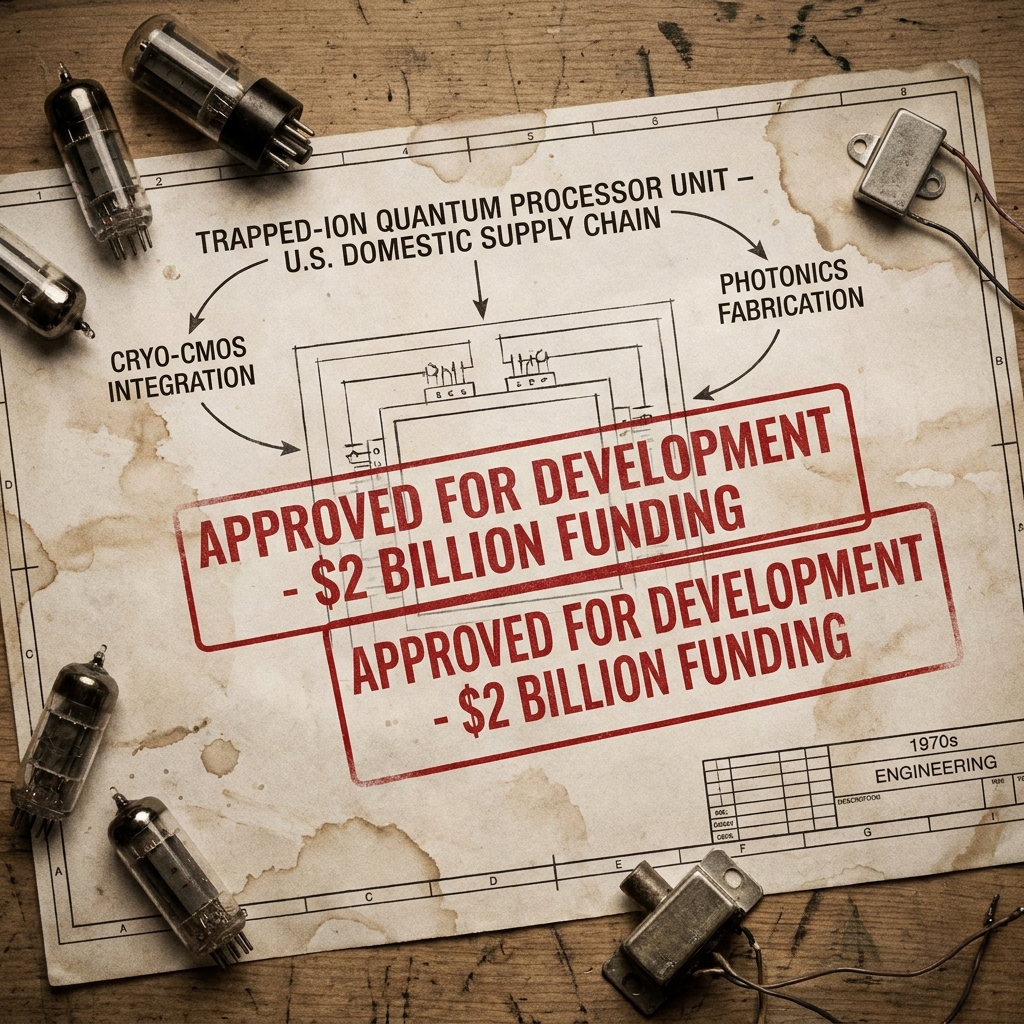
The U.S. just put $2 billion behind quantum computing, and the trapped-ion approach is getting a serious spotlight.
A new letter of intent between the CHIPS R&D Office and a leading trapped-ion hardware provider signals a significant federal commitment to building large-scale, fault-tolerant systems on American soil. This initiative goes beyond the lab. It is designed to strengthen domestic semiconductor supply chains, onshore critical manufacturing for areas like cryo-CMOS and integrated photonics, and develop the specialized workforce these systems demand.
This is part of a broader portfolio strategy that backs multiple quantum modalities. The logic is clear: fault-tolerant quantum computing is transitioning from a theoretical physics goal into a scalable engineering challenge.
What makes this particularly noteworthy is the intense focus on supply chain resilience. Quantum computers depend on highly specialized components, and securing domestic sources for fabrication is the exact groundwork that separates serious commercialization efforts from pure research projects.
For businesses watching the quantum landscape, this is a clear signal that the path from experimental to deployable is coming into focus—and the infrastructure to support it is being built in parallel #QuantumComputing
Quantum computing just got a $2 billion vote of confidence from the U.S. government, and the signal is hard to ignore.
The Commerce Department announced funding for nine quantum companies, with one major player receiving $1 billion to establish a dedicated quantum foundry—a facility focused on manufacturing quantum hardware at scale with the reliability commercialization demands.
This is no longer about proving quantum mechanics works in a lab. The fundamental science questions have largely been answered. What remains is engineering: making wafers reliable, achieving throughput, and producing quantum processors at volume. The transition from whether we can to how fast we can is one of the clearest maturity signals the industry has produced.
The government is taking minority stakes in funded companies rather than using a grant-and-forget model. This ongoing alignment between public interest and private development tends to accelerate timelines.
Establishing a third-party quantum foundry is also significant. Just as classical semiconductor foundries enabled an entire ecosystem of chip designers, a quantum foundry lowers barriers for multiple builders simultaneously. It is an investment in infrastructure, not just a single product bet.
While quantum advantage is getting closer, the highest-impact applications remain in areas where computational complexity explodes: national security, drug discovery, materials science, and financial modeling. In domains where classical machines hit fundamental walls, exploring vast solution spaces simultaneously offers a genuine path forward.
Still, material revenue from quantum computing remains a few years out, with large-scale fault-tolerant systems expected in the 2030s. The market is pricing in potential ahead of profitability.
What is undeniable is that the ecosystem is maturing. Government investment, dedicated manufacturing infrastructure, and a growing community gaining access to quantum hardware are the building blocks of an industry transitioning from experimental to engineered
#QuantumComputing
Quantum computing stocks are still finding their footing in public markets, which is exactly what an emerging industry looks like. With limited analyst ratings on the books for newly listed companies, the coverage landscape remains thin—a reminder that Wall Street is still building its understanding of this space. Early-stage quantum companies face a familiar tension: long development timelines measured against short-term market expectations. The real signal is not any single price target, but the fact that quantum firms are now publicly traded and subject to institutional scrutiny. That scrutiny, even when skeptical, is a sign of growing market relevance #QuantumComputing
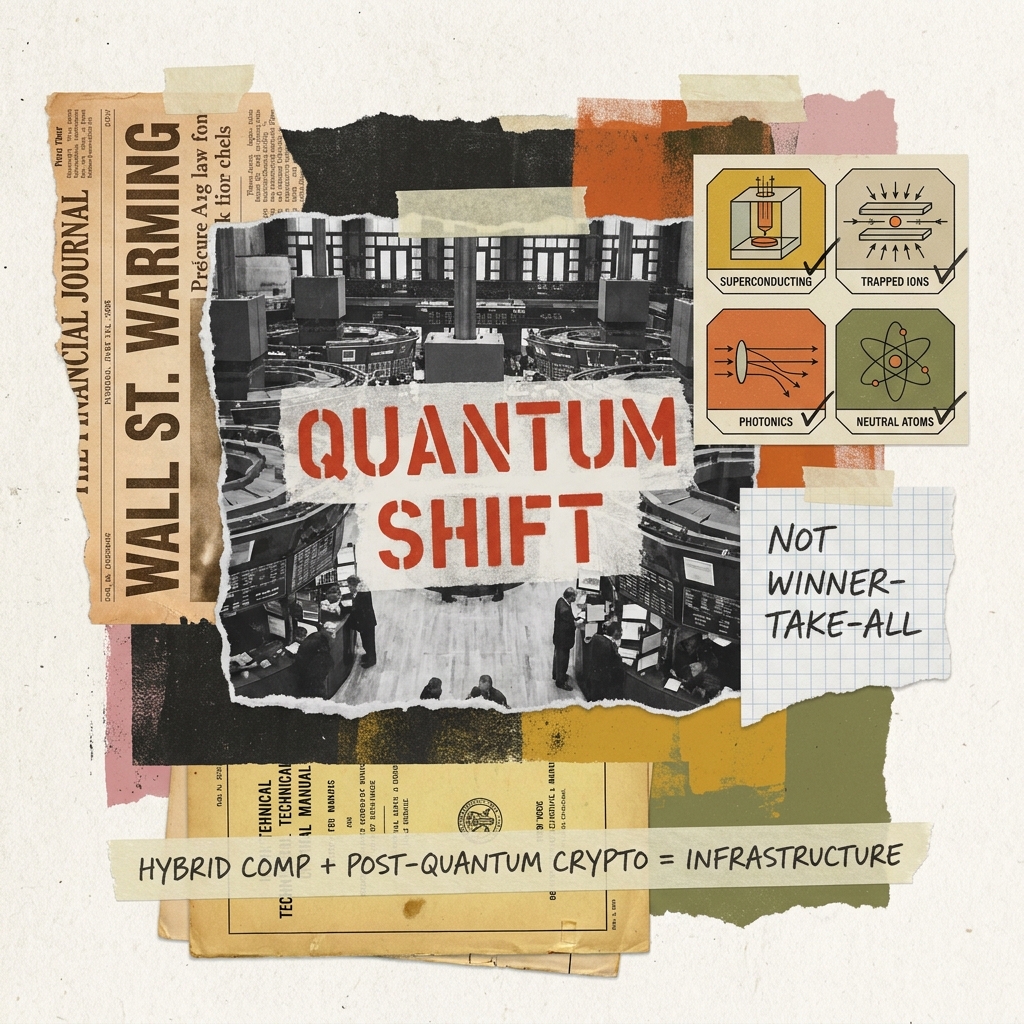
Wall Street is warming up to quantum computing, and the underlying logic is worth unpacking.
A veteran analyst with nearly three decades of experience recently shared how they transitioned from skeptic to believer after analyzing technical progress across the industry. The key insight is that this is not a winner-take-all race. With four primary methodologies—superconducting, trapped ions, photonics, and neutral atoms—each backed by serious development, multiple approaches are positioned to reach commercialization.
A few distinct points stand out:
Hybrid quantum-classical computing is advancing fast. Quantum processors are expected to work alongside CPUs and GPUs within the next couple of years to solve problems that classical systems alone cannot. While full fault-tolerant quantum computing with thousands of logical qubits remains on a longer horizon, practical quantum advantage is arriving steadily.
The biotech comparison is incredibly apt: technical milestones matter far more right now than current revenue. The true metrics to watch are qubit fidelity approaching five nines, growing logical qubit counts, and an expanding base of early adopters testing real-world applications.
Industry forecasts from McKinsey and BCG project tens of billions in direct revenue and hundreds of billions in economic value creation by the mid-2030s, spanning drug discovery, materials science, logistics, and beyond.
Meanwhile, cybersecurity implications are forcing action. The prospect of quantum hardware eventually breaking current encryption standards—known as Q-Day—makes post-quantum cryptography a pressing priority today, regardless of exact timelines.
The broader picture is remarkably encouraging. Capital continues to flow, public markets are expanding, government investment is scaling, and technology is advancing across multiple fronts. The quantum ecosystem is successfully maturing from a speculative frontier into an industry building concrete infrastructure
#QuantumComputing
Illinois just quietly dropped one of the most important documents in quantum workforce development.
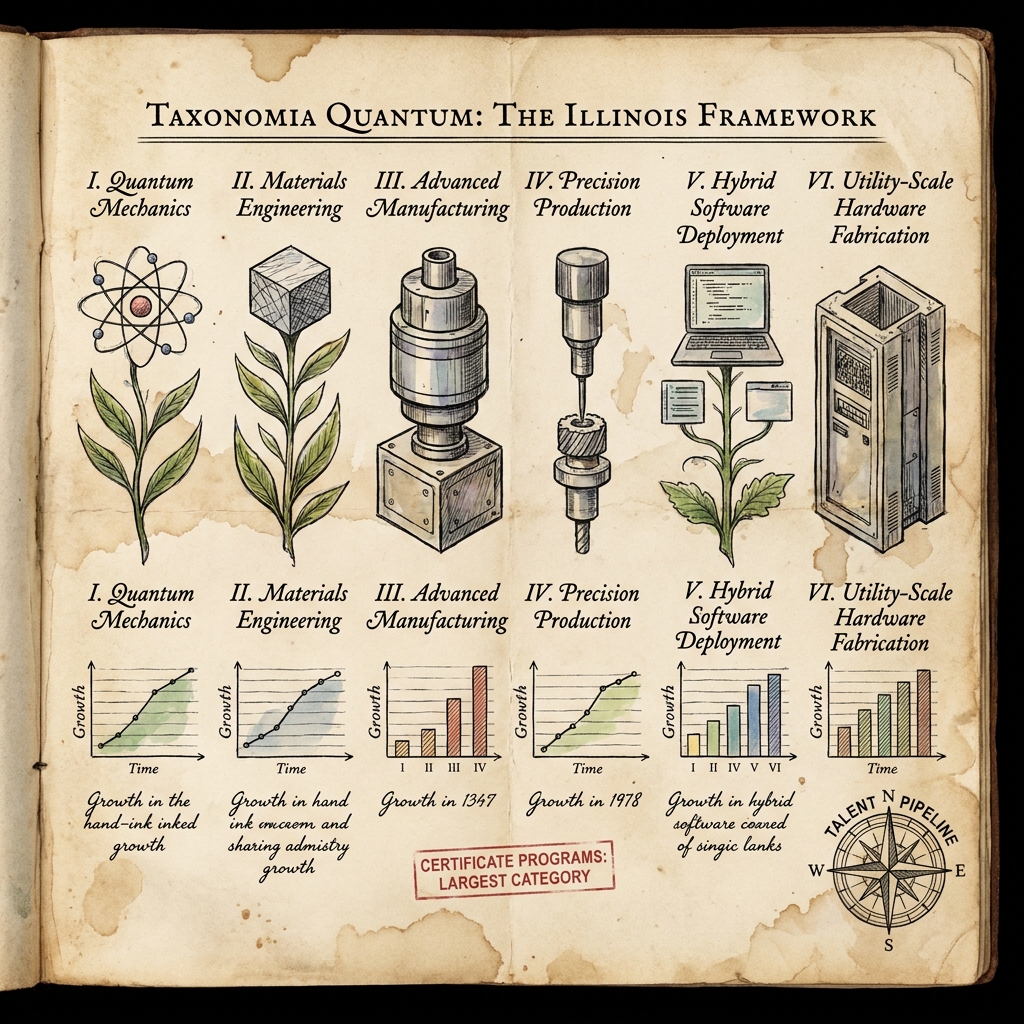
A first-of-its-kind coalition study has built a standardized framework to map the talent pipeline needed for utility-scale quantum hardware fabrication and hybrid-software deployment. The core problem it solves is surprisingly fundamental: the U.S. Department of Education doesn't even have a classification code for quantum engineering. By auditing 171 academic disciplines across six pillars, researchers created a taxonomy that finally makes the quantum workforce measurable.
The numbers tell a compelling story. Illinois produced over 33,400 quantum-relevant degrees and certificates in 2024, representing more than 5% of all related completions nationwide. That pipeline has grown 33% since the National Quantum Initiative Act passed in 2018. Perhaps most notably, technical certificate programs, not Ph.D.s, are the largest category of completions. This fundamentally reframes who the quantum workforce actually is.
The projected $80 billion in regional economic impact across the Illinois-Wisconsin-Indiana corridor by 2035 is ambitious but grounded in something real: a state already graduating nearly 3,000 computer science master's students annually to fill quantum compilation, optimization, and MLOps roles.
What makes this study matter beyond the Midwest is the methodology itself. Every region trying to build a quantum ecosystem faces the exact same measurement problem. Now there is a replicable framework for solving it #QuantumComputing
Illinois just introduced the first standardized framework for measuring quantum workforce readiness, and the numbers tell a compelling story.
A coalition of state research and economic development organizations audited 171 academic disciplines to map the talent pipeline needed for utility-scale quantum hardware fabrication and hybrid software deployment. This exercise was necessary because the U.S. Department of Education still has no dedicated classification code for quantum engineering, leaving a significant blind spot in workforce planning.
Key findings worth noting:
- Illinois produced over 33,400 quantum-relevant degrees and certificates in 2024, representing more than 5% of all such completions nationwide
- That volume has grown 33% since the National Quantum Initiative Act passed in 2018 and 60% over the past decade
- Technical certificate programs, not Ph.D.s, represent the largest category of completions, signaling a meaningful shift toward industrial-scale workforce development
- Nearly 3,000 computer science master's graduates in 2024 alone feed directly into quantum compilation, optimization, and MLOps roles
The projected $80 billion regional economic impact by 2035 is ambitious, but the underlying methodology matters more than the headline figure. By creating a repeatable taxonomy across six technical pillars, from quantum mechanics and materials engineering to advanced manufacturing and precision production, this framework gives other states a blueprint for conducting their own honest assessments.
The broader industry takeaway: quantum computing's bottleneck has never been purely technical. Fabricating and programming these machines at scale requires a workforce that largely does not yet exist in standardized talent pipelines. Illinois is betting that the regions that solve the talent mapping problem first will attract the fabrication facilities and the economic gravity that follows
#QuantumComputing
The U.S. just made one of its largest quantum bets yet. It is not a research grant, but an industrial strategy.
The Department of Commerce is distributing roughly $2 billion across nine companies through the CHIPS and Science Act, with the lion's share flowing to two quantum foundries. The deals include equity stakes for the government, meaning taxpayers share in the upside as these companies grow.
What makes this notable is the shift from funding quantum science to funding quantum manufacturing. Two major foundry operations are spinning up to produce quantum hardware at scale, including a new 300-millimeter quantum wafer foundry. Seven additional quantum computing companies, spanning approaches from neutral atoms to photonics and superconducting qubits, each received between $38 million and $100 million.
The signal is clear. Quantum computing is transitioning from a laboratory curiosity to an industrial priority. When a government structures deals with equity stakes and manufacturing mandates rather than traditional grants, it is treating the technology as critical infrastructure, not speculative research.
With projections suggesting quantum could generate over $2 trillion in economic value by 2035, the race to build domestic supply chains and fabrication capabilities is intensifying. The companies that can reliably manufacture quantum processors at scale will define the next era of the industry just as much as those designing the algorithms that run on them.
The foundry layer of quantum computing has been a quiet bottleneck for years. This investment suggests it will not stay quiet for long
#QuantumComputing
Neutral-atom quantum computing just got a full-stack upgrade.
Infleqtion announced a suite of advances spanning every layer of the quantum stack, from atom transport to gate fidelity to developer tooling.
On the software side, the company open-sourced a resource estimation tool built around neutral-atom architectures. Resource estimation is one of the most practical exercises in quantum computing right now. It tells you exactly how many qubits and how much runtime a real application will need, letting developers map ambition against hardware reality. Open-sourcing this gives the community a way to stress-test assumptions against actual system characteristics instead of abstract benchmarks.
On the hardware front, a dual-species rubidium-cesium entangling gate achieved a reported fidelity of 0.975. This dual-species approach matters because it enables in-place syndrome measurements for quantum error correction. By using different atomic species for data and ancilla qubits, measurement operations disturb neighboring qubits far less—a meaningful architectural advantage when every source of noise compounds at scale.
Complementing the experimental results, new theoretical work outlines a credible path to entangling gate fidelities beyond 99.9% through refined Rydberg gate design. Crossing that threshold would substantially reduce the massive overhead that quantum error correction typically demands.
Finally, a static magnetic-field technique for sub-Doppler cooling and optical transport of cesium atoms simplifies a core operational challenge. Moving atoms while preserving coherence usually requires time-varying magnetic fields that introduce unwanted coupling. The static-field approach achieved transport over 17 cm and temperatures of 17 microkelvins without changing the magnetic-field gradient.
What makes this collection of results notable is the simultaneity. Progress across software, hardware, theory, and atom transport in parallel reflects the integrated development that fault-tolerant systems ultimately require. No single breakthrough gets us there, but coordinated advances across the stack compound in ways that isolated results cannot #QuantumComputing
The U.S. government just became a quantum computing investor to the tune of $2 billion.
The Commerce Department is taking equity stakes across nine quantum computing companies, drawing from CHIPS and Science Act incentives to make Washington's most significant bet on the sector to date.
The highlights: one major chipmaker is receiving $1 billion to establish America's first dedicated quantum chip manufacturing facility in New York. A contract chipmaker is getting $375 million to build a factory producing components for various quantum machines. Several other firms are receiving roughly $100 million each to tackle key technical hurdles holding back more powerful systems.
The signal is clear: quantum computing has graduated from interesting research to a national strategic priority.
This investment validates the industry's momentum, even as major technical challenges remain. The timeline for fault-tolerant quantum computers is still uncertain, largely due to error rates that limit practical performance. However, the scale of this commitment suggests policymakers see enough progress to build manufacturing infrastructure now rather than waiting.
For the broader quantum ecosystem, government equity stakes do something grants alone cannot. They align long-term incentives, secure domestic hardware supply chains, and signal to private capital that this sector is worth backing with patient money.
We are watching quantum computing shift from a laboratory pursuit to an industrial one in real time #QuantumComputing
Neutral-atom quantum computing just got a full-stack upgrade.
Infleqtion announced a series of advances spanning every layer of the quantum stack, from atom transport to gate fidelity to developer tools. Taken together, they paint a compelling picture of what a tightly integrated approach to fault-tolerant quantum computing looks like in practice.
The highlights:
A new open-source resource estimation tool, Resource-Superstaq, built in collaboration with the University of Chicago, lets developers estimate qubit counts and runtimes for fault-tolerant workloads on neutral-atom architectures. Making this openly available is a smart move for the ecosystem since resource estimation only matters when the community can stress-test the assumptions behind it.
On the hardware side, a dual-species rubidium-cesium entangling gate achieved a reported fidelity of 0.975, which the company believes is a world record for inter-species neutral-atom gates. The dual-species approach is particularly interesting because it enables in-place syndrome measurements for error correction without shuffling data qubits around, reducing both time overhead and error accumulation.
New theoretical work charts a path to entangling gate fidelities beyond 99.9%, a threshold that would meaningfully reduce the qubit overhead needed for error correction. Meanwhile, a static magnetic-field technique for sub-Doppler cooling and optical transport of cesium atoms achieved 17 microkelvin temperatures and transport over 17 centimeters, addressing one of the practical engineering challenges of keeping atoms coherent while moving them at scale.
What makes this collection of results noteworthy is the breadth. Any single advance is incremental, but progress across software tooling, dual-species operations, gate theory, and atom transport simultaneously suggests a maturing platform where improvements in one layer genuinely compound with progress in others. That kind of coordinated advancement is what separates roadmap slides from real engineering momentum on the path to fault tolerance #QuantumComputing
Two billion dollars just entered the quantum computing ecosystem through federal grants to nine companies, with the U.S. government taking equity stakes in the process.
This is a significant inflection point. The largest single recipient is receiving $1 billion and matching it with another $1 billion of its own capital to build what would be the nation's first specialized quantum chip manufacturing facility. Other awards range from $38 million to $375 million, with recipients establishing dedicated quantum business units to house the investments.
What makes this notable beyond the dollar figure is the structure. Government equity stakes signal a level of commitment that goes beyond traditional grants—Washington is literally buying into quantum's future, treating it as both an economic and national security priority. The focus on domestic quantum chip manufacturing also mirrors the playbook we saw with classical semiconductors, but applied earlier in the technology's maturity curve.
For the broader industry, this kind of capital injection does three things: it validates quantum computing as a serious priority at the federal level, accelerates the hardware supply chain that every quantum company depends on, and creates a gravitational pull for additional private investment. Markets noticed—one major recipient saw shares jump 12% on the news.
The quantum industry has been building momentum for months with a wave of private investment. Federal funding at this scale turns that momentum into something more durable #QuantumComputing
The U.S. government just became a quantum computing investor to the tune of $2 billion.
Drawing from the CHIPS and Science Act, the Commerce Department is taking equity stakes across nine quantum companies. Allocations target everything from dedicated chip manufacturing facilities to core technical hurdles like error correction and cryogenic scaling.
The funding mechanism is just as notable as the dollar figure. By taking equity positions instead of offering traditional grants, policymakers are signaling a major shift. Quantum computing has crossed a threshold, taking its place alongside semiconductor fabrication and critical minerals in the national interest category.
This broad investment spans multiple hardware approaches and supply chain layers. It represents a deliberate bet on the entire ecosystem rather than a single winner, providing a realistic posture while the technology landscape continues to evolve.
While recent advances have accelerated confidence, the hard physics problems of error rates and scalability still need solving. Government capital adds crucial validation and runway for these ongoing engineering hurdles.
The race to build practical quantum systems is officially a matter of national strategy rather than just scientific curiosity #QuantumComputing
The U.S. just made one of its biggest bets on quantum with nearly $2 billion in CHIPS Act funding flowing to nine companies, and the ripple effects are already visible.
The Department of Commerce signed letters of intent covering two quantum foundry players and seven quantum computing companies, with the lion's share going to manufacturing infrastructure. The awards also come with a twist: the government takes a non-controlling equity stake in each company, designed to let taxpayers share in the upside.
What happened next is the real story. Within hours of the announcement, the two foundry awardees unveiled entirely new business ventures. One launched a standalone 300mm quantum wafer foundry. The other stood up a dedicated quantum technology solutions division focused on scaling manufacturing for utility-scale quantum systems. That is not incremental progress — that is structural investment in the kind of fabrication backbone this industry has needed.
The strategic logic is sound. Quantum algorithms and error correction get most of the headlines, but none of it matters without reliable, scalable hardware manufacturing on domestic soil. Foundries are to quantum computing what fabs are to classical semiconductors: the unglamorous engine room that determines whether breakthroughs stay in the lab or reach the market.
With projections suggesting quantum could unlock between $1.3 trillion and $2.7 trillion in global economic value by 2035, the race to build manufacturing capacity is not just a technology play — it is an industrial policy play. The equity structure signals that the U.S. government sees this less as a grant and more as an investment with expected returns.
This is what a maturing industry looks like: federal capital catalyzing dedicated infrastructure, new entities purpose-built for quantum manufacturing, and a supply chain strategy that treats hardware fabrication as a national priority #QuantumComputing
Every transformative technology has a chapter where the world is still figuring out what it can do. Quantum computing is in that chapter right now. Early-stage industries reward those who build understanding before the crowd arrives. The projected $72 billion market is attracting serious attention from major cloud providers, government initiatives, and investors alike—not because the technology is fully mature, but because the foundations being laid today will define the competitive landscape for decades #QuantumComputing
Quantum isn't coming to replace your CPU or GPU—it's auditioning for a very specific role in the ensemble.
The latest developments from major research labs paint a clearer picture of where quantum fits. It is not a standalone revolution, but a specialized accelerator woven into existing high-performance computing infrastructure. Think of it as the third leg of a computing triumvirate: CPU, GPU, QPU, with each handling what it does best.
Several breakthroughs are cementing this hybrid future. Supercomputing centers are successfully integrating quantum hardware, building architectures that intelligently route jobs to the best-suited processor. Software layers are abstracting away quantum complexity so domain experts can design circuits without needing a physics degree. Simultaneously, AI is proving invaluable for optimizing quantum circuits and tackling error correction bottlenecks.
The global momentum is unmistakable. International consortia are testing quantum-classical hybrid systems for materials science and drug discovery. The market continues to mature, and preparations for post-quantum cryptography are already driving hardware updates.
The parallel to early artificial intelligence is striking. After years as a lab curiosity, a rapid shift is occurring as the integration pieces fall into place. Error correction is advancing, hybrid architectures are maturing, and the tooling gap is narrowing. We are closer to practical quantum utility than conservative estimates suggest, yet it requires more patience than the boldest headlines claim.
The sweet spot, as always, is somewhere in between #QuantumComputing
The quantum computing industry is scaling fast, but two bottlenecks will define who thrives and who falls behind: security readiness and talent.
On the security front, the clock is ticking toward Q-Day—the point when quantum computers become powerful enough to crack RSA encryption, which underpins the security of global banking, healthcare and critical infrastructure. NIST has already published guidelines calling for public and private infrastructure to adopt post-quantum cryptography by 2035, and 2026 has officially become the year quantum security moves from a theoretical concern to an operational priority.
The talent gap is equally stark. The quantum workforce sits at roughly 30,000 professionals today, but projections show the industry will need 250,000 by 2029 and 840,000 by 2035. This is not a gradual ramp. It is an order-of-magnitude shift demanding serious investment in education and cross-disciplinary development. The industry does not just need more quantum physicists; it needs professionals who can translate quantum applications into actionable strategies for business leaders and engineers.
The economic stakes reinforce this urgency. Forecasts put the economic opportunity at $3 trillion by 2035, with massive gains in logistics and telecommunications. Real deployments are already underway, including fully quantum-secured fiber networks connecting research and government facilities.
Geographically, the quantum landscape is refreshingly distributed. Hubs are emerging across Maryland, Florida, Tennessee, Arizona, Colorado, Montana and New Mexico, breaking the traditional mold of tech concentration.
Quantum computing's potential is enormous, but realizing it depends on solving these challenges in parallel. Organizations that invest in post-quantum security strategies and quantum-literate talent today will be far better positioned than those waiting for the pressure to become unavoidable #QuantumComputing