Introducing Qubit Pad:
A memecoin launchpad on a real Quantum computer.
Pick one of 156 qubits on the chip and launch your coin on it.
On the hour, the whole chip is measured.
Coins whose Qubit reads 1 split the pot.
Launch right next to another coin and your Qubits get entangled. Every hour, one of you wins.
Nobody knows which Qubits will read 1. Not even us.
Every result goes on-chain.
CA: QUVBoi1AHedr7Qd1nQ38wPiVc3vLbZUkujQaZsUBAmE
https://t.co/TFY7LSzhmT
One gate, drawn.
Every qubit starts at |0⟩, the north pole of the Bloch sphere.
A Hadamard gate is a half-turn about the (x+z)/√2 axis. It carries |0⟩ down to the equator: |+⟩ = (|0⟩ + |1⟩)/√2.
Measurement projects onto z, so P(1) = (1 �� z)/2 = ½.
Real hardware pulls that to about 0.4965. That one number decides every solo coin on Qubit Pad.
Inside the chip.
Each qubit is a transmon: a Josephson junction and a capacitor. Its two lowest energy levels are 0 and 1.
Couplers link neighbours so they can run the entangling gate.
Readout lines send one microwave tone per qubit, so all 156 are read at the same time.
Bond pads wire it all out of the fridge to the control electronics.
Every coin on Qubit Pad sits on one of these qubits.
Measured on the hour.
156 qubits on a heavy-hex chip, wired by 176 couplers.
Every coin on Qubit Pad sits on one of them.
At the top of every hour, the whole chip is read at once, and every qubit that reads 1 splits the pot.
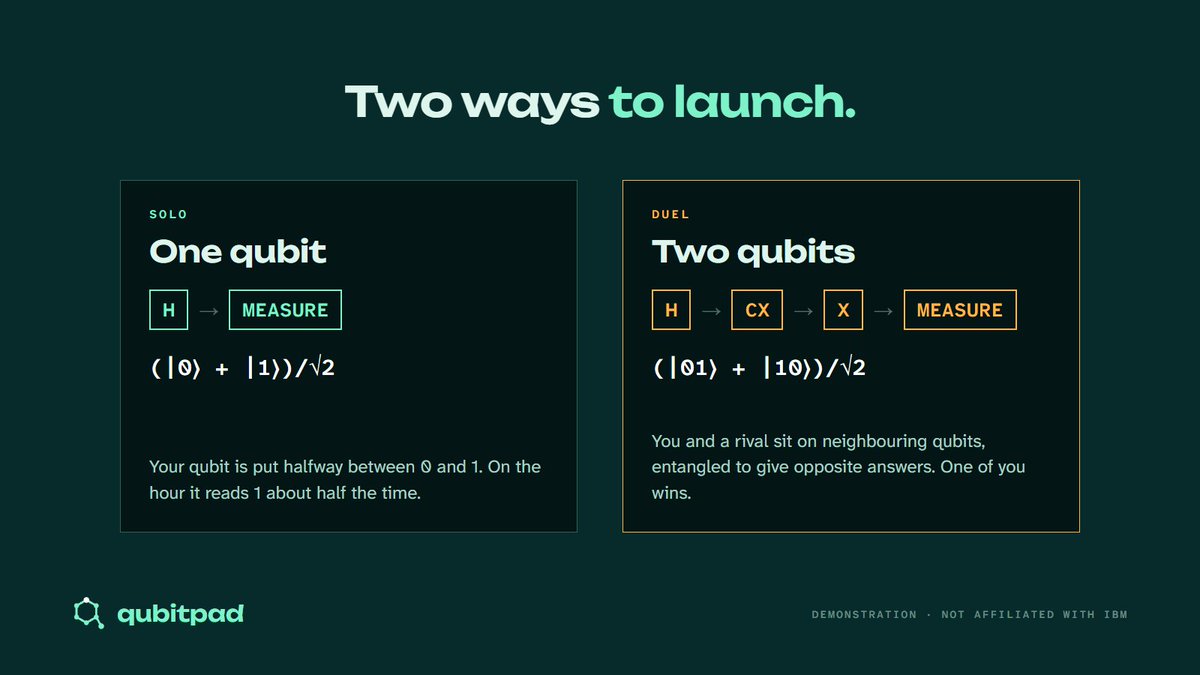
Two ways to launch on Qubit Pad.
Solo: one qubit, one Hadamard gate. On the hour it reads 1 about half the time.
Duel: you and a rival on neighbouring qubits, entangled to give opposite answers. One of you wins.
The stack, end to end.
Sign a plain-text request with your wallet. Signing moves no funds.
On the hour, one job runs on a Heron-class quantum processor: 156 qubits, 8 shots, all measured at once.
The result is hashed and posted on Solana, with the full file next to it.
Price, mcap and volume update live on the site.
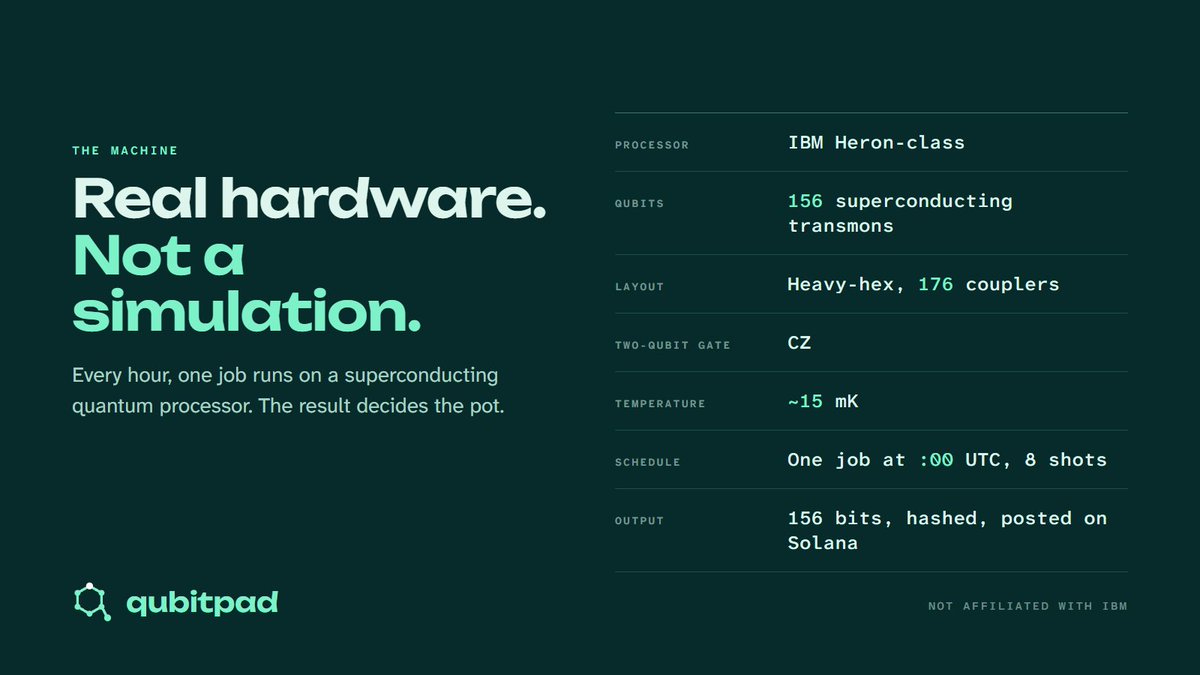
Real hardware. Not a simulation.
Qubit Pad is built on an IBM Heron-class processor: 156 superconducting qubits on a heavy-hex lattice, held at about 15 millikelvin.
One job at the top of every hour, 8 shots, all 156 qubits measured at once.
The result is hashed and posted on Solana, and it decides the pot.
How a qubit actually gets read.
You never look at a qubit directly. You bounce a microwave tone off a resonator coupled to it, and the state shifts the phase of what comes back.
Every shot lands as one point on the IQ plane. Prepare 0, you get one cloud. Prepare 1, you get another.
The readout draws a line between them. Where the clouds overlap, or where a 1 decays during the measurement, a shot ends up on the wrong side.
That's the readout error, and it's different for every qubit. On Qubit Pad, that's what makes one rarer than another.
Do not tap the fridge.
Every coin on Qubit Pad lives on a chip at the bottom of a dilution refrigerator.
Each plate is colder than the one above it, from room temperature down to about 15 millikelvin at the chip.
That's roughly 180× colder than deep space.
Proof, every hour.
Every measurement prints a receipt: the job ID, all 156 bits, the winners and the pot.
The bits and their hash go on Solana, with the full result file next to them.
24 hours of results, one glance.
This is the chip, live on Qubit Pad.
156 qubits, each one spinning until the hour.
Every name you see is a coin sitting on its own qubit.
On the hour, the whole chip is measured, and the ones that read 1 split the pot.
Doors are open.
CA: QUVBoi1AHedr7Qd1nQ38wPiVc3vLbZUkujQaZsUBAmE
Launching on Qubit Pad takes three steps.
Pick a qubit on the chip map. You see its tier, T1 and readout error before you choose.
Name your coin.
Sign once. Signing moves no funds.
Your coin is in the next hour's measurement.
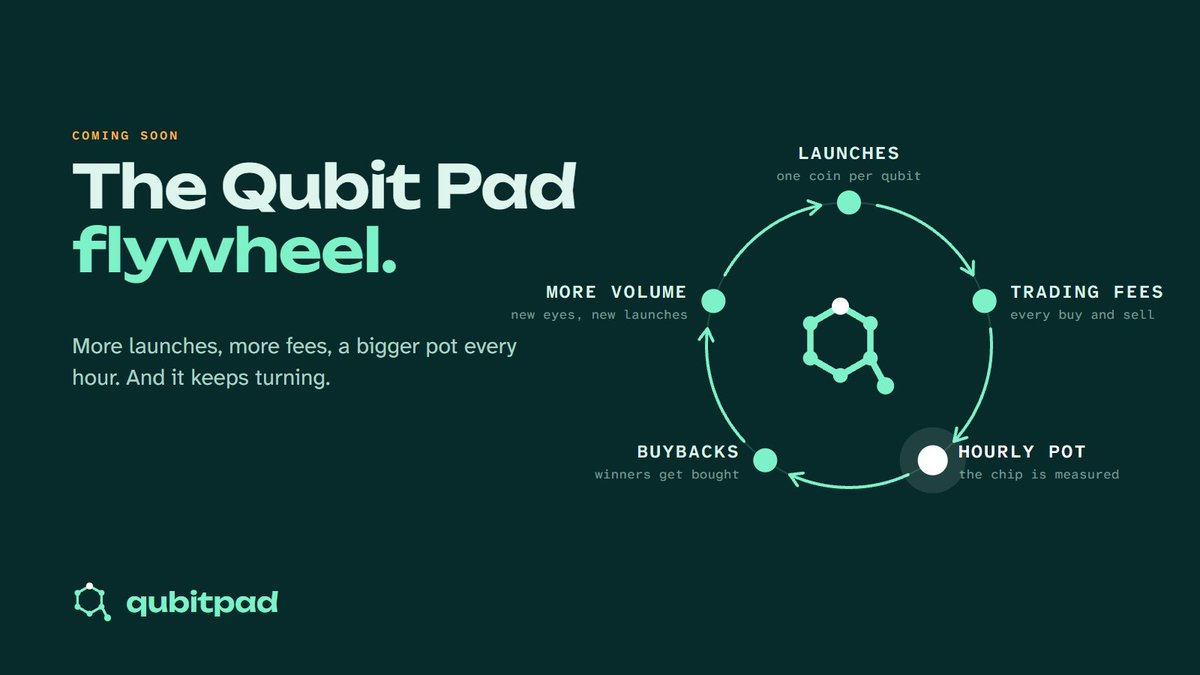
The Qubit Pad flywheel is coming.
More launches mean more fees.
More fees mean a bigger pot every hour.
A bigger pot means bigger buybacks for the coins that read 1.
And that brings more launches.
CA: QUVBoi1AHedr7Qd1nQ38wPiVc3vLbZUkujQaZsUBAmE
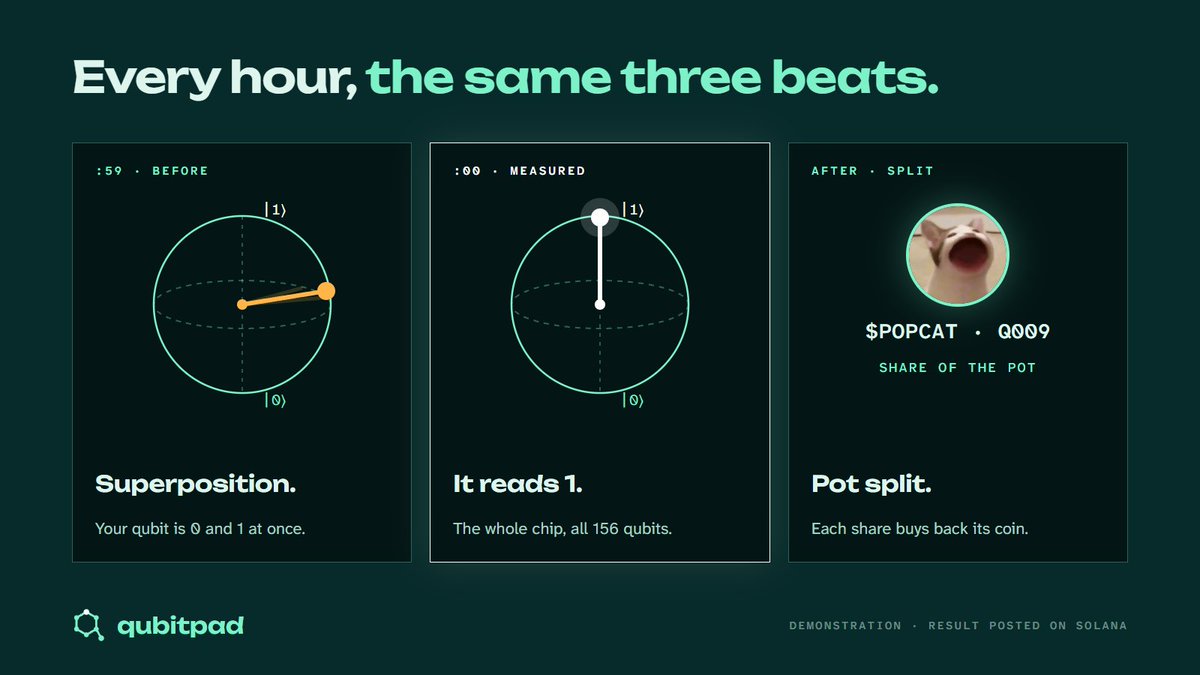
Every hour, the same three beats.
At :59, your qubit is 0 and 1 at once.
At :00, the whole chip is measured.
If yours reads 1, you split the pot, and your share buys back your coin.
CA: QUVBoi1AHedr7Qd1nQ38wPiVc3vLbZUkujQaZsUBAmE
The split and the buybacks run on our side for now, not in a smart contract. That's why every hour's raw result and its hash go on Solana, so anyone can check the payouts against the measurement.
One launch gets one qubit, and the chip only has 156. Duel seats are limited too, since every qubit has at most 3 neighbours.
We'll announce the first real measurement hour before it happens. Until then, everything on the site is marked as a demonstration.
The part that matters most is already open: rebuild SHA-256(jobId:bitstring) and compare it to the hash on Solana. More soon.
Entangled with my rival.
Launch on the qubit right next to a coin you can't stand.
Your two qubits get entangled, so when one reads 1, the other almost always reads 0.
Every hour, the chip picks one of you.
CA: QUVBoi1AHedr7Qd1nQ38wPiVc3vLbZUkujQaZsUBAmE
The odds, honestly.
Your qubit reads 1 about 49.6% of the time. Not 50, because a 1 can fade to 0 before it's read.
Chance anyone can predict it, including us: 0%.
Chance your entangled rival wins the same hour as you: 0%.
Next chance: on the hour, every hour.
CA: QUVBoi1AHedr7Qd1nQ38wPiVc3vLbZUkujQaZsUBAmE
Rarity, but it's physics.
Every qubit on the chip is a little different, and the calibration says exactly how.
Clean ones hold their state and are rarely misread. Only 16 of 156.
Wild ones lose it fast and get misread all the time. Also 16.
You see the tier before you launch. Choose your qubit.
CA: QUVBoi1AHedr7Qd1nQ38wPiVc3vLbZUkujQaZsUBAmE
The coldest bag on Solana.
Every coin on Qubit Pad lives on a chip at the bottom of a dilution fridge.
Room temperature at the top. About 15 millikelvin at the bottom.
That's roughly 180× colder than deep space.
Your coin has never been this cool.