Everyone Keeps Asking About Staking....I think we're asking the wrong question.
One thing I've noticed in almost every crypto community is that the first question is usually:
"When can I stake?"
It's understandable. Crypto has trained us to think that way.
New project?
Ask about APY.
New token?
Ask about staking.
But after following Modulr more closely, I realized we're asking the wrong question.
The better question is:
How does this ecosystem become sustainable?
Think of It Like a Grocery Store
Imagine walking into a grocery store where every shelf is empty.
It doesn't matter how many customers show up or how much money they have....nothing can be bought because there's nothing available.
Now imagine the shelves are always stocked.
People can buy what they need, suppliers keep bringing in products, and the store keeps running smoothly.
That's the simplest way to think about liquidity.
Liquidity keeps the market functioning. It makes it easier for people to buy and sell without causing unnecessary friction.
▨ Where eMDR Fits
Since eMDR is on Uniswap v3, the conversation isn't really about staking right now.
It's about liquidity.
Community members who choose to provide liquidity help make the market healthier and, in return, may earn fees generated from swap activity.
That's an important distinction.
This isn't simply about locking tokens and waiting for rewards.
It's about helping the market function while participating in its activity.
▨ The Bigger Picture
What makes @Modulr_Robotics interesting isn't just liquidity.
It's how the team is thinking beyond crypto itself.
They're exploring how connected real-world assets
like vending machines and other revenue-generating devices could support the ecosystem over time.
Imagine a vending machine connected to the network.
It sells products.
It generates revenue.
Someone restocks it.
Someone services it.
Someone manages its location.
That creates real economic activity.
Instead of value coming only from speculation, it's supported by actual work happening in the real world.
▨ Where Modulr.Gig Comes In
This is why I don't see Modulr.Gig as just another freelance platform.
If connected machines become part of the ecosystem, someone has to maintain them.
Someone has to refill inventory.
Someone has to coordinate operations.
Gig becomes the place where that work gets organized.
The machine creates activity.
Gig connects people to that activity.
The network ties everything together.
▨ Final Thoughts
Most crypto discussions start with one question:
"How do I earn?"
Maybe we should start asking another one instead:
"How does the ecosystem create lasting value?"
For me, that's what makes Modulr worth watching.
It's not just exploring new technology.
It's exploring how real-world work, connected machines, liquidity, and decentralized infrastructure can fit together into one ecosystem.
And that's a much more interesting conversation than staking alone.
Tomorrow’s France 🇫🇷 vs Spain 🇪🇸
Semifinal isn’t the kind of match you casually skip. It’s one of those games where everyone tunes in, every chance matters, and every goal could decide who reaches the World Cup final.
If you’re going to spend 90+ minutes watching anyway, why not make that time count?
With @HerondBrowser, you can watch the match without annoying ads while earning HP through Browse-to-Earn. Keep stacking your HP and use them later in the Herond Point Reward Shop or try your luck in Lucky Spin.
Enjoy the football.
Earn while you browse….Simple!
Get started 👉 https://t.co/iP33COPU9E
Trust shouldn't be bolted onto blockchain. It should be part of the foundation.
@Concordium combines on-chain identity, Zero-Knowledge privacy, and built-in compliance to create an ecosystem where users, businesses, and AI agents can interact with confidence.
Groceries, bills, daily spending all crypto, all month, no exceptions.
That's the challenge @MegPrimePay just put out, and it's a genuinely useful stress test for what spend your crypto actually means in practice.
Download the app, see how it holds up, and tell us if you'd take the same challenge.
𝐓𝐡𝐢𝐬 𝐩𝐨𝐬𝐭 𝐩𝐮𝐭 𝐢𝐧𝐭𝐨 𝐰𝐨𝐫𝐝𝐬 𝐬𝐨𝐦𝐞𝐭𝐡𝐢𝐧𝐠 𝐈'𝐯𝐞 𝐛𝐞𝐞𝐧 𝐭𝐡𝐢𝐧𝐤𝐢𝐧𝐠 𝐚𝐛𝐨𝐮𝐭 𝐟𝐨𝐫 𝐚 𝐰𝐡𝐢𝐥𝐞.
Everyone obsesses over TPS, block times, gas fees, like that's what makes a chain "win." But Ethereum's whole rise proves that's not actually what matters.
Nobody chose Ethereum because it was the fastest chain. They chose it because Uniswap existed.
Because OpenSea existed. Because Aave existed.
The APPLICATIONS pulled people in, the chain was just where it all happened to run.
That's exactly the bet @inter_link is making, not "look how fast our chain is," but "look how many real problems you can solve by building here."
And the part that stands out most: every dApp that succeeds doesn't just help itself, it pulls new users into the whole ecosystem, who then discover everything else built on the same chain.
That's compounding growth, not isolated growth.
If @inter_link pulls this off across payments, RWA, DeFi, and gaming, this isn't just a chain anymore. It's an economy.
#InterLink #ITLG #ITL
@CNPYNetwork
A novel consensus mechanism that combines Proof-of-Stake (PoS) with Proof-of-Age (PoA) to deliver immediate economic security & prevent long-range attacks.
Every new chain added to Canopy scales Web3 horizontally and additively rather than competing for resources
A few days ago I wrote an article on @thehoodstayson
This time, I figured I'd let a meme do the talking.
Hope you enjoy this short clip.
The Hood Stays On. $HOODIE
I am canceling "we are building" tweets with no product and no date.
500 likes. No demo. Then silence. Six months later they are building something else.
That is not marketing. That is attention debt.
@RallyOnChain rewards what is accurate and original, not what sounds exciting and vanishes.
Are you shipping or just posting?
One thing I appreciate about Web3 is that there are more ways to earn than simply buying and holding tokens.
Some projects reward liquidity, others reward referrals.
@xora_finance is rewarding contribution.
XORA has built a Bounty and Contribution Marketplace where creators, developers, educators and community members can get rewarded for helping the ecosystem grow.
Here's how it works.
➠ Create Content and Get Paid.
Whether you're good at writing threads, making videos, designing graphics or explaining crypto in simple terms, there's likely a bounty that matches your skill set.
XORA regularly publishes bounties for different content formats, including:
• Single X posts
• X threads
• Articles
• YouTube Shorts
• Long-form YouTube videos
• TikTok videos
• Instagram content
• LinkedIn posts
• And more.
The best part is you're not competing against other creators.
Your submission is judged on its own merits, not against a leaderboard.
Your work is evaluated based on:
→ Creativity.
→ How clearly it communicates the message.
→ Whether it follows the bounty requirements.
If your submission is approved, you get paid for that post.
Depending on the campaign, rewards can range from $1 to $200+ per approved submission, with some opportunities offering even more.
➠ Help Secure the Platform
Not everyone creates content.
If you're a developer or security researcher, XORA also runs a Public Bug Bounty Program.
The idea is to find vulnerabilities before attackers do.
Researchers who responsibly identify issues within XORA's infrastructure, transaction logic or user interface help strengthen the platform while earning rewards for valid reports.
It's a win for both contributors and the entire community.
➠ Join the Growth Program
XORA understands that communities don't grow by themselves.
That's why it also supports contributors working on adoption.
If you enjoy:
• Hosting meetups.
• Organizing webinars.
• Creating educational content.
• Building partnerships.
• Growing online communities.
You can apply to become part of XORA's Growth & Marketing Contributor Program.
Active contributors may even receive support for campaigns, events, marketing tools and community initiatives based on the impact they create.
The goal is to bring real users into the ecosystem.
➠ Refer & Earn
Sometimes the simplest contribution is introducing someone to a product you genuinely believe in.
With XORA's Refer & Earn program, users can earn rewards by inviting others to join the ecosystem, helping grow the platform while benefiting from their referrals.
Why This Stands Out
A lot of bounty programs feel like competitions where only big accounts win.
XORA takes a different approach.
Your content isn't compared against hundreds of other creators.
If your work is original, follows the brief, and communicates the message effectively, it has the opportunity to be approved and rewarded on its own merit.
That creates a much fairer environment, especially for smaller creators who often get overlooked elsewhere.
After all, the strongest ecosystems aren't just built by their teams, they're built by the communities that grow alongside them.
Most blockchain networks built their peer-to-peer layer on a transport protocol designed in 1974.
For a quantum-hybrid network routing heterogeneous compute in real time, that is a problem.
@quipnetwork runs on QUIC instead.
The same protocol now powering HTTP/3 and adopted by over 35% of the world's most visited websites as of 2026.
QUIC eliminates head-of-line blocking. For @quipnetwork routing jobs between QPUs, GPUs and CPUs simultaneously, one lost packet cannot be allowed to freeze every other connection. On TCP it would.
QUIC establishes secure connections in one round trip instead of two. For a network where node latency directly affects how fast compute jobs get routed and verified, that speed difference compounds across every transaction.
➔ 15 second heartbeat intervals ... 60 second timeout. @quipnetwork nodes stay alive and responsive.
➔ Automatic node discovery ... new peers broadcast instantly across the network.
➔ Chain synchronization ... every node syncs automatically on join.
➔ Every peer connection on @quipnetwork encrypted by default. No unencrypted node-to-node traffic. Ever.
One thing most people skip over.
QUIC with TLS 1.3 is still classical cryptography. Quantum computers will eventually target the key exchange underneath it. @quipnetwork already knows this. That is exactly why the post-quantum signature layer sits on top.
Not waiting for a perfect quantum-native protocol to exist.
Building on the best available infrastructure while the quantum layer matures.
Good morning
I now see more of my mutals on CT nice one @nikitabier
That's good no more engaging big accounts that don't engage back
Fock them.
What are we building today gang
One of the more interesting developments in tokenized credit is how quickly it’s moving beyond DeFi-native distribution.
Maple’s launch of syrupUSDG on Robinhood Chain brings together several pieces of institutional financial infrastructure: a regulated stablecoin (USDG), institutional credit underwriting, independent risk curation, onchain lending infrastructure, and mainstream distribution.
What’s notable isn’t just the product it’s the architecture.
Rather than relying on a single provider, each participant specializes in what they do best: Paxos issues USDG, Maple manages the credit strategy, Steakhouse curates risk, Morpho provides the lending rails, and Robinhood extends distribution.
As tokenized credit matures, this modular approach may become the standard for bringing institutional-grade yield to a much broader user base.
Blessed taco day to everyone! ⚡
Every chain promises speed.
Very few ask what happens when the financial logic itself is too complex for the chain to process cleanly.
@NomismaNetwork started from that question instead of the speed question.
The result is an AI optimized L1 where automated models do not need workarounds,
complex math does not create bottlenecks, and execution does not degrade when strategies get sophisticated.
Speed without complexity handling is just fast failure.
There's a reason clever investors are obsessed with passive income.
They do this because time is most effective when combined with money.
That's why I chose to stake my $KGEN tokens.
The process was simple, took only a few minutes, and now my tokens are actively contributing to the network rather than just sitting in my wallet.
Here's a brief look at how I staked my $KGEN token.
Watch until the end. ⤵️
Something I find quietly interesting about @GalaxySwapLabs .
They are building the liquidity layer on Midnight Network but $GALAXY trades on Solana too. The bridge between both chains is already live.
A privacy first DEX with roots in one of the fastest and most liquid ecosystems in crypto. That is a wider reach than most people associate with an early Midnight project.
Good morning folks 💜
I have entered realms...
I have seen visions...
I have dreamed dreams...
I know what's coming...
And I am ready for it ..
COME WHAT MAY, I WILL CONQUER!!!
ITIA GM Familia
Have a nice day!
Art by @IThinkItsArt
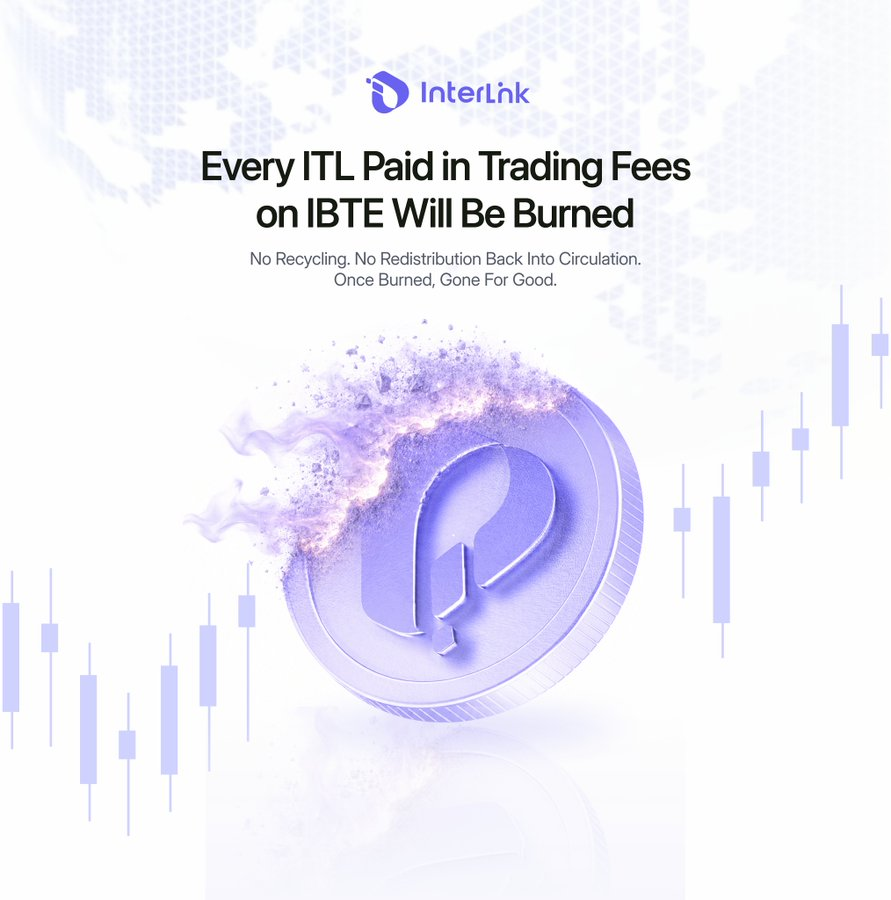
🔥 𝐄𝐕𝐄𝐑𝐘 $𝐈𝐓𝐋 𝐏𝐀𝐈𝐃 𝐈𝐍 𝐓𝐑𝐀𝐃𝐈𝐍𝐆 𝐅𝐄𝐄𝐒 𝐎𝐍 𝐈𝐁𝐓𝐄 𝐖𝐈𝐋𝐋 𝐁𝐄 𝐁𝐔𝐑𝐍𝐄𝐃
Most tokens fight against dilution. $ITL fights back. Here's the mechanism behind it 👇
Most Networks Reward Growth With More Supply
Growth usually means more emissions, more tokens entering circulation. IBTE flips that model entirely, growth in trading activity works AGAINST supply, not with it.
𝙃𝙤𝙬 𝙩𝙝𝙚 𝘽𝙪𝙧𝙣 𝘼𝙘𝙩𝙪𝙖𝙡𝙡𝙮 𝙒𝙤𝙧𝙠𝙨
When a business token is traded on IBTE, the exchange fee is paid in $ITL. That fee doesn't go to a treasury, a team wallet, or a rewards pool. It goes straight to a burn address and is removed from total supply, permanently.
𝗧𝗵𝗶𝘀 𝗦𝘁𝗮𝗰𝗸𝘀 𝗼𝗻 𝗧𝗼𝗽 𝗼𝗳 𝗘𝘅𝗶𝘀𝘁𝗶𝗻𝗴 𝗕𝘂𝗿𝗻𝘀
This isn't $ITL's only burn channel:
→ Base fee burns already remove $ITL on every network transaction
→ Validator slashing burns remove $ITL from misbehaving validators
→ Now IBTE trading fee burns add a THIRD channel, tied directly to real economic activity, not just network usage
𝗪𝗵𝘆 𝗚𝗿𝗼𝘄𝘁𝗵 𝗖𝗼𝗺𝗽𝗼𝘂𝗻𝗱𝘀 𝘁𝗵𝗲 𝗘𝗳𝗳𝗲𝗰𝘁
More businesses list on IBTE → more trading volume → more $ITL burned. The more successful IBTE becomes, the faster $ITL supply compresses. Growth and scarcity move in the SAME direction here, not opposite ones.
𝗙𝗿𝗼𝗺 𝗧𝗿𝗮𝗱𝗶𝗻𝗴 𝗔𝘀𝘀𝗲𝘁 𝘁𝗼 𝗦𝘁𝗼𝗿𝗲 𝗼𝗳 𝗩𝗮𝗹𝘂𝗲
Most tokens ask you to believe in future demand. $ITL backs that belief with a mechanism: every burn is permanent, every burn is public and verifiable on-chain, and every unit removed makes the remaining supply scarcer.
The more the @inter_link ecosystem grows, the less $ITL there is to go around.
#InterLink #ITLG #ITL
Opportunity Lives Here.
Some networks ask for your attention. Unich Network rewards your participation.
Become an Ambassador, connect through the App and get Boosted, earn with the Point Program, turn real-world interactions into value through Peer Meets, and benefit from Buyback cycles where eligible participants receive USDT.
Every feature is another path to grow. Every connection is another opportunity.
Don't just watch the future of Web3, be part of the network that's building it, be part of Unich Network.
Unich Network App >
Use code to signup: UXTLJCII
https://t.co/sfLihCo6Te
Join Batch 14:
✅ Telegram: https://t.co/eTdY93X6je…
✅ Register: https://t.co/xHFp7wZ723…
@unich_com #SocialFi #EarnGrow