@pepijndevos I tried years ago, lol. It's a very obvious idea. But maybe you have a cool twist in mind. There are papers about biasing the nets to make them highly sparse though and hence incredibly interpretably and compact, which is very interesting.
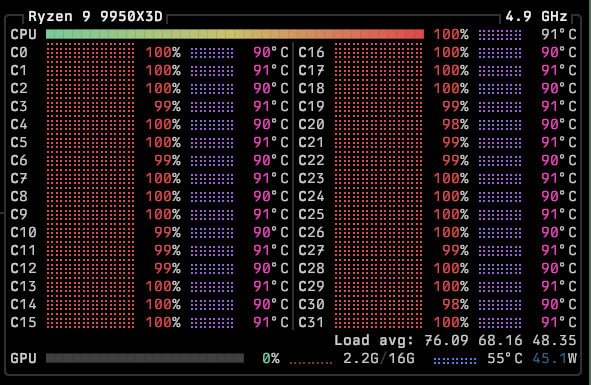
I have a few RTX3090s locally for day-to-day simulations (which is enough for almost everything especially with the upcoming engine update that leads to up to 6x performance and large memory improvements) but I am also regularly renting H100s to make sure BeamZ scales and for the occasional large-scale simulation.
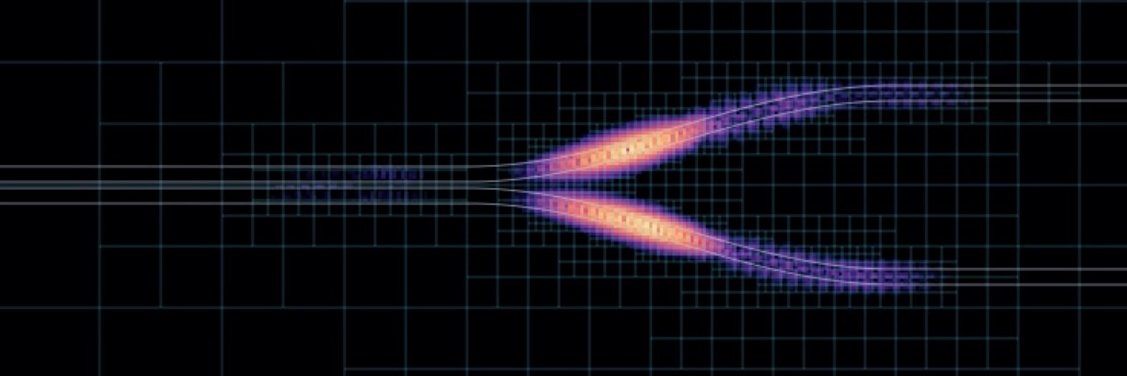
Since this is just a toy-demo, not serious work, I only did a 2D sim with adjoint method for the optimization which is ofc very fast and memory efficient.
I am playing with my FDTD framework BeamZ
https://t.co/fmtm83X7C9 again of course.
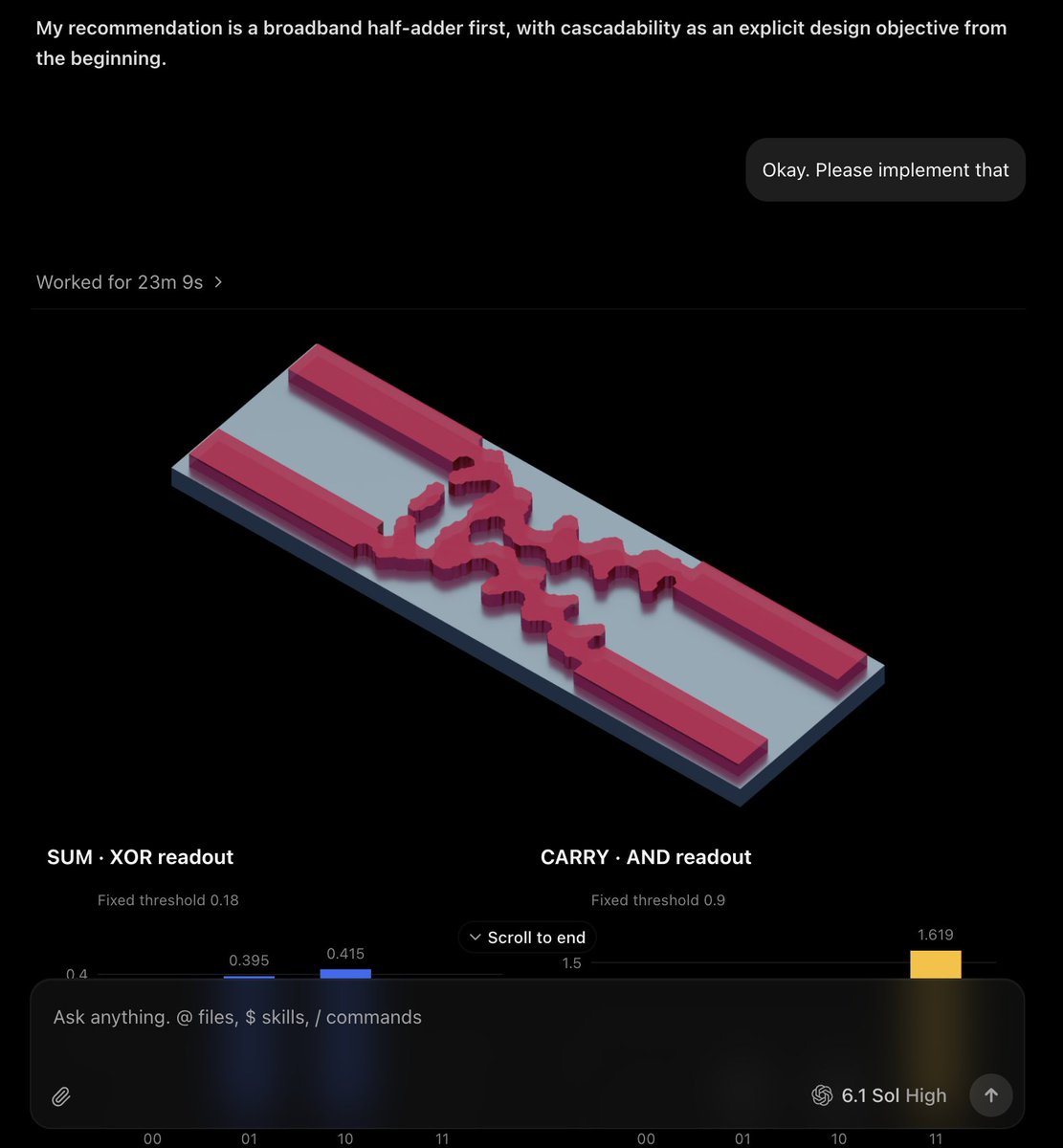
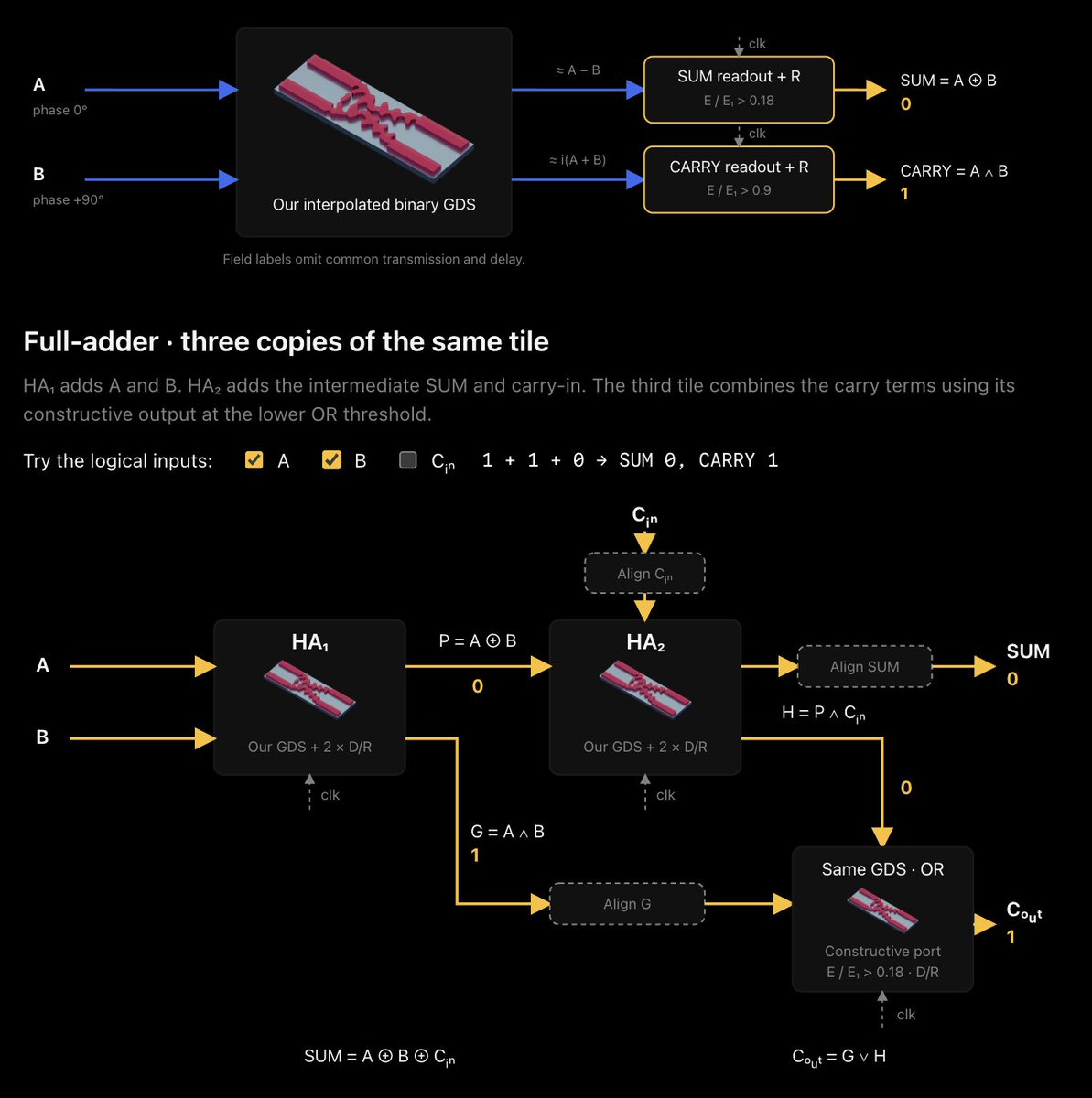
Agents are so good that you can really just give them some vague design specs and they'll just go off with BeamZ and generate one in a few minutes.
Crazy times we live in!
These are classical electromagnetic waves but yes, interference + scattering / refraction are the key mechanisms here as the waves propagate through this structure.
Also "linear" here means that superposition holds but it can delay, filter, resonate, retain a fading history, or perform convolution... This is merely a 2.5/3D inverse design meaning that there was no concern for the temporal aspect but reshaping signals in time is possible with 4D inverse design as well!
Regarding the rest you said, I like where your mind is going. This article comes to mind: https://t.co/DtNIaeggi7
Feedback through a wave-processing structure can implement certain iterative computations!
@config_Geist You are correct. The encoder is doing most of the heavy lifting. But it needs to be co-optimized with the photonic core which - yes - is basically just doing the final matrix multiplication.