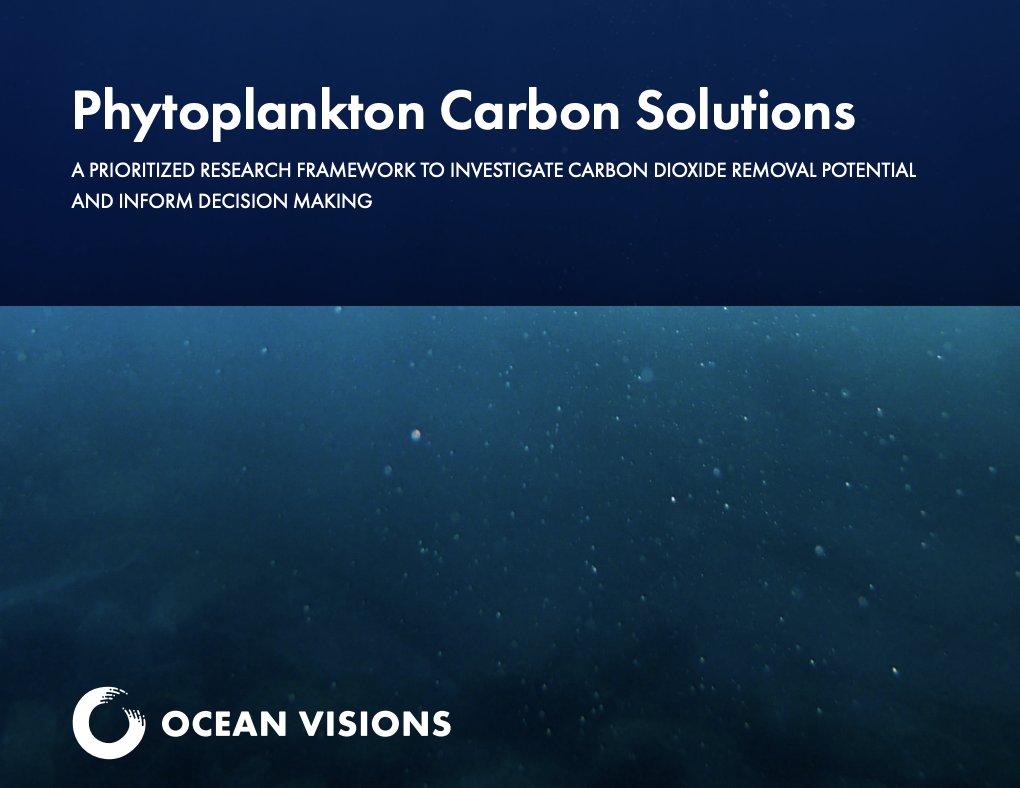
After 15 years stuck in limbo, phytoplankton carbon is getting the institutional validation it needed. Ocean Visions just dropped a landmark framework backed by major players in climate philanthropy. This isn't speculation anymore.
https://t.co/5NF7MorqAz
I’m not trying to flex on being a great Christian or anything but I have never in my life had to explain that the golden statue I was worshipping was technically not a calf so you can’t get mad at me
The good news is that the world's poorest people are much less poor than they used to be.
The bad news is that the process of middle-class formation is really, really carbon intensive.
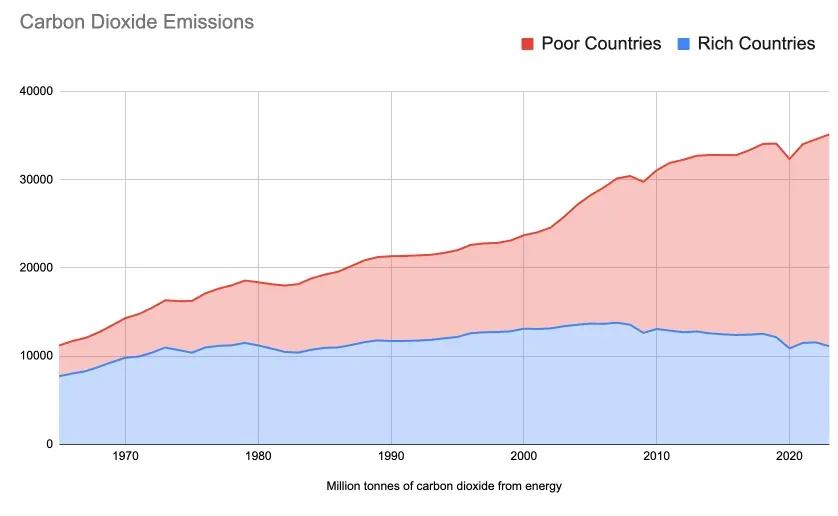
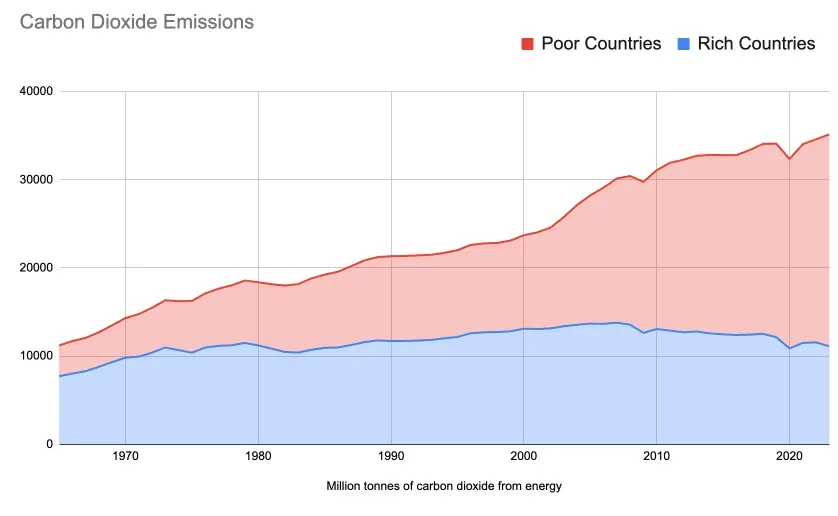
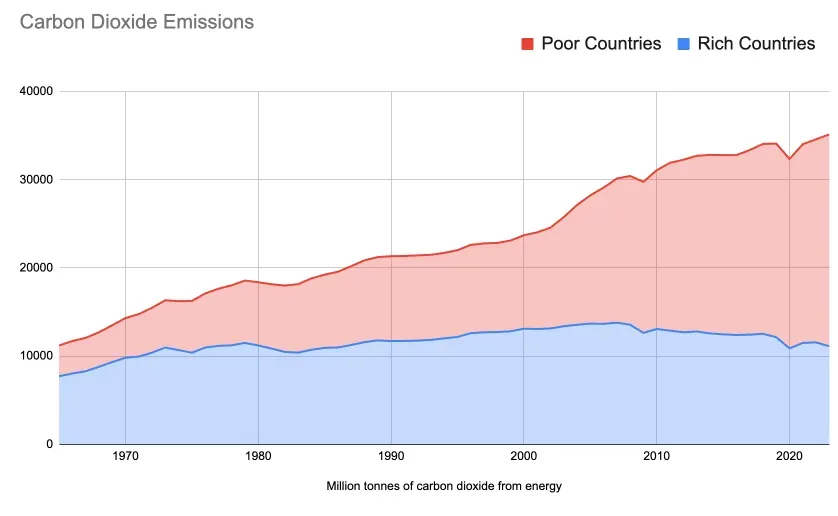
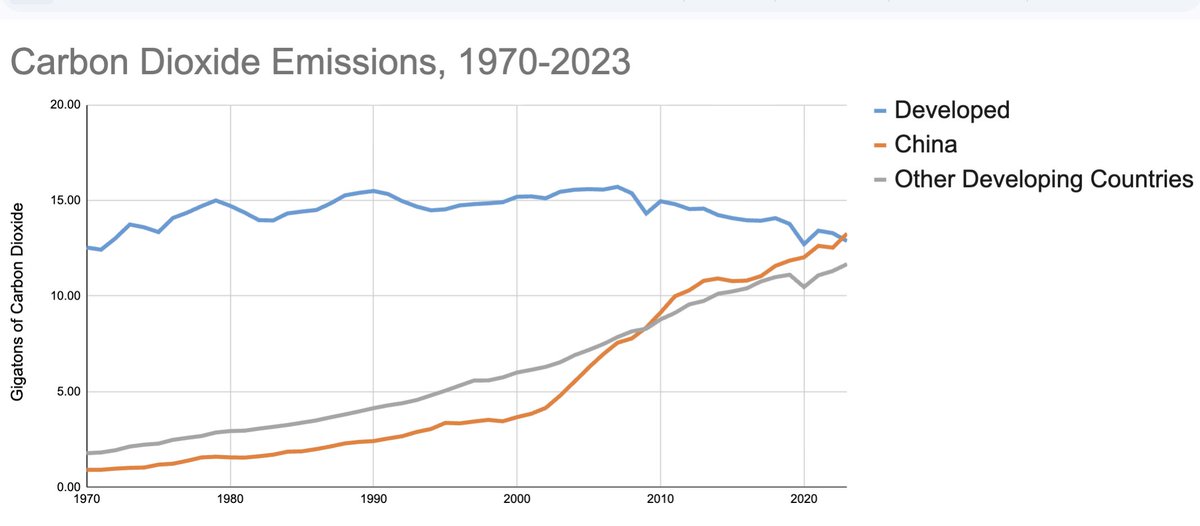
Rich country CO2 emissions peaked at 15.7 billion tons in 2007 and fell to 12.9 billion tons in 2023 (the most recent year we have statistics for.)
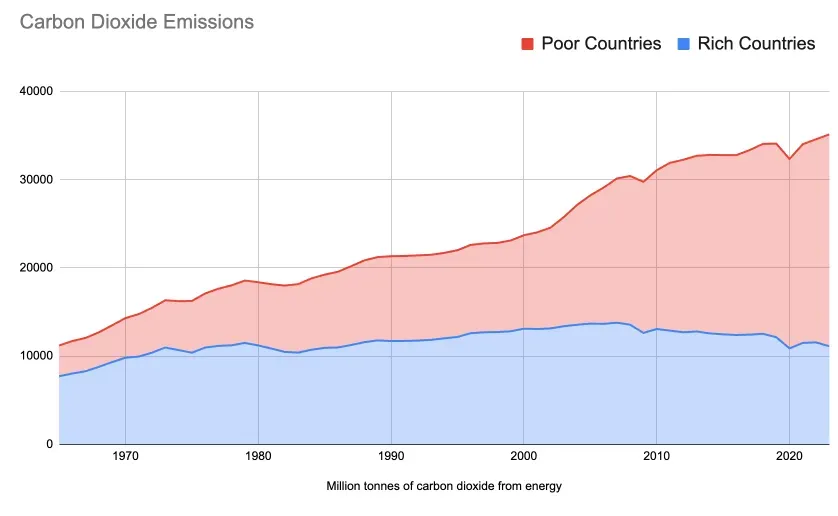
Poor country emissions rose from 15.4 to 24.9 billion tons in the same period.
It’s tempting to think poor country emissions are going up so quickly because the rich countries deindustrialized and moved their industrial emissions to the developing world.
In reality, ut the vast bulk of China’s emissions come from products and services consumed in China.
Billions of people in the developing world are transitioning from deep poverty into something like the global lower middle class.
This is *great* news.
It has obvious climate implications, though.
China now emits more carbon dioxide than all the developed countries put together.
It also emits more than all the other developing countries put together.
Keep shouting yourselves hoarse about the Endangerment Finding if you want but what happens in the U.S. is beside the point.
We want a villain we can properly hate. We want Climate Justice to mean sticking it to capitalist pigs, not reckoning with the fact that emissions are rising because billions of the world’s poorest people have lives incomparably better than their parents did.
In 1970, two thirds of climate emissions came from rich countries, one third from poor countries.
By 2024, those proportions had flipped.
Nobody talks about this.
https://t.co/ZixvdyXnzH
Rich country narcissism insists on making climate about us. Except…it isn’t about us.
Developed country emissions are falling, slowly.
But that fall is swamped by the billions of people who used to consume almost nothing, and now consume just a little bit.
Individually, each of person who rises from extreme poverty into the global lower middle class emits a fraction of the greenhouse gases the average person in a rich country emits. But there are billions of them. And their fast-rising emissions swamp our slow-falling ones.
For lots of carbon removal people, the working assumption is that the way you get to an iPhone is by making a Newton 10% better year after year.
That’s…not how this works.
The carbon removal sector that exists blinds us to the shape of the one that will exist. To get to genuinely low-cost removals, we need to be a bit ruthless. Devoting more time and more money to elegant approaches that won’t scale isn’t going to do the climate a lick of good.
Carbon dioxide removal is in its Newton era.
We have a bunch of clunky technologies that aren’t it, and we spend a lot of time trying to perfect them.
Multi-gigaton carbon removal is not going to happen by making DAC fans 15% more efficient.
Reports like this aren't sexy, obviously. The Ocean Visions frameework won't get covered. Too bureaucratic. But *this*, not the next shiny PR exercise by EnormoCorp or feel-bad push from some environmental scold, is how we actually beat climate change.
https://t.co/5NF7MorqAz
Ocean Visions makes the case that investigating the ocean's biological carbon pump is a top priority: We need 10 gigatons of CDR per year by 2050. We're nowhere close. No other CDR approach combines scalability with affordability like phytoplankton does.
https://t.co/5NF7MorqAz
Ocean Visions workshopped this report with 67 experts at their Vancouver summit, refined it through 56 expert comments in a 30-day public period, and guided it with an international advisory board.
Proper research infrastructure.
https://t.co/5NF7MorqAz
Ocean Visions' umbrella term "Phytoplankton Carbon Solutions" goes way beyond old-school iron fertilization: nitrogen-fixation in subtropical waters, artificial upwelling, export enhancement, macronutrient approaches. This opens a much broader menu.
https://t.co/5NF7MorqAz