Exploring quietly Christian stories, thinkers, art, music. What it means to live faith in the quiet spaces and moments | 1 Thessalonians 4:11-12 | Psalm 46:10
Quiet Christianity is not the absence of noise, but the formation that persists within it.
For God is already at work beneath desire, deed, and direction.
(Philippians 2:12-13)
#QuietChristianity#QuietChristian
This is absolutely brilliant from Laurence Fox
It's a perfect moment to demonstrate not only how intolerant Islam is but also it proves the entire Oxford Union audience know as well despite pretending otherwise
Laurence is about to unveil an image of the Prophet Muhammad, the whole audience are in suspense, there are interruptions, they plead with him, they try to shut him down, the rules come out, there is an intake of breath
You can tell the room is completely on edge from this!
Because they know if he does, his life will be at risk and the Oxford Union may well be at risk too from the supposedly tolerant religion the other side are defending
Proving Laurence's point, that Islam is not compatible with our society at all
I won't ruin what happens you will have to watch for yourselves but Laurence's trick here is absolutely brilliant and well worth 3 minutes of your time
Enjoy
And @LozzaFox take a bow sir 👏
Jeff Shafer argues that a series of Supreme Court decisions—from Griswold and Eisenstadt to Roe and Casey—systematically severed the natural connections between sex, marriage, and children. In his view, the law progressively redefined these realities as independent of one another rather than as parts of an integrated whole.
Shafer contends that the result is a legal vision in which sex is ideally understood as sterile, family relationships become increasingly fragmented, and human freedom is defined by the power to redefine reality itself.
Watch the full conversation here: https://t.co/XvNmwtUex6
I get to write short stories, picture book manuscripts, and new musical settings for the Psalms, and hone my photographic eye, BECAUSE I have a day job. This is 100% spot-on.
Christianity is a religion for women falls apart the moment you find out how the Church actually defines effeminacy.
Aquinas gave it a name. Mollities. Softness. He was not talking about a soft body or a gentle temperament. He was describing a man who will not surrender a pleasure or endure a difficulty for the sake of something higher. A man who folds the second the work stops feeling good.
Sit with that definition and think about who it describes. The man who cannot fast for one day. Who cannot get up when the alarm goes. Whose word dissolves the moment keeping it costs him something. That is effeminacy in the Catholic tradition, and it usually belongs to the loudest man in the comments telling you the faith is for women.
The Stoics wanted the passions dead. Augustine went after them for it, because a man with no anger in the face of real evil has not achieved mastery, he has gone numb. Aquinas says the same thing. The absence of anger where anger is owed is a defect in reason, not a sign of holiness. Your aggression, your appetite, your drive to conquer something are all meant to stay alive and stay under command.
So the training, the fasting, the rule of life you keep when nobody is watching, all of it is you taking the reins of something already strong and aiming it at the highest good. That is the whole project. Nothing about it is soft.
This is an excellent commentary by Stephen LeDrew regarding Carney.
“When it’s talking about getting serious work done, I think we may have a Prime Minister who doesn’t know politics, who thinks he’s running a bank, who has given all kinds of benefits to certain friends…he doesn’t have the character necessary to be a successful Prime Minister to lead this country out of the malaise that it’s been in since 2015”
The gun is the most misunderstood object in Western civilization. Not a weapon. A technology. The technology that made the idea of equality physically real.
1. The longbow democratized warfare – a peasant could kill a knight with a stick and a string, and Agincourt proved it. The gun completed the process. The armored warrior class whose claim to social dominance rested on physical superiority became obsolete. The aristocratic monopoly on violence ended not with a philosophy but with a mechanism. The gun is the physical enforcement of the idea that all men are created equal. Which is why the American founders put it in the second amendment – not as an afterthought, but as the guarantee of everything else.
2. The Roman citizen had the right to bear arms. The Greek citizen had it. The English yeoman had it. The Swiss canton built its entire civilization on it. The disarming of the population has always been, in every civilization, in every century, the first act of the government that intends to stop being answerable to that population. Show me a disarmed population and I will show you a population that lost something else shortly after.
3. The Second Amendment is not about hunting. It is not about sport. It is about the relationship between the armed citizen and the state – the explicit constitutional acknowledgment that the citizen’s right to defend himself, his family, and his civilization against any threat, including the government itself, is not granted by the state and cannot be revoked by it. Power flows upward from the armed citizen, not downward from the armed state.
4. The gun defends the family. The woman alone with her children. The farmer on the edge of civilization. The shopkeeper in the neighborhood the police no longer patrol. The gun is the equalizer – the technology that makes the physical difference between a large man and a small woman irrelevant. Every argument for disarmament is, at its core, an argument that the state will protect you better than you can protect yourself. The evidence for this proposition is not encouraging.
5. In Europe, the disarmament is now nearly complete – and it happened precisely as the state’s ability and willingness to protect its citizens began to decline. The timing is not coincidental. A population that cannot defend itself must trust the state to defend it – which is a population that cannot effectively question whether the state is doing so. The dependency is the design.
6. The gun is a civilizational technology in the deepest sense: it requires responsibility, judgment, and the willingness to accept the consequences of your decisions. You cannot outsource it. You cannot have a committee fire it. It is the most anti-bureaucratic object ever invented – a direct, personal, consequential instrument that puts the full weight of the decision on the individual holding it. Which is precisely why the administrative state finds it intolerable. Not because it is dangerous. Because it is sovereign.
7. The family that can defend itself does not depend on the state for its most fundamental security. The civilization that can defend itself has not yet outsourced its survival to an institution that will negotiate the terms of that survival on its own behalf. The gun determines who controls violence – and therefore who controls everything that violence can threaten. Which is everything. The Sobieski who rode down the hill had a sword and sixty thousand horsemen. The equivalent today is the armed citizen who understands what he is defending and why. Every civilization that forgot this discovered it the hard way. The ones that remembered it are still here.
Jesus presented an unprecedented anomaly in intellectual history. Barely in his early thirties, he delivered a body of moral philosophy so structurally cohesive and psychologically devastating that it remains unmatched.
Profound moral philosophy almost always belongs to the old. Kant, Aristotle, and Confucius were all in their fifties and sixties when framing their ethical systems because understanding the human heart requires decades of friction, trial, and observed failure.
Yet on a hillside in Galilee, a young carpenter laid out a system of relational ethics that locks into his broader corpus with zero trial and error.
That level of structural consistency across human psychology usually only exists at the end of a long life. Which is further proof that he had to be God.
In Matthew 5, Jesus declares that the poor in spirit inherit the kingdom. In Matthew 7, he commands, "Judge not, so that you will not be judged." These are not disconnected proverbs; they are one continuous argument.
The poor in spirit cannot judge because they exist in a state of perpetual awareness of the depths of their own moral rot and complete lack of standing before God. That awareness isn't a feeling, it is a settled posture that makes contempt structurally impossible.
But Matthew 7:3–5 is where his brilliance becomes outrageous. Jesus asks “how you can look at a speck of sawdust in your neighbor's eye while ignoring the plank in your own”.
The claim is deliberate and jurisdictional.
Anything obstructing your vision is fundamentally greater than whatever is troubling your neighbor because it is yours. You carry it, it blinds you, and you will answer for it. Another man's speck cannot do that to you.
You cannot argue, "In this instance, my flaw is objectively smaller." Jesus forecloses that loop. Dispositionally and jurisdictionally, your own rot is always the primary crisis.
Why? Because of what that perception does to the human soul.
Verse 5 tells us to first remove your plank so you can see clearly to assist your neighbor.
But consider what it actually takes to pull a plank out of your own eye. It is painful, exhausting, and transformative.
The man who skips that process to pick at someone else's speck operates out of cheap superiority. But the man who has spent the morning bleeding over his own plank approaches his neighbor with profound warmth: "Brother, I have far, far bigger problems than you."
That shift changes everything because authentic empathy breeds trust. You do not allow a self-appointed prosecutor to touch your eye, but you will trust a fellow sufferer who approaches you dripping with the humble awareness of his own recovery.
Yet, in the very act of attempting that extraction, a second, deeper truth dawns on the man.
He realizes that the plank in his own eye is so vast, and his own sight so compromised, that he was never qualified to wield the scalpel in the first place.
This is the same logic Jesus deployed when he told the Pharisees that whoever is without sin should cast the first stone.
The agonizing labor of confronting your own rot does not produce a confident, self-righteous surgeon, it strips you of the appetite to prosecute entirely.
You drop the tools, lower your hands, and leave the soul to God, who is the remover of specks and planks alike.
This is the kind of immigrant story that actually makes Canada stronger.
A guy who escaped Iran as a kid in 1989 just laid it out plain and simple. He came here and was blown away that parades were about Santa, balloons, and kids having fun — not tanks and missiles. He blended in. He didn’t get offended by pork on the BBQ or rainbow flags. He embraced it.
Now he’s watching newcomers show up and try to bring the exact same poisonous crap they ran from — getting angry at Canadian traditions, shoving religion down everyone’s throat, refusing to participate in something as basic as handing out Halloween candy, and trying to change the rules instead of joining the country that welcomed them.
His message is simple: Canada opens its arms. The least you can do is assimilate and mind your own business. If you’re not here to become Canadian, he’ll personally buy you the plane ticket home.
This is the difference between real immigration that built this country and the current mess that’s fracturing it. One group wanted to join Canada. The other wants to turn Canada into the place they fled.
We need more of the first kind. A lot less of the second.
#cdnpoli #Immigration #Assimilation #CanadaFirst #LiberalFail
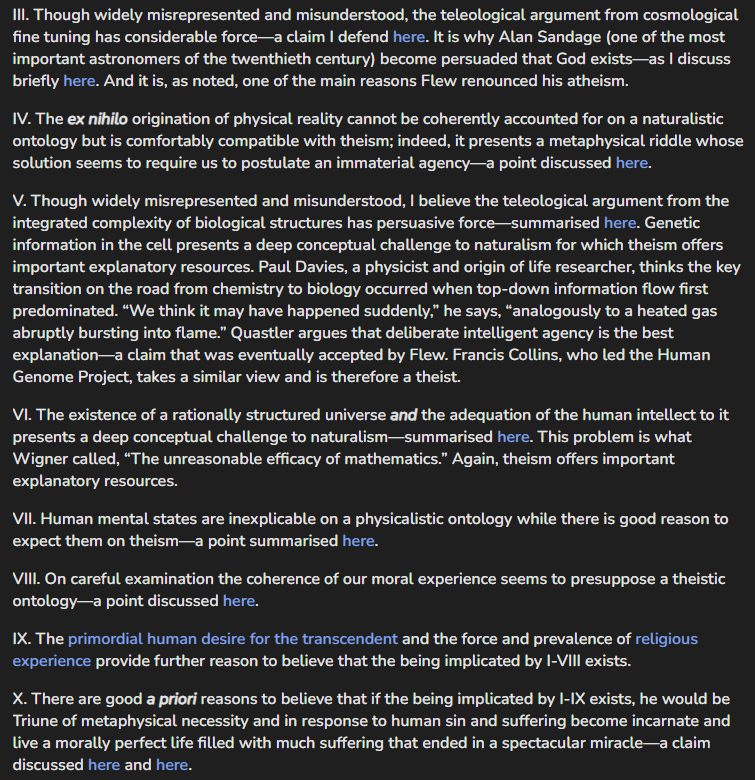
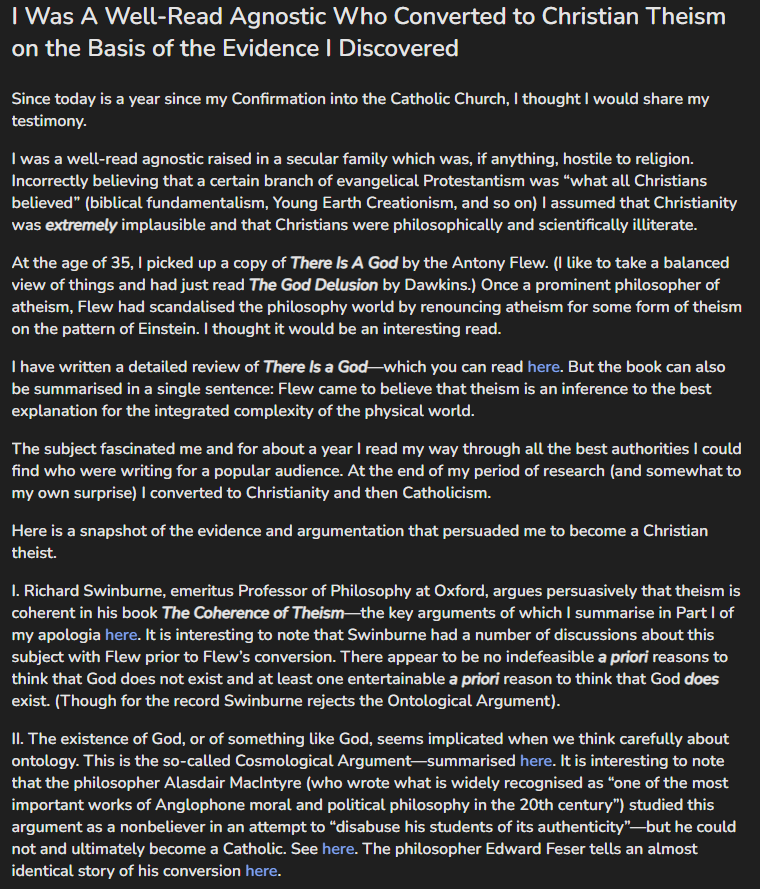
This post has now been deleted and is more than a decade old, but it was one of the few things that got me interested in serious analytic philosophy of religion:
Reading how a well-read agnostic converted to Catholicism primarily from reading Richard Swinburne.
I cannot stress what a PR win it is for Christianity that I keep running into people who are strangely generous and patient, and then I inevitably discover that they're regular church-goers.
"Diversity, equity and inclusion" is classic Marxist doublespeak.
"How can you oppose diversity?"
"What is wrong with an equitable society?"
"Don't you value inclusiveness?"
As with all Marxist ideologies, the theory and the practice diverge wildly.
In theory, DEI sounds virtuous.
In practice, it is a racist, sexist, bigoted, discriminatory doctrine that destroys diversity of thought, is wholly inequitable and is exclusionary in the extreme.
Marxists gain power by hijacking the meanings of words to serve their own nefarious ends. Don't let them.
Someone approached me last week and said that I spend too much time talking about problems, and not enough about solutions. So here are the solutions. You may notice they’re extremely simple, because our problem has never been a lack of fixes, it’s people who refuse to see them.
The biggest lesson I learned in intelligence had nothing to do with secrets. People often assume intelligence is about having access to classified information. It isn't.
The best intel officers I worked with weren't successful because they knew more than everyone else. They were successful because they noticed the little things that others overlooked.
Before the attacks on September 11th, there were clues. Before COVID became a global pandemic, there were clues. Before Russia invaded Ukraine, there were clues. Before the Taliban rapidly retook Afghanistan, there were clues.
The problem wasn't that there was no information. The problem was that the information wasn't connected, prioritized, or ACTED upon.
Good intelligence starts by asking different questions.
What changed?
What's missing?
Why now?
Who benefits?
Those same questions matter just as much outside the intelligence world.
Whether you're evaluating a news story, making a business decision, preparing for hurricane season, or simply trying to understand what's happening around you, the goal isn't to know everything. It's to recognize patterns before everyone else does.
One unusual event rarely tells you much. But when several small indicators all begin pointing in the same direction, that's when you should pay attention. Your goal is not to predict the future, it's to reduce a surprise.
The next time a major story breaks, don't immediately ask whether it's true or false.
Ask:
(1) What do we actually know?
(2) What information is still missing?
(3) Who benefits from this narrative?
(4) Has something like this happened before?
(5) What would change my mind?
Most people consume information.
Think like an analyst instead.
The world doesn't need more opinions. It needs more people willing to slow down, ask better questions, and pay attention.
A grammar book walks into a bar
* An Oxford comma walks into a bar, where it spends the evening watching the television, getting drunk, and smoking cigars.
* A dangling participle walks into a bar. Enjoying a cocktail and chatting with the bartender, the evening passes pleasantly.
* A bar was walked into by the passive voice.
* An oxymoron walked into a bar, and the silence was deafening.
* Two quotation marks walk into a “bar.”
* A malapropism walks into a bar, looking for all intents and purposes like a wolf in cheap clothing, muttering epitaphs and casting dispersions on his magnificent other, who takes him for granite.
* Hyperbole totally rips into this insane bar and absolutely destroys everything.
* A question mark walks into a bar?
* A non sequitur walks into a bar.
In a strong wind, even turkeys can fly.
* Papyrus and Comic Sans walk into a bar. The bartender says, "Get out -- we don't serve your type."
* A mixed metaphor walks into a bar, seeing the handwriting on the wall but hoping to nip it in the bud.
* A comma splice walks into a bar, it has a drink and then leaves.
* Three intransitive verbs walk into a bar. They sit. They converse. They depart.
* A synonym strolls into a tavern.
* At the end of the day, a cliché walks into a bar -- fresh as a daisy, cute as a button, and sharp as a tack.
* A run-on sentence walks into a bar it starts flirting. With a cute little sentence fragment.
* Falling slowly, softly falling, the chiasmus collapses to the bar floor.
* A figure of speech literally walks into a bar and ends up getting figuratively hammered.
* An allusion walks into a bar, despite the fact that alcohol is its Achilles heel.
* The subjunctive would have walked into a bar, had it only known.
* A misplaced modifier walks into a bar owned by a man with a glass eye named Ralph.
* The past, present, and future walked into a bar. It was tense.
* A dyslexic walks into a bra.
* A verb walks into a bar, sees a beautiful noun, and suggests they conjugate. The noun declines.
* A simile walks into a bar, as parched as a desert.
* A gerund and an infinitive walk into a bar, drinking to forget.
* A hyphenated word and a non-hyphenated word walk into a bar and the bartender nearly chokes on the irony .
– Jill Thomas Doyle
It's tempting to think that God offers grace and then waits to see whether we will make ourselves receptive to it. But grace doesn’t begin where our cooperation begins. Grace precedes even our desire to receive grace. It awakens us, prepares us, moves us, heals us, and enables our free cooperation. Our cooperation is real. Our resistance is real. But every movement toward God already begins with God.
The human heart isn’t like ordinary soil. Hardened paths can be broken open. Stones can be removed. Thorns can be cut back. Barren ground can be cultivated. But the soil doesn’t cultivate itself. Christ is not only the Sower who scatters the seed; He also prepares the ground and brings the seed to fruit. No soil is beyond His power to cultivate. No soul is beyond His power to transform. No life is beyond His redemption.
In Young Washington, George Washington is shown studying a book on manners and the rules of civility. That's a real book Washington copied by hand as a teenager. Here are those rules:
1. Every action done in company ought to be with some sign of respect to those that are present.
2. When in company, put not your hands to any part of the body not usually discovered.
3. Show nothing to your friend that may affright him.
4. In the presence of others, sing not to yourself with a humming noise, nor drum with your fingers or feet.
5. If you cough, sneeze, sigh, or yawn, do it not loud but privately; and speak not in your yawning, but put your handkerchief or hand before your face and turn aside.
6. Sleep not when others speak, sit not when others stand, speak not when you should hold your peace, walk not on when others stop.
7. Put not off your clothes in the presence of others, nor go out your chamber half dressed.
8. At play and at fire, it’s good manners to give place to the last comer, and affect not to speak louder than ordinary.
9. Spit not in the fire, nor stoop low before it; neither put your hands into the flames to warm them, nor set your feet upon the fire especially if there be meat before it.
10. When you sit down, keep your feet firm and even, without putting one on the other or crossing them.
11. Shift not yourself in the sight of others nor gnaw your nails.
12. Shake not the head, feet, or legs; roll not the eyes; lift not one eyebrow higher than the other; wry not the mouth, and bedew no man’s face with your spittle by approaching too near him when you speak.
13. Kill no such vermin as fleas, lice ticks in the sight of others; if you see any filth or thick spittle put your foot dexterously upon it; if it be upon the clothes of your companions, put it off privately, and if it be upon your own clothes, return thanks to him who puts it off.
14. Turn not your back to others especially in speaking; jog not the table or desk on which another reads or writes; lean not upon anyone.
15. Keep your nails clean and short, also your hands and teeth clean yet without showing any great concern for them.
16. Do not puff up the cheeks, loll not out the tongue, rub the hands, or beard, thrust out the lips, or bite them or keep the lips too open or too close.
17. Be no flatterer, neither play with any that delights not to be played withal.
18. Read no letters, books, or papers in company; but when there is a necessity for the doing of it, you must ask leave; come not near the books or writings of another so as to read them unless desired, or give your opinion of them unasked; also look not nigh when another is writing a letter.
19. Let your countenance be pleasant, but in serious matters somewhat grave.
20. The gestures of the body must be suited to the discourse you are upon.
21. Reproach none for the infirmities of nature, nor delight to put them that have in mind thereof.
22. Show not yourself glad at the misfortune of another, though he were your enemy.
23. When you see a crime punished, you may be inwardly pleased; but always show pity to the suffering offender.
24. Do not laugh too loud or too much at any public spectacle.
25. Superfluous compliments and all affectation of ceremony are to be avoided, yet where due they are not to be neglected.
26. In pulling off your hat to persons of distinction, as noblemen, justices, churchmen etc, make a reverence, bowing more or less according to the custom of the better bred, and quality of the person; amongst your equals expect not always that they should begin with you first, but to pull off the hat when there is no need is affectation; in the manner of saluting and re-saluting in words keep to the most usual custom.
27. 'Tis ill manners to bid one more eminent than yourself be covered, as well as not to do it to whom it's due; likewise he that makes too much haste to put on his hat does not well, yet he ought to put it on at the first, or at most the second time of being asked; now what is herein spoken, of qualification in behavior in saluting, ought also to be observed in taking of place, and sitting down for ceremonies without bounds is troublesome.
28. If anyone come to speak to you while you are sitting, stand up though he be your inferior, and when you present seats, let it be to everyone according to his degree.
29. When you meet with one of greater quality than yourself, stop, and retire especially if it be at a door or any straight place to give way for him to pass.
30. In walking. the highest place in most countries seems to be on the right hand, therefore place yourself on the left of him whom you desire to honor: but if three walk together, the middle place is the most honorable; the wall is usually given to the most worthy if two walk together.
31. If any one far surpasses others either in age, estate, or merit, yet would give place to a meaner than himself, in his own lodging or elsewhere, the one ought not to accept it, so he on the other part should not use much earnestness nor offer it above once or twice.
32. To one that is your equal, or not much inferior, you are to give the chief place in your lodging; and he to whom ‘tis offered ought at the first to refuse it, but at the second to accept, though not without acknowledging his own unworthiness.
33. They that are in dignity or in office have in all places precedence, but whilst they are young they ought to respect those that are their equals in birth or other qualities, though they have no public charge.
34. It is good manners to prefer them to whom we speak before ourselves, especially if they be above us, with whom in no sort we ought to begin.
35. Let your discourse with men of business be short and comprehensive.
36. Artificers and persons of low degree ought not to use many ceremonies to lords or others of high degree, but respect and highly honor them, and those of high degree ought to treat them with affability and courtesy, without arrogance.
37. In speaking to men of quality, do not lean nor look them full in the face, nor approach too near them; at least keep a full pace from them.
38. In visiting the sick, do not presently play the physician if you do not know therein.
39. In writing or speaking, give to every person his due title according to his degree and the custom of the place.
40. Strive not with your superiors in argument, but always submit your judgment to others with modesty.
41. Undertake not to teach your equal in the art himself professes; it savors of arrogance.
42. Let thy ceremonies in courtesy be proper to the dignity of his place with whom thou converses, for it is absurd to act the same with a clown and a prince.
43. Do not express joy before one sick or in pain, for that contrary passion will aggravate his misery.
44. When a man does all he can, though it succeeds not well, blame not him that did it.
45. Being to advise or reprehend any one, consider whether it ought to be in public or in private, presently or at some other time, in what terms to do it, and in reproving show no sign of choler but do it with all sweetness and mildness.
46. Take all admonitions thankfully in what time or place so ever given; but afterwards, not being culpable, take a time and place convenient to let him know it that gave them.
47. Mock not nor jest at anything of importance; break no jest that are sharp biting; and if you deliver anything witty and pleasant, abstain from laughing thereat yourself.
48. Wherein you reprove another, be unblameable yourself; for example is more prevalent than precepts.
49. Use no reproachful language against anyone; neither curse nor revile.
50. Be not hasty to believe flying reports to the disparagement of any.
51. Wear not your clothes foul, ripped, or dusty, but see they be brushed once every day at least, and take heed that you approach not to any uncleanness.
52. In your apparel be modest and endeavor to accommodate nature, rather than to procure admiration; keep to the fashion of your equals such as are civil and orderly with respect to times and places.
53. Run not in the streets; neither go too slowly nor with mouth open; go not shaking your arms; kick not the earth with your feet; go not upon the toes, nor in a dancing fashion.
54. Play not the peacock, looking everywhere about you to see if you be well-decked, if your shoes fit well if your stockings sit neatly, and clothes handsomely.
55. Eat not in the streets, nor in the house, out of season.
56. Associate yourself with men of good quality if you esteem your own reputation; for 'tis better to be alone than in bad company.
57. In walking up and down in a house, only with one in company if he be greater than yourself, at the first give him the right hand and stop not till he does and be not the first that turns, and when you do turn let it be with your face towards him; if he be a man of great quality, walk not with him cheek by jowl but somewhat behind him; but yet in such a manner that he may easily speak to you.
58. Let your conversation be without malice or envy, for 'tis a sign of a tractable and commendable nature; and in all causes of passion admit reason to govern.
59. Never express anything unbecoming, nor act against the rules moral before your inferiors.
60. Be not immodest in urging your friends to discover a secret.
61. Utter not base and frivolous things amongst grave and learned men; nor very difficult questions or subjects among the ignorant; or things hard to be believed; stuff not your discourse with sentences amongst your betters nor equals.
62. Speak not of doleful things in a time of mirth or at the table; speak not of melancholy things as death and wounds; and if others mention them, change if you can the discourse; tell not your dreams but to your intimate friend.
63. A man ought not to value himself of his achievements or rare qualities of wit; much less of his riches, virtue, or kindred.
64. Break not a jest where none take pleasure in mirth; laugh not aloud, nor at all without occasion; deride no man’s misfortune, though there seem to be some cause.
65. Speak not injurious words neither in jest nor earnest; scoff at none although they give occasion.
66. Be not forward but friendly and courteous; the first to salute; hear and answer and be not pensive when it's a time to converse.
67. Detract not from others; neither be excessive in commanding.
68. Go not thither where you know not whether you shall be welcome or not. Give not advice without being asked; and when desired, do it briefly.
69. If two contend together, take not the part of either unconstrained; and be not obstinate in your own opinion; in things indifferent, be of the major side.
70. Reprehend not the imperfections of others, for that belongs to parents, masters, and superiors.
71. Gaze not on the marks or blemishes of others and ask not how they came. What you may speak in secret to your friend, deliver not before others.
72. Speak not in an unknown tongue in company, but in your own language and that as those of quality do, and not as the vulgar; sublime matters, treat seriously.
73. Think before you speak; pronounce not imperfectly nor bring out your words too hastily, but orderly and distinctly.
74. When another speaks, be attentive yourself and disturb not the audience; if any hesitate in his words, help him not nor prompt him without desired; interrupt him not, nor answer him till his speech be ended.
75. In the midst of discourse. ask not of what one treateth, but if you perceive any stop because of your coming, you may well entreat him gently to proceed; if a person of quality comes in while you’re conversing, it's handsome to repeat what was said before.
76. While you are talking, point not with your finger at him with whom you discourse; nor approach too near to whom you talk, especially to his face.
77. Treat with men at fit times about business, and whisper not in the company of others.
78. Make no comparisons, and if any of the company be commended for any brave act of virtue, commend not another for the same.
79. Be not apt to relate news if you know not the truth thereof. In discoursing of things you have heard, name not your author always; a secret discover not.
80. Be not tedious in discourse or in reading unless you find the company pleased therewith.
81. Be not curious to know the affairs of others; neither approach those that speak in private.
82. Undertake not what you cannot perform, but be careful to keep your promise.
83. When you deliver a matter, do it without passion and with discretion, however mean the person be you do it too.
84. When your superiors talk to anybody, hearken not; neither speak nor laugh.
85. In company of those of higher quality than yourself, speak not 'til you are asked a question; then stand upright, put off your hat and answer in few words.
86. In disputes, be not so desirous to overcome as not to give liberty to each one to deliver his opinion; and submit to the judgment of the major part, especially if they are judges of the dispute.
87. Let thy carriage be such as becomes a man: grave, settled, and attentive to that which is spoken. Contradict not at every turn what others say.
88. Be not tedious in discourse, make not many digressions, nor repeat often the same manner of discourse.
89. Speak not evil of the absent, for it is unjust.
90. Being set at meat, scratch not, neither spit, cough, or blow your nose except when there's a necessity for it.
91. Make no show of taking great delight in your victuals; feed not with greediness; cut your bread with a knife; lean not on the table; neither find fault with what you eat.
92. Take no salt or cut bread with your knife greasy.
93. Entertaining anyone at the table, it is decent to present him with meat; undertake not to help others undesired by the master.
94. If you soak bread in the sauce, let it be no more than what you put in your mouth at a time; and blow not your broth at table, but stay till it cools of itself.
95. Put not your meat to your mouth with your knife in your hand; neither spit forth the stones of any fruit pie upon a dish, nor cast anything under the table.
96. It's unbecoming to stoop much to one’s meat; keep your fingers clean, and when foul, wipe them on a corner of your table napkin.
97. Put not another bit into your mouth till the former is swallowed. Let not your morsels be too big for the jowls.
98. Drink not nor talk with your mouth full; neither gaze about you while you are drinking.
99. Drink not too leisurely nor yet too hastily. Before and after drinking, wipe your lips; breathe not then or ever with too great a noise, for it’s uncivil.
100. Cleanse not your teeth with the table cloth napkin, fork, or knife; but if others do it, let it be done without a peep to them.
101. Rinse not your mouth in the presence of others.
102. It is out of use to call upon the company often to neither eat; nor need you drink to others every time you drink.
103. In the company of your betters, be not longer in eating than they are; lay not your arm but only your hand upon the table.
104. It belongs to the chiefest in company to unfold his napkin and fall to meat first, but he ought then to begin in time and to dispatch with dexterity that the slowest may have time allowed him.
105. Be not angry at the table whatever happens, and if you have reason to be so, show it not; put on a cheerful countenance, especially if there be strangers, for good humor makes one dish of meat a feast.
106. Set not yourself at the upper of the table; but if it were your due, or that the master of the house will have it so, contend not, lest you should trouble the company.
107. If others talk at the table, be attentive but talk not with meat in your mouth.
108. When you speak of god or his attributes, let it be seriously and with reverence. Honor and obey your natural parents although they are poor.
109. Let your recreations be manful, not sinful.
110. Labor to keep alive in your breast that little spark of celestial fire called conscience.
So are you racist, or ignorant?
Those are genuinely the only two options on the table, and I ask as a science teacher who assigns exactly this reading. The minimum wage — the policy you are waving around like a moral trophy — was BUILT to hurt the very people you claim to be fighting for. That is not a hot take. That is the documented historical record. So either you do not know it (ignorant), or you know it and you are pushing it anyway (worse than ignorant).
Let me teach the class you apparently skipped.
Princeton economist Thomas Leonard spent an entire career documenting this. Progressive economists — the intellectual grandparents of your caucus — championed wage floors specifically to price "unemployables" out of the labor market. Their word. Not mine. And "unemployables" meant Black Americans, immigrants, and the disabled. Then came the Davis-Bacon Act of 1931, pushed by Southern Democrats and union bosses who were furious that Black construction workers kept winning federal contracts by accepting competitive wages. Representative Martin Dies said it out loud, on the House floor, in the Congressional Record: you cannot prescribe the same wages for the Black man as the white man. The FLSA of 1938 then conveniently excluded farm and domestic work — the exact sectors where Black labor was concentrated in the Jim Crow South. Milton Friedman, a Nobel laureate and not exactly a wild-eyed radical, called it "the most anti-Negro law on our statute books." That was 1966. So. Racist, or ignorant? Take your time.
Now the part where your heart is supposedly in the right place. It is not helping a single soul. A sixteen-year-old with zero skills and an empty resume is HIRABLE at $7.25. That same kid is UNEMPLOYABLE at $15, because no business on this green Earth pays forty-two grand a year for someone who needs six months of training before they produce a dime of value. Two-thirds of more than a hundred studies (Neumark and Wascher) found negative employment effects. South Carolina: wage hikes cut teen employment by 8.9 percent, and cut it for workers without a high school diploma by 15.5 percent. The CBO said a $17 floor knocks 350,000 people OUT of the labor force entirely. Not up into better jobs. Out.
Here is the revolutionary concept the crayon-eating wing of economic policy cannot seem to grasp, bless the collective heart: wages are a VOLUNTARY agreement. A worker accepts what a business offers. If nobody accepts, the business raises the offer or it folds. McDonald's already pays well above your sacred $7.25, and they will happily tell you the crew job is a STEPPING STONE, not a life sentence. Walmart store managers clear six figures with no college debt. The ladder works fine. You are the one sawing off the bottom rung with a smile and calling the sawdust "a decent quality of life."
And I have to ask what I ask every Democrat, so here it is: what have you actually DONE for the people of Pennsylvania? Because from the cheap seats, the whole pitch is another handout, another dependency, another rung deleted — and a dependent population that has nowhere left to vote but back to you. The antebellum South needed a captive underclass to keep one party in power. The chains got swapped for talking points. The math did not budge an inch. Quinn's First Law of Liberalism, stated plainly: liberalism always generates the exact opposite of its stated intent. You set out to lift the low-wage worker, and you erase his first job. Every single time.
Somewhere a village is short one economist, and I think we found where. The elevator on this policy never left the basement, and you keep mashing the button expecting a penthouse. Running on dial-up in a fiber-optic world. 404: labor economics not found.
But what do I know. I am only a science teacher who actually read Thomas Leonard, the Congressional Record, and the CBO score instead of getting my economics from a caucus meme with a stock photo.
@JoJoFromJerz@atrupar@TheYoungTurks
#MAGA #Veterans #Trump