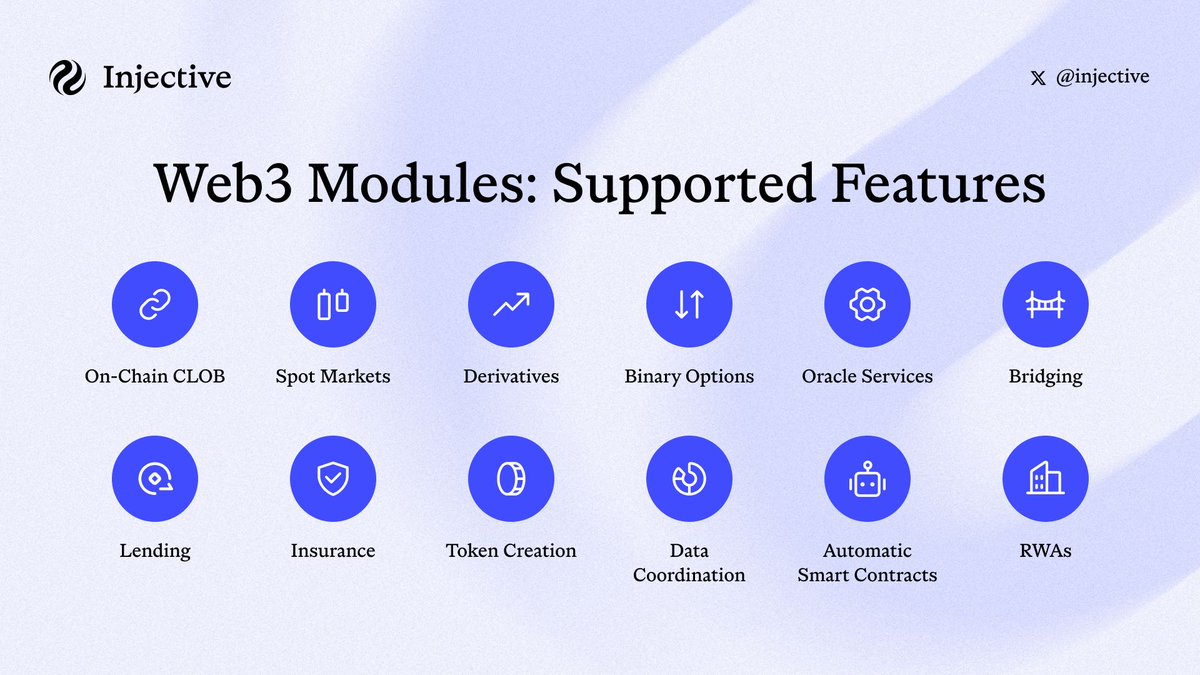
Today we are launching the Injective Ecosystem Page!
Explore 270+ apps, projects and partners integrated with Injective. The page will serve as a starting point for all users and builders who want to pariticpate onchain with $INJ
https://t.co/iWKkjiOmej
I’m buying $INJ
Here’s why I’m bullish
1. RWA Growth
Injective has surpassed $1B in tokenized real-world assets, placing it among the top 10 RWA chains
They’re also launching Injective Mint, allowing institutions to tokenize stocks and other assets with ease
The goal? Become a top-five RWA chain.
2. Native Privacy
Injective is developing CypherOS, bringing privacy to RWAs, perpetual futures, and options.
Privacy will be essential for institutional adoption, and Injective is positioning itself ahead of that demand.
3. Cross-Chain Expansion
$INJ has expanded to Solana with 10+ dApp integrations.
The team is also targeting NEAR and potential Robinhood integrations while bringing assets like TRON, Zcash, and Cardano onto Injective.
More accessibility = more liquidity and potential demand.
4. Major Institutional Partnerships
Injective has established relationships with some of Asia’s largest companies:
• NTT — Japan
• POSCO — South Korea
• LG — South Korea
• Gulf — Thailand
They’re also working with @Securitize to bring four major funds onto Injective, including VanEck and Hamilton Lane.
The long-term goal is to make these tokenized assets usable as collateral in DeFi 👀
5. ETFs & Regulation
Injective has been pursuing INJ ETFs, potentially opening the door to traditional investors.
Their transfer-agent regulatory initiative could also provide an advantage in bringing tokenized securities onchain.
6. Stablecoin Liquidity
Injective is working with Circle to expand native USDC across Cosmos and dYdX, targeting $100M+ in potential stablecoin liquidity.
Combined with EVM support and major bridge integrations, the ecosystem is becoming much more accessible.
7. Tokenomics
This is one of my biggest reasons for buying.
$INJ’s original token allocation is fully unlocked. No more scheduled VC or insider vesting unlocks.
Unlike many newer L1s facing significant future unlocks, INJ has moved past that selling pressure.
It also has staking utility and a token burn mechanism tied to network activity.
So as their RWA adoption grows, tokenomics only get better with usage.
My thesis:
Injective is positioning itself to become a major player in tokenized finance while having attractive tokenomics and multiple catalysts ahead.
The key is turning these developments into real adoption and token demand.
I believe the market is underestimating what they’re building.
That’s why I’m buying $INJ.
NFA.
Today we are releasing the new Injective Whitepaper.
It is the first full rewrite since our original paper in December 2018, which described a front-running-resistant exchange protocol on Ethereum.
Eight years later, Injective has evolved greatly into becoming a layer-1 blockchain for institutional-grade finance and tokenization. Every layer of the protocol exists to issue real-world assets and give them real utility across markets, applications, and AI agents.
Inside the paper
→ Asset issuance. Native RWA tokenization with role-based permissions over mint, send, receive, and burn, plus programmable receive hooks and sealable namespaces
→ RWA exposure. iAssets, stablecoin-margined, oracle-priced derivatives that track external assets with no wrapping or pre-funding
→ Trading. Tokenized assets trade on a fully onchain CLOB where each block runs a sealed frequent batch auction at a uniform clearing price, resisting front-running and ordering MEV
→ Settlement. BFT consensus with a greater-than-two-thirds commit threshold delivers deterministic finality with ~600ms blocks
→ Composability. Native EVM and WASM in one canonical state, with the MultiVM Token Standard keeping a single bank-module balance per asset, exposed to Solidity through precompiles
→ Derivatives. Perpetuals with time-weighted premium funding, initial and maintenance margin checks, reduce-only liquidations, and insurance funds
→ Agentic finance. AI agents operate on tokenized assets through MCP servers, policy-bounded signing, and x402 machine payments in USDC
→ Value accrual. Onchain protocol revenue flows to the recurring Community BuyBack for $INJ
The paper formalizes each mechanism, from the consensus threshold and block lifecycle to the batch clearing rule, oracle accounting, derivative risk checks, permission model, and dynamic issuance controller.
From issuance to settlement, one chain built for the full lifecycle of tokenized finance.
Read it below.
The three engines behind Injective:
-> Tokenization
-> Perpetuals
-> Agentic Finance
A flywheel for the new internet economy powered by unmatched onchain infrastructure and regulated rails.
Most chains give developers a virtual machine and leave them to build the financial infrastructure themselves.
Injective starts with the infrastructure already embedded at the protocol level.
This way builders can focus on the product instead of rebuilding the market plumbing.
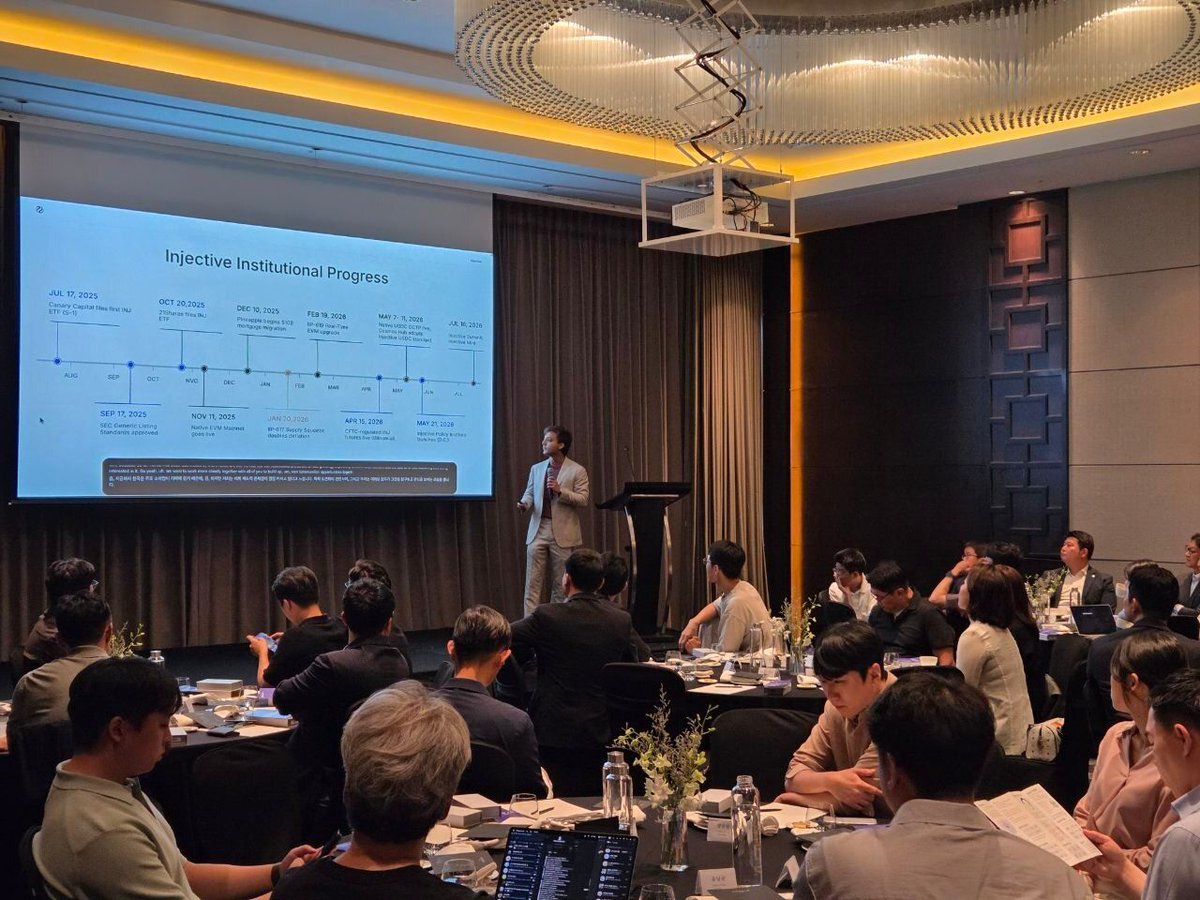
ICYMI: Injective brought more than 40 Korean institutions and local Web3 leaders together for a private lunch forum in Korea last week.
Executives from banks, securities firms, fintech companies, and asset managers heard our COO @mirza break down Injective’s institutional stack.
Until next time! 🇰🇷
ICYMI: Injective joined @lifiprotocol’s cross-chain network, placing the ecosystem within a routing layer that spans 60+ chains and 1,000+ applications.
The significance is distribution. Users now have more ways to move $INJ and native $USDC across Injective without navigating fragmented liquidity or separate bridging experiences.
Injective is becoming easier to access from anywhere onchain.
Institutions aren't asking "if" finance goes onchain anymore. They're choosing which chain to build on.
Most L1s weren't designed with institutional requirements in mind. Injective was.
Chain-level financial tooling, instant finality, near-zero fees, compliance-ready architecture: this is now table stakes for any chain that wants institutional capital flowing through it.
Perps started in crypto, but they are proving useful far beyond it.
Injective supports perpetual markets tied to equities, commodities, foreign exchange, indices, and private companies. Each market can use a reliable price feed and settle through the same fully onchain orderbook.
You should not need to build a new exchange every time you bring a new asset class online. That flexibility is what makes perps such a powerful market primitive.
Injective Ecosystem: Sunday Snapshot 🥷
Here is the $INJ pulse for August 9:
⛓️ Total Transactions: 3.02B
👥 Number of Wallets: 1.68M
📈 Market Cap: 537M
💎 Total Staked: 57M
🔥 INJ Burned: 7.2M
💸 Staking APR: 6.97%
New week, new goals. Let’s make it count, Ninjas. 🥂