“However you slice it, there’s a clear uptick in ODC financing, as investors get excited about this emerging application,” said @ChenrySpace
https://t.co/QstNdNRPlX
How long will it take to get back on track? “If we were looking at something that was purely just a rocket failure, then I would say three to six months is the expected range for a return to flight,” @ChenrySpace said.
But it’s not just a rocket failure.
https://t.co/1iuHSKT40g
Quilty Space moderated the "Building Resilient Infrastructure in Space for Defense" panel at #SmallSat Europe 2026.
Thank you to our panelists for an insightful discussion.
"'Full-stack static fires are insanely loud, and SpaceX keeps running into humans and wildlife that aren't fans,' @Siversen44 said. 'Thirty thousand acres of empty marsh fixes that problem in a way basically nowhere else on the Gulf can.'"
https://t.co/UfLheEdNgN
May the 4th be with anyone reading #FY27 budget docs to see where the puck is going.😵💫
Our latest @QuiltySpace#QuickTake traces the Space Data Network — the star formerly known as #MILNET — across five J-Book lines, $4.1B in FY27 commitments, and one P-40 that openly names #Starshield and #Starlink.
Cover art tuned for maximum #GenX recognition.
https://t.co/HgnHjFiIRA
What the deal does: Amazon gains access to Globalstar’s 24-satellite constellation, existing operations, and most importantly, its spectrum. Globalstar has about 25 MHz of spectrum that can be partially or fully applied to DTD – 8.725 MHz of L-band (plus a 0.95 MHz sliver shared with Iridium) and 16.5 MHz of S-band. Globalstar's spectrum is asymmetric — roughly 8 MHz of uplink paired against 16 MHz of downlink — which caps two-way DTD throughput. Closing that gap likely means acquiring additional L-band, making Iridium's adjacent 1618-1626 MHz allocation a clear target. Iridium hit a 52-week high on the Globalstar announcement.
Read more: https://t.co/RIiME38C9Y
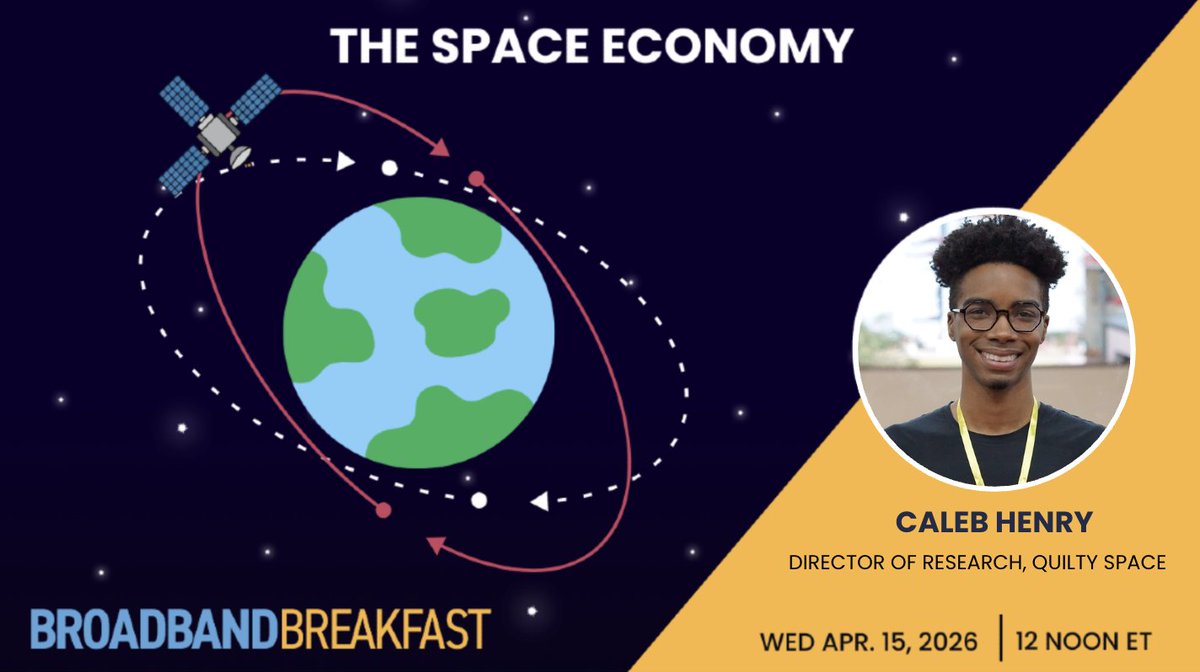
Panelist Spotlight: Caleb Henry
@ChenrySpace is Director of Research at @QuiltySpace, a boutique financial research firm focused on the space industry.
He spent seven years as a journalist covering business and policy developments affecting satellite operators and launch providers, and is the author of a forthcoming book on the history of @oneweb, under contract to Columbia University Press.
📅 Wed. Apr. 15 | 12 Noon ET
SmallSat Europe Speaker Focus: @QuiltySpace Co-CEO Chris Quilty projected Starlink at $15.9B revenue before SpaceX even filed for its IPO. At #SmallSatEurope he joins the Orbital Environmental Services panel to pressure-test whether debris removal economics actually work.
https://t.co/NbH2OWqxCs
Quilty Space on @Starlink:
“The business looks nothing like it did 18 months ago.”
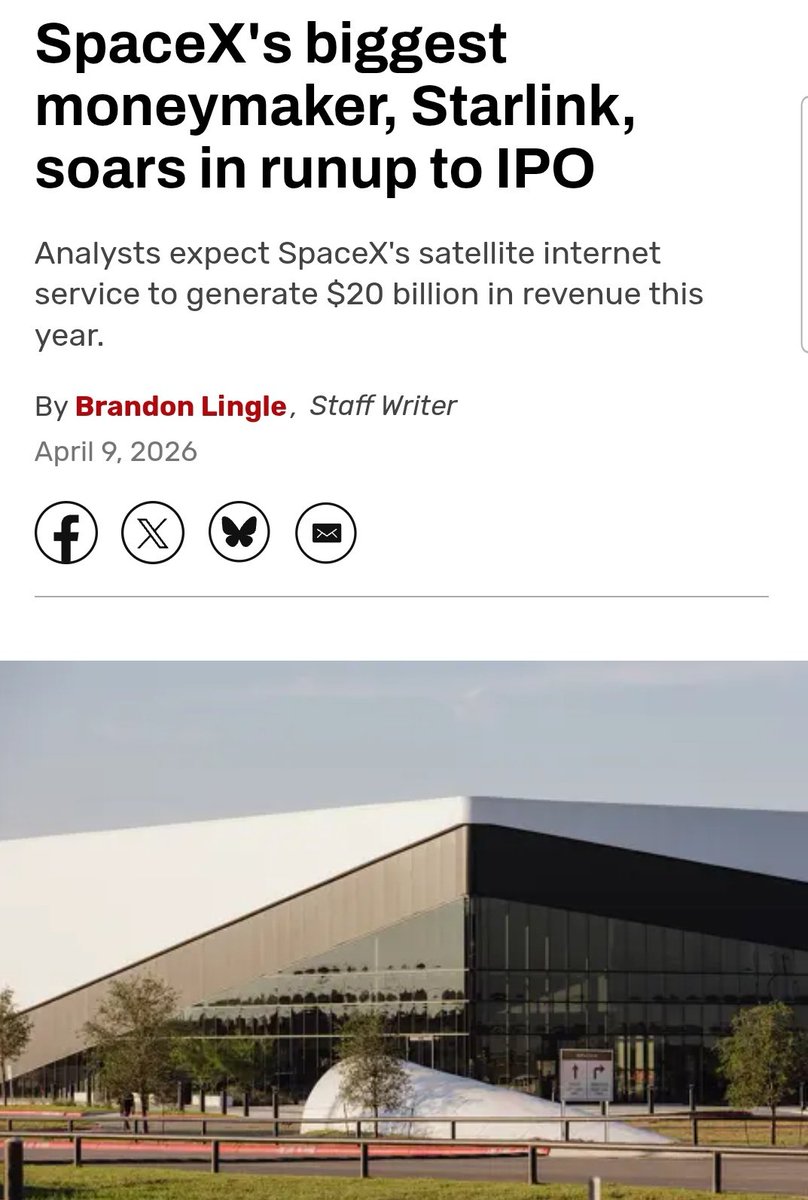
Quilty’s analysts predict that Starlink alone will generate $20 billion in revenue this year, almost doubling the estimated $11.8 billion it made in 2025.
“As Starlink scales globally, the story is no longer just about subscriber growth, but a fundamental shift in revenue mix, pricing dynamics, and the growing role of government demand,” Quilty said in an email.
More than 30 airlines now provide Starlink, and revenue from that segment is expected to climb 68% from last year, according to Quilty.
About 75,000 shipping vessels are expected to add Starlink service this year, which could generate $1.9 billion.
Source: San Antonio Expressnews
We go live in 1 hour at 11am ET.
This will be the final full financial breakdown available before the SpaceX IPO. We expand deeper into enterprise and direct-to-consumer this time.
You don't want to miss: https://t.co/nH2bU5EEtV
In our latest Starlink Financial Overview, we estimate the business is tracking toward $20B in revenue by 2026, alongside $14B in EBITDA.
Join us April 9 at 11 AM ET as we walk through the model and key drivers behind the forecast.
Register here: https://t.co/vZHs3m54hq
The FY27 defense budget request landed last week, and the topline will make you reach for your readers: $1.5 trillion – the largest single-year defense spending jump in modern U.S. history.
We spent the weekend working through the Comptroller exhibits. A few early takeaways:
• The Space Force requests $71.25B, a 238% year-over-year increase and its largest request to date.
• Golden Dome dominates the mandatory column, with $17.5B in explicitly labeled FY27 RDT&E and much more tucked into adjacent procurement lines.
• The request pours major new funding into space-based sensing and transport: AMTI, missile warning and tracking, and proliferated LEO comms.
• Three new program elements point to a major unresolved question for SpaceX and Transport Layer primes: how the Pentagon plans to fund the next-generation data transport layer, and how that funding will be split between the Space Data Network (MILNET) and Tranche 3.
• The budget also begins to reveal the likely winners, even as the most consequential contractor and program linkages remain opaque ahead of the J-books.
We offer an early read on Starshield’s potential take of that emerging stack. Read the full 10-page Industry Insight here: https://t.co/u4R3yE7Ljl