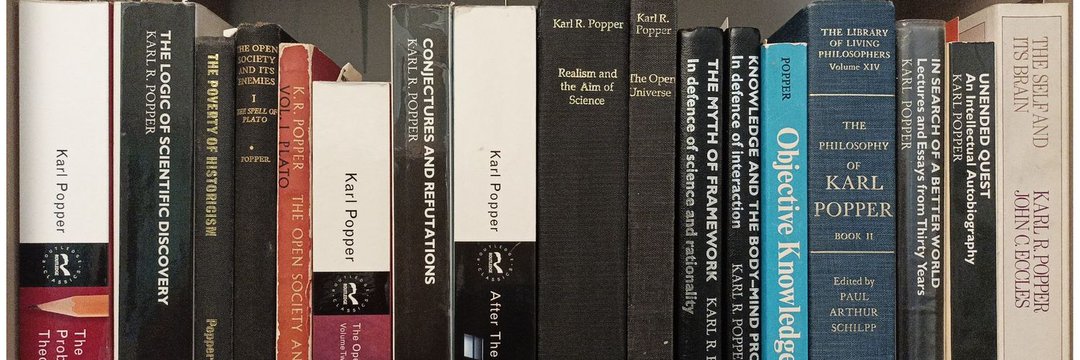
"If we wish our civilization to survive we must break with the habit of deference to great men. Great men may make great mistakes."
—Karl Popper, The Open Society and Its Enemies, Vol 1.
"I think that there is only one way to science—or to philosophy, for that matter: to meet a problem, to see its beauty and fall in love with it; to get married to it and to live with it happily, till death do ye part—unless you should meet another and even more fascinating problem or unless, indeed, you should obtain a solution.
But even if you do obtain a solution, you may then discover, to your delight, the existence of a whole family of enchanting, though perhaps difficult, problem children, for whose welfare you may work, with a purpose, to the end of your days."
—Karl Popper, Realism and the Aim of Science.
"I do believe that very many of the statements which we hold for truths are true. I also believe that very many statements which we hold for truths are false. And I do not believe that there is a criterion to distinguish with certainty between true statements and false statements. And this is the deepest reason for the fallibility of man.
This does not mean that we shouldn't try to find truths, and it does not mean that we shouldn't get nearer and nearer to the truth. It doesn't even mean that we cannot know that we have got nearer to the truths. We can know we have got nearer to the truths, but it means that we can never know that we have reached the truths."
—Karl Popper.
"Only democracy provides an institutional framework that permits reform without violence, and so the use of reason in political matters."
—Karl Popper, The Open Society and Its Enemies, Vol 1.
"In a non-democratic state, the only
way to achieve reasonable reforms is by the violent overthrow of the government, and the introduction of a democratic framework."
—Karl Popper, The Open Society and Its Enemies, Vol 1.
"In a non-democratic state, the only
way to achieve reasonable reforms is by the violent overthrow of the government, and the introduction of a democratic framework."
—Karl Popper, The Open Society and Its Enemies, Vol 1.
"The critical attitude may be described as the conscious attempt to make our theories, our conjectures, suffer in our stead in the struggle for the survival of the fittest. It gives us a chance to survive the elimination of an inadequate hypothesis—when a more dogmatic attitude would eliminate it by eliminating us."
—Karl Popper, Conjectures and Refutations.
"Theories cannot be logically derived from observations. They can, however, clash with observations: they can contradict observations. This fact makes it possible to infer from observations that a theory is false. The possibility of refuting theories by observations is the basis of all empirical tests.
For the test of a theory is, like every rigorous examination, always an attempt to show that the candidate is mistaken—that is, that the theory entails a false assertion. From a logical point of view, all empirical tests are therefore attempted refutations."
—Karl Popper, Conjectures and Refutations.
"Reason works by trial and error. We invent our myths and our theories and we try them out: we try to see how far they take us. And we improve our theories if we can.
The better theory is the one that has the greater explanatory power: that explains more; that explains with greater precision; and that allows us to make better predictions."
—Karl Popper, Conjectures and Refutations.
"With the idol of certainty (including that of degrees of imperfect certainty or probability) there falls one of the defences of obscurantism which bar the way of scientific advance. For the worship of this idol hampers not only the boldness of our questions, but also the rigour and the integrity of our tests.
The wrong view of science betrays itself in the craving to be right; for it is not his possession of knowledge, of irrefutable truth, that makes the man of science, but his persistent and recklessly critical quest for truth."
—Karl Popper, The Logic of Scientific Discovery.
"Have we not destroyed the environment with our natural science? No! We have made great mistakes – all living creatures make mistakes. It is indeed impossible to foresee all the unintended consequences of our actions. Here science is our greatest hope: its method is the correction of error."
—Karl Popper, In Search of a Better World.
"The search for truth is only possible if we speak clearly and simply and avoid unnecessary technicalities and complications. In my view, aiming at simplicity and lucidity is a moral duty of all intellectuals: lack of clarity is a sin, and pretentiousness is a crime."
—Karl Popper, Objective Knowledge.
"For anyone who wants to promote truth and enlightenment it is a necessity and even a duty to train himself in the art of expressing things clearly and unambiguously--even if this means giving up certain niceties of metaphor and clever double meanings."
—Karl Popper, Conjectures and Refutations.
"For anyone who wants to promote truth and enlightenment it is a necessity and even a duty to train himself in the art of expressing things clearly and unambiguously--even if this means giving up certain niceties of metaphor and clever double meanings."
—Karl Popper, Conjectures and Refutations.
"Refutations have often been regarded as establishing the failure of a scientist, or at least of his theory. It should be stressed that this is an inductivist error.
Every refutation should be regarded as a great success; not merely a success of the scientist who refuted the theory, but also of the scientist who created the refuted theory and who thus in the first instance suggested, if only indirectly, the refuting experiment."
—Karl Popper, Conjectures and Refutations
"Epistemology becomes, from an objectivist point of view, the theory of the growth of knowledge. It becomes the theory of problem-solving, or, in other words, of the construction, critical discussion, evaluation, and critical testing, of competing conjectural theories."
—Karl Popper, Objective Knowledge.
“Whenever we try to interpret or to understand a theory or a proposition, even a trivial one like the equation here discussed, we are in fact raising a problem of understanding, and this always turns out to be a problem about a problem; that is to say, a higher level problem.”
—Karl Popper, Objective Knowledge.
"Unlimited tolerance must lead
to the disappearance of tolerance. If we extend unlimited tolerance even to
those who are intolerant, if we are not prepared to defend a tolerant society
against the onslaught of the intolerant, then the tolerant will be destroyed, and tolerance with them."
—Karl Popper, The Open Society and Its Enemies, Vol. 1.
"How can we organize political institutions so that bad or incompetent rulers can be prevented from doing too much damage?"
—Karl Popper, The Open Society and Its Enemies, Vol. 1