Microsoft just banned its own engineers from using AI.
The tool was literally costing MORE than the humans it was supposed to replace.
They lied to you about AI adoption and now the whole narrative is blowing up:
Microsoft gave thousands of engineers access to Claude Code six months ago and encouraged them to use it.
Engineers loved it and adoption exploded. But then the invoices arrived.
Token-based pricing means every query, every code review, every debugging session costs money. At scale across 100,000 engineers, the numbers became so large that Microsoft issued an internal order to cancel nearly all Claude Code licenses by end of June and force everyone onto their own cheaper tool instead.
The company that invested $5 billion in Anthropic just told its own people to stop using Anthropic's product because it costs too much.
Uber's story is even worse...
Their CTO Praveen Neppalli Naga told The Information that the budget he planned for the full year was "blown away already" by April.
Uber had rolled out Claude Code in December 2025. By March, 84% of their 5,000 engineers were using it with 70% of all committed code coming from AI systems.
Heavy users were burning $500 to $2,000 per month each. Naga himself spent $1,200 in a single two-hour demo session.
The company had even built internal leaderboards ranking engineers by how much AI they used. They literally gamified the spending and then ran out of money.
Now look at what Nvidia's own VP of applied deep learning Bryan Catanzaro said to Axios last month. Direct quote:
"For my team, the cost of compute is far beyond the costs of the employees."
This is a VP at the company that SELLS the chips saying that using AI is more expensive than paying humans.
Think about what this means for the entire AI narrative.
Every CEO on every earnings call for the past two years has said the same thing:
AI will make us more efficient, reduce headcount, and cut costs.
The stock market rewarded every company that said it.
Fired workers, stock goes up. Announced AI adoption, stock goes up.
But the actual companies deploying AI at scale are discovering the math doesn't work. The MORE employees use AI, the HIGHER the bill.
Goldman Sachs forecasts a 24x increase in token consumption by 2030 as companies adopt AI agents. Gartner just published a report showing that even though individual token prices will drop 90% by 2030, total enterprise AI costs will go UP because agents consume exponentially more tokens per task than basic tools.
Meta built an internal dashboard called "Claudeonomics" to track which employees use the most AI. Amazon started pushing engineers to "tokenmaxx," their internal term for consuming as many AI tokens as possible.
Both companies are spending hundreds of billions on AI infrastructure this year alone.
And Microsoft, the company that bet its entire future on AI, just told 100,000 engineers to stop using the tool they liked best because the per-token bills got out of control.
The companies building AI are telling investors it saves money. The companies using AI are finding out it costs more than the humans it was supposed to replace. And even the company that makes the chips just admitted it through its own VP.
This is the gap nobody on Wall Street is pricing in.
$725 billion in AI infrastructure spending this year across Big Tech. And the first companies to actually deploy these tools at scale are already pulling back because the economics don't work.
What do you think?
FPV drones with fiber optic cable for control and video are immune to EW jamming.
On the left a spool for a 5km range is mounted on a Russian FPV, while the right one (also Russian) has a 10km spool.
had to write a calligramme (shaped poem) for french class and i got carried away making an english version cause i was getting mad that i didnt know the words i wanted to say
Last year, the moon at Apogee passed in front of the Sun, causing an Annular Eclipse. I drove to Utah to capture a photo of the event, showing the “ring of fire” in all its glory.
This is formatted as a mobile wallpaper, enjoy! I’ll post another tomorrow.
Here’s the time-lapse I promised you from yesterday’s solar activity. Complete with Earth to scale and a bonus of the sun’s rotation.
This is easily one of my cleanest time-lapses I’ve managed over such a long period. Enjoy!
Using a 12" scope I photographed this star-forming region of the Milky Way for dozens of hours. Stellar winds and gravity sculpt fascinating shapes from the interstellar medium, leaving behind these beautiful features.
This is formatted as a mobile wallpaper, enjoy! More coming!
By setting up a telescope in exactly the right point on Earth and using an extremely fast shutter speed, I can capture the ISS against a specific backdrop. In this case, the Apollo 11 landing site.
This is cropped as a phone wallpaper for you. Enjoy! I’ll post another tomorrow.
2/ from gpt4 to AGI: counting the OOMs
- ai progress is rapid. gpt-2 to gpt-4 went from preschooler to smart high schooler in 4 years
- we can expect another jump like that by 2027. this could take us to agi
- progress comes from 3 things: more compute, better algorithms, and "unhobbling" (making models less constrained)
- compute is growing ~0.5 orders of magnitude (OOMs) per year. that's about 3x faster than moore's law
- algorithmic efficiency is also growing ~0.5 OOMs/year. this is often overlooked but just as important as compute
- "unhobbling" gains are harder to quantify but also huge. things like RLHF and chain-of-thought reasoning
- we're looking at 5+ OOMs of effective compute gains in 4 years. that's another gpt-2 to gpt-4 sized jump
- by 2027, we might have models that can do the work of ai researchers and engineers. that's agi (!!)
- we're running out of training data though. this could slow things down unless we find new ways to be more sample efficient
- even if progress slows, it's likely we'll see agi this decade. the question is more "2027 or 2029?" not "2027 or 2050?"
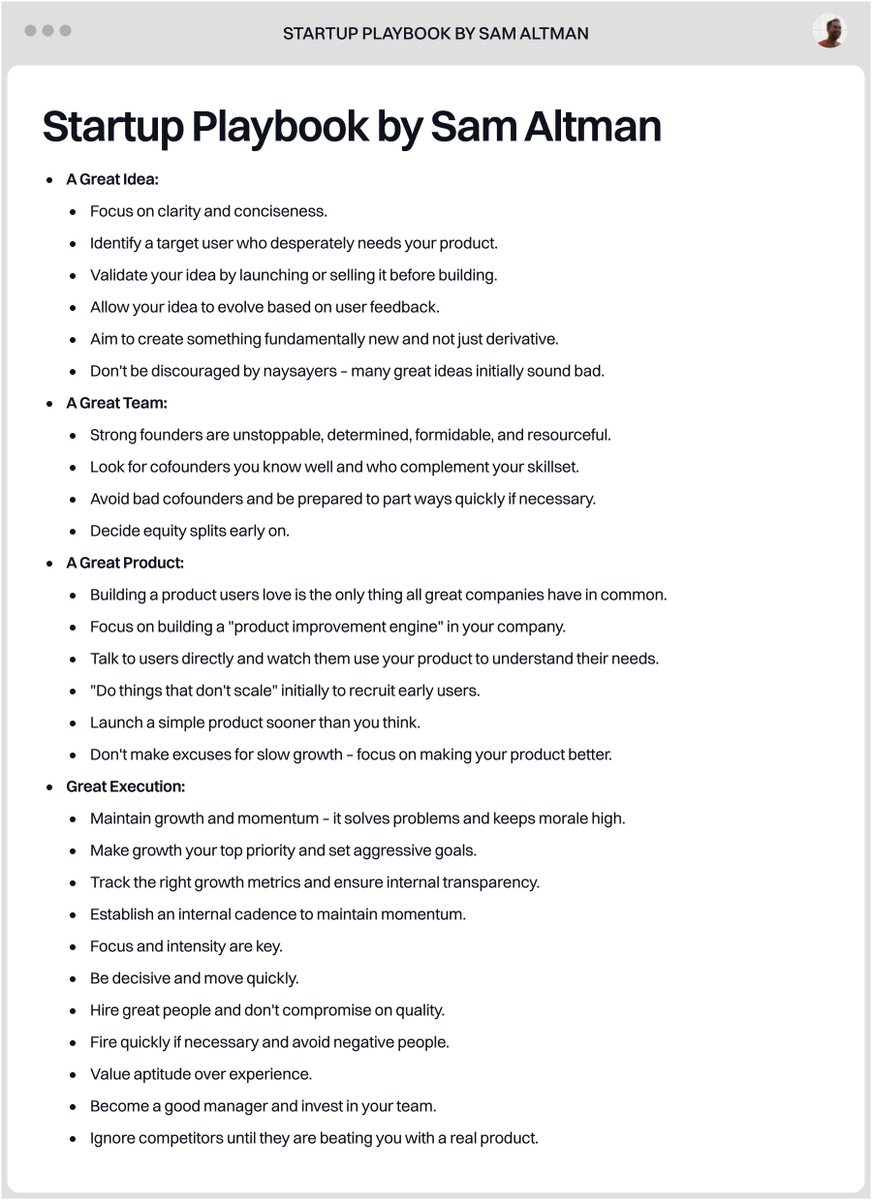
Startup Playbook by Sam Altman (first published a month before the founding of OpenAI in 2015)
Out of all the parts, great execution is my favorite (and is also the hardest)