https://t.co/F323NtrBD0
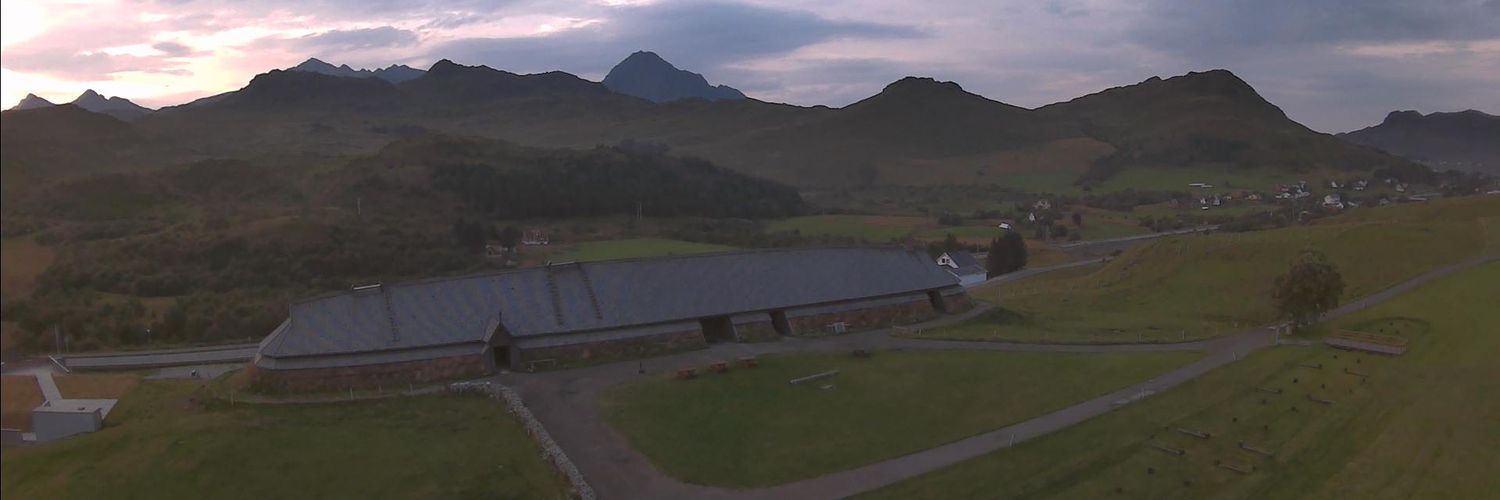
Find out why you need to travel three long days across Scandinavia to get to this incredible place and meet up with friends.#lofotr
https://t.co/ep5o17ZUHi
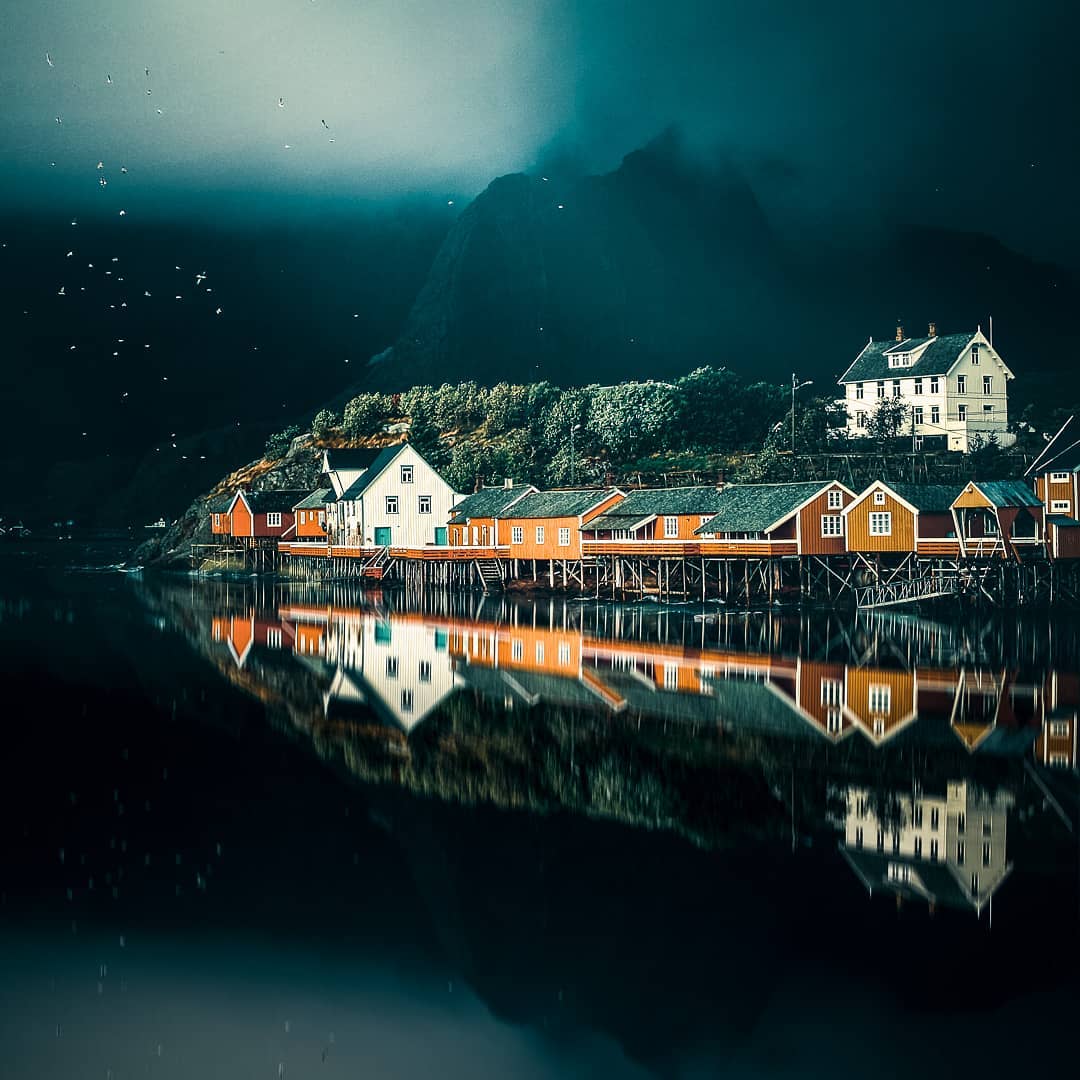
Good night from Norway, where summer lights up fishing villages along the fjords. Vikings worked these shores, mending nets and crafting boats for raids or trade. What part of their coastal life speaks to you?
The discovery of the "Worlds Oldest Football" in Stirling Castle, Scotland, dating back to the 1540s AD, is a truly remarkable find that offers a tangible link to the early history of the world's most popular sport. This artifact provides concrete evidence of football's existence and form in an era long before its modern codified rules.
The composition of the ball – a pig's bladder encased in leather – is particularly insightful. This construction method was common for early footballs, utilizing readily available animal products. The pig's bladder would have provided the necessary inflateable core, giving the ball its spherical shape and a certain degree of bounce, while the leather casing offered durability and protection. Its size, "approximately half the size of a modern football," suggests a game that might have been played with different dynamics than today, perhaps favoring quicker passes or more close-quarters play, or simply reflecting the limitations of available materials and inflation techniques.
Found during reconstruction work at Stirling Castle, a site with centuries of historical significance, the ball's likely use by "soldiers and staff of the castle" paints a vivid picture of leisure activities in a medieval stronghold. It indicates that informal versions of football were played not just by common folk, but also within the confines of military and aristocratic environments. This discovery is crucial for understanding the widespread, albeit uncodified, presence of ball games in pre-modern Europe and highlights Scotland's unique contribution to the sport's deep historical roots.
#archaeohistories
Æthelstan, king of the Anglo-Saxons, ‘succeeded to the kingdom of the Northumbrians’ #OTD in 927 and, at Eamont, Cumbria, received oaths from rulers including Causantín II of Alba, Ealdred of Bebbanburg (Bamburgh) and possibly Owain of Strat Clut (Strathclyde). 📸Athelstan Museum
@vikinghistory Ok the black hearted heathen horde that came from the sea to so visiting there unholy wrath upon there island, are now having their leftover human scat encased under glass in York’s Englands Viking museum, as a priceless precious natural treasure?
Today is "Lerwick Up Helly Aa"! It is a remarkable and vivid fire festival held annually in Lerwick, the capital of Shetland, Scotland. Celebrated on the last Tuesday of January, it is a grand spectacle that marks the end of the Yule season and is deeply rooted in the region's Viking heritage.
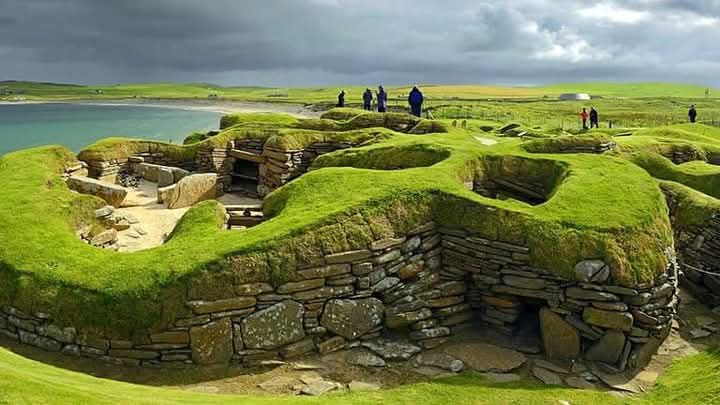
Predating Stonehenge and the pyramids of Giza, extraordinary Skara Brae is one of the world's most evocative prehistoric sites. Consisting of ten stone structures, near the Bay of Skaill, Orkney, Scotland, it is northern Europe’s best-preserved Neolithic village.
Even the stone furniture – beds, boxes and dressers – has survived the 5000 years since a community lived and breathed here, giving an incredible insight into everyday Stone Age life.
Today the village is situated by the shore but when it was inhabited (3100-2500 BC) it would have been further inland. Steady erosion of the land over the centuries has altered the landscape considerably and interpretations of the site, based upon its present location, have had to be re-evaluated in light of this.
The name `Skara Brae' is a corruption of the old name for the site, `Skerrabra' or `Styerrabrae' which designated the mound which buried (and thereby preserved) the buildings of the village. The name by which the original inhabitants knew the site is unknown.
Idyllically situated by a sandy bay 8 miles north of Stromness, the Unesco-listed settlement was hidden until 1850, when waves whipped up by a severe storm eroded the sand and grass above the beach, exposing the houses underneath. It can feel as though the inhabitants have just slipped out to go fishing and could return at any moment.
#archaeohistories
The Scalloway Fire Festival 10.1, first recorded in the late 19th century, began as a local adaptation of midwinter celebrations to commemorate Shetland’s heritage and traditions and is now an annual January event featuring a torchlit procession, a Jarl Squad in Viking attire, and the burning of a specially built galley.
It acknowledges Shetland’s historical ties to Norway—Shetland was under Norwegian rule until 1469—and commemorates ancient Norse customs once observed during midwinter gatherings.
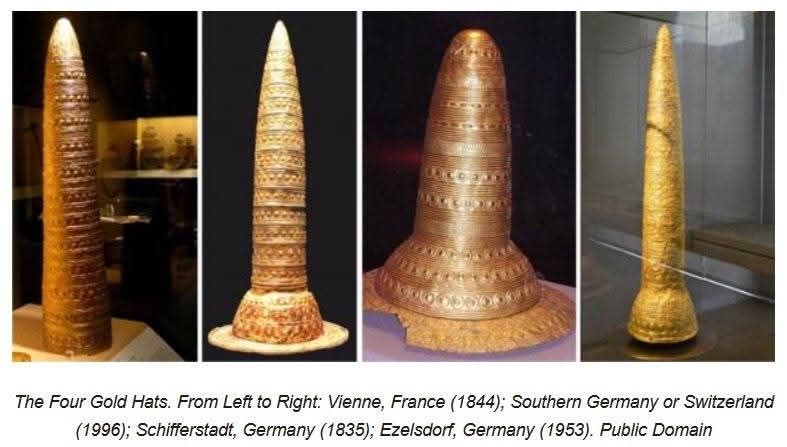
Four Golden Hats of the Bronze Age -
The four gold hats are rare archaeological finds dating back to the Bronze Age. The hats all appear to have been created sometime around the middle of this period, ranging from 1400-800 BC. They were each discovered separately, over the course of 160 years, in different locations, three of them in Germany and one in France.
The golden relics are constructed of sheets of gold, with intricate astronomical designs and demonstrate superb craftsmanship. While the four hats bear striking similarities, they are also somewhat unique in their specific features.
The function of the hats is uncertain. Their conical design mimics the well-known image of a witch’s or wizard’s hat, leading to speculation that the hats were worn by individuals who held such a position. The hats are engraved with symbols that may have been used to make agricultural and/or astronomical predictions, and possibly raising the wearer to divine status.
#archaeohistories
We're excited to share the final live video from 'Live at the Acropolis' before its release in a week. Watch "Heimta Thurs" on our YouTube Channel now!
Watch the video here: https://t.co/6tQYruFH3Y
Bluetooth technology takes its name from a Viking king, Harald "Bluetooth" Gormsson, who ruled over Denmark in 10th Century AD. Known for unifying the disparate factions of Denmark and Norway, Harald’s legacy mirrors the function of Bluetooth technology today, which brings together different electronic devices across various platforms. The name symbolizes the technology’s purpose of connectivity, linking multiple systems in the same way Harald unified people through his leadership.
The Bluetooth logo, too, draws from this historical connection, incorporating the Nordic runes for Harald’s initials—H.B. This design serves as a visual nod to the Viking king, celebrating both his name and his achievements in creating unity. The incorporation of runic elements into the logo highlights the rich cultural and historical significance embedded in the technology’s identity.
As for the origins of Harald's nickname, "Bluetooth," there are competing theories. One explanation suggests that he had a fondness for eating blueberries, which stained his teeth a permanent blue, while another theory proposes that he suffered from a dead tooth that had a distinct blue-gray color. Whatever the true origin, the name has become synonymous with an essential element of modern technology, and it continues to honor a historical figure whose efforts helped shape the Nordic world.
#archaeohistories
One of the most iconic photo spots in Norway, the Sword in Rocks monument commemorating the Battle of Hafrsfjord in 872, after which Viking Harald Fairhair made himself King of Norway.
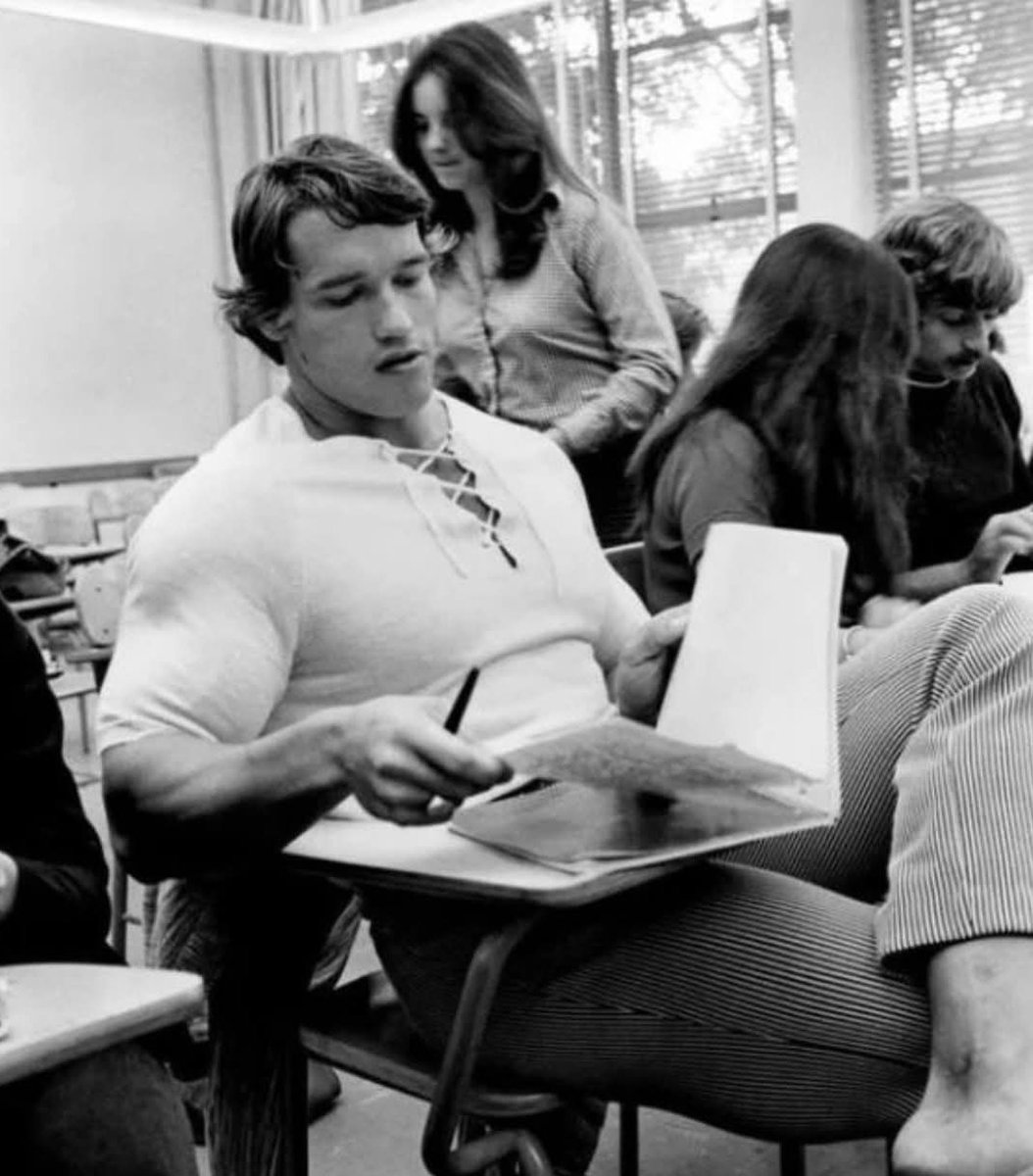
In 1973, Arnold Schwarzenegger, still rising as a bodybuilding champion, was laying the groundwork for a future beyond fitness. A photograph from that year shows him attending night school in California, studying business and English to prepare for broader success. Despite his growing fame, Schwarzenegger prioritized education, showcasing his commitment to long-term goals and self-improvement.
As an immigrant from Austria, he faced challenges like a language barrier and cultural adjustments but used education as a tool to overcome them. This phase of his life demonstrated his work ethic and vision, setting the stage for his success as an actor, entrepreneur, and politician.
#drthehistories