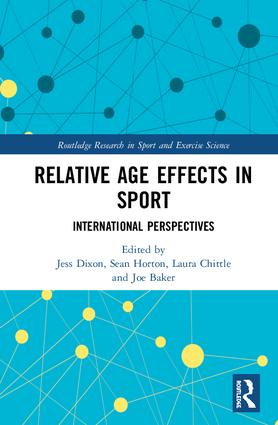
Thanks to the hard work by @DrJessDixon, Sean Horton, Laura Chittle, @bakerjyorku, and all our chapter authors you can order your copy at the link below: https://t.co/NRfV9DvaVE
In the final chapter of Relative Age Effects in Sport, @bakerjyorku, Laura Chittle, Sean Horton, and Jess C. Dixon will draw conclusions based on our current understanding of RAEs and emphasize key areas where future work is needed. #RAEtextbook
Chapter 11 is jam packed with information! Stephen Cobley, Shaun Abbott, Kylie Moulds, Clorinda Hogan, and Michael Romann discuss the re-balancing of RAE scales by highlighting meta-analytical trends, causes, and corrective adjustment procedures as a solution.
Coaches and talent scouts listen up! In Chapter 10, @david_l_mann examines different strategies designed to mitigate RAEs in situations where the performance of young athletes is evaluated subjectively. #RAEtextbook
So, what have we learned after 20 years of RAE research? In Chapter 9, @WeHelsen & Janet Starkes will outline research on the mechanisms underlying the RAE and focus on what potential solutions have been recommended/attempted to date.
Want to learn more about academic timing? In Chapter 8, Laura Chittle, Sean Horton, and Jess C. Dixon will highlight studies that have examined the influence of academic timing on the relative age effect in intercollegiate sport. #RAEtextbook#academictiming#relativeageeffect
RAEs are often assumed to disadvantage the relative younger, but is this always the case in sport? In Chapter 7, Kristy Smith & @PattiWeir1 examine the existing evidence for the reversal of relative age advantages, also called the 'Underdog Hypothesis'.
RAEs not only affect youth development in sport but in education as well. In Chapter 6, Relative Age Effects and Youth Development, @SrdjanLemez, @JFraserThomas, & @wattien highlight the role of age disparities in youth on pertinent education- and sport-based issues 📚
In Chapter 5, @wattien & @bakerjyorku will summarize the research on RAEs in female sport, and touch on the methodological issues that affect this research. Pre-order now available at: https://t.co/fTMtCPOgrq
What do soccer & basketball have in common? Currently they are the top 2 sports examined in female RAE studies!
Unfortunately, our understanding of RAEs in female sport is limited by the relatively small number of studies in this area (compared to male athletes).
In Chapter 4, @jrschorer, Ingo Roden, Dirk Büsch & Irene Faber will give you the the short and long-itudinal of RAEs!
Along with discussing the strengths and limitations of cross-sectional research, they will present longitudinal studies on German handball & French table tennis🏓
There is more to the RAE than just birthdates. In Chapter 3, Antecedents and explanations of Relative Age Effects, @ProfHancockMUN tells us more about the three mechanisms researchers attribute to RAEs: sport structures, physical development, and social agents.
DYK that relative age research in sport began with a casual observation at a Lethbridge Broncos game in 1983? In Chapter 2, The Relative Age Effect: Early Studies, Paula Barnsley, Roger Barnsley & Gus Thompson highlight their first 4 RAE studies!
What does skiing at Sun Peaks, British Columbia have to do with RAE research? Read Chapter 1: Serendipity Strikes, written by Jess C. Dixon, Laura Chittle, @bakerjyorku, and Sean Horton to find out!
Long time no see, but we are back with some exciting news! Our conference legacy is coming to fruition with "Relative Age Effects in Sport" now available for pre-order at the link below: https://t.co/fTMtCQ5RQ0