Why I'm Tracking Aether Industries Closely 👀
The market is finally beginning to appreciate what Aether Industries has been quietly building over the years.
🔹 High-value specialty chemicals with complex manufacturing capabilities, not commodity products.
🔹 Strong presence in Agrochemicals, Pharmaceuticals, Electronic Chemicals, Oil & Gas, Coatings, High-Performance Materials, and Fine Chemicals.
🔹 Increasing share of Contract Research & Manufacturing (CRAMS) and custom synthesis, leading to sticky customer relationships and better margins.
🔹 Deep R&D capabilities with continuous investments in new molecules and process innovation.
Management's Vision
Instead of chasing short-term volumes, the management has focused on:
✅ Building niche chemistry capabilities
✅ Expanding into import substitutes and export-oriented products
✅ Long-term customer partnerships with global innovators
✅ Creating capacity ahead of demand
This patient approach is now starting to reflect in business momentum.
Why Aether Could Be Entering a New Phase
• Specialty chemicals cycle appears to be improving.
• Capacity expansion is getting utilized.
• New products are entering commercialization.
• Global customers continue to diversify supply chains beyond China.
• Higher share of value-added products can support earnings growth over the coming years.
Businesses with strong technology, execution, and capital allocation often spend years consolidating before the market recognizes their potential.
Aether Industries is definitely one to keep on the watchlist.
Not a buy/sell recommendation. Please do your own research before investing.
The data center vertical is the most potent margin-accretive lever in KOEL’s "$2 Billion by FY30" (2B2B) vision. The HyperNext deal is unlikely to be a one-off. Because hyperscale AI infrastructure relies on extreme standardization, establishing the 2,500 kVA Optiprime as the "spec" design for HyperNext guarantees sticky, repeat business for future expansions, while serving as a live reference site to aggressively win market share from competitors.
Excellent breakdown. The biggest takeaway for me isn't just the 30–35% FY27 revenue guidance—it's the improvement in business quality. Higher share of Automotive, Industrial, MedTech and ODM, rising exports, improving working capital (69 → 63 days), positive operating cash flow, and a shift from net debt to net cash all point to disciplined execution. If the PCB backward integration executes on time, it could become the next major margin and growth catalyst from FY28 onward. 👏📈
The company has competitive advantage due to its stringent adherence to global safety and quality standards, boasting certifications including ASME U & R Stamp, DOT 39, PESO, CE, and IATF 16949. The company faces limited competition in the domestic market due to regulatory hurdles (like PESO approvals) that currently block Chinese manufacturers from dumping transport tanks in India.
The company has GoldMan Sachs backing
The FII and DII stakes increasing continuously
The public holding decreasing continuously
Disclaimer : Not holding not buying sell recommendation
BBOX CAPITAL MARKET DAY PRESENTATION
A $500M hyperscaler pipeline means little on its own.
A second contract from the same hyperscaler after successful execution means everything.
In infrastructure services, repeat business is the highest form of validation.
We are entering a phase of stock-specific earnings-driven differentiation. While index-level valuation multiples look stretched relative to Taiwan or South Korea
The government successfully met its FY26 fiscal deficit target of 4.4% of GDP (₹15.58 lakh crore). However, April 2026 data shows the deficit nearly doubled year-on-year in value terms due to a 21% drop in revenue receipts and a 23% spike in expenditure.
A "higher-for-longer" US Fed rate path and rising US Treasury yields are triggering massive FII exodus from India to AI-heavy EMs like South Korea. Persistent West Asia geopolitical conflict has driven Brent crude to $94-95/bbl, creating significant imported inflation across the manufacturing supply chain
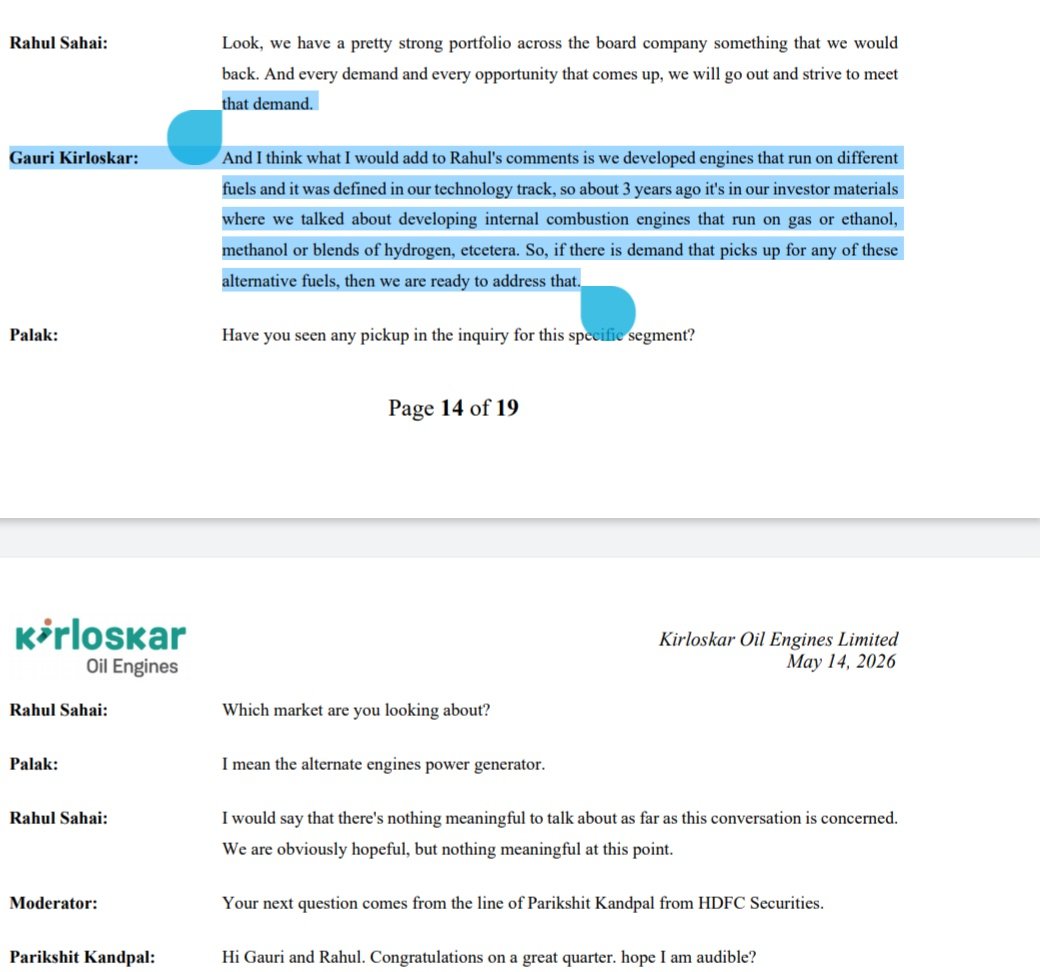
Kirloskar Oil Engine Limited Data Center Play: Optiprime’s space-saving architecture gives KOEL a high-margin wedge into Data Centers. They are targeting "non-spec" Edge and Colocation centers to bypass MNC incumbents, aggressively scaling up deployments to 2,500 kVA and 3,000 kVA units. Management specifically targets a "double-digit" revenue contribution from this vertical. Further,The management highlighted they have sold some of the units but reserve to disclose the number . They are targeting Double digit revenue from this segment.
@REDBOXINDIA What’s positive
Creates India’s largest QSR platform (KFC, Pizza Hut, Costa)
Strong bargaining power with landlords, suppliers & aggregators
Better store economics + shared backend → margin expansion potential
Scale positions the entity well for long-term consumption growth
@Anvith_ Multi Asset Allocation Funds blend equity, debt, and other assets to deliver smoother returns and diversification across market cycles — often suitable for medium-to-long-term investors seeking balanced exposure.
Gold’s Big Rally Explained in Simple Words
Must Read Article On Gold
There's something almost absurd about gold's 2025 performance. While we're all obsessed with AI, crypto, and digital everything, this ancient metal just soared 40%—its biggest yearly jump since 1979—blowing past $5,000 an ounce.
In an era of blockchain and ChatGPT, why does humanity still worship a shiny rock?
The Ultimate Chaos Hedge
Pratik Ghansham Salvi, writing for the IMF's Finance & Development Magazine, nails the paradox: gold stopped trying to be money decades ago. When Nixon killed the gold standard in 1971, everyone assumed gold was finished. Instead, it transformed into something more powerful—**the world's insurance policy against everything going wrong**.
Financial crisis in 2008? Gold soared. Pandemic panic in 2020? Record highs. Inflation fears and geopolitical chaos in 2025? It shattered through $5,000.
Why Central Banks Are Hoarding It
China, India, Turkey, and Poland just bought over 1,100 metric tons. China's central bank alone holds 2,300+ metric tons. This isn't nostalgia—it's strategy.
In a world where Western sanctions can freeze your reserves overnight and the dollar has become a geopolitical weapon, gold offers something priceless: it belongs to no one and answers to no government. It's the ultimate neutral asset in an increasingly fractured world.
The Psychology Behind the Glitter
Here's what's fascinating: gold's value has nothing to do with usefulness. Economist Robert Mundell put it perfectly—gold endures "because of the trust we place in its uselessness."
Indian households hold over 25,000 metric tons—more than the top 10 central banks combined. It's wedding dowries, festival gifts, and financial security all rolled into one. In China, it represents virtue and stability. This isn't economics—it's anthropology.
Bitcoin Wishes It Were Gold
Bitcoin fans call it "digital gold," but Salvi exposes the flaw: Bitcoin is code that can be banned, hacked, or lost in a power outage. Gold is a 5,000-year story humanity has collectively agreed to believe in. You can hold it. Hide it. Pass it down for generations.
Bitcoin represents speculative belief. Gold embodies collective memory.
The Real Reason for 2025's Surge
Beyond inflation fears and Fed policy, gold's recent explosion reflects something darker: **trust is breaking down**. Trust in governments, currencies, institutions, and the global order itself.
US exchange-traded gold funds jumped 40% to nearly $200 billion. When people are scared, they don't buy stocks or bonds. They buy the one thing that's survived every empire, every crisis, every financial innovation for five millennia.
The Bottom Line
Gold won't make you rich during good times—it often stagnates when economies boom. But that 5-10% allocation in your portfolio? It's not about returns. It's about sleeping at night when everything else is falling apart.
As Salvi brilliantly concludes: "Gold endures because trust is fragile, and belief—not metal—remains the ultimate foundation of value."
In our race toward a digital future, maybe the smartest investment is the oldest one. Those ancient Lydians minting gold coins in 700 BCE? Turns out they were onto something.
---
**Credit:** Pratik Ghansham Salvi, Assistant Professor of Economics, Banking, and Finance at Ness Wadia College of Commerce, Pune, India. Originally published in IMF Finance & Development Magazine, December 2025.
*Is gold a smart hedge or outdated thinking? Drop your take below.*
Read This Story From India to Understand How Lower Taxes Drive Growth
When corporate tax was slashed from 30% to 22% in 2019, there was initial revenue concern. But within 2-3 years, corporate profitability boomed, more companies entered the formal sector, and actual corporate tax collections increased.
The same principle applies here.
Lower capital gains taxes → Better market sentiment → Higher volumes → More transactions → More STT revenue (if retained) → More corporate growth → More jobs → More income tax → More consumption → More GST.
Plus the indirect multiplier effects:
More startup funding → More innovation → More jobs
More FII inflows → Stronger rupee → Lower inflation
Deeper markets → Better price discovery → More efficient capital allocation