@Mazen_AIEx I am also very interested in many real-world applications, but this opens a world of possibilities that it is hard to know which will be the first successes. Personally, I would love to see it become a musical instrument like the linnstrument @rogerlinndesign
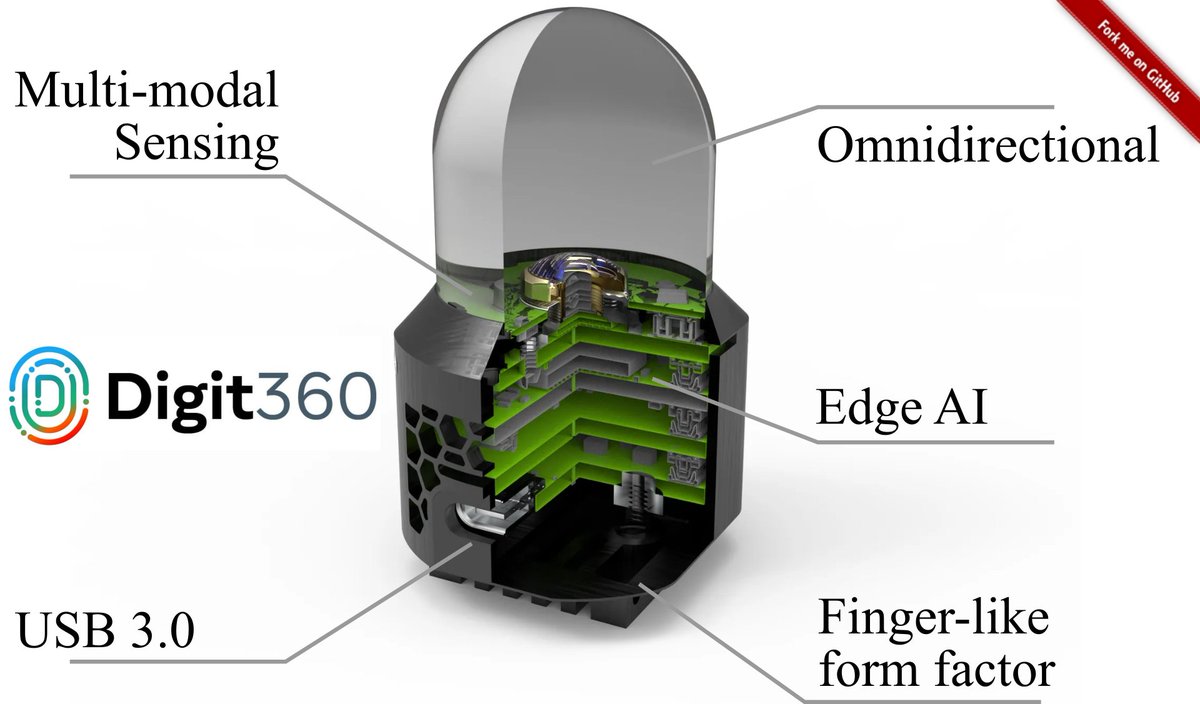
I am very excited to introduce Digit360, our new super-human omnidirectional tactile sensor. Digit360 is truly multimodal (sensing forces as small as 1 mN, geometries down to 7 µm, vibrations to 9Khz, heat, and even smell). (1/3)
In addition, Digit360 has Edge AI capabilities to quickly process data locally and provide fast motor reflexes
Digit360 is the result of many years of research with an amazing team - Mike Lambeta, @AIatMeta, @tudresden_de , @SECAI_School and @TactileInternet . (2/3)
Researchers from @ias_tudarmstadt and @lasr_lab present a novel, open-source event-based optical #tactilesensor called Evetac. By applying this sensor, the researchers are able to create fast and robust closed-loop grasp controllers for manipulation.
https://t.co/R6ejt8mPME
Excited to announce the first Touch Sensing and Processing Summer School hosted in Dresden on September 2-6. The summer school is sponsored by @SECAI_School and @TactileInternet. Accommodations and meals will be fully covered by the summer school. Apply at https://t.co/e4EhV2HdvR
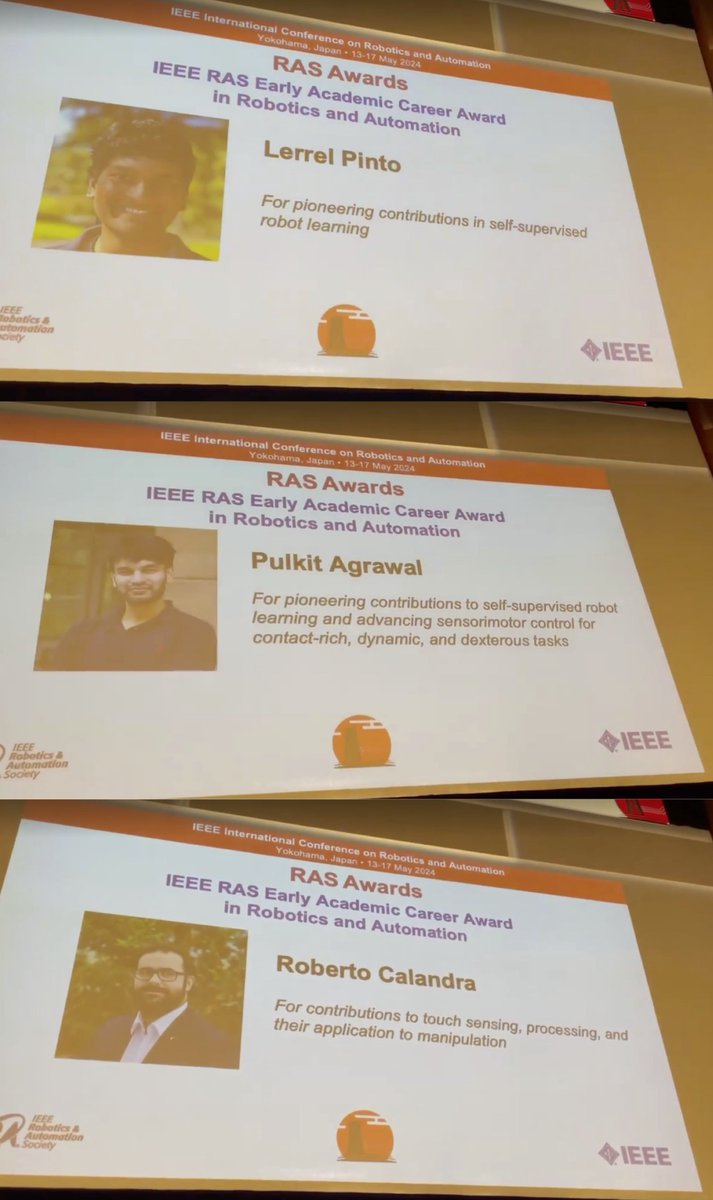
It is a great honor to receive here at ICRA 2024 in Yokohama the IEEE Early Academic Career Award from the Robotics and Automation Society. Thank you to all the splendid collaborators that made this research possible over the years.
Would like to do research in touch sensing, but don't have the right hardware? @AIatMeta is now accepting proposals to donate DIGIT sensors. Please apply at https://t.co/rvNWmiucGx
@sanoj500 The technology is quite different since it is vision-based. In terms of performance, the main advantage is a much higher resolution, more sensitive, and less noisy (including wrt. to magnetic fields)
We just released our new work on miniaturizing high-resolution tactile sensors using fiber optics, and open-sourced the new DIGIT Pinky sensor.
Paper: https://t.co/9Hv7PndrvM
Design: https://t.co/Nx3taPHdqD
Preliminary results show that our sensor, in conjunction with the right AI models, can detect cancer in real prostate tissue. In the future, we hope that this might lead to real-world medical applications.
NeuralFeels is just scratching the surface of what's possible possible with affordable vision and touch— here we focus on in-hand SLAM.
Data/code will follow shortly, for more details check out https://t.co/8hhmlfUoYb
If you're generally excited about #robotics, catch up with our 6th (!!!) Robot Learning workshop on the 16th!
'Pretraining, Fine-Tuning, and Generalization with Large Scale Models'
https://t.co/v1LKtPBv9C