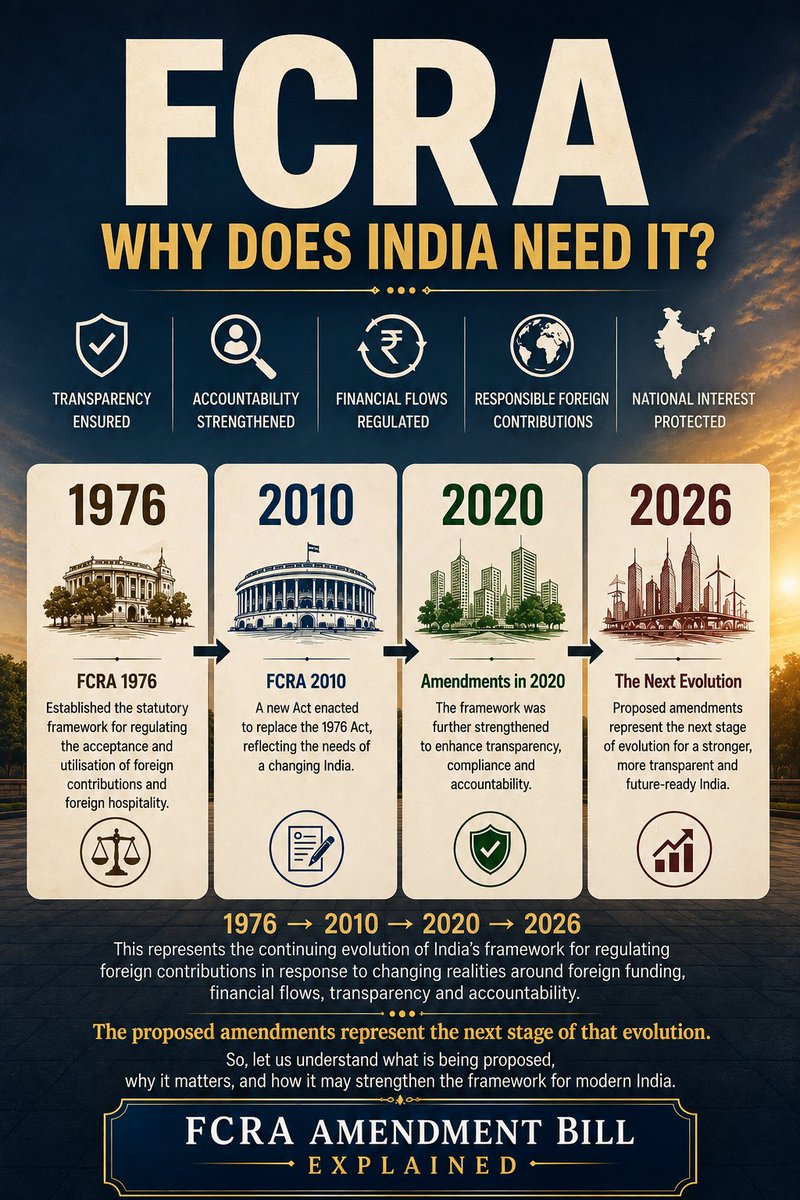
FCRA | WHY DOES INDIA NEED IT?
Foreign contributions have long required a regulatory framework in India.
The FCRA 1976 established the statutory framework for regulating the acceptance and utilisation of foreign contributions and foreign hospitality.
As India evolved, so did the framework.
In 2006, during the UPA government, a Bill was introduced in Parliament to replace the 1976 Act. It eventually became the FCRA 2010, enacted in 2010 and brought into force in 2011.
The framework was subsequently strengthened through amendments, including significant changes in 2020.
1976 → 2010 → 2020 → 2026
This represents the continuing evolution of India’s framework for regulating foreign contributions in response to changing realities around foreign funding, financial flows, transparency and accountability.
The proposed amendments represent the next stage of that evolution.
So, let us understand what is being proposed, why it matters, and how it may strengthen the framework for modern India.
FCRA Amendment Bill | Explained.
Next: 1 | Designated Authority
#FCRA #FCRAAmendmentBill #ForeignContributions #PolicyExplained #KnowTheLaw #Governance #Transparency #Accountability #NationalInterest #LegislativeReforms #IndiaFirst #Parliament #PublicPolicy #NewIndia #AtmanirbharBharat
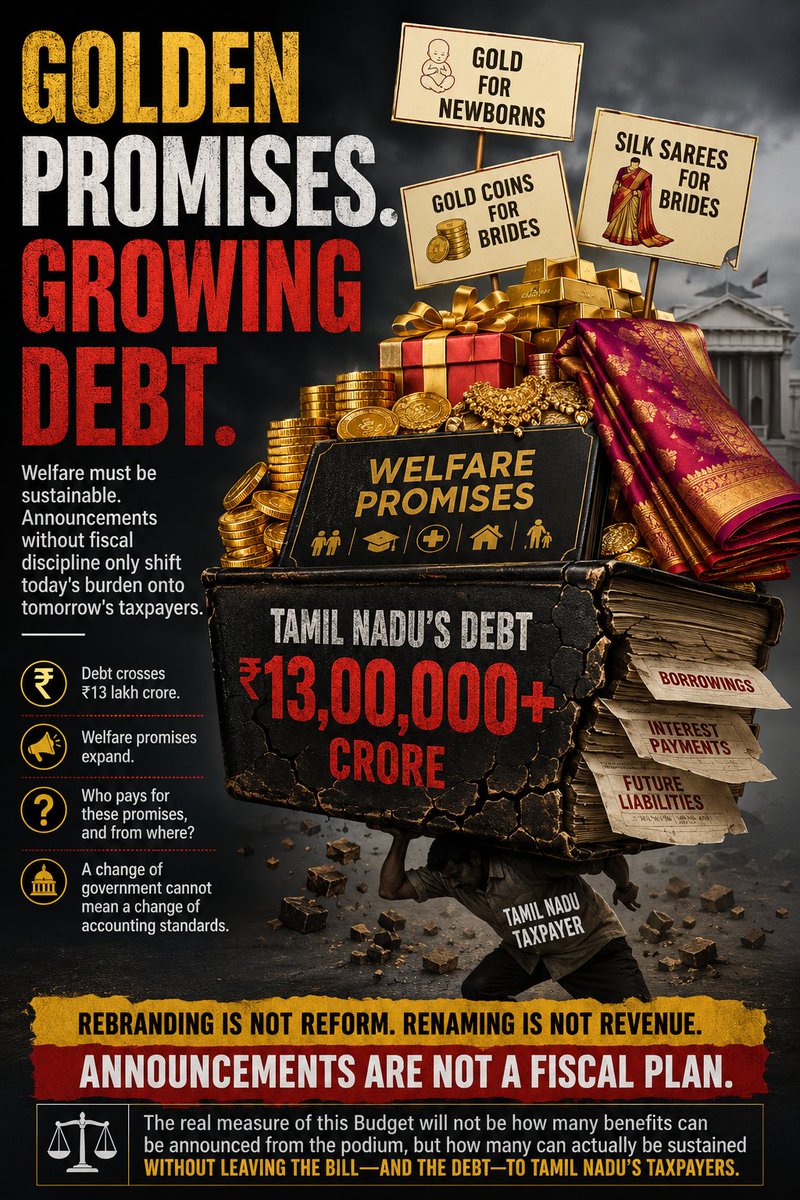
Tamil Nadu’s debt has reportedly crossed the ₹13 lakh crore mark, yet the Budget arrives with a generous parade of welfare promises - from gold for newborns to gold coins and silk sarees for brides.
There is nothing wrong with welfare. But when the State’s finances are already under strain, the question cannot be avoided: who pays for this expanding catalogue of promises, and from where?
And wasn’t the previous administration criticised for giving old schemes new labels and presenting Central initiatives with a different political wrapper? If that was questionable then, why should the same practice become acceptable now?
A change of government cannot mean a change of accounting standards.
Rebranding is not reform. Renaming is not revenue. And announcements are not a fiscal plan.
The real measure of this Budget will not be how many benefits can be announced from the podium, but how many can actually be sustained without leaving the bill—and the debt—to Tamil Nadu’s taxpayers.
#TamilNaduBudget #TamilNadu #FiscalResponsibility #PublicFinance #TaxpayerFirst #DebtMatters #Budget2026 #EconomicPolicy #GoodGovernance #Accountability #TransparentGovernance #SustainableDevelopment #FinancialDiscipline #GovernanceMatters #IndiaPolitics #Bharat #PublicPolicy #ReformNotRebranding #ResponsibleGovernance #BudgetDebate
Meta has accepted that lot of money was used for creating such type of deep fake content.
The responsibility to provide all such IP addresses and the details of such content so that the Indian Police can take action
Selective memory isn't history.
Congress didn't only build institutions—it also left behind the Emergency, Bofors, the 2G and coal scandals, the 1984 anti-Sikh riots, and decades of policy failures.
BJP hasn't only faced criticism—it has also overseen Digital India, UPI's scale-up, Jan Dhan, Ayushman Bharat, record infrastructure expansion, defence reforms, and major welfare schemes.
If the standard is "judge governments by both achievements and failures," then apply it equally—not only to the party you oppose.
@Priyaa_Purohit Yes heard that #rahulgandhi is going to #Ranchi to help the students in their protest... God give him all powers... And finally the education minister resign...
A statistic can be true. A conclusion can still be false.
Your poster doesn't prove that "most of India's growth happened before 2014." It proves only that numbers can be made to tell a story when context is removed.
Here's what's misleading:
• It compares different time periods and different end years (2024, 2025, 2026), making it an apples-to-oranges comparison.
• It uses a non-standard formula to calculate the so-called "percentage of growth before 2014." No economist measures a country's growth this way.
• It ignores the base effect. Growing from a small base naturally produces a much higher percentage than growing from a much larger base. That doesn't mean more development happened.
• It overlooks transformative achievements after 2014: UPI, Jan Dhan, Direct Benefit Transfer, GST, Insolvency & Bankruptcy Code, rapid highway expansion, railway electrification, renewable energy growth, mobile manufacturing, defence exports, and large-scale digital governance.
• It selectively chooses indicators that support one narrative while omitting many others that tell a different story.
India's growth is not the achievement of one decade or one government. It is the cumulative result of decades of reforms, investments, entrepreneurship, and the hard work of 1.4 billion Indians.
Facts deserve context. Statistics deserve honesty. Political narratives should never replace objective analysis.
So the next come up with something better from germany...
@MumbaichaDon@sagarikaghose@sardesairajdeep It is always nautanki... What sort of behaviour? They are wasting the tax payers money by doing these kinds of buffoonery... Nonsense
@Pawankhera Ouch - that's the beauty of Sanatan. You may not understand that... Being a piddi is tough to live with... But do continue with your piddiism...
What sort of opposition do we have? Just to bring chaos do we need an opposition??? Are they even bothered about the people of this country???
They live on the tax payers money! They are answerable...
#IndiAlliance#Opposition#India
So, this is what has everyone worried.
India wants to put tighter checks on foreign money entering the country, the usual chorus begins.
An American lawmaker weighs in.
Congress declares it will resist the FCRA changes “very strongly.”
And a measure centred on greater oversight of foreign funds is suddenly presented as something far more sinister.
That alone deserves scrutiny.
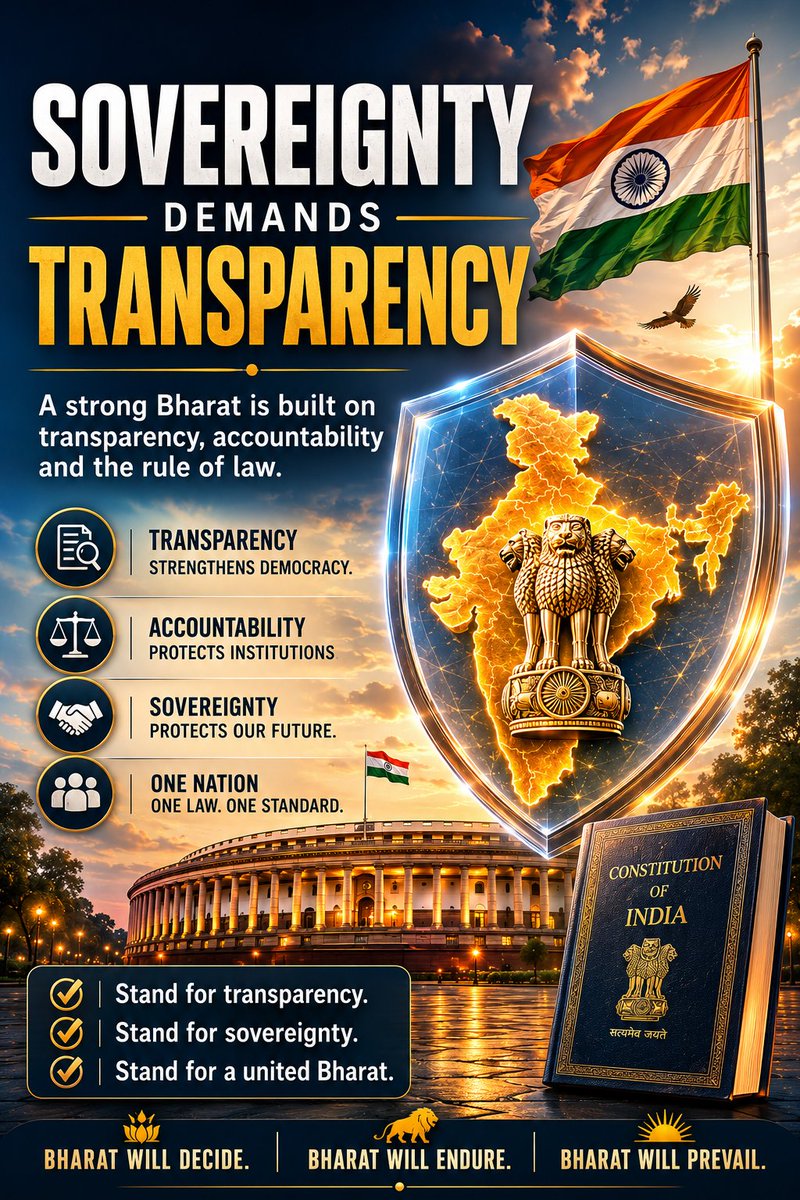
India is a sovereign country. It has every right to ask a basic question: when money crosses our borders, who sends it, who receives it and what safeguards govern its use?
That should be routine, not revolutionary.
Foreign assistance can do enormous good. But good intentions cannot mean exemption from accountability. Nor can invoking religion, charity or human rights place financial oversight beyond the reach of Indian law.
And perhaps this is where the debate becomes uncomfortable.
For generations, India has witnessed external ideas, interests and institutions acquire influence within its social and political life. We have also seen how India's existing divisions can become the subject of competing agendas.
Today, a more confident Bharat is saying: enough of unquestioned influence.
We can welcome legitimate cooperation without surrendering scrutiny.
We can respect every faith without surrendering sovereignty.
We can protect civil society without creating islands of unaccountability.
So let the debate be held in the open.
If the funding is legitimate, transparency should strengthen it - not threaten it.
If the work is genuine, accountability should not be feared.
And if the law is India's law, India must have the final say.
The real issue is therefore not who is offended by FCRA reform.
It is why anyone believes India should apologise for wanting to know what foreign money is doing inside India.
No insinuations. No special exemptions. No double standards.
One country. One law. One standard of accountability.
Bharat's institutions must answer to Bharatiyas, not to external pressure.
Stand for transparency.
Stand for sovereignty.
Stand for a united Bharat.
Bharat will decide. Bharat will endure. Bharat will prevail.
#FCRA #Transparency #NationalSovereignty #Accountability #RuleOfLaw #OneLawForAll #UnitedBharat #StrongerBharat #IndiaFirst #Democracy
Seven years after the abrogation of Article 370, Jammu & Kashmir has witnessed a new phase of development marked by improved infrastructure, expanding healthcare and education, record tourism, greater investment, and the extension of constitutional rights and central welfare schemes. The journey continues, but the focus has shifted from isolation to opportunity, from uncertainty to aspiration. 🇮🇳
#Article370 #JammuAndKashmir #NewIndia #EkBharatShreshthaBharat
@Iyervval Ha ha ha... Please leave these cockroaches... Let them live a peaceful life... We the people of India need some sort of entertainment other than pappu... His jokes are kind of outdated now... Please stop 🛑