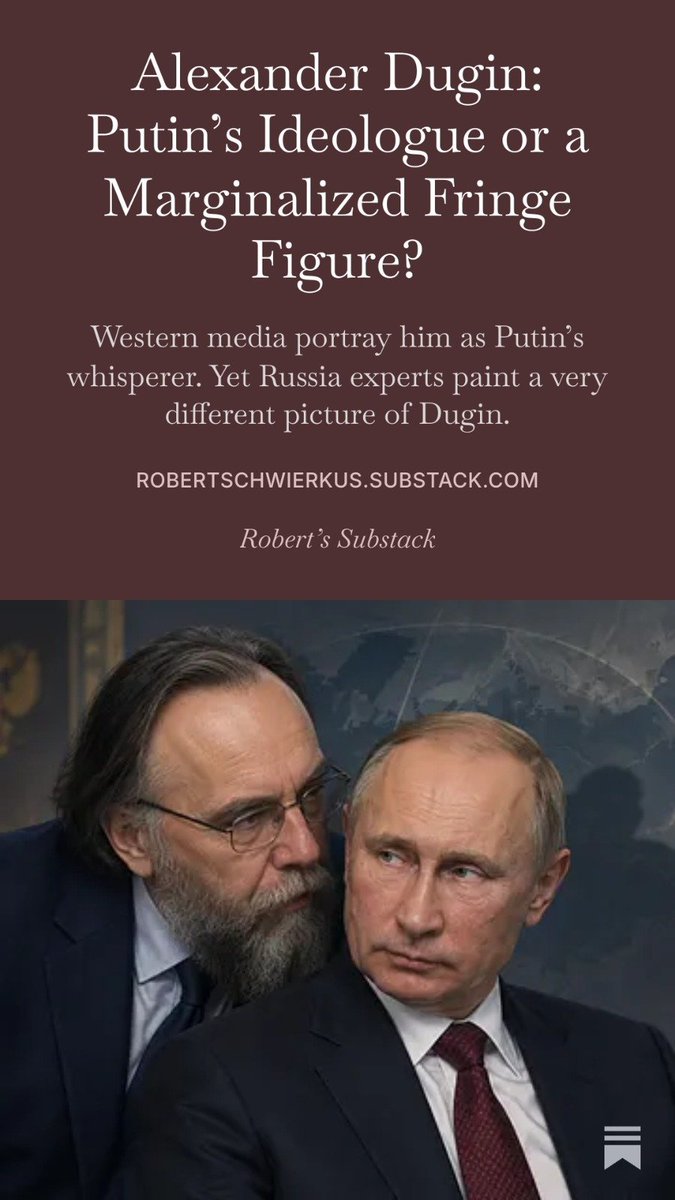
Another day, another Western trope about how Russia does or does not function. One of the most famous examples is the figure of Alexander Dugin, who is, time and again, portrayed as "Putin's ideologue". In this piece, I argued for another perspective. Now in English.
An interesting discussion here with @rochowanski. What I would add:
1) At each turning point, a compromise solution was rejected, and the deepening of the conflict and the escalation of violence to a higher level were accepted, on the assumption that Russia was weak and would be weakened even more, and would eventually fail at the next step of the escalation ladder.
2) The failure of Russia’s original plan for a limited “special military operation” was seen precisely in the same logic, with the same expectations, and seized as an opportunity.
3) When those expectations failed too, continuing the war, as it drains ever more resources and deepens domestic crises in the Western countries, of NATO as such, and of the US-centered international order in general, may be driven by a different set of motivations and interests than the dynamics that led to the outbreak of the war.
The very public execution of my professorship and reputation continues in Norway. Today’s media article about me makes three claims that are misleading and/or false.
1) The article dismisses my claim that my research is being criminalized as the journalists merely cite the dismissive comments from the university - no arguments are apparently required.
It is not possible for an academic anymore to analyse the policies of rival powers by assessing their security concerns, as it will be smeared by the government, the government’s NGOs and the media as “legitimizing” the enemy and supporting their narratives. The current Defence Minister singled me out with the accusation of spreading propaganda and criticised two podcasters for even speaking with me (as I have already been cancelled by the media in Norway). How was this accusation by the Defence Minister substantiated? I had argued that NATO expansion triggered the war in Ukraine, which the Defence Minister denounce as dangerous “Russian propaganda”, with no need to substantiate his vile accusation. I can cite a sea of evidence and also refer to statements by American and European political leaders, ambassadors, intelligence chiefs, and others to make my case. However, the purpose is not to engage in debate, but to smear, censor, and cancel. By going after an individual academic for challenging official truths, the government has already claimed a monopoly on the truth. Academics should have their arguments scrutinised and criticised, but these are severe personal attacks from the government without the possibility of even defending myself. How is this not criminalising the research of an academic?
I cannot even speak at any events in Norway without the event being cancelled. The last event I agreed to speak at was because I shared the stage with the former CIA officer John Kiriakou. A newspaper had the event at a church cancelled, and when the backup location did not also cancel, the journalist simply printed in the paper that it had been cancelled so people would not show up. Is this normal? I must use my allotted holiday days to attend conferences because any event I attend can be presented as “controversial,” and then the NGOs and journalists will go after the reputation of the university. Is this normal? Every newspaper article about me merely refers to me as “controversial” or “pro-Russian” without ever assigning meaning to these labels or presenting my argument.
I have argued, much like former CIA director Burns, that if the West attempts to pull Ukraine into the NATO orbit, then there would be war and Ukraine would be destroyed. This is considered a “pro-Russian” argument. Arguing that we should respect the will of most Ukrainians who want negotiations to end the war is also considered a “pro-Russian” argument, while in contrast, boycotting diplomacy, deporting Ukrainian refugees, and calling for the conscription of Ukrainian women is “pro-Ukrainian”.
2) To avoid addressing any of my arguments, the journalists go on to uncritically cite personal attacks against me, pointing out that I have been called a propagandist by the Norwegian Helsinki Committee. This is a “non-governmental organisation” financed by the government and the National Endowment for Democracy (NED), which was set up by Reagan and the CIA director in 1983 to manipulate the civil society of other states. The Norwegian Helsinki Committee has been relentless in its smears on social media to have me fired, writing hit pieces in the media, pushing to cancel my speaking events, writing a letter to my university, and even posting a picture of my house on social media. This is a governmental "human rights organisation" that cites human rights concerns to build the case for war.
3) Lastly, to further avoid addressing my actual arguments, they simply cite the fact that arguments I made at a debate last year have been “wholly or partially debunked” by a fact-check. The state-run media (NRK) invited the state-run military defence institute (FFI) to fact-check three of my claims. What claims did they "debunk"?
My first claim was that only 20% of Ukrainians wanted NATO membership between 1991 and the regime change in February 2014. The fact-checker argued that the number went up by the middle of 2014 (after Russia responded by seizing Crimea), which is a completely meaningless comment intended to muddy the waters, as my argument was about the previous era.
My second claim was that Zelensky had argued in an interview with The Economist in March 2022 that there were some Western countries that would like a long war with Russia to weaken a strategic rival, even if it would result in the destruction of Ukraine. The fact-checker argued that not all Western countries wanted a long war and that it was not an official policy. I never claimed it was an official policy, as it was primarily the US and UK pushing for a long war.
My third claim was that the US and UK sabotaged the Istanbul peace agreement in April 2022. The fact-checker claimed this was incorrect and suggested that it could only be based on one statement by David Arakhamia. The fact-checker did not want to mention that both mediators also confirmed it: Turkey’s foreign minister and the former Israeli prime minister both said that Russia and Ukraine were close to a deal, but the US and UK saw an opportunity to weaken Russia by fighting with Ukrainians. Zelensky’s former adviser Arestovych confirmed it, and the Ukrainian ambassador Chaly, who participated in the negotiations, confirmed that Putin was willing to do almost anything to end the war. The former head of the German armed forces confirmed that Boris Johnson sabotaged it, and Boris Johnson himself wrote articles warning about a “bad peace” and arguing for “strategic patience.” I am being fact-checked by war propagandists.
Unfortunately, none of my arguments matter because in Norway there is no debate and no interest in any arguments. Reality means nothing anymore as war narratives must be defended against inconvenient truths. I used to be naïve and think that the endless smears were caused by misunderstanding, as I had simply not been able to convey my arguments properly. However, the endless articles with smears and labels are deliberate lies and deceptions.
This would sound pretty plausible, esp the lack of material planning/preparation, if I hadn't been there from 2014/15, meeting with European and US diplomats who were quite candid with me (because they thought "Western NGO lady, must be one of us") about how this was the idea.
Selbstreflexion auf @faznet-Niveau. Vllt erwachen halt einfach nur langsam Teile der Bevölkerung aus der einseitigen Erzählung, die per Trommelfeuer die unbedingte materielle Unterstützung der Ukraine, gegen den bösen und irrationalen Aggressor Russland, als alternativlos verkauft.
Eine Hinterfragung dieses Narrativs lässt sich übrigens auch argumentieren, ohne dafür auf russische Quellen und Narrative zurückgreifen zu müssen. Ich für meinen Teil arbeite in meinen Texten zum Thema nahezu ausschließlich mit westlichen Quellen.
Das Absurde ist, dass wir schon seit längerem an einem Punkt angekommen sind, an dem selbst hochdekorierte westliche Akademiker wie Jonathan Haslam, den man wohl kaum als kremlaffin bezeichnen kann, für ihre Kritik an der westlichen "Hybris" gegenüber Russland als zitierbare Quelle diskreditiert werden sollen.
Es gibt in der Wahrnehmung dieser Leute nur die vollkommen einseitige Verurteilung Russlands oder eben "Kremlnarrative". Das ist die eigentliche Tragik an der gegenwärtigen Situation, in der auf ewig am inhumanen und unnötigen Ausbluten der Ukraine, auf Kosten aller europäischen Bevölkerungen, festgehalten werden soll.
Es ist lange überfällig, diesen vermeidbaren Krieg zu beenden. Ich bin mir vergleichsweise sicher, dass materielle Unterstützung für den Wiederaufbau der Ukraine auf mehr Unterstützung stoßen würde, als für deren fortlaufende Zerstörung.
Das ist aus meiner Sicht die Tragik des Trommelfeuers vonseiten AfD und BSW. Die bisher erstaunlich stabilen und hohen Zustimmungswerte für die Unterstützung der Ukraine geraten unter Druck. Deshalb muss man den Kreml-Narrativen entschieden entgegentreten.
Du bist nicht "die anderen alle" Dirk. Was du definitiv bist, auch wenn du das nicht gerne liest, ist ein politischer Laie. Und oben drauf offenbar auch noch ein Wissenschaftler, der denkt sich stets an den vermeintlichen Konsens zu halten, würde einen in Sachen Erkenntnis irgendwie weiterbringen.
Du verstehst auch den Begriff Echokammer offenbar nicht richtig. Der beschreibt einen Zustand, indem man instinktiv Informationen ausblendet, die dem bereits erlernten Wissen widersprechen. Das ist exakt was du tust. Ich hingegen habe die zur Verfügung stehenden Positionen studiert und bin zu dem Schluss gekommen, dass der im Westen - auch unter Einsatz von Zwang - etablierte Konsens mich argumentativ nicht überzeugt. Er ist zudem hochgradig selbstgefällig und konfliktfördernd.
Ich befinde mich mit meinen Positionen auch in guter Gesellschaft - von Leuten, die wirklich Ahnung haben wovon sie sprechen (Politik) und integer sind. Ein Beispiel? Das ist ein Zitat aus Stephen Walts aktueller Kolumne im Foreign Policy-Magazin:
"The seizure of Crimea in 2014 and the invasion of Ukraine in 2022 did not come out of nowhere, or spring unbidden from the fevered imperialist brow of Russian President Vladimir Putin. As many experts had warned since the mid-1990s, they were a response to a long series of Western actions that virtually the entire Russian political elite viewed as threatening, an existential danger so great that Moscow eventually decided to launch an illegal preventive war."
Jetzt denk vllt nochmal etwas intensiver darüber nach, wer von uns beiden in einer Echokammer feststeckt.
https://t.co/mJeihQQr4q
@RDisarray@Dummophob@faznet Du willst suggerieren, dass die anderen alle in einer Echokammer sind – dabei ist es eher der Konsens. Dabei hast du dich in die Schmollecke zurückgezogen, in der ihr euch gegenseitig für eure angeblich bessere Haltung auf die Schulter klopft. Das nennt man Echokammer.
@dirk_fasshauer Gib nicht mir die Schuld dafür, dass sich dieser Eindruck aufdrängt.
Mach dir nichts draus. Du bist, wie das Zitat klar macht, nicht der einzige Deutsche, der Schwierigkeiten mit dem Unterschied zwischen "verstehen" und "verzeihen" hat.
@dirk_fasshauer Erneut irrst du dich in mehrfacher Hinsicht. Erstens habe ich mich vorher noch nie zu dem Interview geäußert. Zweitens verharmlose ich den russischen Krieg gegen die Ukraine nicht.
Dein durch deine Echokammer geprägter Verstand missinterpretiert meine Intention.
@dirk_fasshauer@Dummophob@faznet Intensiv nachdenken scheint ebenfalls nicht dein Metier zu sein.
Ich zitiere Stephen Walt und du bringst reflexhaft ein Ronzheimer-Interview, um umgehend meine Einordnung von dir zu bestätigen. Dann BILD dir mal schön weiter deine Meinung Dirk. Ich denke damit ist alles gesagt.
Du bist nicht "die anderen alle" Dirk. Was du definitiv bist, auch wenn du das nicht gerne liest, ist ein politischer Laie. Und oben drauf offenbar auch noch ein Wissenschaftler, der denkt sich stets an den vermeintlichen Konsens zu halten, würde einen in Sachen Erkenntnis irgendwie weiterbringen.
Du verstehst auch den Begriff Echokammer offenbar nicht richtig. Der beschreibt einen Zustand, indem man instinktiv Informationen ausblendet, die dem bereits erlernten Wissen widersprechen. Das ist exakt was du tust. Ich hingegen habe die zur Verfügung stehenden Positionen studiert und bin zu dem Schluss gekommen, dass der im Westen - auch unter Einsatz von Zwang - etablierte Konsens mich argumentativ nicht überzeugt. Er ist zudem hochgradig selbstgefällig und konfliktfördernd.
Ich befinde mich mit meinen Positionen auch in guter Gesellschaft - von Leuten, die wirklich Ahnung haben wovon sie sprechen (Politik) und integer sind. Ein Beispiel? Das ist ein Zitat aus Stephen Walts aktueller Kolumne im Foreign Policy-Magazin:
"The seizure of Crimea in 2014 and the invasion of Ukraine in 2022 did not come out of nowhere, or spring unbidden from the fevered imperialist brow of Russian President Vladimir Putin. As many experts had warned since the mid-1990s, they were a response to a long series of Western actions that virtually the entire Russian political elite viewed as threatening, an existential danger so great that Moscow eventually decided to launch an illegal preventive war."
Jetzt denk vllt nochmal etwas intensiver darüber nach, wer von uns beiden in einer Echokammer feststeckt.
https://t.co/mJeihQQr4q
@dirk_fasshauer@Dummophob@faznet Wann hab ich das denn eingestanden? Und wie sollte ich mich in einer Echokammer bewegen? Der westliche/deutsche Diskursraum ist übersättigt mit Positionen, die den meinen oft diametral gegenüberstehen.
Ich befürchte du projizierst wieder.
The history of the conflict did not start in 2021-2022. Influential groups in the Western elite saw Ukraine (in fact, all the Eastern Partnership countries, but Ukraine above all) as essential to preventing the consolidation of a sovereign center of capital accumulation in the post-Soviet region under an untamed Russian elite in possession of vast strategic resources and nuclear arsenal. The “democracy promotion” and regime-change agenda has been there for a long time. It is wrong to read the path to the war, and the inability to get out of it, as just the result of a series of miscalculations.
@dirk_fasshauer@Dummophob@faznet Dirk war wohl noch etwas angefressen, weil jemand seine politische Expertise in Zweifel gezogen hat. Scheint er nicht gewohnt zu sein in seiner Echokammer.
Interesting posting by Lemoine, in essence a historical theory of how the "West" fixed itself into the position of fighting a surrogate war in Ukraine. I think he's right about the expectation of a quick Ukrainian defeat whatever that meant in practice. And US planners were...
These days, barely a week goes by in Europe without a drone sighting, a fire or a power outage being blamed on Russia. We’re told that these incidents are all part of a relentless, and escalating, “hybrid war” that Moscow is waging against the continent.
But does the evidence support Western claims that Russia is engaged in a systematic hybrid war against Europe? As I argue in my first piece for @RStatecraft, not really.
Most claims of Russian involvement turned out to be establishment-amplified speculation that collapsed under basic scrutiny. In many cases, there is no evidence the incidents themselves actually even happened (drones supposedly swarming European airports, etc.).
So is this just a case of collective panic fuelled by click-addicted media? Or, given that the claims of a Russian “hybrid war” against Europe appear to rest on little more than propaganda, is there a concerted effort by the EU-NATO establishment to condition citizens to believe that Europe is under attack from Russia?
In Italy, the expression “strategy of tension” evokes a dark period, from the late 60s to the early 80s, in which intelligence services and secret paramilitary networks operating under NATO auspices inflated the terrorist threat to frighten the electorate, including by engaging in terrorist acts that in some cases were then blamed on the left. European leaders should be wary of reviving such a strategy.
Read the article here: https://t.co/mMtUxVxofY