Day 35 of war with Iran and only 1% of the population have internet.
That 1% isn’t normal citizens. The vast majority are regime agents on white SIM cards — the ones the government still keeps online so they can flood every platform with their narrative.
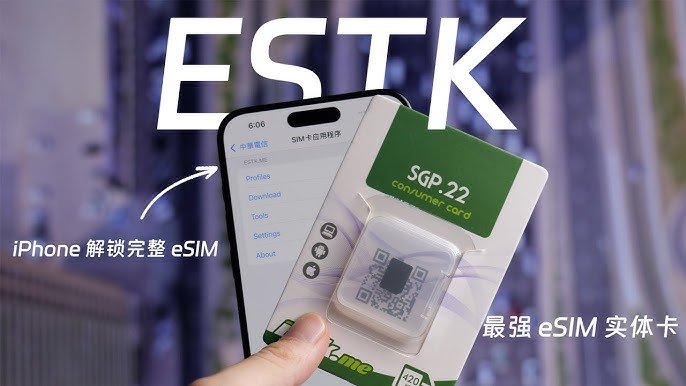
People like me with Starlink or expensive configs? We’re 1% of that 1%. A tiny, fragile window to the outside world.
And sometimes it feels crushing. Every single day I’m trying to push back against the tsunami of propaganda the regime and its supporters (both inside Iran and abroad) are pumping out.
Every lie, every edited video, every twisted narrative. I screenshot, I translate, I document, I reply, I post, I repost… and I still catch myself thinking: Am I doing enough? Because when almost nobody else can even get online, it starts to feel like the truth is resting on the shoulders of a handful of us who have to fight tooth and nail to still have signal.
If you’re reading this and you still have internet, you’re not just scrolling. You’re one of the last witnesses. Don’t look away. Be our voice.
#DigitalBlackOutIran
#KingRezaPahlaviForIran
BREAKING: Oman and Iran held deputy foreign minister-level talks Saturday to discuss “smooth passage” through the Strait of Hormuz, per the Omani Foreign Ministry.
This formalizes Iran’s April 2 push for a joint Iran-Oman “protocol” to oversee Hormuz transit. Araghchi said last week the future of Hormuz “rests with Iran and Oman.”
At the same time, UK maritime shipping journal Lloyd’s List is tracking three Omani vessels, two oil supertankers and an LNG carrier, transiting the Strait today outside Iran’s approved corridor, sailing unusually close to the Omani coast.
Oman is at the negotiating table and simultaneously sending its own ships around Iran’s control zone. That is what hedging looks like.
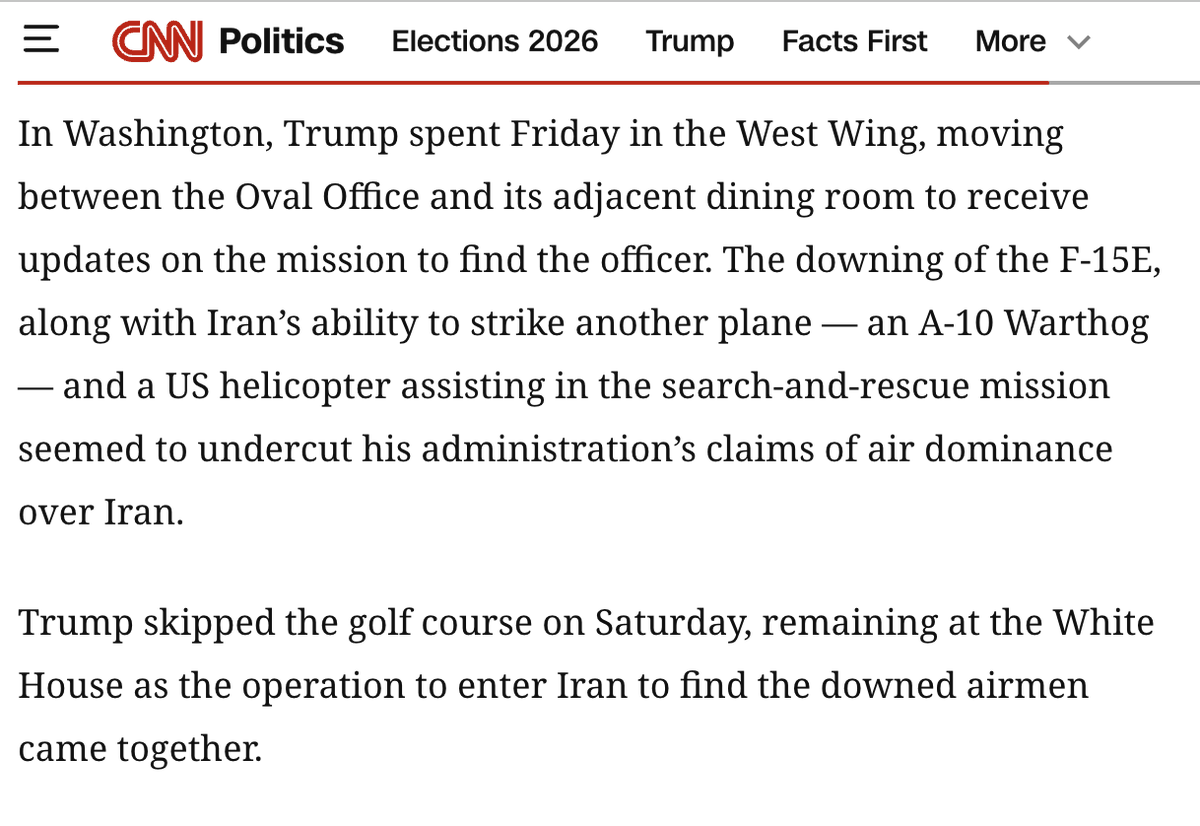
🇺🇸🇮🇷TRUMP: Tuesday will be Power Plant Day, and Bridge Day, all wrapped up in one, in Iran. There will be nothing like it!!! Open the Fuckin’ Strait, you crazy bastards, or you’ll be living in Hell - JUST WATCH! Praise be to Allah.
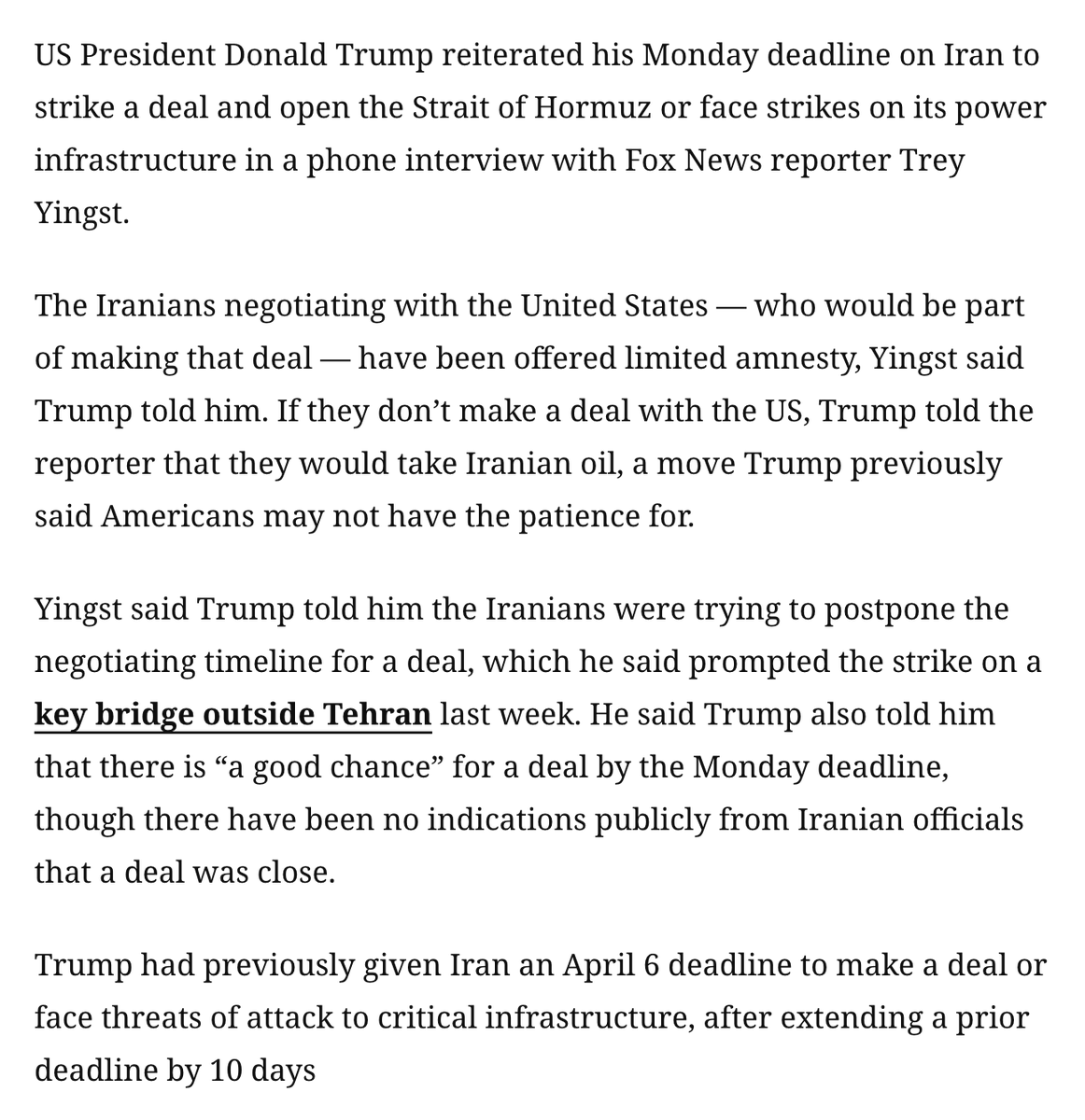
BREAKING: President Trump says he believes he can "get a deal with Iran" by Monday and that Iran is "negotiating now."
Trump also says he is considering "blowing everything up" and "taking Iranian oil" if Iran does not make a deal "fast."
MS and Google Pursuing LTA with SK Hynix
SK Hynix is entering into long-term supply agreements (LTAs) for DRAM with major global AI companies including Microsoft (MS) and Google. Big Tech is moving to lock in DRAM—a product known for high price volatility—over extended periods. As concerns over DRAM supply shortages intensify amid the global AI infrastructure investment boom, Big Tech is strategizing to secure stable access to memory, a critical component for data centers. Samsung Electronics and SK Hynix, the world's No. 1 and No. 2 DRAM makers, are ramping up capital expenditure in response to the growing supply-demand imbalance.
◇ MS and Google Arrive with Long-Term DRAM Contracts
According to industry sources on the 5th, SK Hynix is in final-stage negotiations with MS on a long-term supply agreement for DDR5. The deal, valued in the tens of trillions of won, would cover a three-year period starting this year. Discussions are reportedly centered on provisions such as a price floor to hedge against significant DRAM ASP declines during the contract period, and terms under which 10–30% of the total contract value would be paid upfront.
SK Hynix is also in discussions with Google on a long-term supply agreement. The negotiations reportedly cover not only its flagship High Bandwidth Memory (HBM) but also commodity DRAM used in servers. MS and Google are also pursuing long-term memory supply agreements with Samsung Electronics. Micron Technology, the U.S.-based No. 3 DRAM maker behind Samsung and SK Hynix, reportedly signed a similar contract last month.
◇ "Securing Volume Matters More Than Price"
A long-term supply agreement is a contract in which volume and pricing are predetermined over an extended period. This type of agreement is typically employed when prices for a specific product surge or supply becomes scarce. Until now, large companies like MS and Google had not entered into annual or multi-year memory supply contracts with memory manufacturers, given that memory is a highly cyclical product subject to significant price volatility.
Nevertheless, Big Tech has recently been approaching Samsung Electronics and SK Hynix with LTA proposals one after another due to an increasingly acute memory shortage. Memory supply has tightened significantly as AI infrastructure investment expands worldwide, and prices have surged accordingly. According to DRAMeXchange, the DDR4 contract price, which stood at just $1.35 in March of last year, skyrocketed to $13.00 by the end of last month.
Moreover, as the AI infrastructure hegemony race appears set to become protracted, analysts note that AI companies have shifted to a strategy of securing volume first. A senior semiconductor industry executive explained, "Right now, the fact that prices have risen so much is secondary—the real issue is that DRAM volume itself is extremely difficult to procure."
◇ Samsung and SK Hynix to Significantly Expand DRAM CAPEX
Samsung Electronics and SK Hynix have decided to aggressively invest in DRAM capacity this year in light of these conditions. Samsung Electronics is focusing on ramping up volume of 10nm-class 6th-generation (1c) DRAM—used in HBM4—at its main DRAM production base, the Pyeongtaek campus in Gyeonggi Province. At its Hwaseong campus, the company is accelerating process migration to 10nm-class 5th-generation (1b) DRAM, which serves as the base die for SOCAMM and commodity DRAM modules.
SK Hynix is addressing new HBM volume demand centered on M15X, its new production base in Cheongju, North Chungcheong Province. Its headquarters campus in Icheon, Gyeonggi Province, is also aggressively pursuing process migration to its most advanced 1c DRAM node.
Driven by the DRAM supply crunch, both companies' Q1 earnings are estimated to reach all-time highs. In a report on the 3rd, Meritz Securities projected Samsung Electronics' Q1 estimated revenue at KRW 122 trillion and operating profit at KRW 54 trillion. The estimated operating profit is more than triple the previous Q1 record of KRW 14.12 trillion set in 2022. FnGuide estimates SK Hynix's Q1 revenue at KRW 46.6252 trillion and operating profit at KRW 31.5627 trillion—4.2x the KRW 7.4405 trillion reported in the year-ago quarter.