🚨BREAKING: Henry Nowak's father speaks out on the murder of his son:
"He told officers he could not breathe NINE TIMES, he said he had been stabbed FOUR TIMES, but the officer replied saying' 'I don't think you have, mate.'"
What a brave man.
“You’ve been stabbed? I don’t think you have, mate,” the officer responded.
The @HantsPolice body camera footage of the arrest of a dying Henry Nowak has been released.
The university student tried desperate to tell police he had been stabbed and that he couldn’t breathe. They turn him around on the ground and handcuff him until he goes limp.
Nowak was killed by an Indian man who lied and said he was the victim of a racist attack, a tactic often used and encouraged by leftists to get an upper hand against others.
When I speak to the average liberal Canadian, it leaves me speechless. It is as though they are another species void of the survival adaptations that shape the trajectory of every species.
Humanity, created by God in all its grandeur, is today facing a pivotal choice: either to construct a new Tower of Babel or to build the city in which God and humanity dwell together. In Jesus Christ, this humanity in its grandeur becomes the Way, the Truth and the Life, opening the path for each of us to grow toward fullness. #MagnificaHumanitas
https://t.co/6i9MWs6LJl
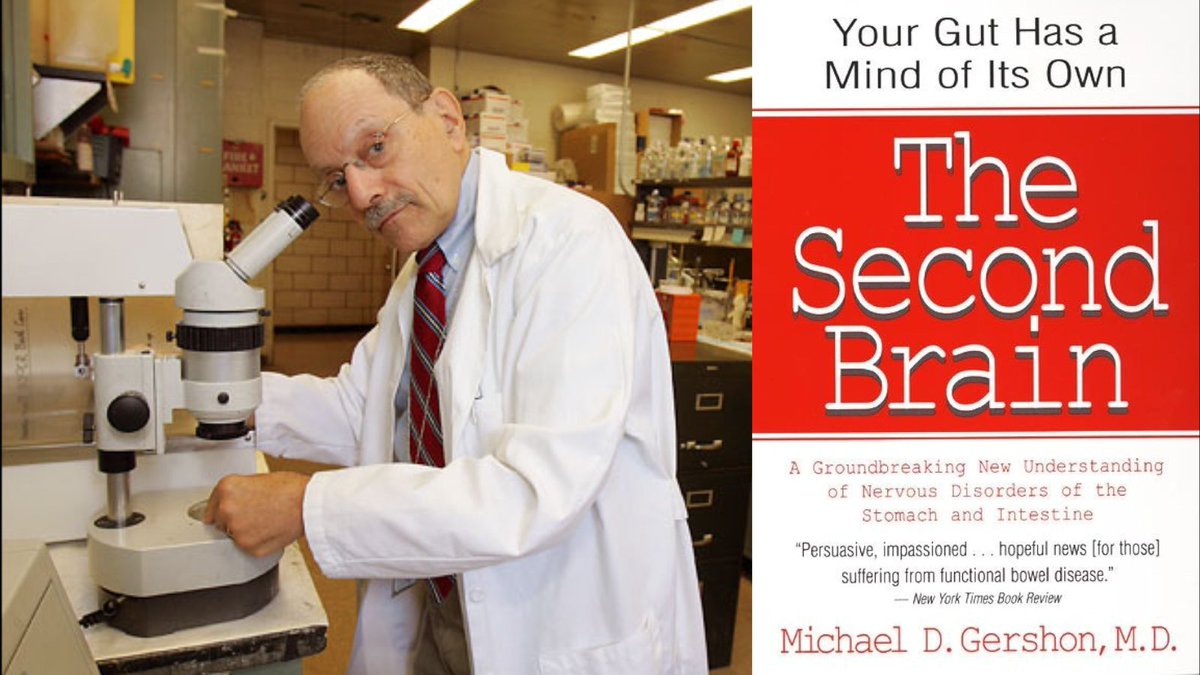
A neurobiologist at Columbia spent 30 years proving that the gut has its own brain, and the day he finally published the book that named it, almost every psychiatrist in America stopped returning his calls.
His name is Michael Gershon.
He runs the Department of Anatomy and Cell Biology at Columbia University Medical Center in New York, and the field he built from the ground up is called neurogastroenterology in short brain-gut axis.
The book that announced it to the world was published in 1998, and the title alone tells you everything about what he was up against. He called it The Second Brain.
The claim sounded like science fiction in the 1990s. Gershon was saying that the human gut contains its own fully functional nervous system, with around 100 million neurons embedded in the walls of the alimentary canal, which is the nine-meter tube running from your esophagus to your anus.
That is more neurons than your entire spinal cord, and more than your entire peripheral nervous system put together. The gut was not just digesting food. It was running its own intelligence, with its own reflexes, its own memory, and its own way of deciding what to do without asking the brain in your head for permission.
The medical establishment treated this as borderline heretical when he first started publishing it. The brain was supposed to be the command center. Everything else was supposed to be the periphery. A second brain in the belly did not fit the architecture anyone had been taught.
Then the data started piling up, and it was impossible to argue with.
The first finding that broke the old model was about serotonin. You might have heard Andrew Huberman talking about it on his podcasts. Serotonin is the neurotransmitter associated with mood, well-being, sleep, and depression. Every antidepressant on the market targets it.
The assumption for decades was that serotonin was a brain chemical, produced in the brain, regulated in the brain, and responsible for what happened inside the brain.
Gershon's lab showed that 90 to 95 percent of the body's serotonin is not produced in the brain at all. It is produced in the gut, by specialized cells called enterochromaffin cells embedded in the intestinal lining.
Your stomach and intestines are the largest serotonin factory in the human body, and the brain in your skull is producing only a tiny fraction of what is circulating below your neck.
The second finding was even harder to swallow. The vagus nerve is the longest cranial nerve in the body, running from the base of the brain down through the neck, the chest, and into the abdomen, where it branches into the gut. For most of the 20th century, doctors assumed the vagus was the brain's way of giving orders to the digestive system, in the same way the brain gives orders to the rest of the body.
The actual measurements showed almost the opposite. Roughly 90 percent of the fibers in the vagus nerve are carrying signals upward, from the gut to the brain, and only a small fraction are carrying signals downward. Your gut is sending nine times more information to your head than your head is sending to your gut.
The bandwidth is wildly asymmetrical, and almost all of it is going in a direction the medical textbooks had quietly been wrong about for decades.
The implication of those two findings together is what changed psychiatry.
If most of your serotonin is being produced in your gut, and most of the information flowing through your vagus nerve is moving from your gut to your brain, then your mood is being shaped from the bottom up far more than it is being directed from the top down.
The feeling of dread before a difficult meeting. The sudden clarity after a good meal. The low-grade anxiety that will not go away no matter how much you talk through it. All of it is downstream of signals that started below your diaphragm.
A 2019 study at McMaster University put the final piece in place. Researchers gave mice oral antidepressants and watched what happened. The drugs activated the vagus nerve from the gut side, and the gut-to-brain signaling was what produced the antidepressant effect.
When they cut the vagus nerve and tried the same drugs, the antidepressant effect disappeared completely. The drug was not working on the brain directly. It was working on the gut, and the gut was working on the brain.
The follow-up research on the microbiome made the connection even tighter. Mice raised in completely sterile environments with no gut bacteria produced about 60 percent less serotonin in their intestines than normal mice. When the bacteria were reintroduced, serotonin production returned to normal.
The trillions of microorganisms living in your digestive tract are not passengers. They are running the factory that makes the chemical your antidepressant is trying to manipulate.
The most haunting line from Gershon's interviews is the one I keep coming back to.
He said the second brain does not do philosophy or poetry, and it cannot help you write a novel. But it is the brain that decides whether you wake up in the morning feeling like the day is full of possibility or feeling like something is wrong before anything has even happened.
The mood you assume your conscious mind is generating from your thoughts is mostly being generated underneath you, by a nervous system you cannot feel and cannot consciously access, in an organ you have spent your entire life thinking about as a digestion machine.
The decision your gut makes about how you are going to feel arrives in your head a fraction of a second before your brain catches up to it. The conscious thought is the explanation your mind invents for a verdict that has already been reached somewhere lower.
You did not feel uneasy because you were thinking dark thoughts.
You started thinking dark thoughts because your gut was already uneasy.
في عام ١٩٢٧، دخلت باحثة شابة من روسيا أحد مقاهي برلين لتتغدى، وهناك لاحظت شيئًا غريبًا في تصرفات النادل.
وما كانت تعرف إن هذي الملاحظة البسيطة ستغير علم النفس للأبد..
اقتربت من النادل وطلبت منه ببساطة..
Today, a CIA whistleblower sat before my committee and confirmed what I've said for years: government officials, including Dr. Fauci, deliberately misled the American people about the origins of COVID-19. This is not a conspiracy theory. This is sworn testimony. 🧵
Police time will no longer be wasted investigating legal social media posts, freeing up officers to patrol the streets and tackle real crime.
By scrapping Non‑Crime Hate Incidents, we are balancing the protection of vulnerable communities while respecting free speech.
This millennial would like Gen X to sit down. Does he understand what would happen to the world if we decided to do that??
Take a listen to this response.
It is perfection! 👌🏼
The actual research is wild. Every time you push down a feeling, your brain has to choose between suppressing that emotion and recording what’s happening around you. It picks the suppression. The memory doesn’t get saved.
A 2000 Stanford study confirmed this: people told to hide their emotions while watching a film remembered far fewer details than people who just reacted naturally. Suppressing emotions uses up mental energy, and that leaves less brain power for saving new memories.
Brain scans show why. A 2012 study found that suppression quiets the hippocampus (your brain’s memory-recording center) right when it should be saving information. The two brain regions that normally team up to lock in memories stop talking to each other.
Over time it gets worse. Suppression keeps cortisol (the stress hormone) elevated, and cortisol shrinks the hippocampus. Chronically stressed people can lose 10 to 15% of its volume. Just three weeks of high cortisol can shrink the tiny connection points between brain cells by about 20%. The good news: studies show this shrinkage can partially reverse once stress levels drop. Not necessarily permanent.
A Finnish study of 1,137 older adults tracked over roughly a decade found that habitual emotion suppressors had nearly 5x the risk of developing dementia, even after controlling for genetics, smoking, obesity, and education.
There’s a better way to handle emotions that doesn’t cost you your memory. It’s called cognitive reappraisal: instead of bottling the feeling, you reframe what’s causing it. (“This meeting isn’t a threat, it’s practice.”) A 2003 Stanford/UC Berkeley study found reappraisers had more positive emotion, better relationships, and higher wellbeing. Suppressors got the opposite on every measure. And reappraisal carries zero memory cost.
The difference comes down to timing. Suppression kicks in after the emotion has already fired, so your brain is fighting its own response while simultaneously trying to record the moment. Reappraisal changes how you interpret the situation before the emotion fully activates. Same event, same person, but your hippocampus stays free to do its actual job: recording your life.
Eastern Europe is the most exploitable talent arbitrage on the planet right now and almost nobody in the Western business world is paying attention because they're too busy overpaying for mid work from the Philippines and India…
Romania, Bulgaria, Serbia, Poland, Ukraine, Croatia. Average salaries $500-1,000/month. But the talent coming out of these countries isn't $500/month talent. It's $5,000-8,000/month talent priced at a tenth of what you'd pay in the US because the local economy hasn't caught up to the skill level yet
That gap is the exploit
Every other "hire cheap overseas" conversation defaults to Southeast Asia or South Asia. And sure, the prices are low. But anyone who's actually tried to scale operations in those regions knows the pattern. Language barriers. Cultural disconnect. Equipment issues. Endless training loops. You spend more time managing output than you save in cost. The $4/hour rate sounds nice until you're on revision 14 and the work still isn't usable
Eastern Europe skips all of that
These countries have legitimate university systems. Strong STEM education. English fluency across the entire 18-30 demographic, sometimes better than native speakers in the US (not even joking). They grew up on the same internet, same memes, same cultural references. Zero cultural gap when working with Western businesses. You don't need to explain context. You don't need to translate intent. They just get it
And they have real infrastructure. Laptops. Fast wifi. Proper software. Modern tools. You're not onboarding someone who needs you to walk them through basic setup. You're hiring someone who's already operating at a professional level but happens to live in a country where $1,000/month is a great salary
The applications go way beyond content. Developers in Bucharest building full-stack apps for $1,500/month that would cost you $8-12k from a US agency. Designers in Belgrade producing brand assets at agency quality for $800/month. Sales closers in Sofia running calls in perfect English for $1,000/month plus commission. Media buyers in Warsaw managing $50k+/month ad accounts for $1,200/month. Copywriters, project managers, data analysts, customer support, operations managers. Every single role in your business can be filled from Eastern Europe at 80-90% cost reduction with zero quality drop
The training speed is the real cheat code though. Hand someone in Bucharest a brief on Monday and you get back usable output by Wednesday. Not "needs 6 rounds of feedback" output. Actually usable, deploy-immediately output. The baseline competency is just different when the talent pool is educated, tech-native, and hungry
It's common now for operators running lean businesses to have their entire team in Eastern Europe except themselves. 4-8 people. Total payroll $5-8k/month. Output equivalent to a $40-60k/month US team. The business runs 24/7 because the time zone overlap with the US is actually perfect for async work
(btw it doesn't hurt that Eastern Europe has the baddest bitches on the planet. If you need on-camera talent for any kind of brand content targeting Western audiences, a girl in Sofia or Bucharest is visually indistinguishable from a girl in LA but costs a fraction. The talent pool for that specific use case is bottomless and nobody's tapped it properly yet)
The freelance platforms are the worst place to find these people. The best ones are in local Facebook groups, Telegram channels, and Eastern European Twitter. You DM 50 people, 40 respond within hours because an $800/month retainer is life-changing money and they actually take pride in the work. The talent density is absurd once you know where to look