I lost ₹50 lakhs in real estate.
Not because I was dumb but because I stopped running the numbers.
I was the "real estate guy" in my circle. Everyone came to me before buying. I got overconfident. Stopped following my own rules.
Then I realised that India has 1000 property listing sites but zero decision tools.
I wrote down every rule I'd abandoned. I built a tool, shared it with my mentor. He loved it. His students loved it.
That tool is now being used by 500+ retail property buyers/investors and I present the same for everyone
https://t.co/QjgB5Idb4I
• #RealEstate #IndianRealEstate #PropertyInvestment #HomeBuying #PersonalFinance
Jodhpur has always had the pull — the forts, the desert, the culture. What it sometimes lacked was the infrastructure to match its ambition.
A modern terminal doesn't just handle more passengers. It signals to businesses, investors, and families that this city is being taken seriously.
For a city like Jodhpur, better connectivity is quietly one of the most important things that can happen — not because it creates demand from nothing, but because it finally gives existing demand a proper door to walk through.
When getting around a city becomes easier, something quietly shifts for the families who live there.
Less time stuck in traffic. Less stress on weekday mornings. More hours back in the day. These aren't small things, in fact they compound over years into a genuinely better quality of life.
For Ahmedabad, this is not just an infrastructure project. It's the city investing in its own liveability — and cities that do that consistently tend to reward the people who chose to put down roots there.
Seven corridors is an ambitious vision. Delivery will take years, and anyone who has watched Mumbai-Ahmedabad knows that patience is part of the journey. But the direction is clear, and the cities on this map — Pune, Hyderabad, Bengaluru, Chennai, Varanasi — already have strong fundamentals pulling people toward them.
The rail doesn't create that gravity. It multiplies it.
For homebuyers in these corridors, that's worth sitting with — not as a reason to rush, but as a reason to think carefully about where you're planting roots and why.
When a city consistently attracts high earners, it's telling you something important — people are choosing it, again and again, for their careers, their families, and their futures.
Bengaluru, Delhi, Chandigarh topping the income charts isn't just an economic statistic. It's a signal that these cities have something people want to stay close to — opportunity, infrastructure, and a quality of life worth paying for.
For anyone thinking about where to put down roots, that's not a bad place to start the conversation.
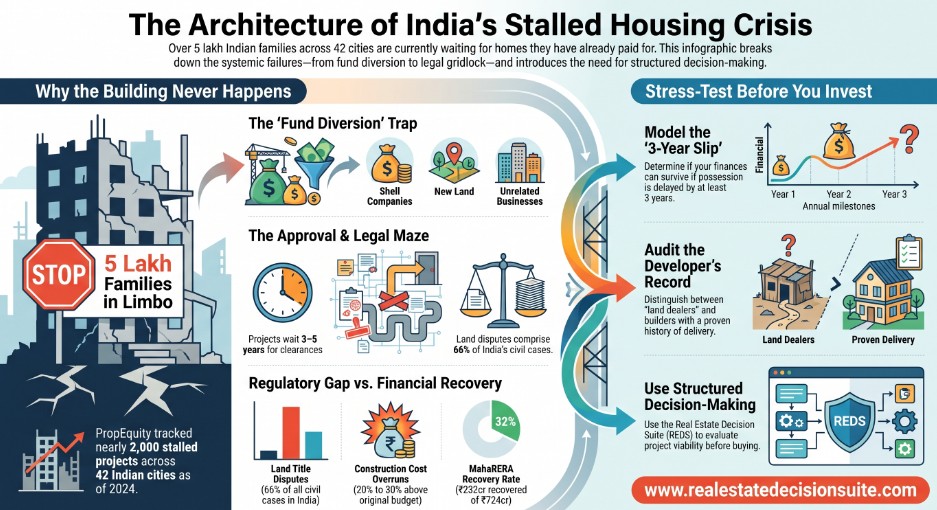
5 lakh Indian families are waiting for a home they've already paid for.
Not a rumour. PropEquity tracked nearly 2,000 stalled projects across 42 cities as of 2024. The money is gone. The building isn't there.
Here's why this keeps happening:
1. Your money built someone else's project.
Developers collect advances from buyers and quietly divert them to new land purchases, older loans, or entirely different launches. Forensic auditors in landmark cases found funds routed to shell companies, personal accounts, and unrelated businesses. The project you paid for was funding a project you'd never heard of.
2. The approval maze swallows years.
Environmental clearances, municipal NOCs, layout sanctions, fire department approvals — some projects wait 3 to 5 years just to legally break ground. RERA itself does not address delays caused by government approval bodies. The developer isn't always the problem. The system often is.
3. Projects are sold before they're viable.
Launches happen on ambition, not secured funding. When sales slow down mid-project, the cash pipeline collapses. Construction doesn't fail dramatically — it just quietly stops.
4. Land titles were never clean to begin with.
66% of all civil cases in India are land and property disputes. Developers sometimes begin construction on land with unresolved ownership claims, family disputes, or encumbrances. One legal challenge from one co-owner can freeze an entire project for years.
5. Construction costs blow past original estimates.
Material costs, labour shortages, and supply chain disruptions routinely push project costs 20 to 30% above what was budgeted at launch. Developers who priced tightly have no buffer. The project becomes unviable to complete at the original price point.
6. Many developers are land dealers, not builders.
They're skilled at assembling land and launching projects. Actually delivering them at scale — managing contractors, timelines, and cash flows simultaneously — is a completely different capability. One many never actually had.
7. Insolvency proceedings freeze everything.
When a developer goes under, the project enters IBC proceedings. Resolution plans take years. IBC has been largely ineffective in real estate insolvencies, with most cases failing to achieve resolution and homebuyers struggling to recover their investments. Buyers are left choosing between a refund that may never come or waiting indefinitely.
8. RERA exists. Enforcement is another story.
MahaRERA — India's most advanced state regulator — recovered only ₹232 crore of ₹724 crore ordered in recovery warrants, a 32% recovery rate, as of July 2025. The orders are real. The money rarely follows.
The brochure is not the building. The launch date is not the possession date.
Every buyer deserves to ask hard questions before they sign — about the developer's completion track record, the project's funding structure, the title clarity of the land, and whether their EMI can survive a 2 to 3 year delay.
These aren't pessimistic questions. They're the ones that separate a structured decision from an emotional one.
That's exactly what REDS was built for — to help Indian homebuyers stress-test a property before they fall in love with it, not after. Tools like Crystal Ball Pro model what happens to your finances if possession is delayed. The Investment Stress Tests show whether your plan survives a rate hike or an income shock. The OD Facility Analyzer helps you stay liquid while you wait.
Feelings start the decision. Frameworks finish it.
https://t.co/TLpLMasIHm
A new international airport doesn't just add flights — it adds possibility.
Visakhapatnam has always had the geography, the coastline, and the talent. What it sometimes lacked was the connectivity that turns a great city into a magnet for jobs, investment, and people.
Bhogapuram changes that. When passengers, businesses, and capital can move in and out easily, the city starts attracting the kind of economic activity that makes neighborhoods grow, not just expand.
Ujjain just got a ₹1,266 crore PepsiCo plant and 800 new jobs.
That's 800 families with steady income, in a city known more for temples and tourism than industry. Good jobs tend to pull in more jobs around them, transport, housing, small businesses that serve the workforce.
One factory doesn't turn a city into a hotspot overnight. But this is exactly how demand gets built, slowly, on the back of real employment rather than a press release.
Mumbai is quietly entering a new redevelopment phase. A Knight Frank report from earlier this month puts numbers on it: nearly 59,000 new homes worth around ₹1.5 trillion by 2031, developer agreements crossing 1,050 for the first time since 2020, and stamp duty alone expected to bring in over ₹9,115 crore for the state.
The more telling shift is in project size. The average redevelopment plot has grown from about 1,850 sq m last year to nearly 3,000 sq m now, more than half of new agreements involve plots over 10,000 sq m.
Mumbai is moving away from one-building-at-a-time redevelopment toward entire neighbourhood clusters, mostly concentrated in Borivali, Andheri, and Bandra.
Here's the part most coverage skips. Mumbai already has close to 2.9 lakh unsold homes sitting in inventory, and the bottleneck isn't a lack of supply, it's affordability against a city housing nearly 30,600 people per sq km. More units arriving over the next five years doesn't automatically mean more of them get sold or lived in.
If you're weighing whether to wait for a redevelopment unit in your building versus buying elsewhere now, that's exactly the kind of decision a stress test earns its keep on, timeline risk, holding costs, and resale demand all change the math more than the headline number does.
Mumbai had its busiest June in 14 years. 13,302 homes registered, up 15% from last year.
But the government's stamp duty collection only rose 4%. More people buying, smaller or cheaper homes on average.
That's not a warning sign. If anything, it's the healthier version of growth, more ordinary buyers instead of a few big-ticket deals holding up the number.
So next time a headline says "best month ever," check what's actually being bought underneath it.
Genuinely good news, after years of delays, a real, usable section is finally close.
Surat to Vapi is a solid 100km stretch that proves the engineering and execution can work, and that matters more than people realize.
Every long corridor starts with one working segment. Once this opens, it becomes the proof point the rest of the line gets built around.
Worth watching closely, this could be the start of something that reshapes how that whole Gujarat stretch connects and grows.
Vadhavan is a genuinely exciting long-term bet, a deep-sea port already underway, an airport eyeing 90 million passengers, and a real economic corridor forming around both. That combination doesn't come along often.
The honest part is timing. The port itself is aiming for the end of the decade, the airport's a step behind that. So this is a decade story, not a today story, and that's actually the upside. Real corridors give you time to plan instead of chase. Watch the port's progress over the next few years, it'll tell you more about Palghar's future than any headline will.
Worth separating the headline from the cities driving it. MMR and NCR alone account for a huge share of national volume, and both fell.
Kolkata's +10% looks strong on a small base but won't move the all-India number much.
A recovery isn't "more cities turned positive than expected," it's whether the cities with the largest buyer pools and deepest job concentration are absorbing supply faster, not slower.
Right now the biggest markets are still digesting, not recovering
14 years ago, Ahmedabad bet that a cleaner riverbank would change how people felt about their city.
It did. And property prices around it quietly confirmed it.
Sabarmati didn't just move water. It moved perception — from a city that tolerated dysfunction to one that proved it could build something and keep it. That shift in trust is what creates lasting premiums, not the marble and the lighting.
Most buyers chase location. The sharper question is always: who is governing this location, and do they finish what they start?
Five years ago, someone bought in Gurugram and didn't tell anyone. Today, they don't have to.
Since 2019, Gurugram has appreciated nearly 150%. Pune 115%. Noida and Greater Noida around 104%. Mumbai and Bengaluru close to 98% each. These weren't lucky bets. Every city on this list had jobs concentrating, infrastructure committing, and institutions planting roots before the prices moved. The appreciation was the market catching up to reality.
Now look one layer below — and the story gets interesting.
Jaipur has grown roughly 65% between 2020 and 2025. Coimbatore posted a 52% year-on-year surge in sales value in early 2025, with Lucknow close behind at 48%. Entry prices still affordable. Demand anchors still forming. Infrastructure still arriving.
That combination — early gravity, lower entry, genuine job growth — is historically where patient buyers build wealth quietly, before the city makes headlines.
The metros rewarded those who read gravity early.
Tier 2 is where the next chapter is being written. The question worth asking isn't where prices have already run. It's where jobs, connectivity and institutions are arriving next — and whether you're early enough to matter.
Delhi to Varanasi in under 4 hours does something interesting — it doesn't just compress distance, it blurs the line between a work city and a roots city.
For millions of UP families holding that quiet two-home instinct, this corridor makes the math more honest. The income engine and the identity engine don't have to be as far apart as they once were.
Jewar is the sleeper pick here. Airport plus bullet train in the same node is rare infrastructure density. That kind of layering is what separates a location from a long-term demand anchor.
Announcements travel faster than trains. But the corridor logic is sound, and the gravity is already forming around it.
100 km of uninterrupted, access-controlled expressway is already live — and that's not nothing.
When the full Bengaluru–Chennai corridor delivers, commute math changes for an entire band of towns. Hosur, Krishnagiri, Vellore — corridors that today feel distant start feeling connectable.
December 2026 is the target. There's gap work remaining, so timelines may slide. But the direction is clear and the momentum is real.
Buyers who understand corridor logic and time entry on delivery, not ceremony, will be well positioned when this one closes.
A high-speed charging hub doesn't land in a city on faith. Someone ran the numbers on vehicle movement, incomes, and EV adoption — and Hyderabad cleared every bar.
That's the real signal. Not the charger, but what had to already be true for it to arrive here.
Infrastructure doesn't pioneer. It validates. Every metro line, data center, and EV hub that keeps landing in this city is less a cause and more a receipt — proof the underlying economy already earned it.
Hyderabad isn't being built into a future-ready city. It's being recognised as one.
An experienced operator taking over Nagpur's airport is genuinely good news. The city's getting a builder who's delivered modern terminals elsewhere — a real head start.
A terminal like that does more than move passengers. It signals intent — telling firms, investors, and talent that the city is opening a serious door.
What turns a fine airport into a thriving one is what grows around it: offices, industry, the daily reasons people fly. Hyderabad's airport works because Hyderabad's economy gave it something to carry. Connectivity and growth move together.
For Nagpur, the runway is the invitation. The exciting part is watching the city rise to meet it.
For decades, what blocked Mumbai's redevelopment wasn't money or demand. It was getting a few hundred neighbours in an ageing building to all say yes at once.
That was the wall. A single policy change — dropping the consent requirement on large contiguous plots — quietly took it down.
The demand was always there. The ageing stock was always there. The capital was waiting. The state didn't manufacture a boom; it removed the friction that had trapped value for a generation.
That's the pattern worth carrying. Good policy rarely creates growth from nothing. It unlocks what was already standing there, waiting for one obstacle to move.
Four of the top ten cities for homes sold in five years sit in or around Mumbai. Yet Mumbai proper isn't the leader — Thane sold more, Pune nearly double.
That's not Mumbai fading. It's buyers doing the math and deciding the island city's per-sq-ft doesn't survive a growing family. So they move to where the same money buys a life.
The quieter signal is at the bottom. Chennai and Kolkata — two of India's biggest cities, rank below Gurugram. Population doesn't buy homes. Jobs, new households, and a deep pool of ready buyers do.
A big city with slow sales is really telling you how easily you'd find a buyer the day you want out. And that's the only number on your side when you sell.