Exudyn - a C++&Python library from @uniinnsbruck @J_Gerstmayr for simulation of flexible multibody dynamics systems for engineering, robotics, biomechanics, ...
Just put version 1.9.83 of #Exudyn on #Github and #PyPI. While this is a pre-release, it adds two very important features:
- auto-Assemble()
- integrated animations (ffmpeg)
This is not only important for our users, but also large language models (#LLM) love our auto-assemble😉
✨We are excited to introduce the new journal "Machine Learning for Computational Science and Engineering"!
📝Submit your paper today and be a part of shaping the future landscape of modeling in science and engineering!
Learn more here: https://t.co/Te2QD6vbTZ
#MachineLearning
We have now succeeded in getting the inverted quadruple pendulum (4-link pendulum) to run stably. The inverted 5-link pendulum is also running in some tests! How far could we go? 6-link, 7-link? ... inverted rope?
https://t.co/LBEgU9vOMj
https://t.co/n83bERxzl2
Visit us today at the reseachers' night #LNF24 at Campus Technik, T13, ground floor - starting at 5pm. You can see and touch our programmable matter or accept the challenge with the AI cyclist. Participants will get some prices.
Bidding farewell to 2023 and welcoming 2024! 🎉 Take a stroll down memory lane with @FireTechnology as we revisit the archives. Rediscover the essence of pyrotechnics through a delightful editorial. 🔥✨ #NewYearReflections#FireTechnology#Pyrotechnics
https://t.co/uStoMhZbQa
Happy New Year! A great year for Exudyn, as we will see advanced models created just from natural language and no programming knowledge. Our paper in Multibody System Dynamics just has been accepted: https://t.co/EAYeMTvXW1
Currently, we are running first finetuning experiments!
We just finished our work on "Multibody Models Generated from Natural Language" showing that Multibody systems can be created with Exudyn just from simple texts. This could drastically simplify modeling in the future. preprint: https://t.co/XF9cvM8E3p
See the model in the video.
The rigid bodies are exposed to gravity which acts in Y-direction and the first link is attached to ground with a revolute joint at the left end. Put all output into a single Python script. ...
Our paper on Exudyn finally got published: https://t.co/LdA3PqJl5J
as part of the special issue from the IMSD2022 conference. Thanks to all supporters to make this happen!
Our Springer-Nature Multibody System Dynamics article has recently been accepted. As soon as it is available, the link will be posted here and users can refer to it easily. The paper not only shows the structure but also multi-threading performance.
EXUDYN now has a file https://t.co/3QwKRLg0pv which can be used with #ChatGPT to create a simple #multibody dynamics simulation model from natural language. In some cases the full Python code is 100% correct!
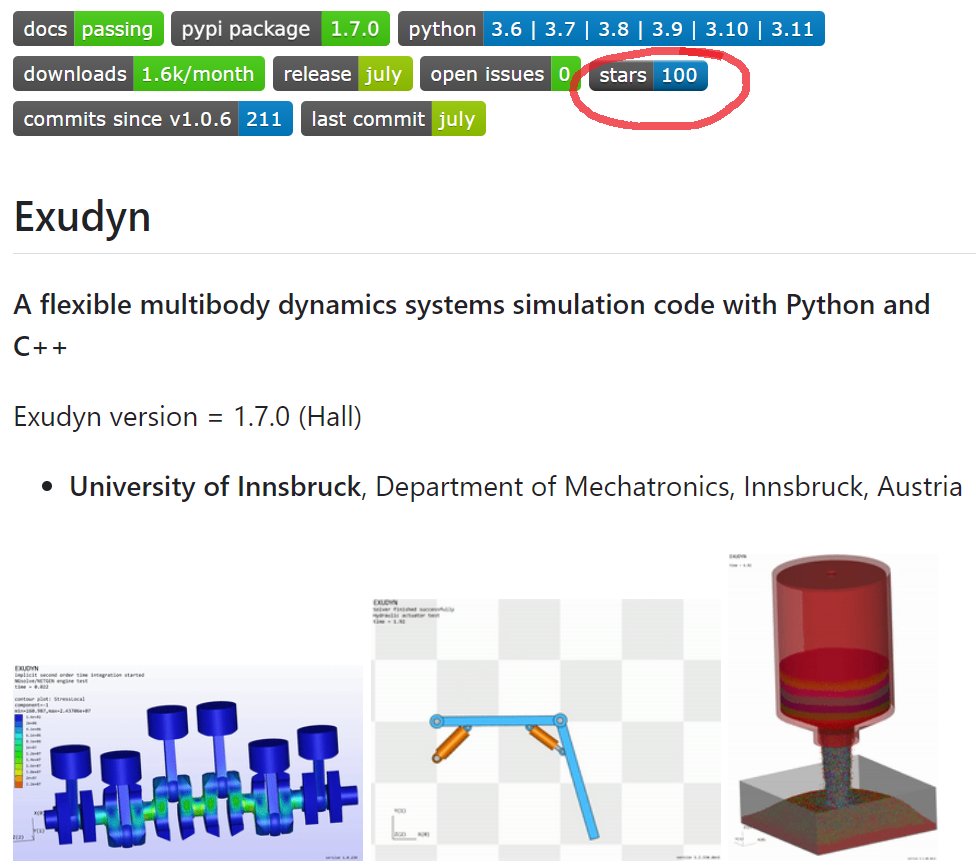
Just saw that #Exudyn@RExudyn reached 100 likes on Github: https://t.co/3tcGygUhbr. That may sound little, it's a lot for a small community in #MultibodyDynamics. And it even means even more to us, as Github stars are used to judge whether a code is read by GPTs or not.
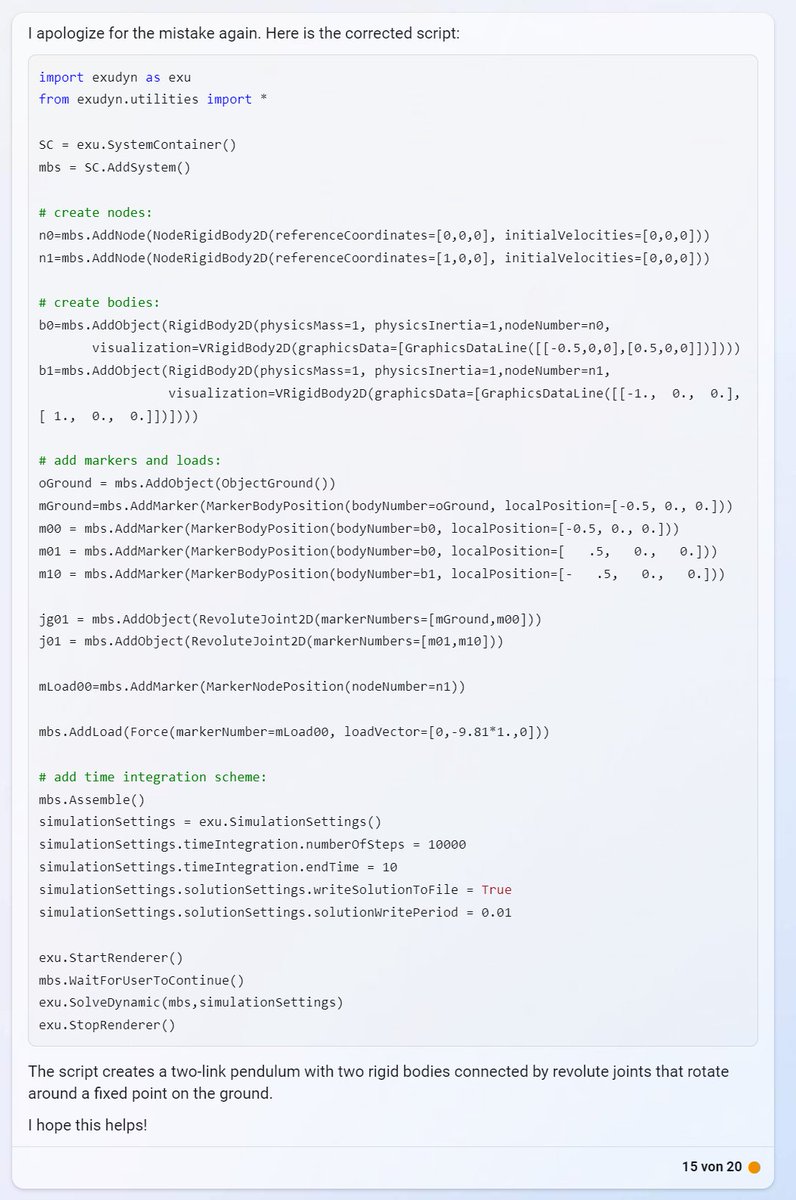
While still waiting for #GPT4 access, I now tested Microsoft @Bing AI for Exudyn capabilities to create a double pendulum. After 15 trials and several corrections, it gives the script below: fully working and much better than ChatGPT. Even the first attempt is much better!
Since the last micro update of exudyn, most of the documentation went to github pages and to Read the Docs: https://t.co/IUNKlUJBfu. This allows finding item names, settings, interfaces and Python utilities easier. Settings show full paths, which you can copy and paste. Enjoy