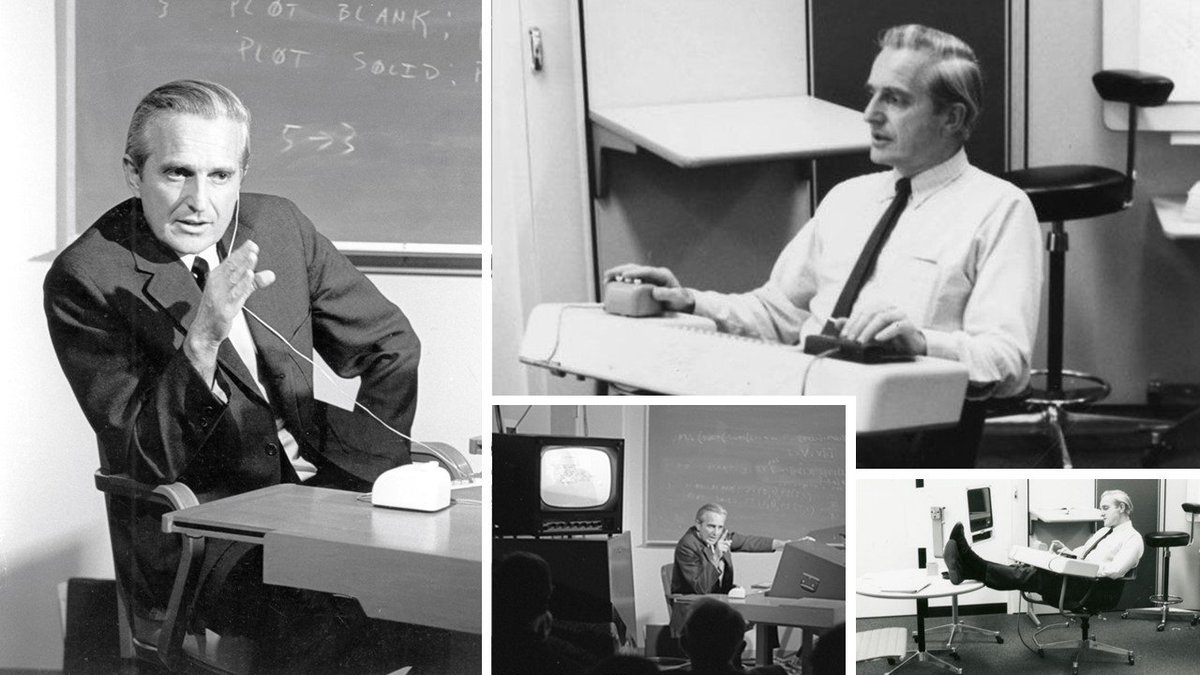
This man invented:
> The computer mouse
> The windows you are looking at right now
> Video calls
> Hypertext links, the thing every website on earth is built on
> Copy and paste
> Real time collaborative editing, the same tech behind Google Docs
He showed all of it, working, live, on one stage, in one 90 minute demo.
In 1968. Sixteen years before the first Macintosh. Twenty five years before the World Wide Web.
He got nothing for it.
I found the footage at 1am and sat there for the full 90 minutes like it was a movie.
His name is Douglas Engelbart. The demo is called The Mother of All Demos.
December 9th, 1968. San Francisco. A stage in front of a thousand computer scientists who had never seen a computer do anything except print numbers on a card.
Engelbart walked out and used a small wooden box with a wire coming out the back to move a pointer around a screen. Nobody in that room had ever seen a mouse before. He had built it himself with an engineer named Bill English two years earlier, and this was its public debut.
Then he opened something that looked like a modern folder system. Windows on a screen. Clickable text. He clicked a word and it jumped him to a different document. That was hypertext, the exact idea that Tim Berners-Lee would use to build the web twenty three years later.
Then the part that should have broken the room. He picked up a phone, called a colleague thirty miles away at his lab in Menlo Park, and a live video feed of that colleague appeared on the big screen behind him. They edited the same document together, in real time, watching each other's cursor move.
A video call. In 1968. On dial up equipment built from scratch in a government funded lab.
The room did not know how to react. People said later they assumed it was a trick, like a magician's stage. It was not a trick. Every piece of it was real and running live on hardware Engelbart's team had built from nothing.
He called the whole project "augmenting human intellect." His theory was simple and huge at the same time. The world's hardest problems, disease, poverty, war, were too complex for any single human brain to hold. He believed computers could become an extension of human thinking itself, not a machine you used but a machine you thought with. The mouse and the windows and the links were never the point. They were just the tools he needed to build to prove the bigger idea could work.
Here is the part that stings.
Within a few years, his own lab started falling apart. Funding dried up. His best engineers, the same ones who helped build the mouse and the windows, left one by one for a new lab down the road called Xerox PARC. PARC took the ideas, refined them, and built the first real graphical interface. Steve Jobs visited PARC in 1979, saw it, and built the Macintosh around it. Microsoft followed a few years after that.
Engelbart held the original patent on the mouse. Patent number 3,541,541. It expired in 1987, right before the mouse became standard equipment on every desk on the planet. He never collected a cent in royalties on the device that now sits under a billion hands a day.
He spent the rest of his career trying to get funding for the bigger idea, the one about augmenting human intellect, and mostly failed to get anyone interested. The tech world took his tools and left his mission on the table.
He did get recognized eventually. The Turing Award in 1997. The National Medal of Technology from Bill Clinton in 2000. But by then the mouse had already made other men billionaires, and the windows he demoed first were already sitting inside operating systems built by companies that were not his.
He died in 2013 in his home in Atherton, a few miles from the labs that had taken his ideas decades earlier.
The footage of that 90 minute demo is still online right now, free, in full, on YouTube.
You can watch a man invent the next fifty years of computing on a single stage, then watch history hand the profits to everyone except him.
La route du pire est toujours pavée de bonnes intentions
Quand je vois la jeune génération réclamer toujours plus de marxisme, plus de socialisme, plus d'État, plus de « planification » pour réparer un monde qu'on lui a appris à détester — je n'ai pas envie de ricaner. J'ai envie de crier.
Parce que je reconnais le premier chapitre d'une histoire dont je connais, moi, la dernière page.
Cette histoire, un homme l'a écrite en 1944, sous les bombes. Friedrich Hayek. Le livre : La Route de la Servitude. Et il l'a dédié — lisez bien — « aux socialistes de tous les partis ». Pas par mépris. Par affection. Par urgence. Parce qu'il avait vu, de ses propres yeux, une Europe entière basculer.
Retenez ceci, c'est le cœur de tout : le totalitarisme ne commence jamais avec des monstres. Il commence avec des gens bien.
Il commence avec des idéalistes qui veulent le bien commun. Des jeunes gens généreux qui ne supportent plus l'injustice. Des partis mous, consensuels, qui promettent de tout arranger si on leur confie juste un peu plus de pouvoir. Le problème n'est pas leurs intentions. Le problème est le mécanisme qu'ils enclenchent.
Voici ce mécanisme. Suivez-le, il est implacable.
Pour planifier une économie, il faut une décision unique là où il y avait des millions de choix libres. Il faut donc concentrer le pouvoir. Or aucune société n'est jamais d'accord sur un plan unique — chacun a ses fins, ses rêves, ses priorités. Le planificateur se heurte alors à un mur : le désaccord. Et le désaccord devient un obstacle à éliminer. On commence par convaincre. Puis par contraindre. Puis par réduire au silence. Non par sadisme — par nécessité logique. Le plan exige qu'on écrase ce qui lui résiste.
Et arrive alors le chapitre le plus glaçant de Hayek : « Pourquoi les pires accèdent au sommet. » Dans un système qui réclame un pouvoir total, ce ne sont pas les meilleurs qui gagnent. Ce sont ceux qui sont prêts à tout. L'homme scrupuleux hésite ; l'homme sans scrupule agit. La machine collectiviste, quelles que soient ses couleurs, sélectionne mécaniquement les brutes.
Regardez l'Allemagne. On vous a raconté que Hitler tombait du ciel, une anomalie, un accident du mal. C'est faux, et c'est dangereux de le croire. Ce que Hayek a compris, c'est que l'Allemagne avait passé un demi-siècle à abandonner le libéralisme classique — l'individu, le droit, le marché — au profit du culte de l'organisation, du collectif, de l'État qui sait mieux que vous. La gauche et la droite partageaient déjà la même prémisse : l'individu doit se soumettre au plan de la nation. Hitler n'a pas eu à construire cette machine. Il l'a trouvée déjà montée, chauffée, prête. Il n'a eu qu'à saisir le volant.
C'est ça, l'avertissement. Le totalitarisme n'est pas une idéologie. C'est une structure. Vous pouvez la remplir de rouge, de brun, de n'importe quelle couleur généreuse. Une fois que vous avez accepté que l'individu doit plier devant le collectif, que la propriété n'est qu'un privilège révocable, que la liberté d'échanger, de parler, d'entreprendre s'arrête là où commence « le bien commun » décrété d'en haut — vous avez posé les rails. Le train, lui, viendra tout seul.
Et il vient toujours avec les meilleures intentions du monde. Chaque marche vers l'abîme est justifiée, raisonnable, compassionnelle. Un impôt de plus pour les pauvres. Un contrôle de plus contre les méchants. Une liberté de moins, mais « juste celle-là ». Personne ne choisit la servitude. On y glisse, une bonne intention après l'autre.
Alors je lance cette bouteille à la mer. À vous qui avez vingt ans et le cœur en feu. Votre révolte contre l'injustice est belle — gardez-la. Mais par l'amour de Dieu, apprenez l'histoire. Lisez Hayek. Lisez ce que fut réellement le XXᵉ siècle, non pas la caricature qu'on vous en sert. Les dizaines de millions de morts qu'il a laissés derrière lui n'ont pas été tués par des sadiques venus d'ailleurs, mais par des systèmes bâtis, au départ, sur des rêves de justice.
La liberté n'est pas le problème à réparer. Elle est le trésor qu'on est en train de vous convaincre de brader.
Réveillez-vous.
Nuclear power is the only realistic climate solution. It produces far less lifetime greenhouse gases than solar, and is about the same as wind.
And no, it doesn't make smoke. That's steam you see coming out of the cooling tower. And no, it's not radioactive. In fact, nuclear power produces less radioactive pollution than coal. Coal contains trace radioactive elements that go into the air when burned. 100% of all nuclear waste is contained, and a nuclear waste casket has never leaked in the entire history of nuclear power in the US.
Since solar only works when the sun is shining and wind only works when the wind is blowing, it needs to rely on batteries during non-productive hours. Those batteries are full of toxic metals such as lithium and cobalt, most of the world's supply of which comes from mines that rely on forced labor in Africa. There is no forced labor in the US uranium supply chain.
Speaking of uranium, a single nuclear fuel pellet produces as much energy as a ton of coal. If all of the electricity you will ever use in your lifetime were produced by nuclear power, the total amount of fuel you use would fit in a soda can.
Solar panels and wind turbines also contain non-recyclable toxic materials that we have no plan to deal with once they reach the end of their lifetime, which is only about ten years. Nuclear fuel can be recycled at 95% efficiency. If all of the electricity you ever used during your lifetime was produced by nuclear power, the total amount of non-recyclable waste from your lifetime usage would fit in a shot glass. That's not an exaggeration.
Solar panels also rely on polysilicon. More than 80% of the world's supply of polysilicon is controlled by three Chinese companies. If we were dependent on solar power, we would be economically at the mercy of China, the same country that owns most of those African lithium and cobalt mines that use slave labor.
Some celebrate with a party, some celebrate with fireworks, this pilot is celebrating America’s semiquincentennial with a very special flight. #America250
"Eat your vegetables. It's what nature intended."
Nature intended no such thing.
Broccoli does not exist in the wild. Neither does cauliflower, kale, cabbage, kohlrabi, or the Brussels sprout. They are all the same plant, a straggly bitter weed called wild cabbage that clings to sea cliffs, tortured by centuries of human breeding into whatever shape sold best that century. Nature made the weed. We made the rest, in a field, on purpose.
Your carrot was a stringy pale root that tasted of soap until people spent hundreds of years patiently breeding the bitterness out and the sweetness in. Sweetcorn was a wild grass with a handful of hard beads on a stalk. The vegetable aisle is not a stroll through the wilderness. It is a museum of human tinkering, a monument to what we could bully a plant into becoming if we leaned on it for a thousand years.
Now look at the ruminant. The cow, the sheep, grazing a hillside in more or less the body it wore before we invented farming. Barely touched by our meddling. Already perfect at turning grass you cannot eat into meat and milk you can.
They told you the thing we engineered in a field was natural, and the animal that was here long before us was not.
I am having a drink this evening with a friend in a Chiswick pub. Two policemen have just come into the pub and asked me to step outside. I have stepped outside and they have threatened me because I tweeted about a councillor banning seating outside pubs in Chiswick. They admit on video (watch it!) that I did not break the law at all. They came to threaten me. To warn me off tweeting about councillors and the council. This is modern Britain. This is the police state. Please, please, please watch this video. It does involve me using very bad language, but this has got to be seen. Police coming out to threaten someone who hasn’t committed a crime. I’m fuming.
In 1821, Britain returned to gold at the old parity of £3 17s 10½d per ounce. Robert Peel's Currency Act made it official, undoing the wartime suspension that had run since 1797. The pound became gold again. Prices fell for the next two decades.
The textbooks never explain what actually happened. Falling price levels did not strangle British industry. They coincided with the most explosive productive burst in human history. Between 1821 and 1850, wholesale prices in Britain dropped by roughly a third. Over that same span, cotton output multiplied, railway mileage went from zero to over 6,000, and pig iron production tripled. Deflation and the Industrial Revolution marched together through the front door, dismantling the deflationary bogeyman that every central banker uses to justify his existence.
Think about what a falling price level under a fixed gold pound actually means. Output grows faster than the money stock. Each ounce of gold, each sovereign in a Manchester workman's pocket, buys more bread, more cloth, more candles this year than last. Real wages rise without a union boss lifting a finger. The saver is rewarded. The capital that funds Stephenson's locomotives and Arkwright's successors comes from real abstention, real deferred consumption, not from a printing press manufacturing paper claims on goods that do not yet exist.
Compare that to the modern priesthood at the Bank of England, which panics if inflation dips below 2 percent and calls a stable price level a "deflationary spiral." They claim falling prices freeze spending, that consumers wait forever for cheaper goods and the economy seizes. The British consumer of 1830 apparently never got the memo. He bought the cheaper cotton shirt and bought two. Your smartphone gets cheaper every year and you keep buying them, so you already know the theory is garbage.
The Peel deflation was benign because gold disciplined the currency while entrepreneurs did the real work of making things abundant. No stimulus. No dual mandate. No wise men adjusting a dial. The gold standard did not permit them the levers, and Britain became the workshop of the world anyway. Every economist who insists you need 2 percent inflation to grow is asking you to ignore the single greatest growth episode on record.
My wife and I own a pharmacy. Last month we spent days trying to pry one prescription loose from a company that did everything it could to hold onto it.
The drug was everolimus. A generic. It treats cancer and protects transplant patients from rejecting their new organ. Not exotic. Not rare. A pill.
The patient wanted it filled with us because we're cash-pay and cost-plus. No insurance. No PBM. No secret markups, no games. Our price was $318. That's not cheap by our standards — most of what we fill runs under $20 — but it was honest.
Here's what that same prescription looked like on the other side of the counter.
In 2023, Medicare was paying about $6,645 for it. That's roughly 21 times our price for the identical medication. Medicare spent around $240 million on everolimus alone that year. If they'd paid our price, they'd have saved roughly $230 million. On one generic drug.
So how does an insurance company profit off a drug that expensive? Don't they pay for it?
No. You pay for it. In your premiums. Their job isn't to spend less — it's to keep your healthcare dollars circulating inside their own companies. And the tool they use is called spread pricing.
Spread pricing works like this: the middleman bills the health plan one price, pays the pharmacy a lower one, and keeps the difference. You never see it. On TRICARE, they pay an independent pharmacy like mine about $311 to fill everolimus. That barely covers our cost of the drug. Meanwhile the plan gets billed thousands. That gap — north of $6,000 on a single fill — is pure margin the middleman pockets.
Now here's the part they'd rather you not think about.
The pharmacy we were fighting was Accredo. Accredo is owned by Express Scripts. Express Scripts is the pharmacy benefit manager owned by Cigna. Same company, three masks. That nesting-doll structure isn't an accident — it's the whole design. When the pharmacy, the PBM, and the insurer are all one entity, they can shuffle money between their own pockets and call it whatever they want. The confusion is the product.
And this isn't a story about one weird drug. It's the business model.
The FTC has been digging into exactly this. In its January 2025 report on the three biggest PBMs — CVS Caremark, Express Scripts, and OptumRx — staff found those companies marked up specialty generic drugs by hundreds and thousands of percent when dispensing through their own affiliated pharmacies. Just those markups generated more than $7.3 billion above what the drugs actually cost to acquire, from 2017 to 2022. One in five of the specialty generics they studied was marked up over 1,000%. Some cancer generics: over 3,000%. On top of that, the FTC pegged spread pricing on those same drugs at another $1.4 billion.
One example straight from the FTC's files: dimethyl fumarate, a multiple sclerosis drug. Costs about $177 to acquire. The PBMs paid their own pharmacies close to $4,000 for a 30-day supply. Same trick. Different drug.
And they steer the profitable ones to themselves on purpose. Pharmacies affiliated with the big three took in 68% of specialty dispensing revenue in 2023 — up from 54% in 2016. The prescriptions marked up more than $1,000 disproportionately end up at their own pharmacies, not independents like mine.
So when we called to transfer this patient's everolimus to be filled without insurance, it landed like we were asking them to set $6,000 on fire. Of course they stonewalled us.
That's why we fired them.
No insurance means no invisible $6,000 charge buried in a premium you can't itemize. It means the price you see is the price. Ours was $318. Theirs was thousands. Same pill.
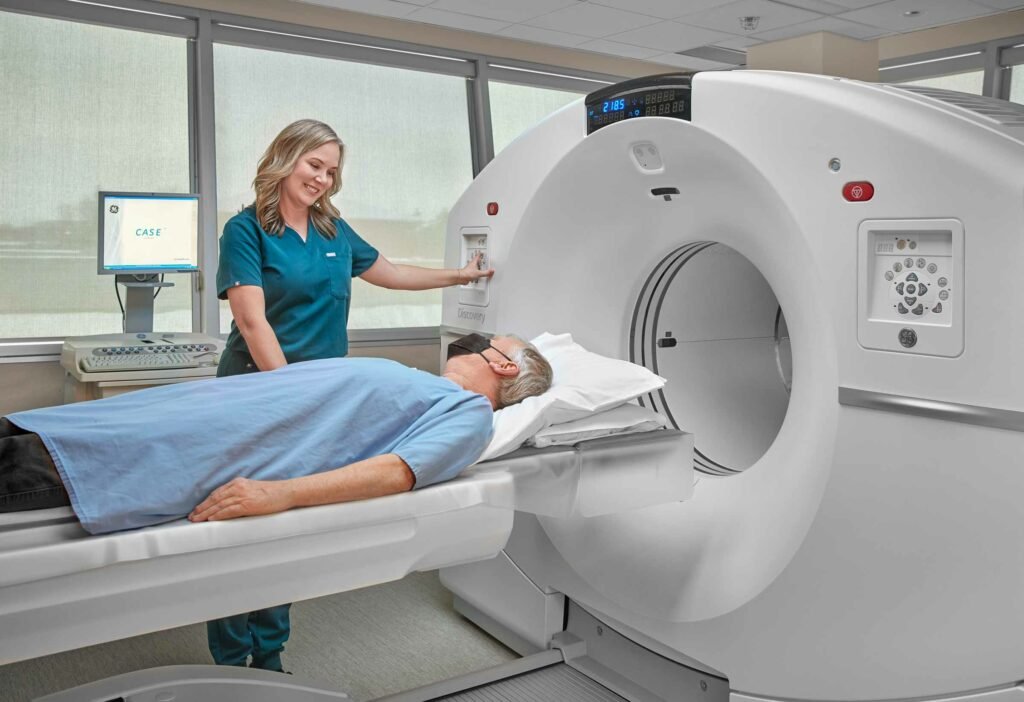
To find a hidden tumour, they inject you with radioactive sugar and photograph where it goes.
It works, reliably, because the cancer drinks that glucose so greedily it flares up on the scan like a bonfire while the healthy tissue around it sits dark. The entire technology rests on one fact nobody says out loud in the room: the tumour runs on sugar, and it will outbid the rest of your body for every last gram of it.
We have known about this appetite for the better part of a century. We built a vast imaging industry on the back of it. We use it today, in every major hospital, to hunt the disease down.
Then, having located the cancer by following the sugar, they bring round the lunch trolley. White toast. Tinned fruit in syrup. A carton of juice, a biscuit, and a leaflet recommending plenty of wholesome carbohydrates to keep your strength up.
We spend a fortune using sugar to find the thing.
Then we sit the patient down and feed it.
Read that twice.
🚨 Confronting the Co-Sponsors of the Stop Nick Shirley Act:
Under bill AB 2624, this video would be illegal. All an “immigration support service provider” would need to do is give you a paper saying you cannot post the video, and you would face a minimum $4,000 fine plus court costs and attorney fees.
CHIRLA the co-sponsor of this bill, has received over $80,000,000 in taxpayer dollars to help illegal immigrants. It does not allow public entry into its building and is rumored to be tied to the cartels.
When I tried to speak with a employee, they all fled and closed the building. What do they have to hide while using taxpayer funds to operate?
This is why they need this bill to pass so they can shield the public from looking into California’s corruption.
EXPOSE IT ALL.
EAST TO WEST: Many were asking about the thunderstorm motion across North Alabama yesterday.
Normally storms across Alabama move in a general motion from west to east. But, yesterday, storms were going “backwards”… from east to west.
This is actually fairly common in summer. The storms are simply following the clockwise circulation of the upper high centered north of the state, which represents the center of the “heat dome”.
When I was a child, my grandfather would sometimes solemnly intone at the dinner table: "The purpose of socialism is to organize scarcity."
As a kid it sort-of didn't register in my brain as meaning anything beyond "socialism bad", but eventually when I was 12 or something, I did ask what he meant by those specific words.
And he said: socialists establish control of valuable resources and then create an artificial scarcity of these resources, so that they can then use them as a tool of control by deciding who gets and doesn't get those resources.
And I thought that was wrong. I mean, are socialists misguided? Sure. But to claim that they deliberately create scarcity as a means of political control? That seemed far-fetched.
But, of course, he was entirely correct.
"Operation Flockout" is targeting Flock nationwide.
"Knock the Flock" is doing the same across the Midwest.
2 groups. 1 goal:
Remove every Flock camera in 🇺🇸 by 2027.
For the first time ever, the surveillance state is facing organized, multi-regional resistance.
Blessed are the privacy makers. 🕊️
"We should stop farming cattle to save the Amazon from soy."
Before you swing that one around, have a look at where the world's soy actually goes. The Oxford food researchers did, and the breakdown is not what the documentary implied.
37% is fed to chickens.
Around 20% goes to pigs.
6% goes to farmed fish.
And beef and dairy cattle, the animals on the poster, take 2%.
Two per cent. The cow you have been told is eating the Amazon accounts for tuppence in every pound of the world's soy. The bird in your supermarket nuggets eats nearly twenty times more of it than she does.
It gets better. A soybean is crushed into two things at once, meal and oil, and the oil is a prize in its own right. It fills the fryers, floods the ultra-processed aisle, and increasingly it does not get eaten at all. Close to half of America's soybean oil is now burned in fuel tanks as biodiesel, wearing a green halo while the forest that grew it does not.
And the British cow being lectured about all this spends her life on grass and hay, off hillsides where no soy has ever grown and no crop ever could. Tofu, soy milk and edamame, for the record, take 7% of the world's crop, so even the vegans are only modest customers.
So the field was cleared to feed the chicken shed, the frying vat and the fuel tank. And the animal standing on a Welsh hill eating rain-fed grass got the blame, because she was easier to film.