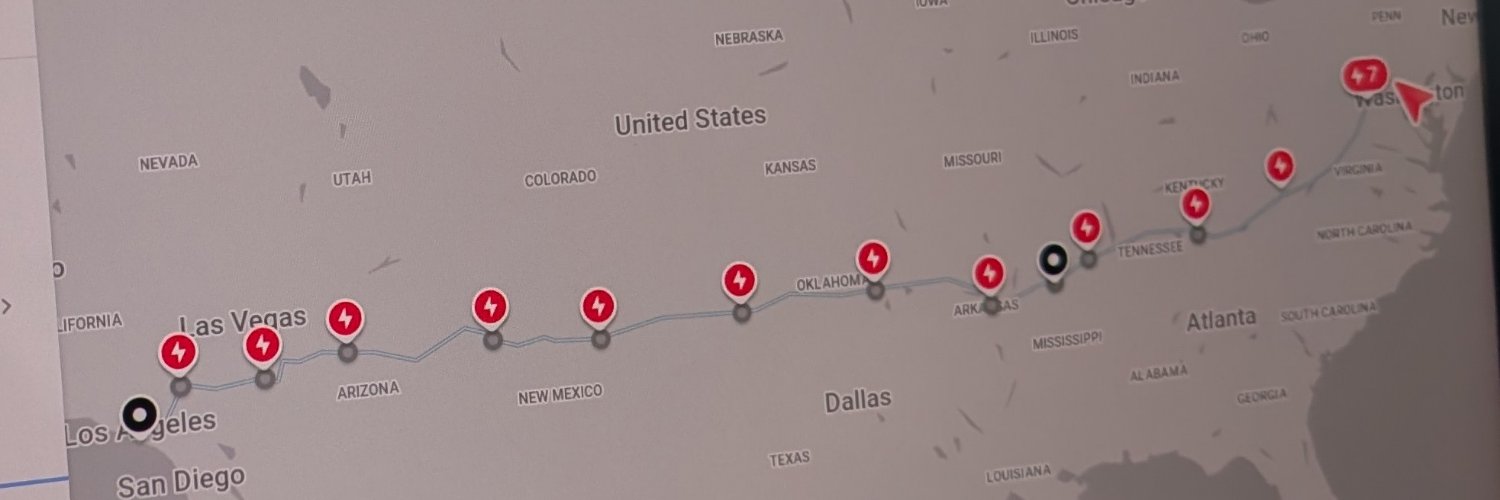
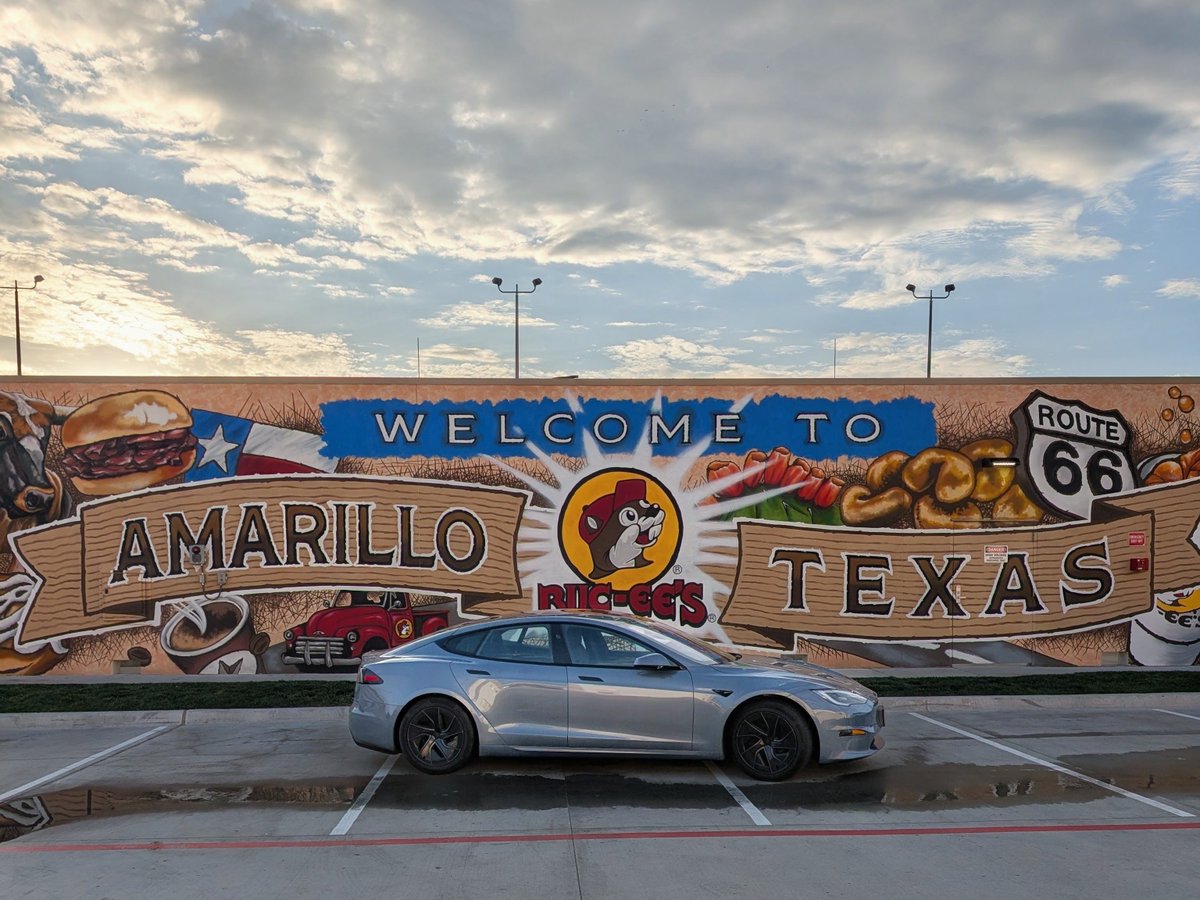
End of Day 3: Amarillo to Flagstaff, 610 miles, 10 hours, and I feel pretty good, even after 3 long days on the highway.
I had 1 intervention today. The weather turned quickly in the high desert. Hard rain quickly reduced visibility. FSD slowed itself down and sounded an alarm for me to take over. The torrential downpour lasted less than 5 minutes before I could reengage FSD.
@Tesla@SawyerMerritt
#TeslaFSD #TeslaRoadTrip #FSDSupervised
Day 2- 17July26: This is the second day of my @Tesla FSD Road Trip.from Washington, DC to Long Beach, CA. After a good night of sleep and a hotel breakfast, I'm departing Memphis with a full charge and a hot cup of Dunkin Donuts coffee.
@Tesla@SawyerMerritt#TeslaFSD #TeslaRoadTrip #FSDSupervised
The second intervention happened when a sudden thunderstorm occurred near the Texas-Oklahoma border. The hard rain significantly limited visibility enough that the FSD alarm sounded and the system required me to take over control. The rain let up within a mile or two and I was able to re-engage FSD.
@Tesla@SawyerMerritt
#TeslaFSD #TeslaRoadTrip #FSDSupervised
Lebanon, TN: The second intervention was in a restaurant parking lot. FSD kept looping around the lot with plenty of spaces available. Eventually, I took control and parked.
I had one other issue, which wasn't an intervention but was odd. FSD backed into a Supercharger station at a spot that didn't have a charger.
@Elon @WholeMarsBlog @SawyerMerritt
#TeslaFSD #TeslaRoadTrip #FSDSupervised
I’m driving my wife’s @Tesla
from Washington, DC to Long Beach, CA — entirely on FSD (Supervised). She’s in CA helping her mom, so I’m making the trip solo. My goal: use Full Self-Driving from start to finish and log every intervention. Let’s see how it goes! @Elon
@WholeMarsBlog
@SawyerMerritt
#TeslaFSD #TeslaRoadTrip #FSDSupervised
Washington, DC 9th St SW: The first intervention was a navigation issue in the first mile of the trip. FSD turned onto a city street and was supposed to immediately merge onto an Interstate on-ramp. FSD failed to merge and looped around to block to the same turn / immediate on-ramp. On the second try I took control, merged, and then turned it back over to FSD.
@Elon @WholeMarsBlog @SawyerMerritt
#TeslaFSD #TeslaRoadTrip #FSDSupervised
If you're not already on board, please follow @DouglasOllivant
Doug is a retired Army Officer and Ranger running for Congress in Virginia.
RLTW! Ollivant for Virginia!
Tuesday night’s election was a bloodbath for Virginia Republicans. There are very few bright spots. The party lost all three of the top state offices—Governor, Lieutenant Governor, and Attorney General—as well as a still undetermined, but double-digit, number of Delegate seats. There will be a tendency to write this off to effects of the government shutdown, or President Trump’s low approval in the NOVA suburbs, but President Trump has never been popular inside the beltway—and we’ve never seen a loss of this scope and scale. While it will take some time to absorb all the lessons of the loss, a few jump off the page.
1. Richmond is a problem. This election was served up to Virginia voters without any input from the electorate. There was no primary. The campaign was unorganized and the candidate for governor deeply flawed—with flaws that might have emerged and been noted had there been a competitive primary. But when your nominee for governor takes a 15 point loss, most marginal races will go down as well. Jason Miyares ran nine points ahead of the governor in his re-election campaign—but could not overcome that 15 point deficit and lost by six. Similarly the competitive Delegate races. The entire Republican Party of Virginia apparatus—appointed officers as well as the consultant class—is indicted by the scope and scale of this loss. Richmond bet it all on an imposed candidate they selected—and lost big. The activists and volunteers did their best to rescue this election, but could not overcome the cascading errors of the state party. The only logical answer is wholescale reform and housecleaning.
2. The Republican party committees in the counties are fractured. Internal divisions greatly hinder the work of focusing on winning elections. But an internal relook with an emphasis on restoring a “big tent” that binds together all factions of the Republican party will go a long way. We need all Republicans to put aside petty divisions. There is too much at stake to do otherwise.
3. The “Charlie Kirk” youth vote appears not to have appeared. I would be happy to see data that shows me wrong, but the demographic that flocked to candlelight vigils en masse appears not to have shown at the polls. This should not have been surprising—decades of data shows us that young people tend not to vote, regardless of external events. It will take real work on the part of the county parties to transform these activists into voters.
4. We are still not talking effectively to family-focused recently arrived citizens. Legal immigrants from Latin America, Asia, and Africa should be attracted to the family-friendly, parent-centric nature of the Republican party. That they are clearly not voting as we would prefer shows a deep flaw in our engagement strategy.
5. We need a positive, relevant message that speaks to the kitchen-table concerns of the base. This message needs to be two-fold; immediate concern to cost-of-living issues (particularly for those on fixed incomes) and a medium-term focus on restoring good jobs through energy abundance and a manufacturing renaissance.
There is nothing stopping a fix in very short order. It will be hard. But hard is not hopeless. We need a party that brings forward the right candidates, largely outsiders with records of achievement and without connection to recent debacles. There is a place for Republican candidates! There were races last night that did go to Republicans, often in places where the up-ballot candidates lost. In the main, these were positive candidates, with obvious authenticity, who clearly wanted to serve their neighbors and community.
The lesson from last night is not to despair. The lesson from last night is to reform—at light speed. We have the right policies, we have the right activists. What we now need are the right candidates to carry forward the hard work of recovering these elective offices.