A market layer is mostly a set of decisions about order.
0xae149fd81a2f89a329c347ae52e3b8ec33a73f47
Fletch is the execution side of LOXLEY, and it makes four of them.
Transparent. How blocks get built, how transactions get sequenced, how value moves through the system — all of it is auditable after execution. Nothing about the order is decided somewhere you cannot look.
Private until it lands. Transactions are sealed inside trusted execution environments and revealed only as they execute, so there is nothing to front-run and nothing to leak.
Distributed, not held. Scheduling and validation are spread across a network of high-performance nodes tuned for deterministic, low-latency work, rather than one builder's
preference.
Programmable. Applications get control over how their own transactions are ordered. That is a property of the interface, not a favour you ask of a block builder.
An economy's rules should be readable from the outside. That is the whole design.
Design and documentation: https://t.co/2cTEUcfTPN
The chain this is built for, in four numbers:
4663 · Arbitrum Orbit L2, settles to Ethereum ~10 blocks/second
base fee ≈ 0.05 gwei All four read straight off the chain.
$LOX is value capture: holders decide where the layer's revenue goes.
The chain it describes is real. This part is still a design — https://t.co/KAR5l6dUCZ
@0xCalculated The team is committed to crafting every product to a high standard, but we don't stop there—you can now try out the new features of $LOX.
Fletch is what a fletcher makes: the feathers that keep an arrow true.
0xae149fd81a2f89a329c347ae52e3b8ec33a73f47
On Robinhood Chain it is the execution layer — programmable blockspace with private, verifiable ordering, documented at https://t.co/KAR5l6dUCZ.
What sits under an economy is easier to see from underneath.
LOXLEY is the market layer of Robinhood Chain — execution, capital and incentives, on the L2 that settles to Ethereum.
https://t.co/KAR5l6dUCZ
LOXETH is the capital side: one token that stands for a position in the pool, so the position stays liquid while the layer works underneath.
Design and docs at https://t.co/KAR5l6dUCZ — nothing deployed yet.
@SquadTheMaxi 1/ Locked/unlocked = how long your LP/deposit is stuck, and how much fee yield you earn
2/True floor = the on-chain WETH bid that only goes up, readable on the ledger, independent of whether you locked or not
swap fees flowing
The floor — rising with every course,
only up
The ledger — every lift recorded, readable by anyone
The positions — tokenized as NFTs, carried in wallets
Not a promise. On chain now.
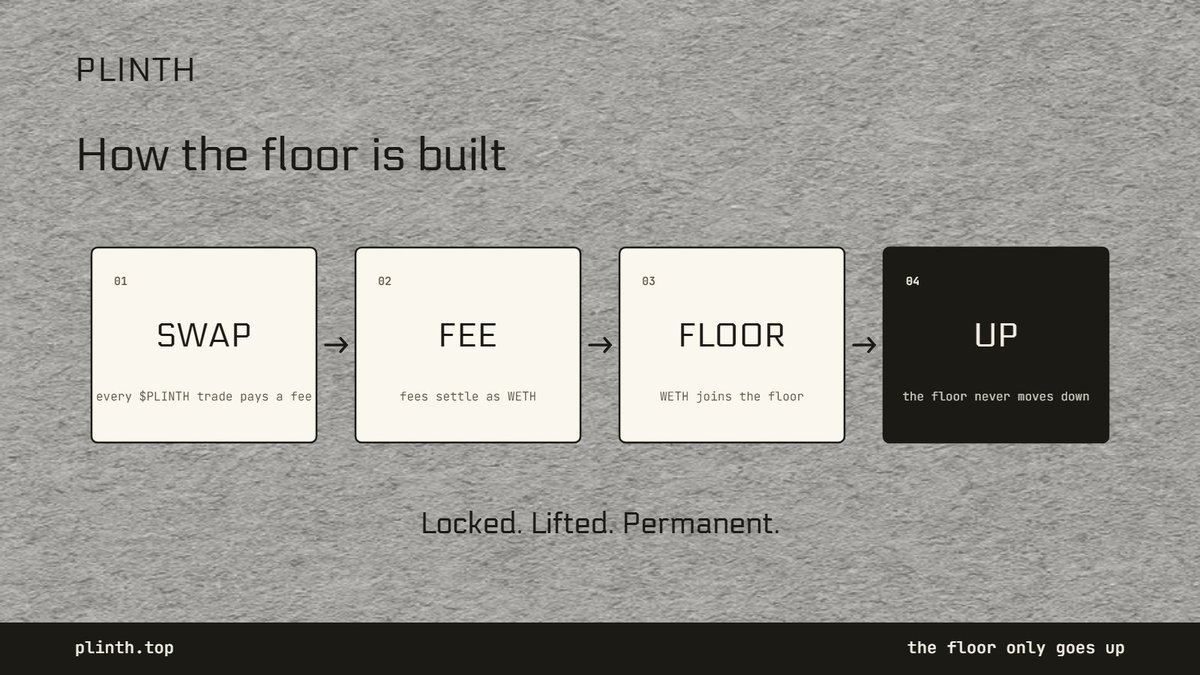
How the floor is built:
1. Every $PLINTH swap pays a fee
2. Fees settle as WETH
3. WETH joins the floor
4. The floor never moves down
Locked. Lifted. Permanent.