$VEX
Narratives fade. Infrastructure compounds.
After reviewing $VEX, I don’t see another “AI trading agent”—I see an execution-layer architecture designed around deterministic enforcement rather than autonomous discretion.
The thesis isn’t AI alpha generation; it’s verifiable execution with policy-constrained agent orchestration.
Instead of granting an LLM wallet authority, VEX separates cognition from execution through a local Runtime that validates every proposed action against predefined safety constraints before cryptographic authorization.
Private keys remain device-resident, execution is local-first, and every decision path is hash-verifiable—creating an auditable trail instead of a black-box agent.
That architectural separation is far more interesting than another autonomous trading narrative.
The fact that there’s already a functioning Runtime, open-source codebase, and iterative releases suggests they’re shipping infrastructure, not marketing.
Token utility is directly coupled to network activity and the broader Agentic Capital Markets thesis rather than relying solely on speculative demand.
The Virtuals ecosystem provides composability, while Robinhood Chain integrations could materially expand execution surfaces across swaps, bridges, analytics, and perpetuals.
If agentic finance evolves toward trust-minimized execution instead of unrestricted autonomy, I think $VEX is positioned in one of the more intellectually compelling segments of the AI x crypto stack.
Called $VEX & $VENA below $500K MC.
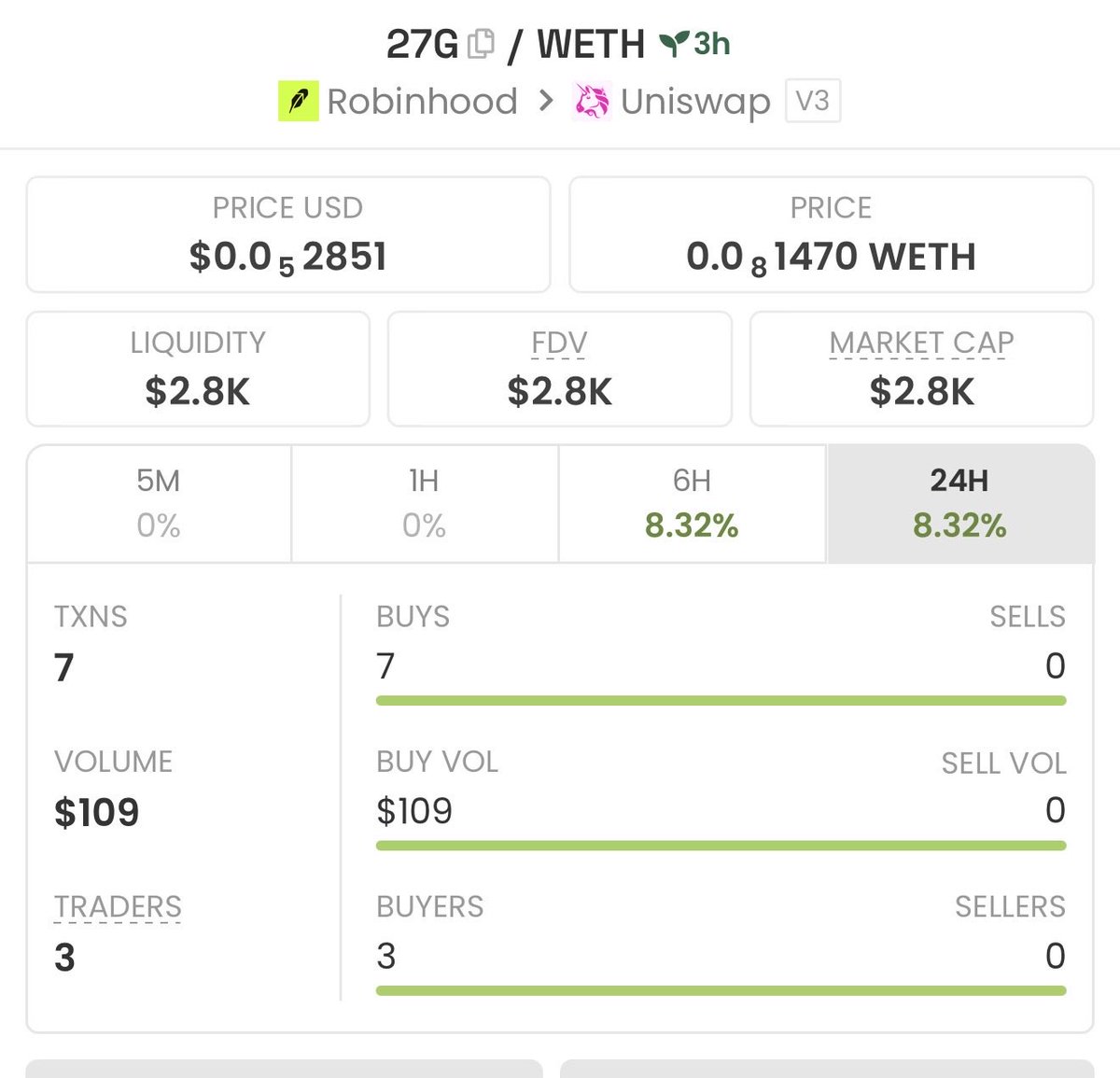
Next conviction: $27G on @ponsdotfamily ($PONS).
If PONS is building the https://t.co/Em7aIj3W65 for Robinhood, every @vladtenev notification should instantly spawn a meme.
$27G is that meme.
Simple narrative. Massive potential for ignition
0x1459CAB6803d3C9fBAb5446A7b019Dda4326e46C