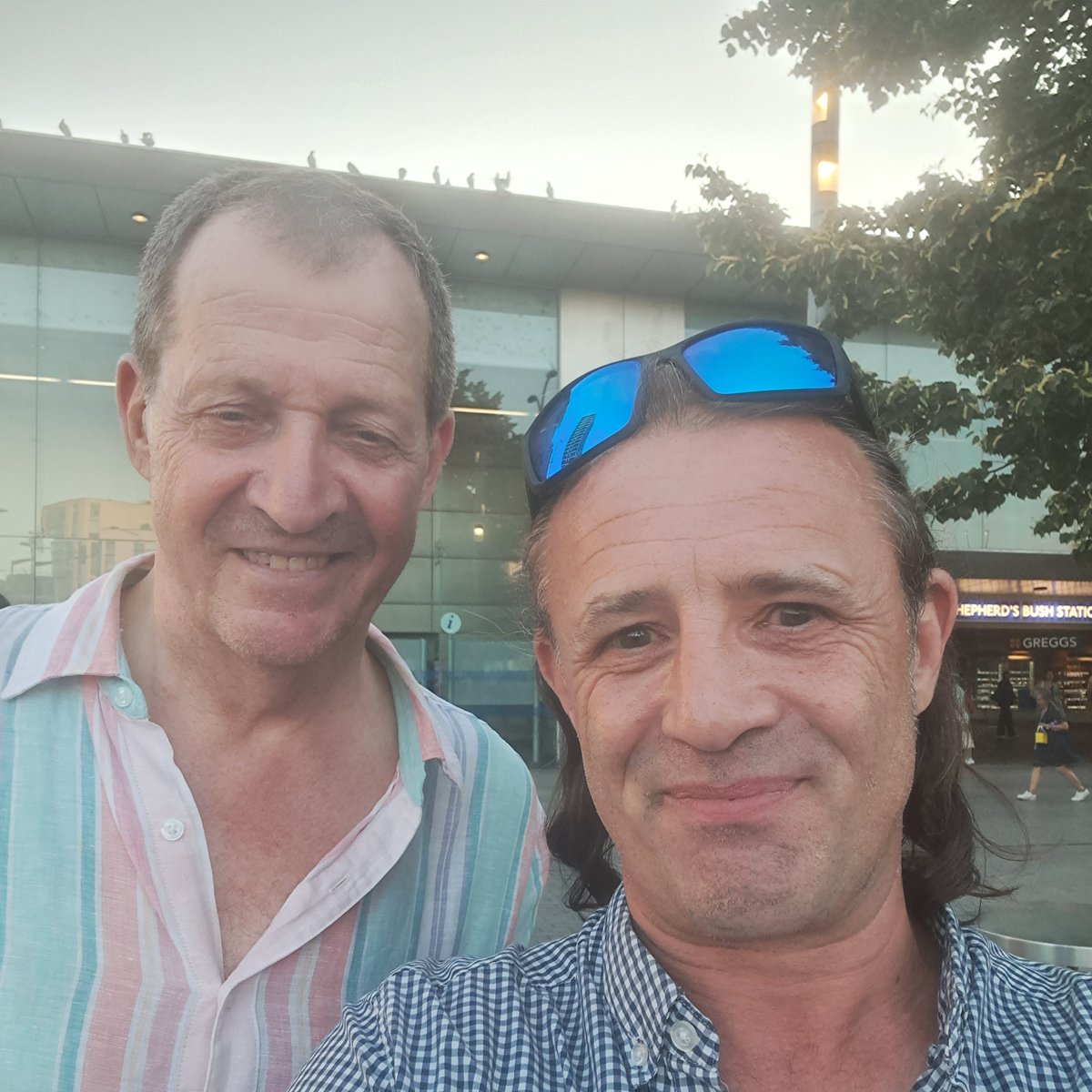
It was said to me that I was so effective in shouting #FreeAssange now that even @campbellclaret knows my face.
I didn't expect him to remember me & we spoke like adults, no shouting involved.
A free Assange 🥳 - Tories out 🥳 now onto #JUSTICE4LULINSPECTOR.
As he was doing a live interview with @SkyNews years ago, he shouted out to me,' o look, there's Assange's mate'.
I don't, Mr. Assange - I just lent my lungs to get him freed.
@wikileaks
Here's the transcript of this spaces from the day of Roger Peace's evidence at the #spycops inquiry
https://t.co/fqTwveuXfR
I missed most of the morning session, but the afternoon session was an absolute blinder. The first thing to say is that the public inquiry definitely appears to be losing patience with the police or starting to see just how bad what they were doing was. We were terribly frustrated in Tranche 1 with the cross-examination of the police, which was more like a friendly chat. Today’s was a proper cross-examination, I would say. They’re definitely coming into their own.
Pearce, in particular, was vile. The racism, the misogyny, the arrogance, and the absolute refusal to accept that he could possibly have done anything wrong were just throughout the evidence. Even when he was saying, "Yes, obviously that shouldn’t have been reported," and "Yes, that has absolutely no intelligence value," and "Yes, that is quite inappropriate," he was still completely unrepentant about any of it and defended his vile racist and sexist language on the basis that everybody thought like that in the 1980s. I’m old enough to remember the 1980s, and that’s crap.
The live video was not available to the public for this cross-examination. It was available to some of the core participants, and obviously, there were people like Tom also present in the hearings, but the live video wasn’t available because of all the really vile and nasty things that Roger Pearce put in his reporting about people who are still alive today and don’t want his nasty comments about their weight, their sexual preferences, their skin color, or whatever else he was joking about to his handlers. That was a theme that came up quite a lot: he was basically writing his reports to entertain the Special Branch officers reading the reports, not for any intelligence value. He repeatedly accepted that the stuff he was writing had no intelligence value and had been written because he was trying to be funny. But then when the cross-examiner went into that and said, "So this stuff would have been joked about in the back room then? People would have been laughing at these jokes in the back room?" he was like, "Oh no, no, they got absolutely no reaction at all." Which seems quite unlikely given that he kept on and on making these jokes throughout the years he was undercover.
The videos weren’t live-streamed because of the unpleasant things that he said and because of the danger that somebody might say somebody’s name in that context. So, yeah.
The video will be checked to make sure everybody’s privacy has been respected and then it will be put online by the Undercover Policing Inquiry. At that point, we will do a whole bunch more reporting, and I would really encourage people to check it out. We will hopefully be pulling out the highlights because this is what we were really expecting and what we wanted from this public inquiry: these cops really being put on the spot and exposed for what they did. We haven’t seen that much of it up until now, so today really was quite—I hesitate to say enjoyable, but there was a certain sense of poetic justice watching this guy. The inquiry was obviously absolutely furious about his cavalier attitude to legal professional privilege, the legal profession in general, the justice system, and the courts—a whole bunch of stuff that they quite clearly took very personally and gave him a very hard time over. Pearce, as well as having gone on to be the head of the Metropolitan Police Intelligence Unit, which is a whole other topic that needs to be gone into in-depth, also trained as a barrister. He was, in fact, a trained barrister, I believe, at the time he was undercover. So, there’s no question that he wouldn’t have understood legal professional privilege or the significance of the stuff that he was saying. I think they were particularly offended by an article that he wrote as an undercover officer in which he basically said, "The legal system is a load of shite and you might as well just plead guilty." They were like, "Do you really think it’s appropriate to be advising people to plead guilty?" There were a bunch of moments like that where you could see they were genuinely quite offended by the stuff he was saying. That’s before we got into his comments about the Blacks or about fat women or—I can’t even remember, there was so much. There was a point where it just kept coming, and Tom was doing an amazing job of keeping up with the tweeting of just the absolute clangers that were coming one after another.
It’s definitely worth checking out the video when it comes because it’s very hard to do justice to just how much he must have been squirming under that questioning. Oh, there was a great moment. I’m doing a bit of a monologue here, so if there is anyone else out there who wants to chip in, that would be great. But yeah, the one particularly key moment—so yesterday we heard evidence from Dave Morris, which included the fact that Roger Pearce had reported or written in his statement that Dave Morris had been part of a bomb plot at army barracks in Aldershot. Dave was just like, "This is absolute fiction." Pearce made it clear in his evidence that he had been mistaken in fingering Dave for that. That was quite a good moment.
I can hear you fine, Tom, by the way. I don’t know about other people. Like I say, when I was listening, it sounded really bad, and I kind of applied to be a speaker, and as soon as I was accepted as a speaker, the sound became really clear. I’m not sure what that’s about. I’m now co-host, Tom, so if you wanted to drop in and drop out again as somebody has suggested...
Tom Fowler sounds like an Aphex Twin B-side played on a record player in a washing machine.
Alright, anyway, I don’t know, Tom. Do you want to try dropping out and dropping in again? I will try and keep it going while you’re gone.
We can hear him fine now, to be honest. Sorry to jump in like this, but I just wanted to clarify. The only reason I requested the speaker was just to let Tom know that we could hear you perfectly, Kate. But when Tom was speaking, we couldn’t hear. But now he’s—I think he just spoke up, and we can hear both of you fine.
Brilliant, thank you. Anything to add then, Tom?
He’s gone.
It says he’s still here. Alright, anyway, going back to today’s hearing, another interesting thing: it ran over by about two hours. It must have been absolutely grueling for everybody there. So, yeah, I recommend checking out the summaries and highlights because there’s a good—nine till about six. Yeah, Tom did over 300 tweets, so you can also check out the best of those on his timeline.
I was going to go more into Roger Pearce’s later career. We’re not just talking about a particularly vile minion of the Metropolitan Police who was an undercover officer for a few years in the 1980s and has really unpleasant views about ethnic minorities and women. This guy, after filing all those comedy-as-he-saw-it intelligence reports of absolutely no intelligence value whatsoever, got promoted up the ranks of the Metropolitan Police to basically be the director of intelligence. He was in charge of hundreds of undercover deployments—not just the SDS or the NPIO and the ones going into political movements, but pretty much undercover policing and intelligence gathering across the whole Metropolitan Police. He was high up in Special Branch. That is where this kind of nasty, repellent attitude got you in the Metropolitan Police. It’s interesting because there was a bit of a siloing of the questioning. We’re in Tranche 1, Part 1, where Roger Pearce was still an undercover officer, and the questioning was kind of siloed to his time undercover. He spent a lot of time blaming his managers. There were a lot of questions about the appropriateness of what he was reporting, and he was like, "As far as I was concerned, that all went into the office and they did the filtering. It was up to them to decide what was appropriate and hand it on." That was really interesting because I thought David Barr did really well there. Because obviously, before he was deployed into the field, Roger Pearce worked in the back room and processed those reports. What he refers to in his own witness statement was a matter of "topping and tailing," so putting an introduction and conclusion on, just putting all the usual sort of bits and pieces that are at the end of each one, but he would never touch the content. So it was put to him that when it came, why did he think then that when he became a field officer, someone was going to filter and edit the content of his reports?
Given how strongly he said he understood legal professional privilege in the opening bit of his evidence to be so heavily particularly on that issue, to say that it was to be filtered out by the back office was quite laughable, really.
On that issue of legal professional privilege, for those people who weren’t able to listen to it, he was great at reporting what legal advice had been given to people. He was getting involved in defense campaigns. As I said, he was also doing a whole bunch of stuff that really kind of undermined the sanctity of the judicial system. The barristers and the judges in the inquiry were very unimpressed.
I was just happy that really spoke to also about the way that his deployment generally worked. He started off before you put the anarchist groups not to build his cover, making me again. We see a lot the other on the government. Is he infiltrated into nuclear groups? Called the local ones at Portobello area, I think it was. I was quite interested in where it was pointed out like he admitted that there
was the only reason for him to be in this group was to pull this cover, but he was reporting on an extensively. Well, there was a series of a report that he put out that kind of explained what was planning, which was the piece of street theatre at the Royal Tournament.
If anybody wants to join, if anybody's going into more like someone like everyone in the coverage which group, if you want to join the chat, just put in that you want to speak now.
Yes, for the Royal Tournament, they were planning to do some street theatre and give out some leaflets. Then he reports the next meeting, which talks about how overwhelming numbers of police came in, neutralized the street theatre, and stopped the leafleting from happening.
PS is very clear these groups were not subversive, they had no public order threat. Yet, they were completely silenced from their perfect, legitimate, legal protest. Something we saw quite a lot with the coronation, if you remember, the people holding up the blank pieces of paper as King Charles was sworn in. But yes, the policing of objections to the Royal family and that whole kind of medieval political approach is quite interesting across the board. I think that's maybe one of the examples of that, that the police would have bothered to act on that and go and shut down the street theatre and see all the leaflets is quite indicative of a policing priority that hasn't been focused on that much. But I think it's going to come up more and more in later tranches. We will hear about the arrests of Rod Richardson on movement against the monarchy protests, including being arrested with, I think, about two dozen other people in a pub who later got compensation and an apology from the police. So, we may see some more about having access to legally privileged information on that one.
Does anyone know if Roger Pearce is going to be called back? Have the inquiry confirmed? Because the issue is, this guy did all this dreadful stuff, and it's really worth watching the video to get a real feel for just how vile it is. But he went on to get promoted.
He is going to be called back.
Oh, that's good, because as I say, the questioning was very much limited to his role as an undercover cop. And there was this whole kind of subtext whenever he kind of blamed the managers or whatever. It was like, well, this is all going to come back to bite you, mate, because you went on to be in charge of this stuff.
No. I think it's one of those things where I wonder if he's going to be taking the long holiday for the next trunk. When he would be called back. So these applications can be brought in.
I would not be at all surprised if he joins the growing list of police officers who have decided to emigrate rather than give live evidence at the public inquiry.
Another interesting thing about Pearce was the very close relationship with MI5. He said it was like early in '81 he was approached by the anarchist desk of MI5. They had a particular interest in him anyway. And he continued to meet them every few months. There was some sort of debate about whether this was seek from his senior officers or not. He said there was no attempt to hide that contact with his managers. And then we saw a lot of these shopping lists, as they were referred to. These brief memos that MI5 would pass on to the SDS, requesting specific information, sometimes about groups, individuals, wider campaigns. Asking for particular update on particular people's activities. And a lot of that was about the Royal Wedding. Just particular specifics, very specific things. And I think David did quite a good job of taking us through sort of like, well, here's this note saying they wanted information on this, this, and this. And there's your report that speaks to these things. And then later on there's a follow-up, which is obviously based on how they read your report and asking another ones. And it really felt like Pearce saw himself as being directly employed by MI5, really.
I think this is the sort of thing which really, when we talk about the spy cops, like when we say it's not a rogue unit, it's part of this wider infrastructure of repression that includes all sorts of elements and security services and police and state.
I kind of noticed that in Tranche 1 that there was this sort of, you know, it was a little bit sad really, but it was this kind of obvious kind of respect that these cops had for the security services and this idea that, well, but you know what we were doing was kind of at the behest of the security services and so it must have been all right, you know, because they're like... And there was a kind of awe surrounding it. And I think, you know, that gets a bit more interesting now. This issue you were mentioning of the disagreement among the police force about whether Roger Pearce's meeting with the security service were sanctioned and known about or whether they were, you know, going on the sly is this thing where as you get into the later '80s, the parliament and the public generally start to really question this relationship between the police and the security services and kind of political spying and the inappropriateness of it becomes a lot more... You know, the awareness of how inappropriate it is grows within the police. And you can see it in the stuff that's going on. But it still carries on. And so there is this meeting, which is certainly in the beginning set up in secret, the commanders aren't told about it, and they carry on meeting. And it's set up in secret and it's recognized that it would probably be frowned upon. And then either it continues in secret or it continues and as well. I mean, Pearce claims that it continues and, you know, the managers, despite knowing that they should be frowning upon this, are happy to let this go ahead. And there is this kind of sense you get from them that MI5 were actually running the show. And it's really unfair for us to blame them because they were just doing what the security services said and the security services must be right.
Absolutely. One of the other themes, and there was a big thing that when he was a member of the Freedom Press editorial collective, so the people who put together the newspaper every fortnight, but he's, I mean, he was, you know, a member of that for quite a long period of time, but he wrote very few articles. In fact, there's nine articles that are identified and were shown to us through the course of the day. And a great many of them were. And so on yesterday as well, Steve Sober from Freedom Press just getting his comments on them as well. And I think quite a lot of what was what happened yesterday makes a lot more sense after seeing the evidence of Roger Pearce today. But these articles, a lot at first, he starts writing on legal issues, talking about jury trials, which is funny enough. Quite pertinent at the moment. There was a defend our juries protest outside today while we were in court. I saw that coming up on my feed. But there’s the loading of juries, very similar issue, which one at the time in it, he sort of advises people, you know, because it’s so corrupt, they’re better off just pleading guilty and getting it over with, which, you know, is ridiculous. But then what he goes on to write about a lot is Irish republicanism. And this is an issue which really divides the anarchist movement, well, the Freedom Press collective, certainly, anyway. Whether you should support that, whether the IRA were a chauvinistic, nationalistic, militaristic, sexist organization that were statist and, you know, should be opposed like any other statist national organization should be, and those are good on them for fighting the British state. Roger Pearce wrote articles about how, you know, we should be supporting the political prison status for IRA prisoners and various things about it, which led other members of the collective to have an editorial alongside it sort of countering these points and giving the other side of the anarchist position on Irish republicanism, which then interestingly led to the Belfast anarchist collective inviting the Freedom Editorial Collective to come into Belfast so they could understand the situation better, because they felt that these people, you know, in London were not getting what the reality of the situation was. This precedes Roger Pearce's first trip to Belfast and expanding his spookery over there, which I think is another one of those interesting things you can kind of see through the reports and the articles that are kind of happening.
Barr's questioning on this was particularly probing in terms of how his role, his editorial role and his role of creating political content for Freedom magazine influenced events and influenced the direction of the movement. This is the big issue around this thing that has been singled out by the chair of the inquiry, which is these police officers taking positions of influence and power within the organizations that they're spying on. We can see Roger Pearce stoking divisions, picking divisive issues, and picking a side, creating content to promote that side of the divisive issue, and basically taking actions that change people's political organizing. That's the manipulation by the state of people's right to organize is a really big issue. The other one that came up in the questioning around that was journalistic rights to freedom of expression. Barr was really quite incisive on that as well when he was saying to him, "Well, journalistic freedom of expression..." And Pearce's reply was interesting because he said, "Well, it wasn't really journalism, was it? This was propaganda. These people were just trying to spread their ideas. They weren't about reporting facts." And I'm thinking, right, whereas the Daily Mail, you know, that's real journalism. That's not about promoting ideological position at all. So, there was this real idea that, you know, right-wing newspapers, well,
that's journalism. That obviously, that gets the right freedom of expression. But these guys were promoting ideas that I don't like, so obviously they're not actual journalism. He used the word propaganda a lot in order to kind of try and justify his interference in and the inquiry, to their credit, said, "Well, that is people's right to freedom of expression, is to express their ideas and try and bring people around to them. And that is actually what it means." But you could really see the deep-rooted prejudice. I liked the phrase. There was a point where Barr basically read some bits of his reporting out and just said, "That's dripping with prejudice, isn't it?" And he was like, "Oh no, prejudice? No, I wouldn't say prejudice. Just the ideas of the time." But, you know, it was quite clear that even the public inquiry were losing patience with this nasty man.
He maintained his spying across different sorts of sectors. While he was really at the center of the anarchist stuff, he was a point on back on the likes to look at the fair fare campaign, time campaign, fares in like public transport fares, which was a campaign that was backed by the Greater London Council. You know, pretty mild organizations, but were being put in the same...
Yeah, the Greater London Council in the 1980s wouldn't fit everybody's description of...
Mild? Maybe not. But I mean, there's a fairly mild campaign in the scheme of things.
They were a definite thorn in the government’s side, which is why they were done away with. I remember marching to defend the GLC when I was a kid, and they were done away with, and we didn’t have a Greater London Council for years, decades. Ken Livingstone, of course, is one of the people who was spied on, and these are people who were not being spied on because of any public order threat or criminal activity. These are people who are being spied on because they threaten the policies of the government of the day. This is the police being used to manipulate and undermine the political opposition, and that’s the real story, I think, in Tranche 2. That’s one of the most interesting things that we’re seeing.
Steve Barr keeps coming back to excessive reporting, reporting on perfectly legitimate legal activity by logistic campaign groups. Someone who was in regular contact with MI5, talking about supposedly dangerous anarchists, was still spending his time reporting with other things as well. The two go hand in hand. There was a lot of chat about the definition of subversion and the huge level of discretion that individual officers had for what they considered to be subversion. Roger Pearce talked about it with anarchist groups in terms of being aspirational rather than the capacity to be subversive. It seemed that anybody who wanted to be subversive was a subversive threat to the state. He was asked whether he could see subversion separate from public order and criminality. Pearce openly rolled all three of those things together.
I was feeling this a lot listening to him talking about anarchism. This starts to come up in the disclosure that I’ve seen in the IPT. There’s a lot of reference to like-minded individuals, and it’s people who are clearly being spied on because of what they believe, not because of what they’re doing or even because of what they might want to do or be planning on doing, but just for holding ideas that are considered threatening to the status quo. I again got frustrated yesterday when listening to the cross-examination of Dave Morris, who was absolutely cracking, I have to say, and really held his own. But there was this underlying assumption in the lines of questioning that wanting to change the political system somehow made you a legitimate target. There was this idea that if you make a group that wants to change the political system, that's okay, so long as you don't get anywhere near succeeding. This idea that people who want a better, fairer, more democratic, less corrupt political system are allowed to try, but if it looks like they're going to be anywhere near succeeding, then it becomes justified to spy on them. That’s quite an insidious way of thinking. If you transpose it to another political system where people were fighting corruption or looking for democracy or trying to empower communities to have more control over their lives, like in Hong Kong now, then if you say, "It's all very well for these people to aspire to change the regime or to change the political system, but if they get anywhere close to succeeding, then the government is absolutely justified to step in and crack down." So yeah, I think I want to be careful about that underlying insidious belief that you can detect behind the questioning.
A number of articles about officers fathering children had appeared in the press before the publication of the novel. He claims not to have been aware.
Pearce claims that he was not glorifying the deceptive sexual relationships in his novel. Despite the fact we have heard extracts that do just that.
Pearce said he gave no thought to the women deceived into sexual relationships when publishing a book that detailed that exact activity for entertainment. He gave no thought to the feelings of the children born of these relationships either.
There are sections of another of Pearce's books, "The Extremist," that include references to very recent events like the Leveson inquiry and the exposure of the SDS. Published two years after it all went public, Pearce claims that he had written it all decades earlier.
There is a reference to "Affirmative Inaction" from the top brass of the Met Police in one of Pearce's books. Barr asks if this was the reality of the Met. Pearce flaps around and says it was only the perception by some officers of this.
Pearce claims he never heard anything about any of the officers who have admitted to having sex with activists. Many of these officers served at the same time as him, but he maintains he never had any idea of any of it.
We now refer to the time that Pearce was arrested. He wasn't tried, but if it had gone to trial, he would have remained under his false name. He assumed it would not have resulted in courts being misled despite the fact it clearly would have.
We've just had a short break, follow-up questions for Pearce. Firstly, that none of the "bombs" he talked about resulted in a prosecution of anyone.
Pearce is taken to a report that refers to "the purely criminal element" in Brixton, which appears to refer to the young black community. Pearce sidesteps the point.
The video of Roger Pearce being questioned at the #spycops inquiry is STILL not online. Probably the most damning live evidence that has been filmed as is meant to have a general release.
Maybe it'll be released over the weekend, but until then, here's all my tweets from 9th July whilst he was speaking:
The Inquiry will hear evidence from HN85 Roger Pearce AKA “Roger Thorley.”
Roger Pearce is looking surprisingly chipper, "them suits don't come cheap."
Roger Pearce invited the wrath of god by swearing on a Bible. "If the gospels are to be believed, there is likely to be a lightning strike fairly soon."
David Barr KC questions Roger Pearce on how he came to pass the bar after being trained as a lawyer in the 1970s, probing his understanding of legal professional privilege and confidentiality. Pearce claims to have a good understanding.
Asked about how much of Special Branch training focused on Legal Professional privilege, Pearce responds, "Very little it would seem," but adds that he was trained with MI5 on matters including subversion.
Before joining the SDS, Roger Pearce spent a number of weeks on C squad, which gave him an understanding of what Special Branch was interested in with the left wing, though not specifically on anarchists.
On his recruitment into the SDS, Roger Pearce says he was tapped up by HN96, cover name "Michael James," who was a friend. By this time Pearce was already aware of the SDS and how they operated.
David Barr KC asks Roger Pearce if HN96 "warned him about being approached by women for sex."
Asked about what he witnessed when in the back office of the SDS, Pearce says there was frequent and informal communication between senior officers. "Says officers were very close, and would put their head around the door."
Roger Pearce says that Geoffrey Craft regularly visited the SDS safe house among many other senior officers.
Explaining how senior officers like Gilbert Kellard visited the SDS safe house, "enjoying our undercooked chicken and cheap wine" before inviting each officer to do a pen picture of their deployments.
Assistant Commissioner Geoffrey Dear, another senior officer, was another regular visitor to the SDS safe house and was made fully aware of challenges of the unit. Pearce then lists the "discreet problems" of SDS officers.
Roger Pearce says that there was no talk of the potential for sexual activity between officers and the activists they were deployed to target.
On the visits of Commissioner Kenneth Newman, David Barr KC asks, "Was there a feel it was exciting and special work?" Pearce responds, "No, it was a feeling that he understood the stresses and strains."
Pearce says that the role of officers was one of great integrity, to a sharp intake of breath from most in the room. He then goes on at length about how the role was such a "necessary and justifiable" job. It's a wild take and shows a real lack of self-awareness.
David Barr KC asks, "Was there an awareness that there was a risk of things going too far?" Pearce responds, "Yes, it wasn't talked about, but it was understood."
Pearce ties himself in knots saying that there was no "structured conversation," but it was "talked about" that there was a danger of things "going too far."
Pearce says that sexual relationships whilst undercover were not talked about by the SDS because they were "such bright red flags." There was an understanding and no need to raise them specifically.
Despite the "high risk" of sexual relationships in long-term undercover deployments, Pearce claims it was not talked about. He asserts individual officers kept it completely secret.
Asked if there was any subtle or direct asking about sexual relationships by senior officers, Pearce says there was none and in hindsight, that was wrong.
Asking conventional individuals to live the lives of unconventional revolutionary individuals was liable to cause problems. "It was asking for trouble, wasn't it?" "Yes."
Whilst preparing to be deployed, Pearce would meet twice weekly with SDS officers who were already undercover. Says it was useful because it meant he knew little details, like 'knowing your star sign.'
Pearce says exposure to people doing the job was very useful. Says there was never any discussion of dealing with the opposite sex. Pressed if he's sure, he says yes, it's a curious thing, but it was never mentioned.
Pearce said there was discussion about bringing a female special branch officer as a pretend girlfriend, but that wouldn't work as the group would try to recruit them to the revolution.
Pearce says there was discussion about pretending to have a girlfriend from outside London, but that was not to reject sexual advances but to show you had a full life.
Asked if there was an understanding that having sex with someone who does not know who you really are was wrong, Pearce says there was not.
Asked about any discussion about trespass and entering a private home, Pearce says there was no discussion and there were "no privacy guardrails" at the time. He never thought about it.
Pearce says that his targets were anarchists, so he was encouraged to gather more personal private information as there was little otherwise available compared to more formal groups.
David Barr KC asserts, "But you reported on all these things without restraint." Pearce says his primary duty was to report everything he would hear, "it was for the office to filter."
Talking about how he worked on reports when he was in the back office, Pearce says he was "topping and tailing" the reports, doing grammar corrections but keeping all the content.
David Barr KC says, "Nobody ever filtered these reports?" Pearce responds, "I think I assumed they were. I reported what I heard and saw, submitted everything I could and it would be for the office to edit the report."
Asking what level of discretion he personally had when it came to what he reported on, Pearce says it was based on what he considered to be subversive. Roger Pearce is floundering around trying to define his understanding of the meaning of the term subversion. "Less on the potency of a group and more on its aims?" suggests Barr.
On the cover identity of using a dead child's identity, Pearce is asked who told him to do it. He starts talking generally about "a pre-digital age" before David Barr KC says, "just answer the question."
David Barr KC says that Pearce chose an eleven-year-old dead child on the advice of others. Says it was a sensible way to proceed and didn't consider the circumstances of the child's death. As the child was killed in a road accident, which would have been reported, Pearce says he couldn't find any reporting on it.
Not only a risk to the cover, the use of an eleven-year-old child who suffered a tragic death also risked great trauma to the family. Asked if he considered the family, Pearce said he didn't because it was meant to be secret forever.
Pearce says that he was told there was no other way of building a false identity other than taking the identity of a dead child. There was no discussion of any alternative.
Roger Pearce visited Stoke-on-Trent, where the young Thorley had grown up. He went around the streets and visited the schools Thorley would have attended, building a full identity based on the life the boy would have had if he hadn't died.
Pearce says there was a "very intrusive" meeting with two of his senior SDS officers with his wife before he joined the SDS.
Pearce says his wife was advised that she could call either of the senior SDS officers if she felt there was anything "off" about him.
David Barr KC says that left-wing groups were known to be promiscuous. Pearce says that in both policing and MI5 circles there was an assumption this was the case, but doesn't think it was entirely true.
Pearce says that nothing was ever said about sexual temptations to his wife directly, but there was an assumption.
Pearce admits he may have actually been in the IRSP/INLA.
A report from Roger Pearce on 12th August 1981 at a meeting of the Autonomy Club was full of detail about the chair of the meeting, Ronan Bennett. Pearce claimed that this man was an IRA volunteer who was convicted of the murder of an RUC officer, quashed on appeal.
Replying to @MadocRoberts, "it's only possible with the complete othering of their targets. Requires a certain sort of mindset."
Another report is shown, a specific response by Roger Pearce to a specific request from Box 500 (MI5) for information on an individual.
We are shown another report by Roger Pearce on the Autonomy Centre with a hand-drawn plan of the layout of the centre and a full description of all the details of the building.
A brief is shown that details requests for specific information on anarchist involvement in certain campaigns and connections between named activists.
We are now shown a report of Roger Pearce which directly answers the requests from MI5 on groups and individuals. Clear that he saw fulfilling these requests to be a priority of his job.
We are looking at the 'Fare Fight' campaign materials which were backed by the Greater London Council about public transport costs. Alongside a report by Roger Pearce that was submitted with the leaflets to his managers.
Asked why they were targeting such a mild campaign like Fare Fight, Roger Pearce said there was a determination to look at the evidence. David Barr KC said, "it's excessive reporting."
Replying to @wednesday_jones, "completely."
Another MI5 'shopping list' is shown with specific tasking on gathering information on named anarchist groups, broad-based campaign groups, and the political stance of certain individuals.
Now being shown one of Roger Pearce's reports that directly answers the MI5 shopping list that we were previously shown.
We are now being shown a report by officer HN85 Roger Pearce, cover name Roger Thorley, about a benefit gig that anarcho-punk band @crAsswords played for the Oxford 48 defense committee.
Roger Pearce is floundering around trying to define his understanding of the meaning of the term subversion. "Less on the potency of a group and more on its aims?" suggests Barr
.
Barr: "Were you thinking of subversion separately from public order and criminality?" Pearce: "I rolled them all together." Barr: "You cast a wide net and reported on everything." Pearce: "Yes."
Roger Pearce is talking about how he discovered a "crude barrel bomb" that he heard about but couldn't remember where from, that was found on railway tracks that had been there a month unnoticed. "Whole story sounds nonsense."
We are now shown a report by Roger Pearce about the production of a pamphlet that supposedly was planned to include making petrol bombs and other urban warfare tactics drawn from the Anarchist cookbook. Pearce says he can't recall it, but it would be uncommon.
Another Roger Pearce report from January 1982, this time about the printing of a publication called 'My Little Black Book,' which would include urban guerrilla tactics.
Considering "My Little Black Book" had already been published in the USA, what was the policing concern about its publication in the UK? Pearce says, "it would be on the streets of London!"
Roger Pearce says that Freedom Collective was hoping for "capitalist gain" from the publication of 'My Little Black Book.'
The arrest of Steve Sorba and others in a raid on the Freedom building in April 1982 was the result of evidence submitted by Roger Pearce.
There is a report shown by Roger Pearce about the stopping of the publication of My Little Black Book. It includes the information that a copy of the original publication from the USA was held by Stuart Christie.
Now a report of Roger Pearce from 2nd November 1989 about an attempted attack on the British consulate in Amsterdam. The attack was thwarted, and there is no other evidence it took place. Pearce says he cannot remember the source. "Is it all fiction?"
There was a bomb at a prison officers training school in Wakefield in November 1982 by a group calling themselves "The angry Brigade resistance movement." We are shown a report based on the communique that was sent into Freedom paper.
Pearce cannot recall any explosion in Wakefield to relate to his report. Reports say, "it wasn't much of an explosion." We are shown a report by Pearce on this.
We are now shown a special branch report on the raid of Freedom Press in December 1982 after a letter from a group claiming responsibility for a bomb was sent to Freedom. Police were attempting to retrieve the original letter, but it had been thrown away.
Roger Pearce was in the building when the police raid took place, and his cover details are included in the special branch report of the raid.
Individuals have been targeted by secret undercover police due to their involvement in political activism. Citizens have been spied on, manipulated, and abused in order to undermine democratic...
We are back for the afternoon session of the Inquiry with further live evidence from former undercover officer HN85 Roger Pearce. Pearce was deployed undercover in anarchist groups in the early 1980s using the cover identity of "Roger Thorley," a child from Stoke on Trent.
As ever, we are treated to the same speech from John Mitting at the start of every hearing of the Inquiry. Given he is doing it live rather than play a recording as he did in tranche 1, "I get the impression Johnny is now finding it as tiresome as everyone else."
Roger Pearce is now being questioned about the reconnaissance of Aldershot Barracks he did whilst undercover with a group of anarchists. He claims he was attempting to deter and distract the group as he makes the ludicrous claim they would be shot if they got too close.
We are shown a report about Roger Pearce's visit to Aldershot. It includes a redacted list of names. It is pointed out by David Barr that Dave Morris is not listed in the names. Pearce said that he was there in his witness statement, but he now withdraws that.
Asked about his own "criminality" whilst deployed undercover in the anarchist movement, Pearce did not do any graffiti or fly-posting, nor did he accompany anyone who did.
We are now shown a report from 20th September 1982, then a report from 26th January 1983, both by Roger Pearce, relating to a woman who attempted to join the Young Conservatives under a false name and was later arrested by anti-terrorist police.
We are now shown a Roger Pearce report that includes the advice the woman received from her solicitor following her arrest.
David Barr KC: "This shouldn't have been reported, should it?" Pearce: "I reported everything I heard, I expected it should have been filtered at the..."
Asked about a bomb at the Whitehall cinema, Pearce says he heard about a bomb, so he called it in. Says he heard about it from an anarchist; he doesn't say who.
Another bomb at Holborn Theatre is brought up, Pearce asks for more details. David Barr KC says he is going purely from Pearce's own evidence and directs him to his witness statement. Pearce says he can't recall it now.
We are now being shown a report from 11th October 1983 that includes reference to an "attack" on the American Express offices. Asked what sort of attack, Pearce says he can't remember.
We are shown an MI5 'shopping list' about "recent bombs." Pearce can't remember any of it. David Barr says they can't find any other evidence for any of it.
We are shown a report by Pearce that suggests that Dave McCabe was planning on hunting down certain police officers who hurt him at the Brixton riots. Pearce says he can't remember it, but "in character, but bravado."
We are shown a report by Pearce about a bomb being put on the train line near Charing Cross station. Pearce says it was from a secondary source.
A report from April 1984 that is subtitled "Angry Brigade" that claims that armed anarchist groups are about to launch a campaign. It includes the naming of a number of anarchists, including Stuart Christie and Albert Meltzer, who are behind it.
Asked if any of this came to pass, Pearce admits it did not.
Roger Pearce's report on the so-called resurgence and relaunch of the Angry Brigade. It is a mixture of second-hand information and hearsay he heard at a dinner.
Roger Pearce claims that he reported on the planning of squats in order to protect police who would be forcing entry.
Another report from Pearce that reports on the private legal advice being given to someone by their lawyer.
We are shown a report by Pearce about a party that lists the details of the attendees, including lawyers and their clients. Pearce claims his managers had no interest in such things; he was just showing his cover.
We are shown a report by Pearce that includes reporting on conversations between friends that includes speculation by Pearce. Utterly pointless. But Pearce claims it strengthens what was already known.
We are shown Pearce's witness statement: "We also knew it was unacceptable to obtain information as a result of a deployment that was subject to legal privilege between a litigant/client and their legal representative about matters likely to be the subject of legal proceedings."
We are shown a report from Pearce from a party on 20th December 1980, which is one of very many examples of derogatory, disparaging, and denigrating. David Barr KC says it was totally unnecessary, wasn't it? Pearce says it was true that he was irritated by the people he...
We are shown another of Pearce's reports that discusses the sex lives of individuals described in sarcastic tones. Pearce concedes that it is utterly indefensible.
We are shown another Pearce report from a party this time in 1983, which again showcases the sarcastic and sneering tone about those he was spying on, written to entertain other officers.
Yet another report by Pearce, this time about an individual. It includes reference to the bisexuality of the target. Pearce concedes there was no security value whatsoever. When pressed on this, Pearce says he may have made a move on him. Barr asks what relevance it has.
Pearce is claiming that it was "a different time" and talking about people in such a derogatory way would have been fine back then. Total bollocks, of course.
We are now being shown another of Pearce's reports which includes racist language. Asked why he used these terms, Pearce tries to change the subject. Barr pushes him to ask if officers all spoke like this. Pearce says he can't remember.
Another of Pearce's reports that manages a double whammy of reporting on private legal privilege and also the race of the barrister. David Barr KC asks if it was because a black barrister defending people accused of riot offenses was someone that was to be reported on.
More of Pearce's reports commenting on the race of a police officer. It's put to Pearce that it might be that he was reporting on the race of people because it was significant.
We are shown a report by Pearce that comments on the sex life of a female activist. "Her constant preoccupation with startling accounts of her sexual experiences makes for lively if a little disconcerting conversation." Barr asks, "Was this for the entertainment of your..."
A report by Pearce of November 1981: "Dressed as never before in blouse, skirt, tights, smart shoes, and odd earrings, Weir appeared almost feminine." Asked why he wrote this in an official report, Pearce said, "She had made a move on me on several occasions." He really is an...
Another report from December 1982 by Pearce which describes a female activist as "The shapely." Pearce says it was inappropriate now. Barr points out it was inappropriate then and asks if it was for the titillation of his colleagues. Pearce says he can't remember.
There is
a really offensive section of one of Pearce's reports that refer to a "beefy" woman who did live nude modeling as "suitable to artists who draw life on a grand scale." Barr says, "There are a lot of these comments, were they getting a reaction?" Pearce squirms...
David Barr KC has been going through quote after quote from Pearce's reports at breakneck speed. It showcases horrible misogyny and a cruel 'humour' that has left everyone in the room feeling dirty.
After such a long day at the Inquiry, it is difficult to keep on top of evidence that David Barr KC is presenting. It's utterly damning. Pearce is slowly giving up trying to defend himself for these unacceptable comments. Whenever he attempts to, Barr is firing back with...
Another of Pearce's reports is shown, this time relating to the White Hart public house that had started having topless barmaids. Describing the Nags Head pub that does not have topless barmaids as "cheerless."
We are shown a report by Pearce that refers to the launch of an Anarchist Feminist Magazine that refers to a "robotic, lesbian, drug-taking anarchist female who regrettably writes exactly as she speaks."
Another of Pearce's reports in which he talks of someone being thrown out of Freedom by what is described as "an abusive if entirely appropriate sexist remark." "This is one of your regular subjective remarks, isn't it?" - Barr. Pearce tries to defend himself saying that he was...
A report from July 1983 by Pearce describes a female activist as having "alarmingly intemperate sexual habits make her a difficult associate and worthy of a government health warning. She leaves little doubt that a visit would not be for coffee and biscuits." Pearce...
A report from October 1983 by Pearce on a meeting of anarchism and feminism that talks of women as "bulky." Pearce says it wouldn't be considered inappropriate at the time. Barr asks if he means inside the SDS. Pearce says, "No, in society at large."
A report from 13th May 1984 by Pearce where he talks about a female activist, "Her masculine feature softened by the application of a gorilla mask." Pearce defends the comment saying that he is reporting what he heard at the time. Barr shoots back, "That's no excuse whatsoever."
David Barr KC points out to Pearce that his reports illustrate the culture of sexism and misogyny within the unit that the Met Police apologized for during the opening statement. Pearce disagrees and talks about it being a different time. Pearce says the Met police...
Barr asks Pearce if he stands by his remarks that he never heard anything sexist or racist within the SDS. Pearce says he never heard anything beyond what was common parlance in society in the 1980s.
Another report by Pearce about reporting the birth of a child by a couple that was being spied upon, and an inappropriate joke about the birth.
Another report by Pearce on the death of the printer who printed Freedom newspaper before it was taken in-house. "The net was cast so wide it went from cradle to grave." - Barr.
A report from February 1984 by Pearce about the personal private sex life of Dave Morris, which Dave refuted yesterday as nonsense. Pearce says he didn't write this report and attempts to pretend to respect Dave Morris, saying it was unlikely to be true.
Pearce said that in order to avoid sexual relations when undercover, he claimed that he would say he didn't have protection, or was too drunk, or was going elsewhere.
Pearce claims to have told his managers about the unwanted sexual advances he was constantly subject to. "No one in this room believes a word of any of this."
Pearce says that despite how commonplace sexual advances towards him were, he would never have talked about it in front of other officers and he never got any advice. He contradicts himself now saying he didn't report it.
David Barr KC has totally skewered Pearce now. He has given him enough rope to explain himself. After claiming it wasn't discussed, he then goes on to explain the attitudes of officers on the issue. "How is that possible when you didn't discuss it?" - Barr. Pearce has no...
Pearce says that he didn't stay in touch with his former colleagues. But he would bump into people, but would never talk about SDS.
We are now being shown Pearce's book "Agent Of The State," published in 2012. He claims to have written it in the 1990s as a first draft. Claims he had no contact with former officers about it.
David Barr KC takes the plot of the novel by Pearce about a rule-bending undercover cop who has a deceptive sexual relationship with a female activist that results in a child. As Barr goes through the text, he draws connections to Pearce's real life.
It is very clear that Pearce's novel is based on characters that he spied on whilst deployed as an officer.
Pearce claims to have no idea that undercover police officers had had children with activists whilst deployed when he wrote the novel that closely resembles exactly the same thing.
Alhamdulillah, Pakistani Prime Minister Imran Khan and his wife have been acquitted of all charges in the so-called 'iddat case' by an appeals court in Pakistan.
We pray that justice be served, and that religion not be misused for political games