Looking to access private inference from the comfort of those mainstream providers (Claude/ChatGPT)?
You can simply utilize Dot's API to access private inference directly from your existing coding workflow.
You don't need to locally host models, manage GPUs, or change the way you use those mainstream providers.
Simply route inference through Dot's API and let Dot handle the underlying model infrastructure: https://t.co/4GrVldCgFc
Private AI infrastructure, at your fingertips.
My buddy @BorotradeJ has been talking about $DOT for the longest.
I finally checked in @usedotai to see what the big deal is, and I can say that I was genuinely blown away by how innovative this team is.
DYOR and BTFDOT
Something is building at @usedotai.
If you’ve been watching from the sidelines, now is the time to get involved.
Follow the updates. Join the community. Understand what’s being built.
The next phase is going to be interesting.
Don’t just watch it happen. Be part of it.
base:0x23a2847d772803f9efc64b4277b782b06296fe51 @usedotai
A chad asked us whether eyebrow is scalable. We could have commented yes. Instead, we decided to write it out and share our vision in line with the roadmap, products and direction we shared here in the last days and weeks.
The short answer is a big yes. The detailed answer will be shared tomorrow.
We love these valid questions. eyebrow is crystal clear for us, but we acknowledge it may not be for people checking eyebrow out or new joiners, so we are also working on a simplified article about eyebrow in a nutshell. No dev jargon, promise.
On a sidenote, the Github App is coming nicely, and we got some very positive feedback from the first users of our API.
You can already guess how we will use the first revenue batch, right? Even small branches burn.
$BROW #EYEBROW
We are also closing in on Staking. Once released, we will enable users to begin selling inference credits back to us through a similar mechanism. This should be relatively easy to implement as it will live within the same infrastructure as our Staking/IRM model.
Then, we hard focus our app. This is something we want to get absolutely right, because it's a big expansion for us, and as with everything we do at Dot, it has to be perfect.
Beyond that we have a few very exciting (and ambitious) plans that we look to put into action, but more on that once we push through the current deliverables.
Ultimately, we want to create a fully fledged consumer application that is multi-faucted in design, but private in execution.
We've already confirmed appetite, now it's time to expand.
(Oh, and I'll also be attending some podcasts soon, where I look forward to representing Dot, everything we stand for, and everything we look to become)
Big things coming, we are far from satisifed.
Today, @ourcryptotalk wrote a beautifully laid out piece on what DOT is, and where we’ve come in 4 short months.
They highlight the fact that we are an up-and-coming player in the privacy AI space, and have been gaining significant traction which is evident by the fact that usage metrics are at all-time highs across the board.
They also referenced the fact that many of our closest “competitors” have valuations that are 200x or MORE above our current $7 million dollar market cap.
The team @usedotai is where the story really gets interesting… these guys have been delivering at such a face melting pace that it is almost difficult to keep up with their progress. They have shipped more updates, upgrades, and innovations less than 120 days than most companies do in years. Up next for the team is a hotly anticipated mobile app and staking features we’re token holders will have the potential to earn inference which they can either use in the network or sell back to the company.
If you’re a serious investor, this is an opportunity that you absolutely need to consider.
DOT baby!!
6.18B AI tokens processed in one week.
~$7M market cap.
~12% of $DOT supply reportedly burned.
@usedotai is a privacy-first AI platform on Base with a live product, growing usage and a token tied directly to platform activity.
Here’s what I found👇
𝟔.𝟏𝟖𝐁 𝐭𝐨𝐤𝐞𝐧𝐬 𝐢𝐧 𝟕 𝐝𝐚𝐲𝐬:
Dot processed 6.18B tokens over the last week, roughly 34% of its entire lifetime volume.
Over the last two weeks, that number reached 7.71B tokens, or around 51% of all-time usage.
Weekly throughput also increased from roughly 520M tokens to ~3.86B.
The usage is coming from a product that covers chat, code, images, video, agents, API calls and MCP connectors.
Users can access everything from one credit balance without creating an account. Dot says it does not retain prompts or train on user conversations.
Frontier models are available through the platform, including Claude Opus 5.5 and Grok 4.7, both with anonymous access.
𝐀 𝐟𝐮𝐥𝐥 𝐀𝐈 𝐬𝐭𝐚𝐜𝐤 𝐚𝐭 ~$𝟕𝐌:
Privacy is built into the product through Smart Privacy, which removes names, emails, wallets and other identity anchors before a prompt leaves the app.
Pricing is another part of the offering.
The team says Claude Opus 5.5 is listed 16.7% below Venice, while other models are priced 10–65% lower.
The platform supports both USDC and $DOT payments. Paying with DOT gives users additional credits.
Dot's product stack currently includes:
• DotChat
• DotCode
• DotImage
• DotVideo
• Agent Chat
• API
• MCP
• Enterprise deployments
That is a relatively broad product stack.
𝐑𝐞𝐯𝐞𝐧𝐮𝐞 𝐢𝐬 𝐚𝐥𝐫𝐞𝐚𝐝𝐲 𝐫𝐞𝐚𝐜𝐡𝐢𝐧𝐠 $𝐃𝐎𝐓:
Dot uses platform revenue to buy $DOT and burn it.
Reported figures:
• Supply reportedly burned: ~12%
• Reported burn value: ~$1.22M
• Latest inference burn: 130,880 DOT
The price has roughly doubled over the last 30 days, while weekly token usage has accelerated sharply.
The team is also working on a staking model that would let users stake DOT for weekly inference capacity.
Unused inference could potentially be sold through an Inference Redemption Market at a demand-based USD value.
That mechanism is planned, not live yet. If implemented, it would give DOT another direct connection to compute access.
Referral links are already live, giving users 35% of a referred user’s first spend.
𝐕𝐞𝐧𝐢𝐜𝐞 𝐬𝐡𝐨𝐰𝐬 𝐭𝐡𝐞 𝐦𝐚𝐫𝐤𝐞𝐭 𝐃𝐨𝐭 𝐢𝐬 𝐞𝐧𝐭𝐞𝐫𝐢𝐧𝐠:
Venice ( $VVV ) is the closest comparison.
It operates across private AI, inference and crypto-native payments on Base.
Venice at roughly a ~$1.5B market cap, 4M+ users and a ~$100M annualized revenue run-rate.
Dot is around ~$7M.
That makes it more than 200x smaller by market cap.
Other AI infrastructure tokens are valued much higher as well:
• Bittensor ( $TAO ): ~$3.2B
• $FET: ~$460M
Dot does not have the user base or revenue of those larger networks.
What it does have is a live consumer AI platform covering chat, code, image, video, agents, API and MCP, alongside 6.18B tokens processed in the latest week.
Venice has also established that users will pay for private AI.
Dot is operating in that market at a much earlier stage and a much smaller valuation.
𝐍𝐮𝐦𝐛𝐞𝐫𝐬 𝐈'𝐝 𝐤𝐞𝐞𝐩 𝐨𝐧 𝐭𝐡𝐞 𝐬𝐜𝐫𝐞𝐞𝐧:
Usage:
~6.18B tokens in 7 days
~7.71B in 14 days
~34% of lifetime volume in one week
~51% of lifetime volume in two weeks
~520M → ~3.86B weekly throughput
The main thing to establish from here is whether the rapid usage growth converts into sustained paid demand and larger usage-driven burns.
Staking and the Inference Redemption Market are the other numbers to watch once they go live.
At ~$7M, Dot is being valued at more than 200x below Venice while operating in the same private-AI category and expanding its product around actual inference usage.
NFA. DYOR.
GPT-6 Sol & Luna are now live and fully anonymous on Dot.
We’ve now integrated the full GPT-6 family across Chat, Agent Chat, DotCode & API.
Standard rates per 1M tokens (input/output):
• Astra: $9 / $45
• Sol: $1.80 / $9
• Luna: $0.09 / $0.45
10% below standard OpenRouter token rates.
Try them now at: https://t.co/eFFR0f09oV
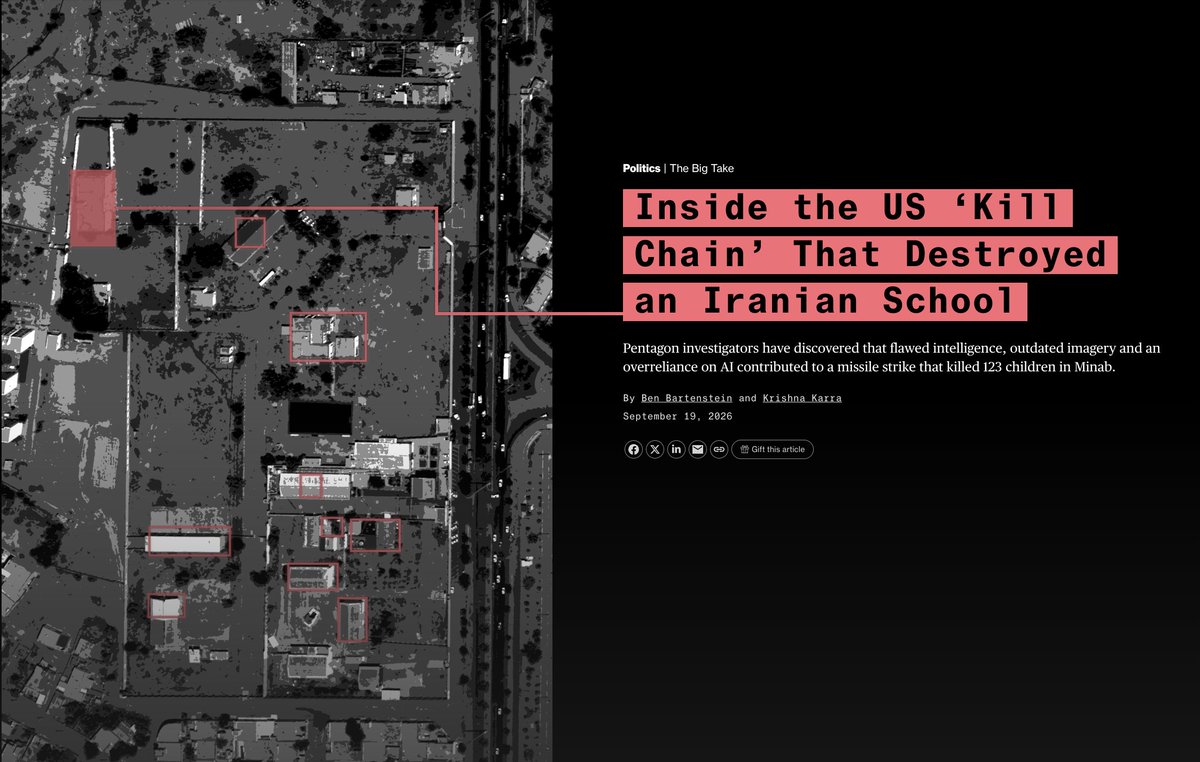
Bloomberg just dropped the most disturbing investigation I have read this year, and every AI builder should read it and take it seriously.
On February 28, two Tomahawk missiles hit an elementary school in Minab, a small town in southern Iran. 156 people died. At least 123 were children. The Pentagon knew within hours that it had bombed a school.
The school had its own website. It was labeled on Google Maps. You could see the soccer pitch from a satellite view. You could see the brightly painted walls. Any 12-year-old with a browser could tell what the building was.
The AI system could not.
Inside US Central Command, personnel were using Palantir's Maven Smart System. It is an AI targeting platform running on a $1.3 billion Pentagon contract, and embedded inside it is Anthropic's Claude.
On day one of the war, more than 1,000 targets went through it in 24 hours. Work that used to take a team hours per target got compressed into minutes.
The satellite imagery Maven was pulling from was seven years old. The site was still tagged in the database as an Islamic Revolutionary Guard facility.
The system spat it out as a recommended day-one target. Humans signed off. The first missile flew. Then a second one landed minutes later to hit the people who came to help.
Investigators later found that some Central Command staff had assumed Maven would flag stale intelligence for them. It did not. Nobody had told it to.
Palantir told Bloomberg the government is responsible for the underlying data. The Pentagon's civilian harm mitigation team, the people whose actual job is to catch a target like this, had been cut back before the war started.
This is not AI going rogue. This is the opposite.
This is AI doing exactly what it was built to do at exactly the speed it was built to do it. And a school full of little girls got vaporized because the humans in the loop trusted the machine more than they trusted their own eyes.
I keep thinking about the version of this story that comes next. What happens when the system is faster. When the target list is not 1,000 in a day but 10,000. When "review" becomes a button the operator has three seconds to hit before the next target loads. When there is no human left slow enough to notice that a soccer pitch is not a helipad.
We are not talking about a spam filter mislabeling an email. We are talking about a system that turned a seven-year-old database entry into two cruise missiles landing on children in the middle of a morning class.
A UN-backed panel has now called it a potential war crime.
In terms of children killed, it is the deadliest American targeting error of the entire 21st century. And according to Bloomberg, some of Defense Secretary Hegseth's own advisors are worried that too much public scrutiny of Maven might slow down its adoption inside the Pentagon.
Read that last line again.
If you build this stuff, you own what it does. You do not get to hide behind "the government owns the data." The whole pitch of your product is that speed and integration save lives. When it takes them instead, that is also on you.
I am not against AI in defense. I am against AI in a hurry. Speed is the entire mechanism that made Minab possible. Every guardrail we already know how to build takes time, and time is exactly what the system was designed to eliminate.
So here is the question I have not been able to stop asking, and I genuinely want to know what you think.
If a piece of software helped kill 123 children in a single morning while behaving exactly as designed, what does "responsible AI" even mean anymore?
If you haven’t started using Dot yet, now is the time.
Simply browse, or build something - the choice is yours, but do it in private.
Privacy is a necessity, not an option.
Use the link below for 10% off their entire platform.
https://t.co/Iie2xqsJb6
When companies like blackrock are starting to speak on open source AI….
Its good to be on the forefront. $DOT @usedotai is doing just that. Offering a new utilize the power of AI compute without giving away your right to privacy.
Big things to come.