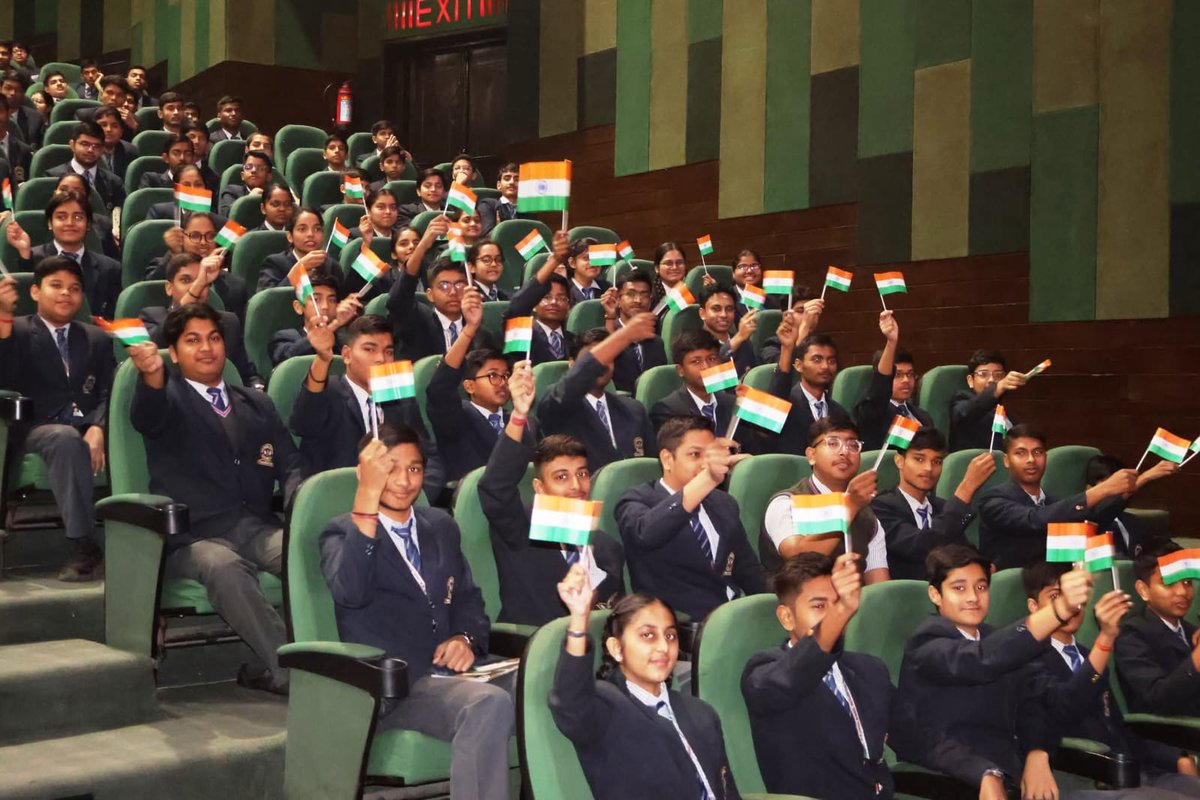
Ahead of India's 80th Independence Day, through the Flag Foundation of India (@FFOIndia ), we have launched a special nationwide initiative. If you have old or worn-out National Flags, you can send them to us at the Flag Foundation of India. We will recycle them with complete respect and dignity to create brand-new flags, giving them a new lease of life. Please visit our website to find your nearest collection point: https://t.co/EcjerDf5Bg
On our 80th Independence Day, India has come a very long way. My message to our GenZ and young dynamic leaders is simple, work hard, work with a spirit of cooperative endeavor, and dedicate yourselves to building a 'Viksit Bharat'. It brings me immense joy to see our nation moving resolutely in the right direction.
170,000 Korean bank accounts discovered what their “income” had actually been paying them to bear.
The final loss was KRW 4.6 trillion.
These equity-linked securities paid frequent coupons while the HSCEI remained above predetermined barriers. When the index fell 59.6%, early redemption failed, knock-in conditions activated, and years of quiet income became one concentrated claim on principal.
The formula was complex. The bargain was not.
Households had effectively accepted crash exposure in exchange for coupons.
If an investment feels safe only while volatility sleeps, was the coupon ever income?
The Founder’s Day was celebrated @opjsrgh by staff and students honouring the enduring vision of our revered Bauji, Syt. O.P. Jindal Ji. We remain forever inspired by Bauji’s vision of empowering youth through excellence and leadership. @JindalFndn@JindalSteel_In
The full research essay, including the cross-currency evidence, transaction-cost tests, quarter-end fingerprint and Federal Reserve balance-sheet data:
https://t.co/dhaihanb14
Finance's closest thing to a physical law broke.
It broke widest on the exact days banks had to show the world their balance sheets.
Covered interest parity says two fully hedged currency routes must end at the same price. After the crisis, the average three-month gap across ten major currencies remained 20.6 basis points.
After 2015, one-week deviations crossing quarter-end widened by an additional 31 to 38 basis points. The arithmetic had not changed. The price of carrying the trade had.
New Federal Reserve data covering $25 trillion in daily exposures found only five cents of exactly maturity-matched, unencumbered foreign safe assets for every dollar banks lent.
When an equation is exact but the institution required to enforce it says no, is the market mispriced, or is the equation missing the true price?
भारत की आन, बान और शान का प्रतीक तिरंगा हर भारतीय को एक साझा पहचान और गौरव के सूत्र में बाँधता है।
भारतीय राष्ट्रीय ध्वज के मूल स्वरूप की परिकल्पना करने वाले महान स्वतंत्रता सेनानी पिंगली वेंकैया जी की जयंती पर सादर नमन। राष्ट्र को दी गई उनकी यह अमूल्य विरासत सदैव सम्मान के साथ स्मरण की जाएगी। 🇮🇳🙏
The market’s biggest crashes were not outliers.
The bell curve was.
Across 40 million five-minute price changes, the probability of an extreme move fell roughly with the cube of its size, from 2 to 100 standard deviations.
Gains produced an exponent of 3.10. Losses produced 2.84. Researchers later argued that even the crashes of 1929 and 1987 belonged to the same tail.
Then came the harder discovery: rival models could imitate this law precisely where the evidence became thinnest.
If 40 million observations cannot reveal the shape of the next extreme, how much certainty should any risk number be allowed to carry?
The stock market compressed $15.2 billion into one final moment.
The deeper contradiction was that this was also one of the cheapest places to move it.
The average closing-price displacement was only 8.1 basis points. The auction absorbed extraordinary size, yet the official close often reversed overnight.
Passive ownership helped pull trading toward the close. As that pool deepened, opening turnover fell 22%, while displayed depth fell 63% over the sample.
That does not prove the close caused the morning to thin. It reveals something more consequential: a benchmark can become the place the market reorganizes itself around.
If liquidity becomes deepest at the moment used to measure the market, what has that measurement moved away from?
Retail-heavy stocks carried more earnings risk. When the numbers arrived, they earned less.
The stocks hardest to value also reacted least to the news meant to clarify them.
Across 151,058 U.S. earnings observations, average announcement-day returns fell from +0.35% in the lowest retail-trading quintile to -0.65% in the highest, even as uncertainty increased.
For the same standardized earnings surprise, the high-retail group’s immediate price response was 49% weaker.
Before earnings, institutions stepped back, retail became a larger share of the remaining market, and trading costs peaked precisely when the news arrived.
If the same information moves one stock less because a different audience is listening, where does the information end and the market begin?
The market can price a crash before the market crashes.
The first warning may be thousands of companies falling alone.
Kelly and Jiang turned those firm-level extreme losses into a monthly tail-risk gauge. A one-standard-deviation rise forecast 4.54 percentage points more expected annualized excess return.
In the sample, stocks most exposed to worsening tail risk earned a 5.4% annualized three-factor alpha.
But a later test across 4,389 firms rejected the simplest assumption behind the measure. The signal survived. Its cleanest explanation did not.
When the index still looks calm, should we trust the aggregate, or the losses already spreading beneath it?
#KargilVijayDiwas
On this momentous day @opjsrgh extends its heartfelt gratitude to all armed forces personnel who ensure our safety and the security of our borders. . Jai Hind!
@JindalFndn@MPNaveenJindal
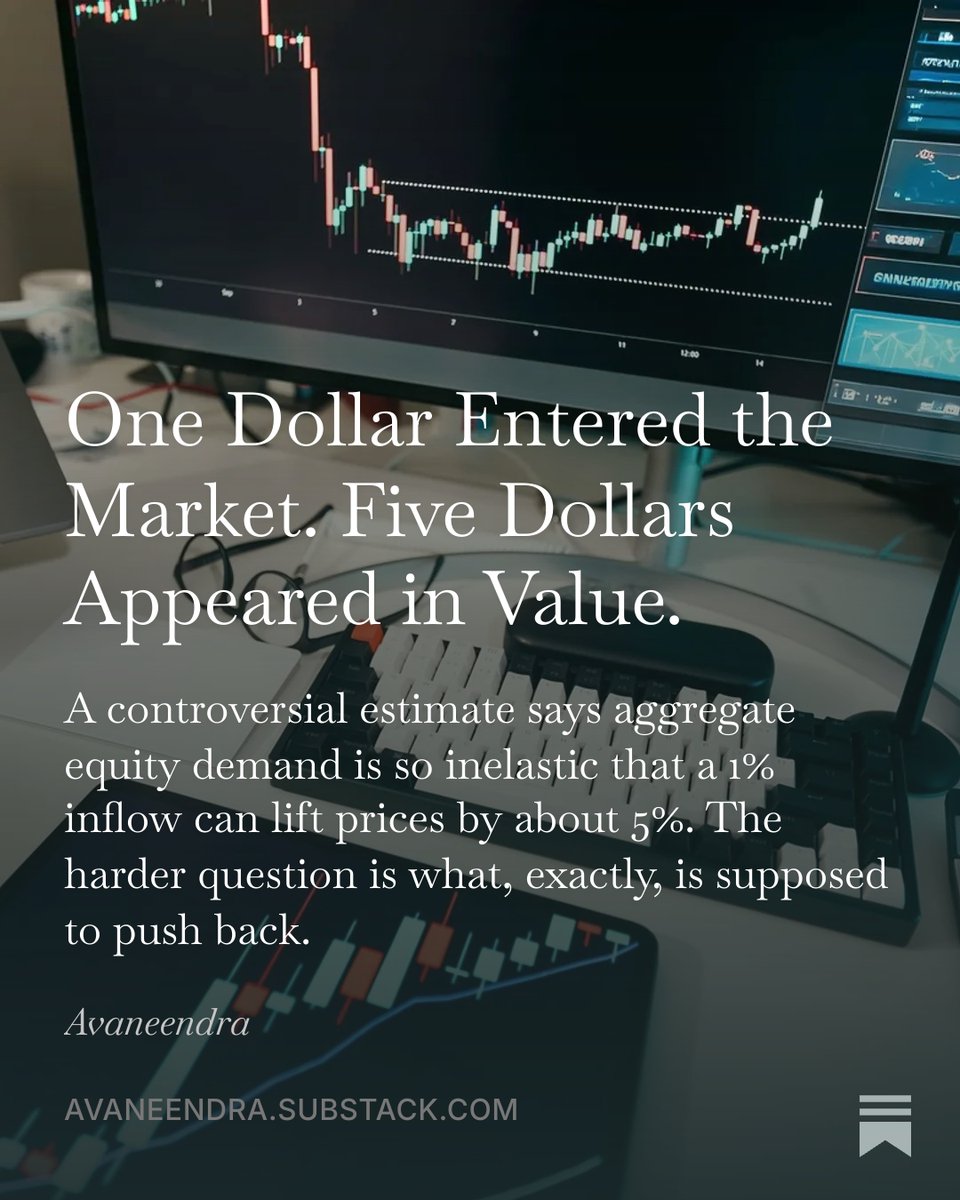
$1 entered the stock market. $5 appeared in value.
The difference was not cash. It was repricing.
Using quarterly US sector flows, Gabaix and Koijen estimate that market-wide buying can increase aggregate valuation far more than the money entering it.
The proposed mechanism is institutional constraint. Funds with fixed mandates cannot freely move from equities into bonds, so prices must absorb more of the adjustment.
Newer evidence complicates the story. Active investors offset roughly two thirds of the elasticity lost as others become passive, yet stock-level demand still became an estimated 11% more inelastic.
A flow is never large or small by itself. Its power depends on how much willing balance-sheet capacity is waiting on the other side.
When modest buying creates enormous value, who was supposed to stop the price from moving?
The most reliable anomaly in finance lost 74.36% in a single month.
It did not collapse because the market fell. It collapsed because the market came back.
In July and August 1932, the stocks everyone had abandoned rose 232%. The former winners gained only 32%. Momentum was long the second group and short the first.
The same structure returned in 2009: past losers rose 163%, while past winners gained only 8%.
During panic rebounds, the loser leg’s market beta can exceed 3, quietly turning a trend strategy into a leveraged short on recovery.
A simple risk rule later raised the Sharpe ratio from 0.53 to 0.97 and cut the worst month from −78.96% to −28.40%.
If a strategy’s greatest danger arrives when conditions improve, is it really momentum, or a hidden short-volatility trade?
Proud moment today! Inaugurated @Epsiloncarbon1 new speciality carbon plant ! A big step in Indias clean backwards integrated carbon chemicals story ! Congratulations @vikramhanda80 soar !!!☺️@sajjanjindal
झारखंड की ताकत यहां के लोग हैं, यहां का जज़्बा है और यहां की मेहनत है।
आज नवीन जिंदल ग्रुप और झारखंड सरकार के बीच 70,000 करोड़ रुपये से अधिक के निवेश का MoU साझेदारी को एक नई दिशा देने वाला ऐतिहासिक कदम है। स्टील में 40,000 करोड़, परमाणु ऊर्जा में 30,000 करोड़ और सौर ऊर्जा में 650 करोड़ रुपये का निवेश, जिससे 11,000 से अधिक युवाओं को प्रत्यक्ष रोजगार मिलेगा।
माननीय मुख्यमंत्री श्री @HemantSorenJMM जी और झारखंड सरकार का हृदय से आभार।
जय हिंद!
A landmark day for Jharkhand and for the Naveen Jindal Group.
Today, we signed an MoU with the Government of Jharkhand for an investment of over ₹70,000 crore across steel, nuclear energy, and renewable energy. This is our confidence in Jharkhand’s future and its people.
₹40,000 crore in steel. ₹30,000 crore in nuclear energy. ₹650 crore in solar. Together, more than 11,000 direct jobs and thousands more across allied sectors.
Grateful to Hon’ble Chief Minister Shri @HemantSorenJMM Ji and the Government of Jharkhand for their trust. Together, we build.
Jai Johar! Jai Hind! 🇮🇳
"जब आदमी भूखा होता है तो वो कुछ भी कर सकता है, अपने पेट के लिए, अपने परिवार के लिए।"
इसी सोच के साथ 2008 में Zero Hunger Resolution मैने संसद में रखा था। जिसपर बाद में Food Security Act आया।
@sansad_tv पर देखें पूरा इंटरव्यू
https://t.co/TFf9hefH3A