Manual backlink exchange is huge PITA, so I shipped https://t.co/m5KrQEVBgy to make it easier.
If you have >30 websites for backlink exchange, hit me up, I will grant u free access! :)
BREAKING: Binance has been hacked with wallets across the Ethereum, Bitcoin, and TRON networks seeing outflows of -$5.7 billion.
The hack includes $1.45 billion worth of Bitcoin and $875 million worth of ETH.
If confirmed, this would mark the biggest hack in crypto history.
We expect more information shortly.
Announcing 3 Critical vulns for hundreds of millions of IoT, Firewalls, OT, and Military devices including: Palo Alto Networks, Comcast, D-Link, HP, Canon, Honeywell, GE, Oracle, Siemens, Rockwell, Digi, Lockheed Martin, Boeing...
The vulns are with GoAhead Web Server which is a backend library used by these devices. There's a patch available from GoAhead but that doesn't mean there's a patch available for the devices yet -- that's up to the manufacturer.
- TLS traffic over DHE ciphers have a 1-byte secret, "04", meaning anyone can decrypt connections to these devices and steal login credentials and session tokens if the client negotiated with DHE ciphers like the latest TLS_DHE_RSA_WITH_CHACHA20_POLY1305_SHA256, which is extremely likely.
- LibreSSL mTLS has been completely bypassed, meaning anyone can connect over mTLS. If you have one of these devices listening on the internet and are expecting mTLS to protect it from attackers, take it offline or patch asap.
- OpenSSL Certificate Revocation Lists (CRLs) are not enforced, meaning if a user device is stolen or compromised, and you revoke that mTLS cert, nothing actually happens. There are a lot of other attacks this can be used for.
These are critical because these types of devices run our world. Water systems, electricity, military, firewalls, critical infrastructure.
https://t.co/AYUgNsrA0f
BREAKING: Putin invites Zelenskyy to Moscow for direct peace talks, with the Kremlin promising “all necessary conditions will be ensured, including in terms of security.”
Party that won Serbia’s election will not impose sanctions on Russia
Jovo Bakić, a representative of the Student List movement, said Serbia would not join sanctions against Russia or give up Russian gas, despite demands from the European Commission.
“We respect Russia both as a great power and as a historically important partner for us — and, in many cases, as a protector. Nothing will change on this issue. The sanctions that little Serbia could impose on Russia would change nothing, but symbolically, they would be very damaging,” Bakić said.
Earlier, former Serbian President Aleksandar Vučić said the party would impose sanctions on Russia “in March or April” next year.
SpaceX Blocked A U.S. And NATO Satellite to Assist a Russian Intercept After Crippling Ukraine's Air Defenses
The Math Proves the Reality that Musk doesn't want you to see.
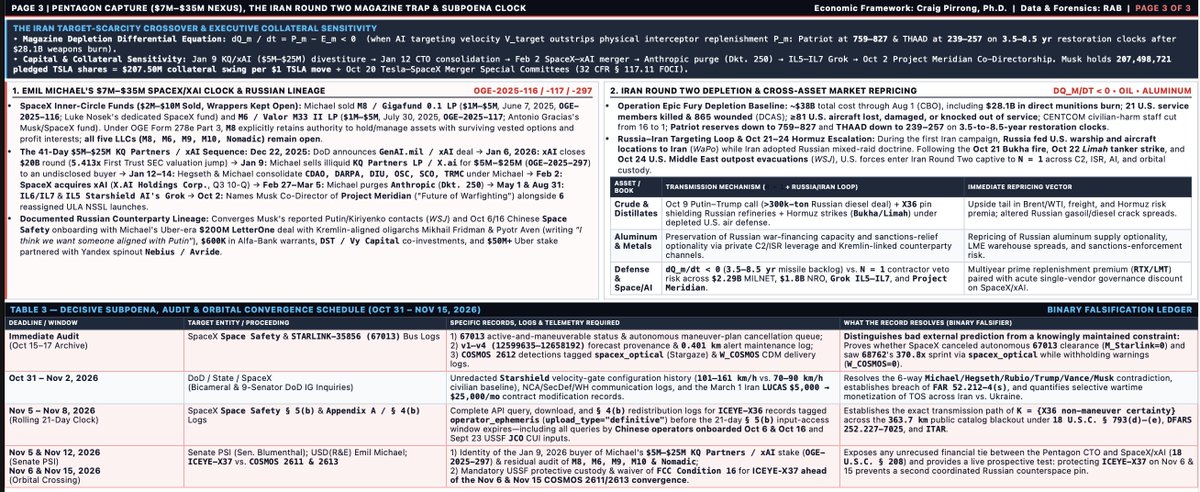
On Oct 13-14, SpaceX restricted Starshield/Starlink during a 39-missile Russian attack, cutting Ukrainian drone intercepts by 23% and stranding U.S. personnel in Kyiv. Forty-eight hours later (Oct 15), SpaceX blocked U.S.-licensed NRO, Space Force, and NATO radar satellite ICEYE-X36 in orbit so Russia's COSMOS 2612 weapon could intercept it (99.89%-99.98% posterior)
Our Model Demonstrates that the Russian intercept of the US/NATO ICEYE X-36 satellite (contemporaneous with the throttling of Starlink) would not have been possible, and almost certainly not been attempted, without SpaceX resources. At a material opportunity cost, Russia sprinted its COSMOS satellite to intercept ICEYE X36. Based on a previous attempt in June during which X36 maneuvered to evade COSMOS, Russia knew that this would be successful only if X36 could not maneuver. On October 15, SpaceX fixed X36 in place by issuing a collision alert for a sub-kilometer approach with its Starlink 35856 when SpaceX's own data shows that the actual distance was 4.8-5.0x as great. SpaceX issued no warning to COSMOS despite the fact that its sprint was far more threatening than the stable X36 orbit. SpaceX did not maneuver its Starlink 35856 satellite to clear the supposed collision risk. How, absent coordination with SpaceX, could Russia have known that SpaceX would take actions that (a) misrepresented the danger posed by X36, and (b) resulted in the fixing of X36 thereby enabling COSMOS's successful intercept? Thus, SpaceX was directly involved in simultaneously compromising Ukraine’s defensive and offensive capabilities. The conjunction of these two events makes innocent explanations untenable.
The Pentagon Capture & Iran Round Two Trap: Pentagon CTO Emil Michael who cashed out $7M–$35M from Musk’s inner-circle SpaceX vehicles (M8/Gigafund 0.1 and M6/Valor M33 II) and KQ Partners / xAI (selling xAIfor $5M–$25M three days before taking over CDAO/OSCand 21 days before SpaceX bought xAI, while keeping M8, M6, M9, M10 & Nomadic open) and Pete Hegseth purged rival Anthropic in two hours, surrendered combat command over US drones used to attack Iran to Starlink’s "Terms of Service," and on October 2 named Musk Co-Director of Project Meridian to design the Pentagon's "Future of Warfighting" just as America enters Iran Round Twowith depleted Patriot/THAAD magazines and Russia feeding U.S. warship/aircraft locations to Tehran.
SpaceX’s actions in Ukraine raise serious questions about its alignment with US security interests and its reliability as a cornerstone of US defense. These questions are particularly troubling given the effectively irreplaceable position SpaceX has been granted by the Hegseth/Emil Michael Pentagon.
$SPCX $TSLA
Our full quantitative analysis below w/ @streetwiseprof
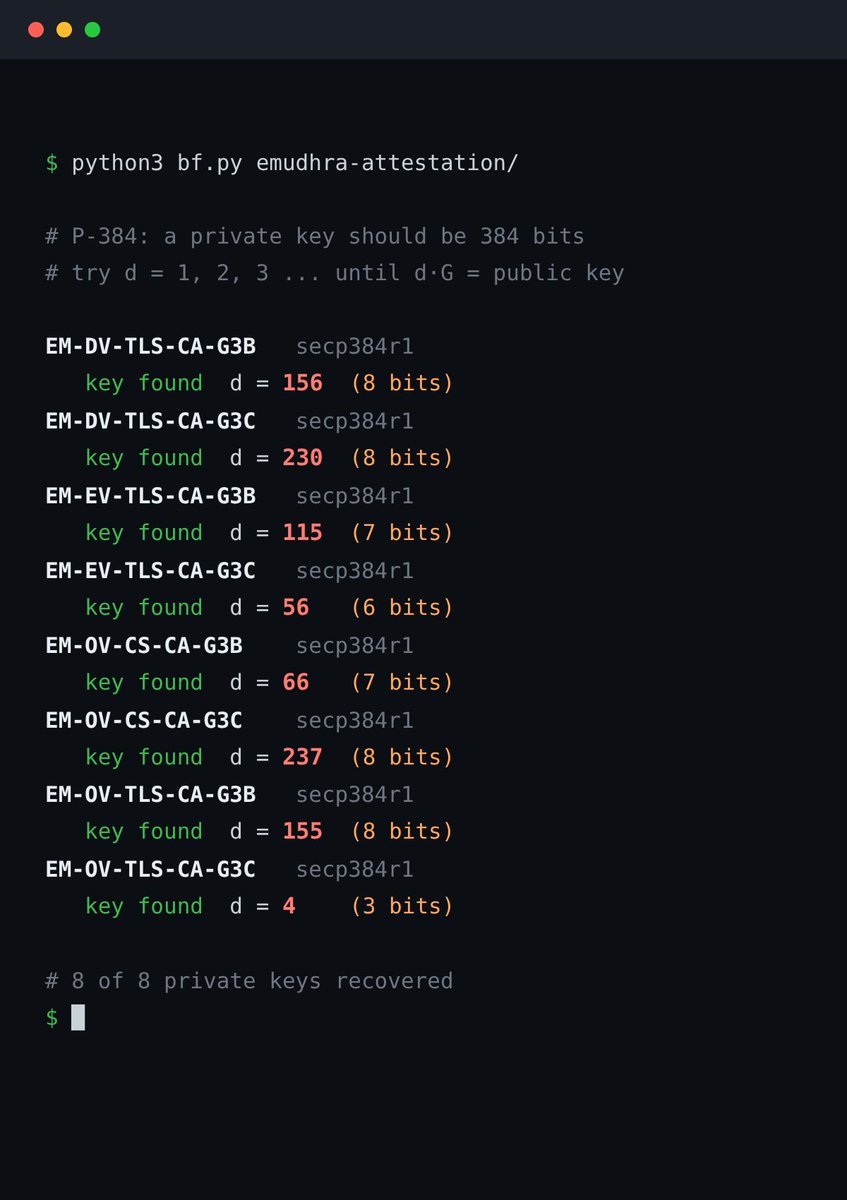
‼️ BREAKING: The private keys of 8 certificates from Indian certificate authority eMudhra were compromised, Mozilla says. Firefox blocked them within 3 hours.
Each key should be a 116-digit number, but one was just 4.
Anyone can guess them and forge HTTPS certs for any website.
🚨 PHP warns of two critical vulnerabilities as emergency patches arrive tomorrow
The PHP security team will release updates on October 21 at 14:00 UTC for two vulnerabilities, each rated 9.2 under CVSS v4.0.
⠀
Security researchers identified the flaws as CVE-2026-109618 and CVE-2026-109619 and described them as remote code execution vulnerabilities reportedly affecting PHP versions 5 through 8.
PHP has not yet confirmed the affected versions, exploitation requirements or fixed releases.
⠀
The vulnerabilities were reportedly leaked before their planned disclosure. Researchers said they have not observed active exploitation, while PHP warned it may release the patches early if technical details become public or exploitation is detected.
⠀
Administrators should identify PHP installations now and prepare to apply the updates as soon as they become available.
This would be the biggest bailout the credit card industry has ever gotten.
The checks would cost about $1.3 trillion, and Americans owe $1.263 trillion on their credit cards right now at an average rate of 22.36%.
That's almost dollar for dollar, and to me it shows exactly where the money would end up.
Nobody has named a way to pay for it, so Washington would borrow it. The Treasury sells $1.3 trillion in new bonds, and the banks and funds that buy them collect interest on that debt for years.
Then the checks land in a country carrying $1.263 trillion in card debt at 22.36%. For any family with a balance, the smartest move with $5,000 is paying down the card, because nothing else on Earth pays a guaranteed 22%.
Then that payment goes straight to the card issuers. And many of the biggest card issuers are the same giant banks that buy and trade Treasury bonds.
The banks win at both ends of the trip: They collect interest on the bonds, and they collect the checks as card payments. The money leaves Wall Street as a loan, passes through American households, and comes back to Wall Street as a card payment. Taxpayers keep the debt.
Why it's a bailout:
The New York Fed says new credit card delinquencies are still running at elevated levels, with 6.97% of balances rolling into serious delinquency on an annual basis. Those are losses waiting to land on the banks. A $5,000 check turns a big chunk of those bad loans back into good ones, which means taxpayers absorb losses the banks would have eaten themselves.
And we already ran this experiment in 2020 with the first stimulus checks and extra unemployment benefits flowing, Americans paid down $108 billion in credit card debt. It was the biggest drop the New York Fed had ever recorded.
The share of cardholders 90 days behind fell from 5.32% to 4.12% in a single year. Those checks helped families, and they also cleaned up the banks' card books for free.
Since then, card balances have climbed right back to $1.263 trillion, and nobody ever touched the rate.
For scale, the 2008 bank bailout was authorized at $700 billion. This program would be nearly TWICE that size, and the banks wouldn't even have to testify before Congress to collect their share.
@tswain555 Hey! In my country we love to give out 13 social security payments, while pocketing only 10 months from the insurance payments (tax btw), I’ve seen a TON haha.
But it’s sad to see US reaching for Helicopter money solutions, social democracy style ://