@finch_shenq@KAUST_BESE We used CoralSCOP (SAM-based) rather than Cellpose, and our images were ex situ plates rather than 4K underwater, which made life much easier on memory. Underwater at that resolution sounds genuinely painful.
Seeing this come full circle is something else. It started as a course project — students collecting fragments, doing the lab work, running the analysis themselves. Glad to have been the TA on this one and to see it published 🪸
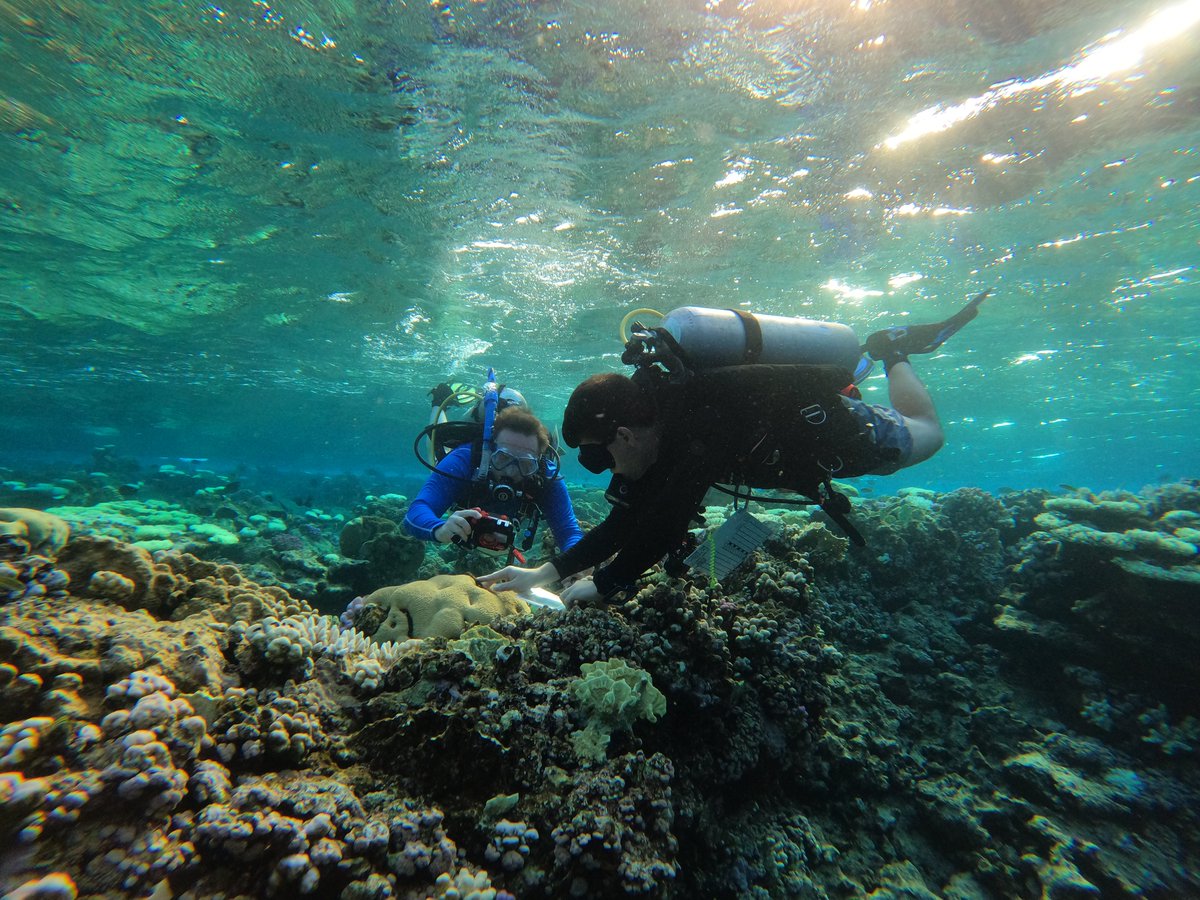
In BESE’s Marine Ecological Genomics course, students explored whether ordinary photographs could be used to measure coral bleaching.
What started as a course project grew into a published research paper, with all the students from the course now as co-authors.
A pretty great example of where teaching can lead.
Read the paper: https://t.co/j9wTi9cEMn
In BESE’s Marine Ecological Genomics course, students explored whether ordinary photographs could be used to measure coral bleaching.
What started as a course project grew into a published research paper, with all the students from the course now as co-authors.
A pretty great example of where teaching can lead.
Read the paper: https://t.co/j9wTi9cEMn
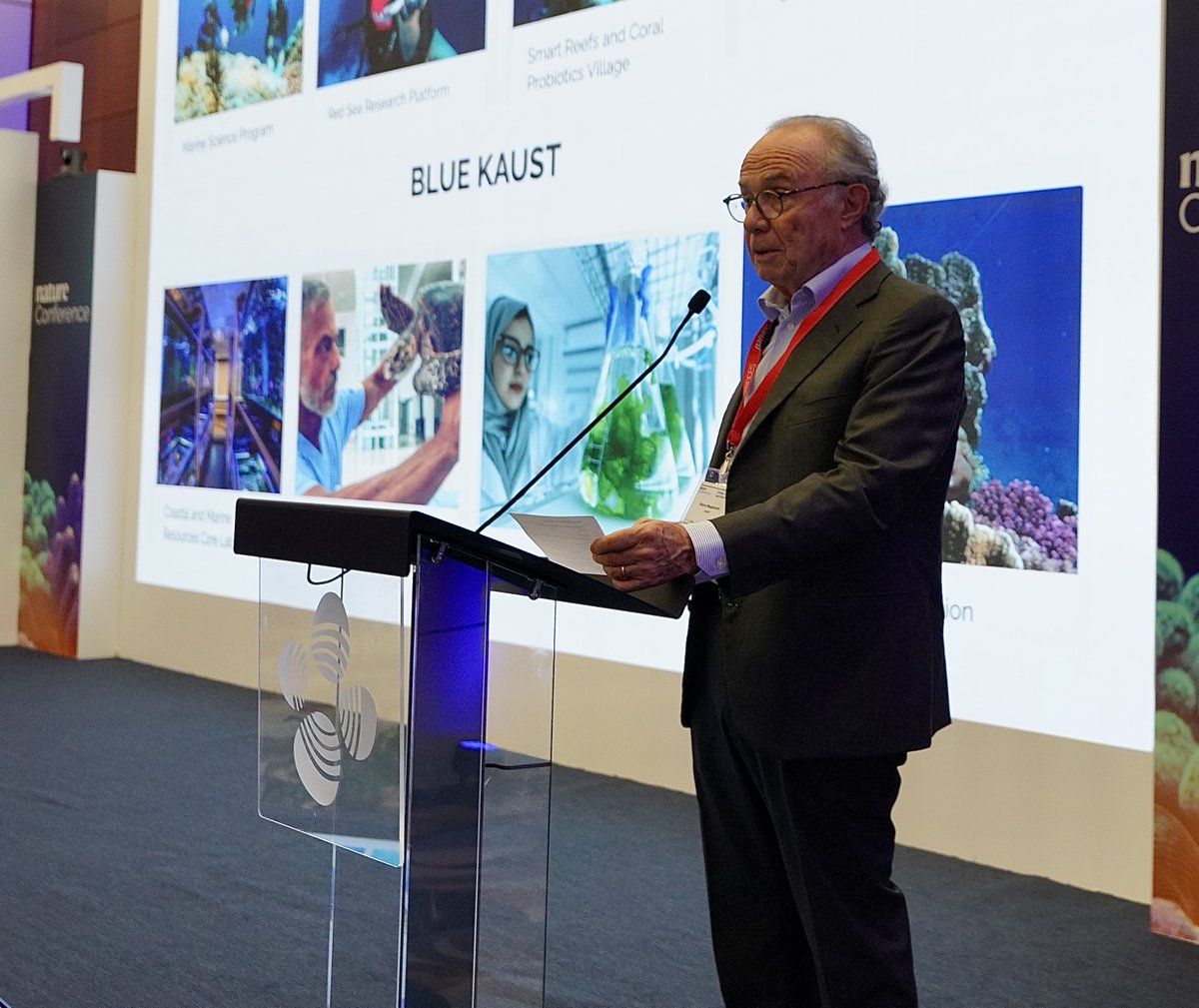
Nature’s Corals, Coasts and One Health conference at KAUST is bringing together the world’s leading coral reef and coastal scientists.
From microbial ecology to policy, the conference advances solutions for reef and coastal resilience, shaping the future of oceans and human well-being.
@NatureConf
Harvard scientists just shattered one of biology’s oldest rules.
We were taught:
Viruses can’t make their own proteins. They hijack yours. That’s why they’re “not alive.”
Except giant DNA viruses just crossed that line.
Researchers found they carry a full eukaryotic-style translation complex (vIF4F). Translation machinery.
Inside a virus. They can keep making proteins even under stress that shuts down normal viral replication.
If a virus brings its own protein-making tools…
Is it still just a parasite?
For decades we’ve drawn a clean boundary:
Cell = alive
Virus = not alive
Nature doesn’t care about our categories.
Maybe viruses aren’t just evolutionary side notes.
Maybe they helped build complex life.
Paper in Cell 👇
https://t.co/QyGzZf9e6o
Harvard news: https://t.co/YKAfEngdS3
🎉 Exciting news! The last manuscript from my dissertation was just published in Royal Society Open Science! And in a fun twist of fate, the cover of this issue happens to feature a Caribbean coral 🪸 (not from our study, but serendipitous nonetheless!) https://t.co/S19s5P9jrK
We're about to create the 1st gen of scientists who can't research without AI. And honestly? I'm not sure if that's evolution or devolution!
𝗦𝗰𝗶𝗲𝗻𝘁𝗶𝘀𝘁𝘀 𝗮𝗿𝗲 𝗻𝗼𝘄 𝘂𝘀𝗶𝗻𝗴 𝗖𝗵𝗮𝘁𝗚𝗣𝗧 𝘁𝗼:
— Extract key findings from dense papers in seconds
— Design entire experiments from scratch
— Turn complex studies into engaging content for public
— Generate survey questionnaires that would take days to create
— Respond to peer reviewers (yes, really)
& this book does a great job going through these details!
But missed the elephant in the room:
⤴️ research inequality.
Universities with AI access will accelerate faster than those without. Researchers fluent in prompt engineering will outpace those who aren't.
We're creating new divides in an already unequal system!
It doesn't address how AI might bias research directions:
⤴️ We're training AI on biased research. Now it's teaching us. See the problem?
Overall, this isn't another "AI will save us all" book.
Authors actually tested ChatGPT on real research tasks & documented both the wins and the spectacular failures.
𝐌𝐲 𝐭𝐚𝐤𝐞𝐚𝐰𝐚𝐲: We need AI-literate researchers, not AI-dependent ones!
💬 𝗪𝗵𝗶𝗰𝗵 𝗮𝗿𝗲 𝘄𝗲 𝗰𝗿𝗲𝗮𝘁𝗶𝗻𝗴?
Comment if you'd like a link to download this book!
-------------------------
Useful find? Pass it on!
🔄 Retweet
👋 I’m Razia
Click my name + follow + 🔔
I post about AI in #research & #analysis
Want FREE tips on using AI in research?
↳ Join 15K+ researchers:
🔗 link in bio
-----------------------
#aiinresearch
Are #corals moving to colder waters because of #climatechange? The answer is no, or not yet. High latitudes corals and their symbiotic algae friends have been there for quite a long time, and are different to the ones in tropical reefs https://t.co/kXRu7TvZmk
Meet Ali Alabyadh, a BESE Ph.D. student and the first Saudi to be selected as one of the 13 young people to take part in the RE.GENERATION Future Leaders Cohort, organized and funded by The Prince Albert II of Monaco Foundation (@FPA2).
Ali is a geologist and a student in the #MarineScience program at KAUST, supervised by Prof. Raquel Peixoto (@peixotors), working on #coralrestoration in the #RedSea.
We are thrilled to announced the publication of chromosome level genome assemblies and genetic maps for the Caribbean corals, Acropora palmata and Acropora cervicornis. https://t.co/N6418jQCwI
Let's gooo!! 🌎 Try our 3D "Street View for Coral Reefs" prototype 2.0! 🪸
We did it! Today we've hit a new milestone! It's been a long journey, but we're one step closer.. We have a 50x times larger 3D Gaussian Splatting model now, covering over 1000 sq meters of corals. So stoked to tell you \o/
🔵 Why? Coral Reefs are so precious, beautiful, incredibly complex and threatened ecosystems. They are dying fast.. But there's a way to protect and restore them! A lot of amazing people fighting for their life. We need to understand deeply how Coral Reefs function, what methods work, what don't, to coordinate precise action. They are a key to protect and restore other ecosystems. That's why we're building a digital twin of coral reef ecosystems -- our first product.
🔵 https://t.co/svYYZm1v9B -- today you can try our second scrappy prototype (20% done) -- works best from computer.
🔵 What you see: it's a 3D "Street View" for Coral Reefs. Someone swam around a reef with a few GoPros, and you can now see high-res photorealistic 3D model of coral reef in the browser! It's a super cheap way of monitoring. Soon you will fly over square kilometres of reefs and see them in centimetre resolution. You can compare reefs in different countries and see how they evolve over time, easy way of getting rid of biases in data.
🔵 The prototype is terrible. Still work in progress (20%), just another sneak peek. We're moving fast and testing one hypothesis after another. Right now we still don't have a smooth progressive loading, there are some wacky splats here and there.
🔵 But it's already much better. This time we used 8382 images from GoPro 10 (instead of 70) and trained over 25x50m model (last time it was about 5x5 m). We respect correct geometry from Metashape (classical photogrammetry tools). Centimetre resolution! I think it's still the best in the world quality you can find.
🔵 Next steps: 3D time-series data (see how coral used to look like 3 months ago), 3D segmentation models, classifying coral species, adding other modalities (acoustics, eDNA, geospatial)... Allowing anyone to run analytics against all our data... Foundation models for biodiversity... Becoming the first generation that actually leaves behind nature better than we found it! 🪸
🔵 This version of a prototype wouldn't happen without these incredible people:
- @BenWilliamsSci -- it's all Ben's fault I'm doing this now, his idea and support
- @jtlrocketman -- Metashape/photogrammetry support
- Greg Tkachenko -- powerful compute cluster
- @rindahvida, @TimACLamont, @shebahopegrows Mars BuildingCoral team -- collecting the data, doing scientific research and restoring this reef you see
- and many many more fantastic people!
We've got terabytes of data from multiple orgs, now scaling the compute and processes. Soon you can play with more and more coral reefs! What a time to be alive! \o/
Understanding the difference between Standard Deviation (SD) and Standard Error (SE) is crucial for accurate data interpretation. SD measures the variability within your data, indicating how spread out the individual data points are from the mean.
In contrast, SE measures the uncertainty around the sample mean as an estimate of the population mean. It reflects the precision of the mean, with SE decreasing as the sample size increases, making your estimate more reliable.
The relationship between SD and SE is given by the formula: SE = SD / √(sample size). While SD remains relatively constant with larger samples, SE diminishes, highlighting the reduced uncertainty in the mean estimate.
A common mistake in research is using the “±” notation without specifying whether it refers to SD or SE, leading to potential misinterpretation of the data. Clear distinction is essential for transparency and accuracy in reporting.
Key Takeaways:
• Use SD to describe data variability.
• Use SE to indicate the precision of the mean.
• Always specify which measure you are reporting.
New paper out! 🚨 We show that vampire bats use amino acids from a recent blood meal to fuel RUNNING - a rare mode of locomotion in bats ideal for stalking prey. I’d worry less about your neck and more about your ankles! 🧛🏻♂️ @WelchLab_UTSC@RSocPublishing
https://t.co/4H5dg7TsNK
The Yanbu 2024 Expedition is a wrap!🪸⛴️Huge thanks to the @CoralSymBiomiX lab for making me part of this incredible journey led by Dr. Holger Anlauf and @RMijailPP
Great moments on the boat and underwater, incredible teamwork, achieved goals, and countless stories to tell!😄
What kind of childhood makes a top scientist? Is it enough to have all the right traits (brilliance, grit, etc) or do you need the right family too?
And why should we care? A 🧵 on our paper on the Nobel Laureates.
A teaser: the income distribution of the laureates' fathers.1/N
We published a thorough review of coral clonal growth and a new universal model of coral clonal growth on the same day (yesterday):
https://t.co/O4KC4J49Pd
https://t.co/uNAyPHxHJE
Hoping they'll be useful in advancing the field and supporting practical applications
Our research titled "Induced sexual reproduction ex situ reveals bidirectional sex change of the coral Montastraea cavernosa" was published in Coral Reefs https://t.co/gRjJHCtk7z Check it out!