#Russian#soldiers#burning#USA#flag
Georgia, august 2008.
This is russia's real attitude towards the USA, towards President Trump.
Show this to the Trump Administration.
This is a very strange war, probably one of the strangest I've ever studied or witnessed.
Off the top of my head I can name about 20 glaring strangeness — about Ukraine and about Russia alike — that defy any reasonable explanation.
Most of those strangeness will have to wait until the war is over, but one — about Russia — I'll go ahead and name.
Russia's death toll is approaching half a million, and by the time you read this, it may have already reached or surpassed that mark.
Losses can sometimes be justified if they yield dividends — but that's not the case with today's Russia or the war it's waging.
I genuinely cannot understand why, after the failed take Kyiv, Russian leadership decided to grind its army year after year, head-on, into Ukraine's most fortified and defended lines.
History has rarely, if ever, seen anything like it — a massive army taken and methodically, year after year, smashed against a wall for minimal gain.
Someone might push back: Ukraine, too, attacked head-on into the most fortified positions in 2023.
True — but after getting burned, Ukrainians drew lessons. What followed was the Kursk operation (a change of direction), robotization, a search for new military solutions.
And before that came the Kharkiv offensive, the defense of Kyiv, the liberation of Kherson through bridge-cutting and encirclement — and much more.
Ukraine's strangeness lies elsewhere — but certainly not in operational art. There they've demonstrated what any cat knows: touch fire once, don't touch it again.
And don't blame Soviet-era generals — even Soviet generals understood and could apply not just the ABC's of military art but higher concepts as well.
But forget the generals — even stranger is why the army itself goes along with it.
Fine, the soldiers — they're terrified, ground down, and cowed. But what about junior and mid-level officers?
Don't questions occur to them — elementary, basic questions — that with a front and theater stretching over 3,000 km, with directions that are either poorly defended or vulnerable, choosing again and again, year after year, the most heavily fortified theater and axis is, to put it mildly, a deliberate strategy to destroy your own army?
The Ukrainians have been slowly falling back all these years, methodically building new lines while simultaneously destroying and grinding down the Russian army.
Looking at that half-million dead, the thought creeps in — the one some Z-bloggers themselves have written about: that this isn't a war, it's a human sacrifice.
Calling it a war in any genuine sense is indeed difficult — because what Russia is doing is simply not how things are done, even when you're Soviet-trained and don't know how to fight.
Because if a man picks up a sword and starts stabbing himself with it — piercing his own hands and feet — you wouldn't say: well, he just doesn't know how to fence — Soviets, you understand...
A lot of lyrical prose has been written about this, and even more clever arguments and attempts to explain it rationally — but all of it misses the point.
The Kremlin is hundreds of people if you count only the very top, and thousands if you include the rest of the apparatus — plus the General Staff, plus senior and junior officers — that's tens of thousands of people.
And not one of them had the basic thought that you cannot smash an army to pieces and burn hundreds of thousands of men alive, head-on, directly into the enemy's fortifications?
The only case we've seen where someone tried to break out of this sacrificial meat grinder was Yevgeny Prigozhin and his Wagner group.
How that ended is well known — but what's not clear is why everyone else is fine with all of this.
And this isn't about humanism — it's about basic utilitarianism. You need an army, an economy, equipment — especially if you have ambitions.
And Russia has them.
But Russia is hurtling toward the abyss and shows no sign of stopping — and fine, the leadership are idiots — but why is everyone else okay with it?
History knows many wars — successful and unsuccessful, justified and not, long and bloody, fast and short — but the war the Kremlin is waging today is not just stupid, senseless, and bloody. It is also profoundly strange.
@LindseyGrahamSC Just need to see this only effective reality.
Mr. President Trump, victory over the PRC is - Ukraine's victory over the cannibal-aggressor from Moscow!
@LindseyGrahamSC And it is also time for President Trump to show greater determination & aggressiveness towards the cannibal Putin and stop futile attempts to pull RF away from the PRC, and instead deal a crushing blow to the ally of the Chinese commi with the best weapon - the Army of Ukraine.
@PalantirTech Absolutely!
Needed Big press-conf., tell everything about this deadly disease - Frankfurt School neo-Marxism. Which was aggres-ly & mass-ly introduced in West. Civiliz. by the so-called liberals and which is disguised under the camouflage of "liberal democracy". Stop neo-Marxism!
Because we get asked a lot.
The Technological Republic, in brief.
1. Silicon Valley owes a moral debt to the country that made its rise possible. The engineering elite of Silicon Valley has an affirmative obligation to participate in the defense of the nation.
2. We must rebel against the tyranny of the apps. Is the iPhone our greatest creative if not crowning achievement as a civilization? The object has changed our lives, but it may also now be limiting and constraining our sense of the possible.
3. Free email is not enough. The decadence of a culture or civilization, and indeed its ruling class, will be forgiven only if that culture is capable of delivering economic growth and security for the public.
4. The limits of soft power, of soaring rhetoric alone, have been exposed. The ability of free and democratic societies to prevail requires something more than moral appeal. It requires hard power, and hard power in this century will be built on software.
5. The question is not whether A.I. weapons will be built; it is who will build them and for what purpose. Our adversaries will not pause to indulge in theatrical debates about the merits of developing technologies with critical military and national security applications. They will proceed.
6. National service should be a universal duty. We should, as a society, seriously consider moving away from an all-volunteer force and only fight the next war if everyone shares in the risk and the cost.
7. If a U.S. Marine asks for a better rifle, we should build it; and the same goes for software. We should as a country be capable of continuing a debate about the appropriateness of military action abroad while remaining unflinching in our commitment to those we have asked to step into harm’s way.
8. Public servants need not be our priests. Any business that compensated its employees in the way that the federal government compensates public servants would struggle to survive.
9. We should show far more grace towards those who have subjected themselves to public life. The eradication of any space for forgiveness—a jettisoning of any tolerance for the complexities and contradictions of the human psyche—may leave us with a cast of characters at the helm we will grow to regret.
10. The psychologization of modern politics is leading us astray. Those who look to the political arena to nourish their soul and sense of self, who rely too heavily on their internal life finding expression in people they may never meet, will be left disappointed.
11. Our society has grown too eager to hasten, and is often gleeful at, the demise of its enemies. The vanquishing of an opponent is a moment to pause, not rejoice.
12. The atomic age is ending. One age of deterrence, the atomic age, is ending, and a new era of deterrence built on A.I. is set to begin.
13. No other country in the history of the world has advanced progressive values more than this one. The United States is far from perfect. But it is easy to forget how much more opportunity exists in this country for those who are not hereditary elites than in any other nation on the planet.
14. American power has made possible an extraordinarily long peace. Too many have forgotten or perhaps take for granted that nearly a century of some version of peace has prevailed in the world without a great power military conflict. At least three generations — billions of people and their children and now grandchildren — have never known a world war.
15. The postwar neutering of Germany and Japan must be undone. The defanging of Germany was an overcorrection for which Europe is now paying a heavy price. A similar and highly theatrical commitment to Japanese pacifism will, if maintained, also threaten to shift the balance of power in Asia.
16. We should applaud those who attempt to build where the market has failed to act. The culture almost snickers at Musk’s interest in grand narrative, as if billionaires ought to simply stay in their lane of enriching themselves . . . . Any curiosity or genuine interest in the value of what he has created is essentially dismissed, or perhaps lurks from beneath a thinly veiled scorn.
17. Silicon Valley must play a role in addressing violent crime. Many politicians across the United States have essentially shrugged when it comes to violent crime, abandoning any serious efforts to address the problem or take on any risk with their constituencies or donors in coming up with solutions and experiments in what should be a desperate bid to save lives.
18. The ruthless exposure of the private lives of public figures drives far too much talent away from government service. The public arena—and the shallow and petty assaults against those who dare to do something other than enrich themselves—has become so unforgiving that the republic is left with a significant roster of ineffectual, empty vessels whose ambition one would forgive if there were any genuine belief structure lurking within.
19. The caution in public life that we unwittingly encourage is corrosive. Those who say nothing wrong often say nothing much at all.
20. The pervasive intolerance of religious belief in certain circles must be resisted. The elite’s intolerance of religious belief is perhaps one of the most telling signs that its political project constitutes a less open intellectual movement than many within it would claim.
21. Some cultures have produced vital advances; others remain dysfunctional and regressive. All cultures are now equal. Criticism and value judgments are forbidden. Yet this new dogma glosses over the fact that certain cultures and indeed subcultures . . . have produced wonders. Others have proven middling, and worse, regressive and harmful.
22. We must resist the shallow temptation of a vacant and hollow pluralism. We, in America and more broadly the West, have for the past half century resisted defining national cultures in the name of inclusivity. But inclusion into what?
Excerpts from the #1 New York Times Bestseller The Technological Republic: Hard Power, Soft Belief, and the Future of the West, by Alexander C. Karp & Nicholas W. Zamiska
https://t.co/8igjazz1On
@Arkasiraee@shanaka86 The Russian budget deficit for 2 months of 2026 is 15-20 billion US dollars. So this temporary easing of sanctions will not help Putin. And the war against the Ayatollah regime will not drag on for months.
Russia is providing Iran with the coordinates of American warships. CNN confirmed this on 6th March. The Washington Post confirmed it independently. Bloomberg reported that Russian satellite imagery is being shared to help Iranian commanders target US forces. The intelligence includes locations of US ships, aircraft positions, and movement patterns. The source is Russian military intelligence. The recipient is the IRGC.
Simultaneously, 201 Ukrainian military specialists are deployed across the UAE, Qatar, Saudi Arabia, and Kuwait, teaching Gulf state forces how to intercept and destroy Iranian Shahed drones. The same drones that Iran builds with Russian components. The same drone model that Russia purchases from Iran and deploys against Ukrainian cities. The same airframe that killed civilians in Odesa, Kharkiv, and Kyiv before it killed a port worker in Bahrain and set fire to Dubai International Airport.
The triangle is complete. Russia gives Iran the data to strike American forces. Iran strikes Gulf states with drones containing Russian guidance components. Ukraine, the country Russia is actively bombing, teaches the Gulf states to shoot those drones down. The country Putin is trying to destroy is defending the countries Putin’s ally is attacking, using expertise gained from defending itself against the same weapon.
Every lesson Ukraine learned intercepting Shaheds over its own territory from 2022 to 2026 is now being applied to IRGC-deployed Shaheds over Gulf refineries. The detection protocols. The jamming frequencies. The acoustic tracking. The small-arms interception techniques for low-altitude approaches. The integrated air defence coordination that links radar, visual spotters, and electronic warfare into a kill chain optimised for cheap autonomous drones. No training manual teaches this. Three years of nightly combat teaches it.
President Trump acknowledged the Russian connection. He said Putin might be helping them a little bit, then compared it to US aid to Ukraine, calling it a similar dynamic. The comparison is structurally inaccurate but politically revealing. US aid to Ukraine is acknowledged, appropriated, and documented. Russian aid to Iran is denied by Moscow, confirmed by US intelligence, and delivered through channels designed to be invisible. One is policy. The other is covert action.
The Christian Science Monitor reported that both Ukraine and Russia see the Iran war as presenting peril and possibility. Ukraine gains leverage by proving its value to Gulf states and the US alliance. Russia gains revenue from energy price spikes, weakens US military readiness through resource diversion, and prepares a spring offensive against Ukraine while American attention and interceptor stocks are consumed in the Gulf. The Foreign Policy Research Institute assessed that every Patriot battery shipped to the Gulf is one that will not deploy to Eastern Europe.
Bloomberg reported Putin’s hidden hand guiding Iranian strikes. The phrase captures the architecture. Russia does not fire missiles at US forces. It provides the targeting data that allows Iran to fire those missiles with greater accuracy. The hand is hidden. The strikes are visible. The intelligence is Russian. The casualties are Iranian, American, and Gulf Arab. The profit is Russian. The cost is everyone else’s.
Two wars. One drone. Three sides. The Shahed connects Odesa to Ras Laffan through a Moscow server.
https://t.co/iFmUcarGdV
@RihardsKols This is because the EU is run by spineless left-wing liberals. For them, all sorts of neo-Marxist crap like LGBT rights, radical feminism, not punishing migrant-savages and not expelling them back to their countries, are more important than fundamental security issues.
Peak EU absurdity.
We are preparing to repair a pipeline Russia itself bombed - to restart the flow of Russian oil we claim to be phasing out - for Hungary, which is blocking €90bn for Ukraine that we’re funding - sans Hungary.
If this is not paid from frozen Russian assets - which it should be, morally and legally -, this move is beyond delusional. We’re subsidising the aggressor instead of making them pay for their own destruction.
That’s clinical-grade masochism - collaboration in our own economic suicide and Ukraine's strangulation.
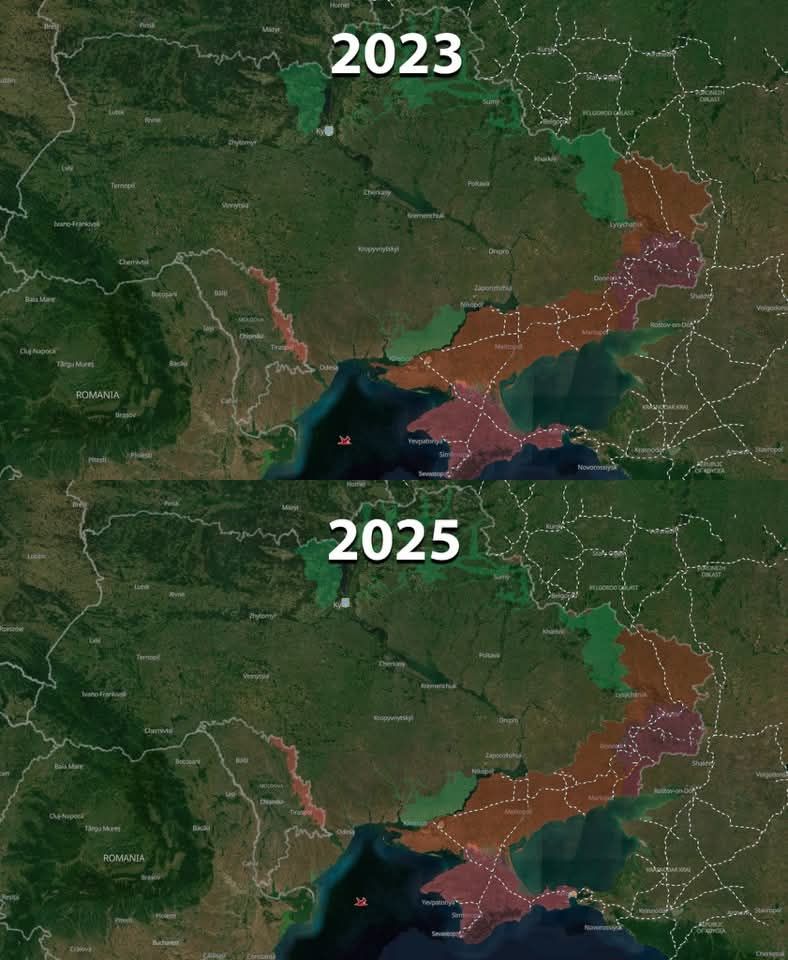
The situation on the front of the Russian-Ukrainian war in 2023 and today - the strategic level.
There is a certain method, one of the first we were taught: for an objective analysis, put yourself in the shoes of a completely external (but competent) observer.
For example, if 50 years from now a Japanese historian — or even better, a Chilean one (Japan, after all, was on Ukraine’s side) — sees this map, a knowledgeable and competent historian, and also sees the figures showing what Russia spent and lost for such “gains,” he will unequivocally call it a military failure, a collapse, an act of glaring incompetence, and national impotence.
Yes, for Ukrainian soldiers who lost their friends, their health, and their nerves in those endless tree lines and villages, this offers no comfort. But the strategic level is not about the soldier; in fact, it is not about people at all.
Strategy and politics are always about big numbers, capacities, processes, potential, and capabilities.
A person, in strategy, is only the sum of sets — a resource. And in military language that is exactly what it is called: human resources.
And yes, attention: I am not going to write disclaimers here with caveats that Ukraine also has everything going badly or even worse. Any Ukrainian already knows and understands this better than you or I do; I show this map to point to something entirely different.
These virtually zero gains, achieved despite more than one million total Russian Armed Forces casualties — several hundred thousand of them killed (these are already documented facts) — along with thousands of destroyed pieces of military equipment, a wrecked Russian economy and finances, and other losses Moscow has suffered, all while Ukraine has: hundreds of thousands of deserters, “teaspoon-per-day” aid from partners, mobilization failures, organizational problems in the army, and so on.
This is what Moscow managed to achieve while fighting the Ukrainian Defense Forces in such conditions.
And what would the picture look like if the situation were improved even slightly: boosted a bit, shut down Russian information-ops, replaced the “help” from partners (especially the Americans) with actual assistance, and fixed at least 20% of the problems with desertion, mobilization, and organization?
Do you think the United States doesn’t understand this (and Europeans as well, though that’s its own story)? They absolutely do. Right now, with the situation exactly as you see it on the map, they are pressuring Ukraine into an agreement that is close in form and substance to a capitulation.
They pressure not because Ukraine is weak. If it were weak, you would be looking at a completely different map. They pressure because Russia is catastrophically weak and incompetent.
That is the essence of this pressure: at Ukraine’s expense, so that Ukrainians pay for Russian stupidity and bloody idiocy.
It seems to me that this is precisely what Kyiv’s diplomats will need to point out this week in their negotiations with the US and Europe.
Not in the sense of “look, Russia is weak, let’s finish it off” — no one planned or plans to finish Russia off (on the contrary). But in the sense of: we understand everything, thank you, but do not take us for fools.
That is the core. Everything else is dust.