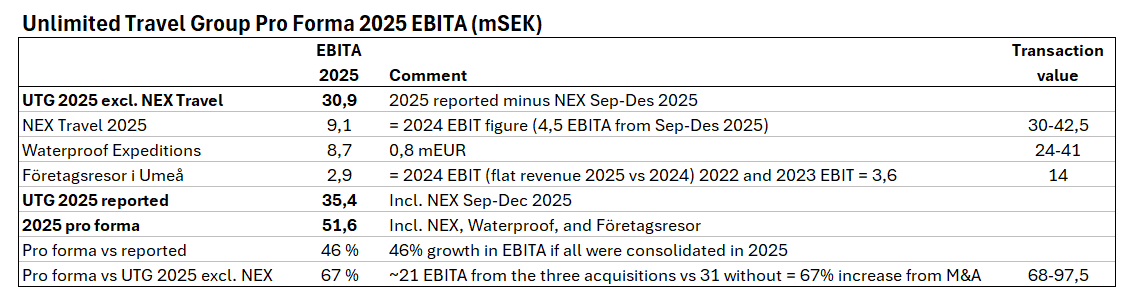
Unlimited Travel Group $UTG is starting to see a significant earnings impact from its acquisitions.
Based on the latest available filings, the 2025 pro forma EBITA is 51.6 million if recent acquisitions were consolidated (vs current market cap of 240m). 21 million (40%) comes from the three acquisitions.
They paid 68–97.5 million SEK for the three large acquisitions (depending on future earn-outs), with earnings of ~21 EBITA.
UTG has communicated a strong start to the year, and it has invested in the organization, so organic growth will come in addition to this.
NEX and Företagsresor could also likely realize some synergies.
Estimated return for North Media’s equity portfolio assuming no changes since the latest disclosed portfolio (31 Jan 2026):
North Media’s equity portfolio would have delivered a pre-tax return of DKK 57 million (6.8%), including dividends (31 Jan - 11 May 2026). Equal to 6% of market cap and ~60% of 2026 EBIT guidance (from operations)
Mainly driven by Teradyne (+50%) and Nvidia (+13%).
Tomorrow’s Q1 report should reveal the updated portfolio.
$NORTHM
Meanwhile, Anta:
22% 10-CAGR. 2015 revenue: CNY 11.125 → 2025 revenue: CNY 80.219
Current annual growth has slowed to 13% (vs. -10% for Nike)
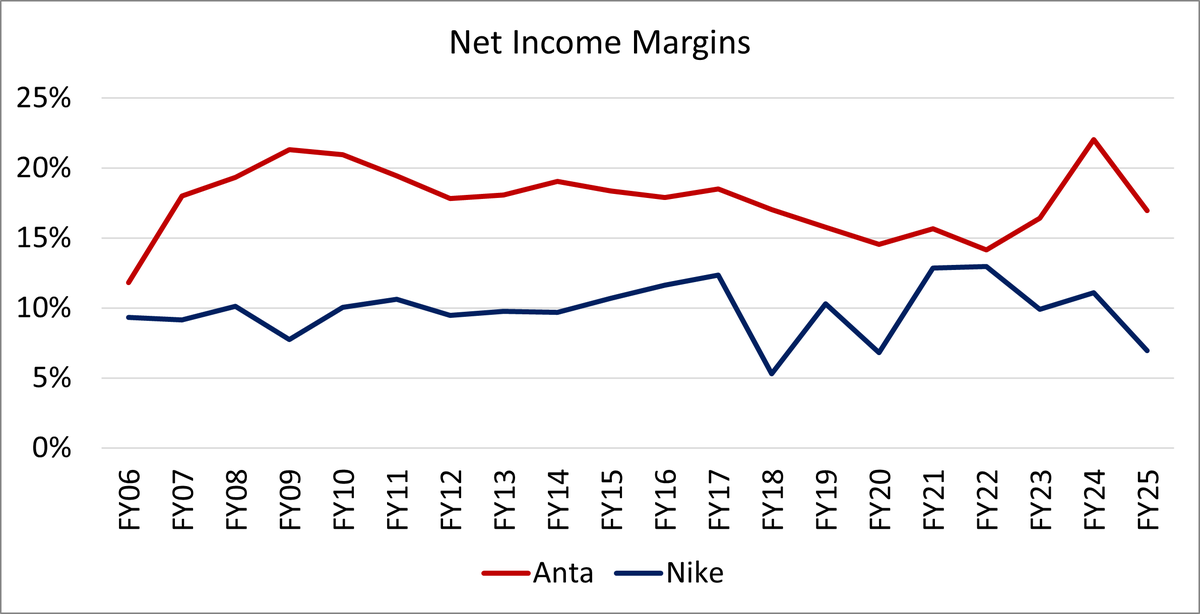
Last year’s net margin: Anta 17% vs. Nike 7%
Now Nike’s market cap is just 2× Anta’s, and 2026E net income is ~2.2B USD for both companies. That’s pretty surprising, considering Anta had just 1.2B USD in revenue in 2013.
Is it still possible to find early Buffett-type investments in today’s high-information market?
@DeepValueStonks wrote an investment case on Saga Furs $SAGCV in January 2026.
It is a market leader in high-quality fur auctions and out of favor due to animal rights concerns and unfavorable regulation. Since Kopenhagen Fur closed, it is the only large European player.
At the time of the write-up, net cash + short-term receivables minus all liabilities made up 187% of market cap. That excludes inventory, real estate, and the operating business.
The company is profitable and pays a high dividend. (Most of last year’s profit is from interest income, but cash flow is strong since they reinvest little in the business.)
Since the write-up, the share price is up >70%. It still trades at a negative EV with cash > market cap.
A few weeks ago, they issued a positive profit warning due to very strong auctions. They announced that sales and profits would increase significantly compared to last year. Auction value doubled year-over-year to levels not seen in 10 years.
4 takeaways from Buffett’s Early Investments (the book by @brettgardner_10).
+1 recent young Buffett-style investment case.
Buffett made his best returns in the early years, often through net-net investments (net current assets > market cap) and special situations. Brett’s book goes in depth on several of these investments.
⬇️
Lesson 4
Swing big when you find attractive low-risk investments.
Buffett at times had 40%–50% of his portfolio in a single stock.
The focus on downside protection helped him hold large positions.
@ReneSellmann $NVR traded below USD 10 in 1995. 1000 bagger!
Since then:
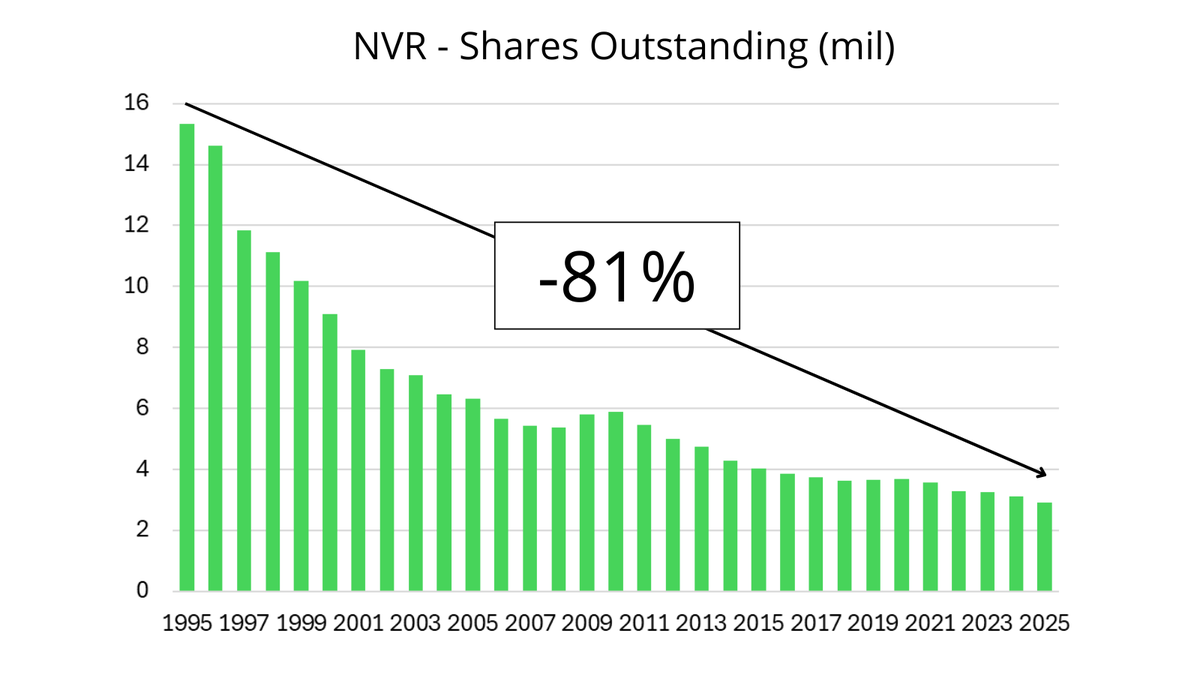
~80% reduction in share count
~70× net income
→ >400× EPS
Here’s how buybacks and incentives drove it:
https://t.co/e0dRm1JTja
Homebuilder NVR grew EPS more than 400× while buying back >80% of its shares over 30 years.
Here’s how they used buybacks and incentives to create massive value.
👇
NVR’s management incentives:
They have used the same incentives for 30 years. They explicitly said in a 1996 proxy that compensation should align management with “creation of long-term shareholder value” and still cite that today.
A very large part of management compensation is tied to long-term equity performance. The fixed compensation is relatively low.
They used stock options tied to performance and with long vesting periods (e.g. based on return on capital relative to peers, vested over 3-6 years).
Executives must hold stock as a multiple of their salary to prevent cashing out.
NVR does not hold quarterly analyst calls. They do not optimize for unit growth or market share.
NVR is a great example of the power of long-term incentives and buy backs.
They never split their shares and now have the second-highest nominal share price in the US (after Berkshire).
USD 10,000 invested in 1995 would be worth USD 6.8 million today.
Homebuilder NVR grew EPS more than 400× while buying back >80% of its shares over 30 years.
Here’s how they used buybacks and incentives to create massive value.
👇
The shift to an asset-light business model enabled buybacks.
NVR is a regional homebuilder. In the early 90s they went bankrupt due to too much debt and a cyclical downturn.
As they emerged from bankruptcy, they developed a new asset light business model.
While competitors were asset- and debt-heavy NVR could grow with high ROIC while returning capital to shareholders through buybacks.
Other homebuilders bought large land banks to secure future growth. NVR bought land options. They paid a small fee for the right, but not the obligation, to build on the land.
When they sold a home, they exercised the option and bought the land. Customers’ prepayments funded working capital.
In case of a market downturn, they abandoned the land options and paid a fee to exit.
All excess capital was used to do share buybacks. And they have continued doing so ever since.
If you owned 1% of the company in 1995, you would own 5% today. And while net income grew 70x over 30 years, EPS grew 408x due to buybacks.
A key driver was long-term-focused incentive in the company. 👇
@investseekers Hopefully, they can make the transition without ending up with consumer-product profit margin levels:
Net profit margin:
Novo Nordisk: 33%
L’Oréal: 14%
Colgate: 10%
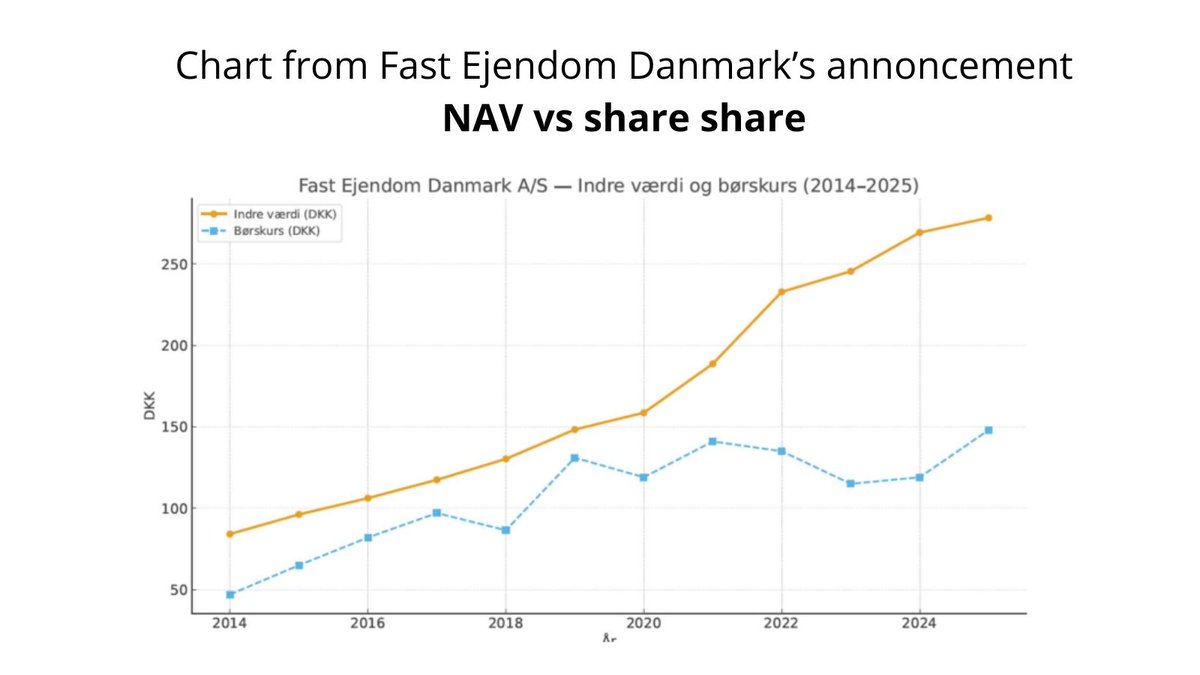
Good write-up, @krisragn. Here is a current example of a Danish small cap closing the NAV gap, and the case might also give an idea of the value of North Media’s properties. $NORTHM
Fast Ejendom Danmark $FED has decided to sell all its properties and return the money to shareholders to realize the NAV.
In October 2025, they announced the plan, and the share price immediately increased by 38%.
And a fun fact 😀 One of the top 5 properties is the next-door neighbor to North Media’s logistics hub in Taastrup. When this gets sold, it might give an idea of the value of North Media’s property.
As a property company, Fast Ejendom Danmark values their properties at market value on the balance sheet and books the gains. North Media depreciates the book value of their properties every year and the value is likely understated.
Generalforsamlingen i $NORTHM nærmer seg, og på nettsiden under ligger det nå en kort og oversiktlig gjennomgang av det jeg mener er et av de skjeveste kapitalallokeringsregnestykkene på børs i dag.
Støtten på nettsiden har så langt vært mye større enn ventet, noe som tyder på at mange aksjonærer ser den samme asymmetrien i caset.
Kort om caset: North Media handles fortsatt med rundt 70 % rabatt til NAV. Bare aksjer og eiendom alene tilsvarer en verdi godt over dagens mcap, og da har vi verken tatt med cashen, som utgjør rundt 13 % av mcap, eller driften, som i en SOTP-vurdering alene kan forsvare over 200 % av mcap.
Historien viser også hvor kraftig dette kan slå ut når tilbakekjøpene faktisk blir store nok.
(1) Topdanmark viste det over tid: 72 % av aksjene ble slettet, og totalavkastningen endte rundt 20 % årlig fra 1999 til 2019.
(2) Jyske Bank er et nyere eksempel. Siden 2020 er aksjebasen kuttet med 15 %, samtidig som aksjen har steget rundt 285 %.
(3) Otello viste det samme. 10 % av antall aksjer ble kjøpt tilbake i 2025, og aksjen steg 138 % samme år.
Når rabatten er stor nok og tilbakekjøpene er store nok, kan totalavkastningen bli langt større enn markedet først tror.
Under legger jeg også en kort tråd med noen slides som forklarer caset steg for steg. De samme slidene, og enkle Excel-filer som viser regnestykkene, ligger også på siden for dem som vil gå dypere.
https://t.co/d5iyvtYIws