Blockchain transaction costs aren't just about gas fees.
A single transaction can depend on multiple external layers: oracle providers, automation keepers, bridges, and other services. Each adds fees, dependencies, and complexity that can ultimately reach the user.
Rialo's approach is to coordinate essential services within one integrated protocol environment.
The potential impact goes beyond cheaper transactions:
– Less infrastructure overhead
– Fewer external dependencies
– More room for developer innovation
– A smoother user experience
The real advantage of integration is reducing the cost of complexity, not just the cost of execution.
That's the direction @RialoHQ is building toward.
Blockchain infrastructure creates value, but fragmented infrastructure can also drain it.
When applications depend on separate providers for execution, oracles, automation, interoperability, and privacy, developers face more fees, dependencies, and operational complexity.
That’s the problem behind rent extraction.
Rialo’s approach is to bring these complementary capabilities into a more unified execution environment.
The bigger opportunity isn’t simply reducing costs. It’s allowing more value to stay with the builders, users, and applications instead of being lost across unnecessary infrastructure layers.
Less fragmentation. Better integration. More value created by the ecosystem.
That’s an important direction to watch with @RialoHQ.
Data privacy shouldn't stop when computation begins.
That's what makes Rialo's approach interesting: protecting information across the entire execution lifecycle, not just securing it at the point of entry.
The workflow connects five stages:
– Secure inputs
– Verified programs
– Protected computation
– Verified results
– Trusted delivery
The key idea is that sensitive data can remain protected while applications process it, verify outcomes, and deliver results to authorized parties.
For institutional and data-sensitive applications, privacy needs to be built into the full workflow.
Rialo is exploring infrastructure where data stays protected from input to delivery. @RialoHQ
Collateral management requires continuous monitoring of asset values, eligibility, and risk.
Rialo's infrastructure could help developers build workflows that combine external price and rating data with predefined financial conditions.
Through validator attested oracle data and Reactive Transactions, applications could automatically respond when collateral eligibility or risk conditions change.
REX adds privacy preserving computation for sensitive financial information, while programmable workflows could support collateral substitution, haircut calculations, and margin related actions.
This could make collateral management more automated, transparent, and efficient, especially in institutional lending and financial markets.
Rialo is building infrastructure for these types of programmable financial applications.
GRialo | Weekly Quiz Recap
Secured #159 in this week’s Rialo Community Quiz.
Every quiz is more than a leaderboard position. It’s an opportunity to evaluate knowledge, sharpen critical thinking, identify knowledge gaps, and improve through consistent participation.
Real progress comes from analyzing mistakes, learning new concepts, and applying those lessons to future challenges.
Current rank: #159. Next target: Top 100.
Consistency drives improvement. The next challenge is another opportunity to do better.
@RialoHQ@RialoBangladesh
🏆 GRialo | Weekly Quiz Recap
Another week, another challenge unlocked! Joined the Rialo Weekly Community Quiz today and landed at #169.
Every question was a chance to think sharper, discover something new, and test what I’ve learned.
The goal isn’t just to show up on the leaderboard — it’s to keep improving, turn knowledge into progress, and make every attempt count.
#169 today. A stronger comeback next week. 🚀
#Rialo #GRialo #CommunityQuiz #KeepLearning
Most blockchains are designed to process transactions. But real-world finance needs infrastructure that can do much more.
That’s the direction @RialoHQ is building toward.
What makes this approach interesting is the focus on three connected layers:
– Native capabilities: Data access, automation, and privacy built into the protocol.
– Institutional engagement: Exploring integrations, proof-of-concepts, and institutional-grade data.
– Real-world applications: Turning blockchain infrastructure into practical financial workflows.
The bigger opportunity is reducing the gap between traditional financial requirements and onchain execution.
Adoption won’t come from blockchain speed alone. It will depend on whether the infrastructure can support real financial needs reliably and efficiently.
Rialo is aiming to move blockchain beyond transaction processing and closer to real-world financial utility.
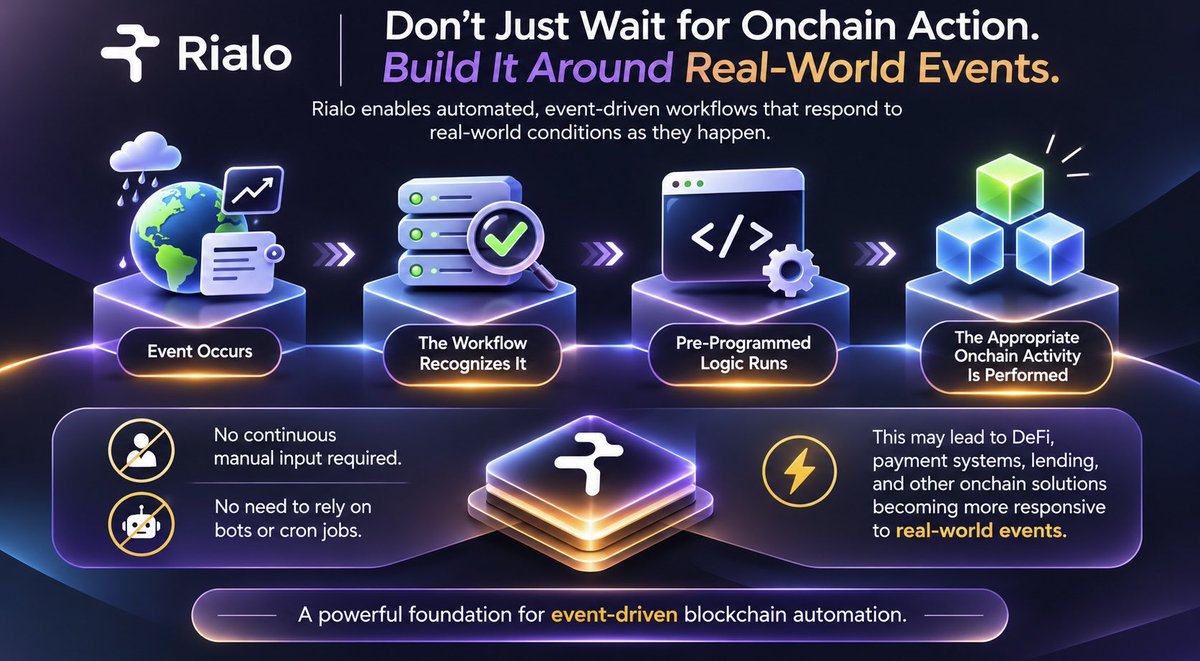
Blockchains shouldn’t have to wait for someone to trigger every action.
The next step in automation is making onchain applications responsive to events as they happen in the real world.
That’s an interesting direction Rialo is exploring.
The workflow is straightforward:
– A real-world event occurs.
– The network recognizes the predefined condition.
– Programmed logic determines the response.
– The appropriate onchain action gets executed.
Why does this matter?
Traditional automation often depends on external bots, cron jobs, and continuous manual coordination. Rialo’s event-driven approach aims to reduce that dependency by making reactive workflows part of the infrastructure.
This could open new possibilities for DeFi, payments, lending, and applications that need to respond to changing conditions.
The bigger shift is from blockchains that simply process submitted transactions to systems that can react when relevant events occur.
Less waiting. Fewer external dependencies. More responsive onchain applications.
That’s worth watching with @RialoHQ | @RialoBangladesh.